During his State of the Union address Tuesday night, President Donald Trump attempted to stanch the public’s bleeding support for building the data centers his administration says are necessary to beat China in the artificial intelligence race. With “many Americans” now “concerned that energy demand from AI data centers could unfairly drive up their electricity bills,” Trump said, he pledged to make major tech companies pay for new power plants to supply electricity to data centers.
New polling from energy intelligence platform Heatmap Pro shows just how dramatically and swiftly American voters are turning against data centers.
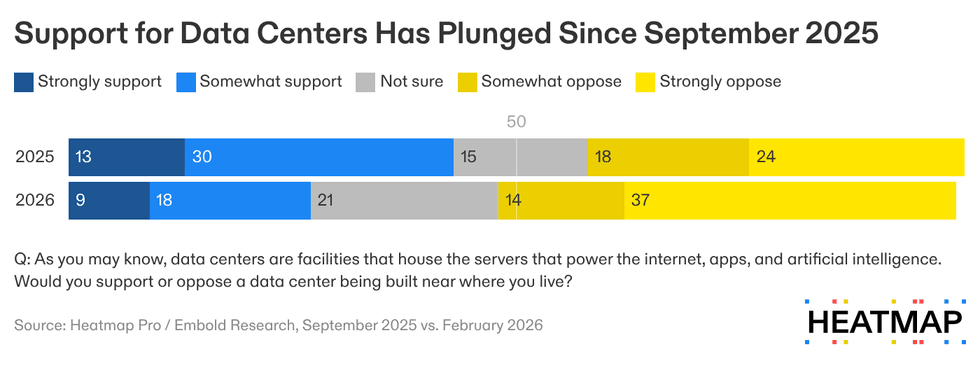
Earlier this month, the survey, conducted by Embold Research, reached out to 2,091 registered voters across the country, explaining that “data centers are facilities that house the servers that power the internet, apps, and artificial intelligence” and asking them, “Would you support or oppose a data center being built near where you live?” Just 28% said they would support or strongly support such a facility in their neighborhood, while 52% said they would oppose or strongly oppose it. That’s a net support of -24%.
When Heatmap Pro asked a national sample of voters the same question last fall, net support came out to +2%, with 44% in support and 42% opposed.

The steep drop highlights a phenomenon Heatmap’s Jael Holzman described last fall — that data centers are "swallowing American politics,” as she put it, uniting conservation-minded factions of the left with anti-renewables activists on the right in opposing a common enemy.
The results of this latest Heatmap Pro poll aren’t an outlier, either. Poll after poll shows surging public antipathy toward data centers as populists at both ends of the political spectrum stoke outrage over rising electricity prices and tech giants struggle to coalesce around a single explanation of their impacts on the grid.
“The hyperscalers have fumbled the comms game here,” Emmet Penney, an energy researcher and senior fellow at the right-leaning Foundation for American Innovation, told me.
A historian of the nuclear power sector, Penney sees parallels between the grassroots pushback to data centers and the 20th century movement to stymie construction of atomic power stations across the Western world. In both cases, opponents fixated on and popularized environmental criticisms that were ultimately deemed minor relative to the benefits of the technology — production of radioactive waste in the case of nuclear plants, and as seems increasingly clear, water usage in the case of data centers.
Likewise, opponents to nuclear power saw urgent efforts to build out the technology in the face of Cold War competition with the Soviet Union as more reason for skepticism about safety. Ditto the current rhetoric on China.
Penney said that both data centers and nuclear power stoke a “fear of bigness.”
“Data centers represent a loss of control over everyday life because artificial intelligence means change,” he said. “The same is true about nuclear,” which reached its peak of expansion right as electric appliances such as dishwashers and washing machines were revolutionizing domestic life in American households.
One of the more fascinating findings of the Heatmap Pro poll is a stark urban-rural divide within the Republican Party. Net support for data centers among GOP voters who live in suburbs or cities came out to -8%. Opposition among rural Republicans was twice as deep, at -20%. While rural Democrats and independents showed more skepticism of data centers than their urbanite fellow partisans, the gap was far smaller.
That could represent a challenge for the Trump administration.
“People in the city are used to a certain level of dynamism baked into their lives just by sheer population density,” Penney said. “If you’re in a rural place, any change stands out.”
Senator Bernie Sanders, the democratic socialist from Vermont, has championed legislation to place a temporary ban on new data centers. Such a move would not be without precedent; Ireland, transformed by tax-haven policies over the past two decades into a hub for Silicon Valley’s giants, only just ended its de facto three-year moratorium on hooking up data centers to the grid.
Senator Josh Hawley, the Missouri Republican firebrand, proposed his own bill that would force data centers off the grid by requiring the complexes to build their own power plants, much as Trump is now promoting.
On the opposite end of the spectrum, you have Republicans such as Mississippi Governor Tate Reeves, who on Tuesday compared halting construction of data centers to “civilizational suicide.”
“I am tempted to sit back and let other states fritter away the generational chance to build. To laugh at their short-sightedness,” he wrote in a post on X. “But the best path for all of us would be to see America dominate, because our foes are not like us. They don’t believe in order, except brutal order under their heels. They don’t believe in prosperity, except for that gained through fraud and plunder. They don’t think or act in a way I can respect as an American.”
Then you have the actual hyperscalers taking opposite tacks. Amazon Web Services, for example, is playing offense, promoting research that shows its data centers are not increasing electricity rates. Claude-maker Anthropic, meanwhile, issued a de facto mea culpa, pledging earlier this month to offset all its electricity use.
Amid that scattershot messaging, the critical rhetoric appears to be striking its targets. Whether Trump’s efforts to curb data centers’ impact on the grid or Reeves’ stirring call to patriotic sacrifice can reverse cratering support for the buildout remains to be seen. The clock is ticking. There are just 36 weeks until the midterm Election Day.