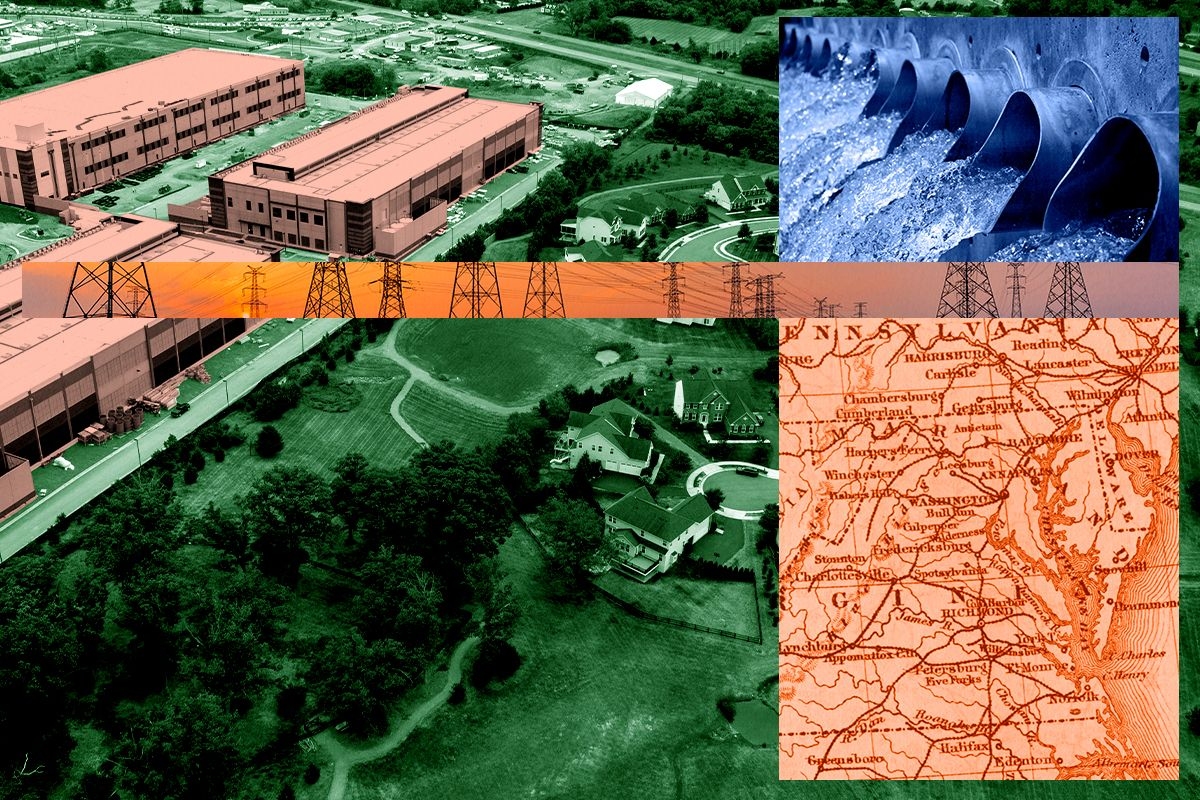
President Trump has staked his administration’s success on America’s ongoing artificial intelligence boom. More than $500 billion may be spent this year to dot the landscape with new data centers, power plants, and other grid equipment needed to sustain the explosively growing sector, according to Goldman Sachs.
There’s just one problem: Many Americans seem to be turning against the buildout. Across the country, scores of communities — including some of the same rural and exurban areas that have rebelled against new wind and solar farms — are blocking proposed data centers from getting built or banning them outright.
At least 25 data center projects were canceled last year following local opposition in the United States, according to a review of press accounts, public records, and project announcements conducted by Heatmap Pro. Those canceled projects accounted for at least 4.7 gigawatts of electricity demand — a meaningful share of the overall data center capacity projected to come online in the coming years.
Those cancellations reflect a sharp increase over recent years, when local backlash rarely played a role in project cancellations, according to Heatmap’s review.
The surge reflects the public’s growing awareness — and increasing skepticism — of the large-scale fixed investment that must be kept up to power the AI economy. It also shows the challenge faced by utilities and grid planners as they try to forecast how the fast-growing sector will shape power demand.
The number of cancellations is likely to grow in the year to come. At least 99 data center projects nationwide are now being contested by local activists or residents, according to a Heatmap review of local news stories and public records, out of about 770 planned data centers across the country, according to Data Center Map. Another 200 or so proposed projects are already under construction.
About 40% of data centers that face sustained local opposition are eventually canceled, Heatmap’s review suggests.
These numbers have not been previously reported. Over the past seven months, researchers at our intelligence platform Heatmap Pro have conducted a comprehensive national survey of local opposition to data center construction. Researchers have monitored local media and called every U.S. county to tally recent data center cancellations and any local restrictions or bans on data center construction.
This data is normally available to companies and individuals who subscribe to Heatmap Pro. In this story, we are making a high-level summary available to the public for the first time.
The number of cancellations seems to be increasing more quickly than other measurements of data center growth. The amount of electricity used by data centers nationwide grew by about 22% last year, according to a recent report from S&P Global, and aggressive estimates suggest that the sector’s power use will double or even triple over the next 10 years. Yet data center cancellations due to local opposition have quadrupled in just the past 12 months.
“Those numbers don’t totally surprise me,” Peter Freed, a founding partner at the Near Horizon Group and the former director of energy strategy at Meta, told me. “This is what projects falling out of the development pipeline looks like.” He expects only about 10% of data center projects that are now being planned or developed to turn into finished projects, he added.
“I also think that the pace of canceled projects will increase, matching the acceleration in new project announcements we saw through the balance of last year,” he added.
The pace of cancellations has already grown rapidly in the past six months. Only two data centers were canceled following sustained local protest in 2023, according to Heatmap data, and six were canceled in 2024. But as electricity inflation surged and the AI boom became the biggest story in the economy, Americans took notice of what was happening on vacant land nearby. Of the 25 data center projects canceled due to local opposition last year, 21 were terminated in the second half of 2025.
Environmental and quality-of-life concerns overwhelmingly drive Americans’ opposition to data centers. Water use is the No. 1 reason cited in press accounts for local opposition to a proposed project, and is mentioned for more than 40% of contested projects, according to our review. (Some experts now dispute that data centers are unusually large water consumers, especially compared to golf courses or farms.)
The next most-cited concerns among opponents are about energy consumption and higher electricity prices, followed by worries about noise.
“Affordability is the first, second, and third issue — at least that’s what I’m hearing,” Freed said of his conversations with developers. “I also fundamentally believe that there are lots of good existing ways and creative new ways to make sure we’re insulating people from costs, but the industry has not done a very good job of telling that story.”
Many technology companies, such as Amazon, now argue that their data centers affirmatively help keep a lid on local power prices. Even so, politicians from both parties — including Energy Secretary Chris Wright — have suggested changing grid rules or requiring tech companies to “bring their own power” to reduce the AI boom’s costs to existing utility ratepayers.
Data center cancellations aren’t evenly spread out across the country. Texas is a hotspot for new data center proposals, and more than 150 gigawatts of data centers have asked to hook up to its grid. But we recorded zero cancellations due to local opposition in the Lone Star State. That’s probably because it’s difficult for residents to cancel any project in Texas, which has no state-level zoning rules.
Most cancellations were located in PJM Interconnection, the country’s largest electricity grid, which spans the Mid-Atlantic and upper Midwest. Virginia — a longstanding locus of data center development — tied with Indiana for the most cancellations due to local opposition. Each saw eight cancellations, including a proposed 600-megawatt facility northeast of Indianapolis. Just last week, local opposition killed yet another planned data center project southeast of Indiana’s capitol.
The overwhelming majority of cancellations came in states that President Trump won in the 2024 election — and often in the very suburban and exurban areas that fueled his victory. Trump won Oldham County, Kentucky, by more than 20 points in 2024. That didn’t help an effort to build a new 600-megawatt AI data center there last year. The project was dropped in July by its developer Western Hospitality Partners, who had once described it as the state’s largest economic development project.
The rising local resistance to data center development may suggest an early victory for the left flank of the environmental movement, which has opposed the expansion of virtually all AI infrastructure. Last month, Greenpeace USA, Friends of the Earth, and Food and Water Watch called for a national moratorium on all new data center construction.
“The rapid, largely unregulated rise of data centers to fuel the AI and crypto frenzy is disrupting communities across the country and threatening Americans’ economic, environmental, climate and water security,” the groups wrote in a letter to lawmakers.
But in many communities, resistance to data centers has come from a more unlikely alliance of environmentalists and anti-renewable energy advocates, Heatmap’s review has found. The same set of concerns people mention about wind farms or solar and battery projects — that they will bring more noise, threaten local farms, and change a community’s rural character — also appear in press reports about why residents oppose data centers.
AI advocates expect that these concerns will continue to spread as the footprint of data centers expands around the country. “Inevitably, as the main electricity arteries of the country get congested and the low-hanging fruit are picked, the projects that are being proposed will expand geographically,” Daniel King, a fellow who studies energy and AI at the Foundation for American Innovation, a center-right think tank, told me. “I expect us to see the obstructions and failed projects spread geographically as well.”
He said developers have been increasingly worried about the rise of cancellations due to local opposition, but that Heatmap’s review suggested to him the problem might not be as bad as he once feared.
Still, “the trend is a concerning one,” he said. Many counties have moved from blocking individual governments to considering bans on new data center construction, he said — another move borrowed from the anti-renewable playbook. That could be “potentially harmful” to the potential for economic development in those areas, he said.