Sign In or Create an Account.

By continuing, you agree to the Terms of Service and acknowledge our Privacy Policy

Politics

Exclusive: Local Opposition to Data Centers Explodes in 2026

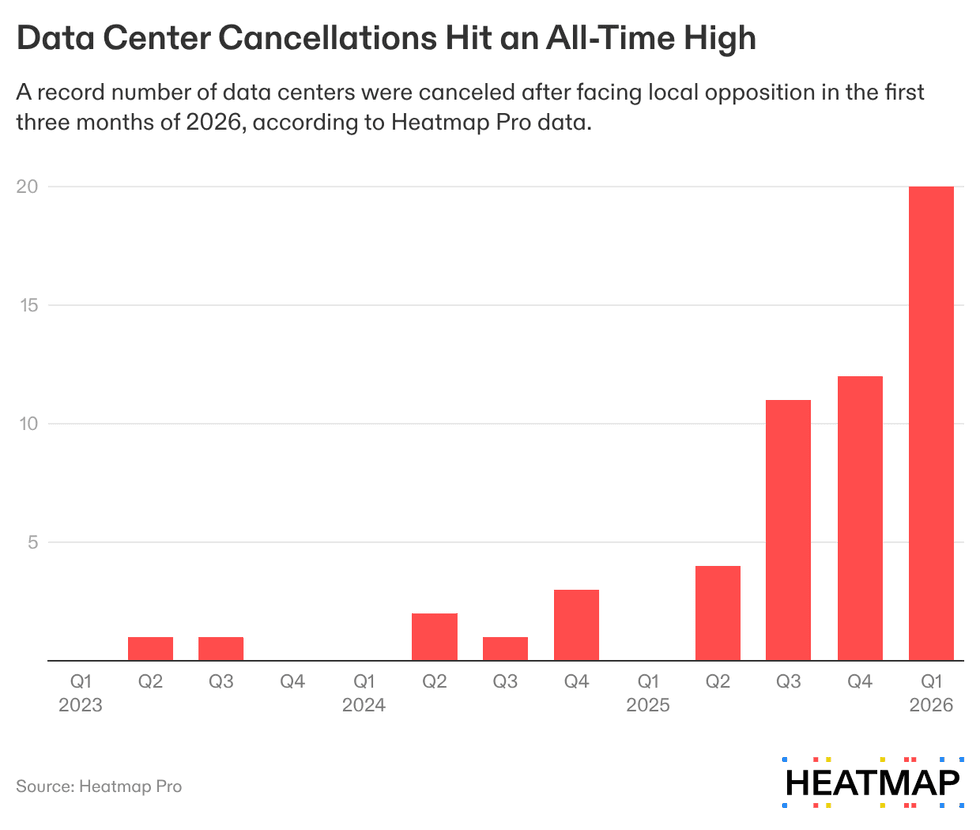
The number of data centers canceled after pushback set a record in the first quarter of the year, new data from Heatmap Pro shows.

Peeling off a data center.
Heatmap Illustration/Getty Images

Data centers are getting larger and larger. But even so, few are as large as the Sentinel Grove Technology Park, a proposed data center near Port St. Lucie, Florida.

The proposed facility — which became known as Project Jarvis — was set to be built on old agricultural land. It would use up to 1 gigawatt of electricity, enough to power a mid-size city, and bring in up to $13.5 billion in investment to the county.

The project was immediately controversial. But its developers anticipated issues: They would build their own self-contained, self-provided water facilities to service the project, and they agreed to set its 60-foot buildings back far enough from the road so that they couldn’t be seen by drivers.

It wasn’t enough. The project lost a key vote in the planning board in October. And in February, Project Jarvis’s developers withdrew their land use application entirely after Governor Ron DeSantis proposed AI regulation in the statehouse.

The facility was the largest data center project canceled after facing opposition in the first quarter of 2026. But it wasn’t the only one.

At least 20 proposed data center projects were canceled after local pushback during the first three months of 2026, smashing a record set only in the previous quarter, according to a review of press accounts, public records, and project announcements conducted by Heatmap Pro.

These canceled projects accounted for more than $41.7 billion in investment and represented at least 3.5 gigawatts of electricity demand.

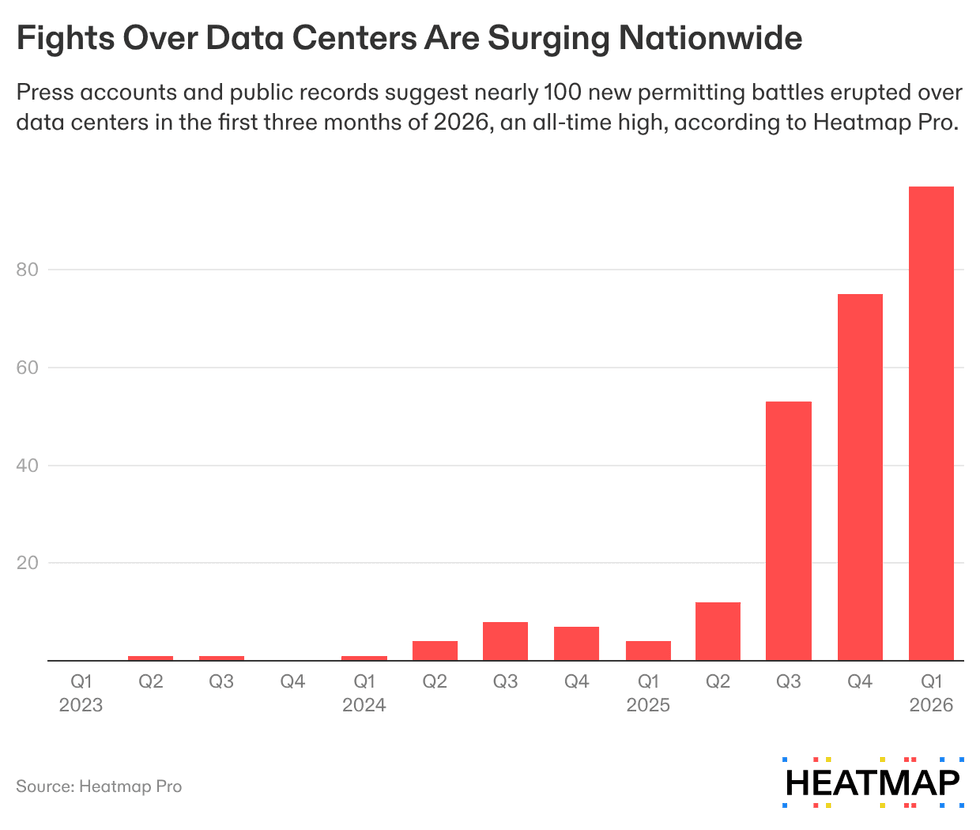
The cancellations reveal the rapidly expanding backlash to data center construction has not yet peaked. From Georgia to Pennsylvania, locals have rebelled against newly proposed data centers, even when the planned facilities are not planning to run artificial intelligence models.

If anything, fights over data centers are surging now. Heatmap Pro’s researchers added roughly 100 new data center fights to their database during the first three months of the past year, a new record.

These fights are succeeding in terminating projects. Last year, roughly 25 data center projects were canceled nationwide after facing some type of local opposition, according to Heatmap Pro data. The country is likely to break that record in 2026 over the next few weeks, our data suggests — only five months into the year.

At least $85 billion in data center projects have been canceled over the past three years, according to Heatmap Pro data.

These numbers haven’t been previously reported. Over the past year, researchers at our intelligence platform Heatmap Pro have conducted a comprehensive national survey of local opposition to data center construction. They have regularly called every U.S. county to tally data center cancellations and any new rules limiting data center construction.

This data is normally available to companies and individuals who subscribe to Heatmap Pro, but we periodically publish a high-level summary of this data. We last released our results in January.


Green

You’re out of free articles.

Subscribe today to experience Heatmap’s expert analysis 
of climate change, clean energy, and sustainability.
To continue reading
Create a free account or sign in to unlock more free articles.
or
Please enter an email address
By continuing, you agree to the Terms of Service and acknowledge our Privacy Policy
AM Briefing

Oklahoma!

On depleted U.S. oil stocks, Taiwan geothermal, and hybrid sales

Gentner Drummond.
Heatmap Illustration/Getty Images

Current conditions: The southwest monsoon known as “hagabat” has started in the Philippines, dumping up to 4 inches of rain on the archipelago • A strong geomagnetic storm, ranked just two levels below the most powerful type of event of this kind, is underway, threatening radio signals, GPS, and other human instruments that are sensitive to shifts in the Earth’s magnetic fields • San Antonio, where the glorious New York Knicks defeated the Spurs last night, is bracing for rain through the weekend.


THE TOP FIVE

1. U.S. oil stocks drop to the lowest level since 2004

To put it in terms a movie lover could understand, President Donald Trump’s Iran War is drinking the U.S. government’s milkshake. Federal stocks of oil have dropped to their lowest level since 2004. Commercial crude stocks fell by 8 million barrels to 433.7 million last week, according to The Wall Street Journal. Unless the Strait of Hormuz reopens soon — which looks less likely now that Iran has called off negotiations with the U.S. and Israel — prices could hit $200 per barrel by summer, said Bob McNally, president of the Rapidan Energy Group consultancy and a former White House adviser. “You start to raise the risk of spillover into other sectors, the economy and financial system … it detonates fragilities in the broader economy and financial system,” he told the Financial Times.

Keep reading...Show less
Blue
Daily Briefing

What’s Powering Clean Energy

Notes from Heatmap’s second Energy Entrepreneurship Summit.

A tokamak.
Heatmap Illustration/Getty Images

I’m writing from Washington, D.C., today, after having the privilege of watching (and moderating) Heatmap’s second Energy Entrepreneurship Summit this morning. We heard from folks leading in a variety of technologies — geothermal, batteries, fusion, conventional nuclear — but I was struck by a few common themes.

The first was the new wave of excitement about fusion energy and how, in some ways, the artificial intelligence boom has reinvigorated the fusion conversation. Much like fusion, AI was a long-prophesied technology that made steady, iterative improvements over time — and then, one day, delivered a transformative product in the form of ChatGPT. I’m not sure if fusion has yet had a raw technological improvement on par with the transformer, the neural network innovation that preceded today’s AI chatbots and agents, but fusion startups have reported significant improvements in recent years. The industry believes — as do some fusion-pilled policymakers — that they will have commercial reactors on the grid by the mid-2030s.

Keep reading...Show less
Blue
Energy

Americans Now Blame Data Centers for Their Rising Power Bills

Our latest Heatmap Pro poll found one big reason why public support for data centers has plummeted.

A data center and an electric bill.
Heatmap Illustration/Getty Images

Americans’ support for data centers cratered over the past nine months. Rising electricity prices are a big part of the reason.

A Heatmap Pro poll conducted in May found that seven in 10 Americans would oppose a data center being built near where they live, up from four in 10 when we asked the same question in August 2025. We also polled people on mounting electricity costs, providing them with about a dozen potential explanations for the surge in prices and asking whether they blame each one “a lot,” “a little,” or “not at all.”

Keep reading...Show less
Blue