You’re out of free articles.
This Halloween, get 20% off using code ADVANCED
Log in
To continue reading, log in to your account.
Create a Free Account
To unlock more free articles, please create a free account.
Sign In or Create an Account.
By continuing, you agree to the Terms of Service and acknowledge our Privacy Policy
Welcome to Heatmap
Thank you for registering with Heatmap. Climate change is one of the greatest challenges of our lives, a force reshaping our economy, our politics, and our culture. We hope to be your trusted, friendly, and insightful guide to that transformation. Please enjoy your free articles. You can check your profile here .
subscribe to get Unlimited access
Offer for a Heatmap News Unlimited Access subscription; please note that your subscription will renew automatically unless you cancel prior to renewal. Cancellation takes effect at the end of your current billing period. We will let you know in advance of any price changes. Taxes may apply. Offer terms are subject to change.
Subscribe to get unlimited Access
Hey, you are out of free articles but you are only a few clicks away from full access. Subscribe below and take advantage of our introductory offer.
subscribe to get Unlimited access
Offer for a Heatmap News Unlimited Access subscription; please note that your subscription will renew automatically unless you cancel prior to renewal. Cancellation takes effect at the end of your current billing period. We will let you know in advance of any price changes. Taxes may apply. Offer terms are subject to change.
Create Your Account
Please Enter Your Password
Forgot your password?
Please enter the email address you use for your account so we can send you a link to reset your password:
Smoke from the raging fires in Indonesia may go down as this year’s deadliest climate tragedy.

It’s a morbid game to try to name the worst climate disaster of 2026. In Europe this summer, a series of extreme heat waves killed an estimated 50,000 people. In September, a thawing Himalayan glacier collapsed, sending a wall of water cascading through Tibet and Nepal, killing at least 1,500 people, with nearly 6,000 still missing months later. And this past January, authorities feared hundreds of migrants died while trying to cross the Mediterranean during Cyclone Harry, including 50 in one shipwreck alone.
But the disaster that will result in perhaps the greatest and longest-lasting tragedy is the one unfolding right now in Indonesia.
Wildfires in Sumatra and Kalimantan have burned more than 7 million acres in what is likely a record year for the fire-prone islands. The blazes have destroyed critical wildlife habitats, including rainforests occupied by orangutans, Sunda pangolins, and Javan leopards. But it’s not the direct human deaths from the fires, the habitat loss, or the historic acreage burned — those being the typical headline numbers for gauging how “bad” a given fire or fire season is — that best tell the story of the impacts, in this case.
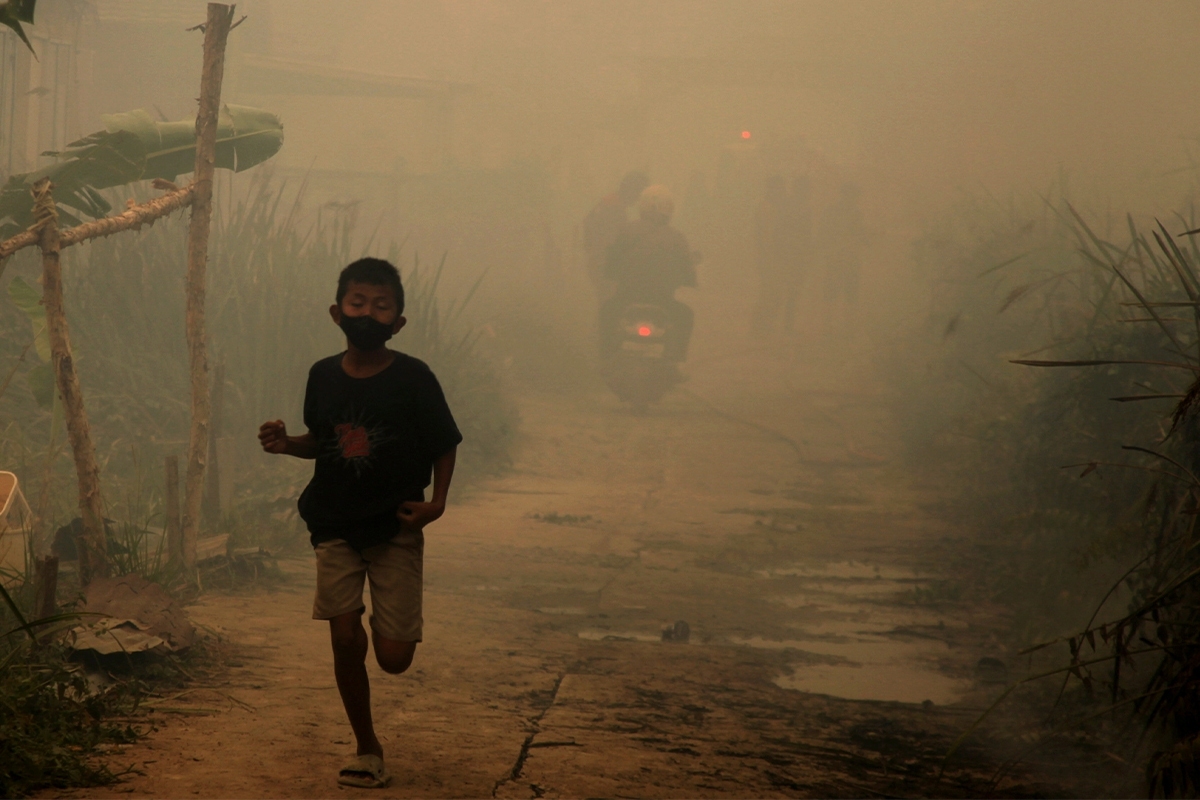
Rather, it is the toxic smoke blanketing Indonesia, Singapore, Malaysia, and Timor-Leste. For months, those emissions have been in every breath taken by the region’s 12.5 million inhabitants, about 4% of the world’s population.
In Indonesia alone, authorities estimate the smoke has caused 400,000 respiratory infections. As of a few weeks ago, more than 75,000 cases had been recorded in children between birth and age 5. “Behind those numbers are worried families, parents keeping watch, and children struggling to breathe,” Herawati Supolo-Sudoyo, a trustee of the Indonesian Open Science Voice Foundation and chair of the Indonesian Academy of Sciences’ Commission on Medical Sciences, said during a recent public health webinar. “Babies certainly cannot say, ‘My chest feels tight.’ They rely on us to protect their breath.” (That’s according to an automated YouTube translation of her remarks.)

Children are especially vulnerable to wildfire smoke because their lungs are not fully developed, and they breathe in more air relative to their body weight than adults. Reports from local hospitals are harrowing. “Yesterday, in the inpatient ward, I saw three toddlers struggling to breathe,” one mother, whose 14-month-old died suddenly after experiencing shortness of breath, told BBC Indonesia (as translated by Mongabay). The Indonesian Philanthropy Association, a nonprofit, has taken to describing the children of Indonesia as the “lost generation” due to the suspected physical and cognitive toll of the relentless smoke exposure. Timor-Leste, which borders Indonesia to the west, has one of Asia’s youngest populations, with about 44% of its inhabitants under 18.
“We must not wait until these children are adults to calculate the losses,” Supolo-Sudoyo said.
There seems little doubt that the smoke is a climate-change-fueled public health crisis. A new study by World Weather Attribution, released Thursday, found that while the super El Niño is the primary cause of the severe reduction in rainfall that helped fuel the fires, Indonesia’s drought was “then exacerbated by record heat throughout the fire season, which was made possible due to human-caused climate change,” Theodore Keeping, a research associate with WWA, said during a press call about the findings. (The study, which uses peer-reviewed methods, has not yet been peer-reviewed itself.)
Indonesia’s fire season was about 1.6 degrees Celsius hotter due to climate change, compared to about a third of a degree Celsius hotter due to the current El Niño, WWA reports. “We also found that this year’s record-breaking heat would have been virtually impossible without climate change, even in a similar El Niño state,” Keeping said.

Smoke is still a relatively new way of quantifying the impact of a wildfire. Alistair Hayden, an assistant professor of practice in Cornell’s Department of Public and Ecosystem Health and creator of the school’s wildfire smoke mortality estimation tool, told me that though researchers have been studying smoke toxicity for years, the bad U.S. fire seasons in 2018 and 2020 helped accelerate interest and urgency. “Really high visibility and growing interest leads to a lot more studies that then enhance our knowledge about the details of this hazard,” he said of the recent spike in smoke-related research.
For example, new research released just last month by researchers at Harvard indicates that wildfire smoke exposure during pregnancy is related to higher instances of autism in children. Separately, a study about chronic wildfire smoke exposure linked the pollution to an estimated 24,100 deaths in the lower 48 states every year — more than twice the number killed in drunk-driving accidents. Looking only at Indonesia, researchers linked smoke exposure in the womb during the region’s severe 1997 fire season to poorer health outcomes by age 17.
Still, coverage of wildfires largely focuses on how many people were killed by direct flame impacts, or how many acres or buildings burned. A “megafire,” for example, is a nonscientific term used by the media to describe how large a fire is physically, but not the thousands of miles further its smoke will travel. The National Interagency Coordination Center’s Wildland Fire Summary and Statistics Annual Report, the end-of-year summary of fire season impacts in the United States, doesn’t even mention smoke exposure. Deadly and destructive fires in Maui and Los Angeles stand out in memory, but the hazardous air quality in the Midwest this season from the Canadian wildfires may turn out to cost as many or more lives. (Smoke toxicity and chronic exposure also complicate the cost-benefit analysis of a favorite tool of progressive fire managers: prescribed burns.)
In fact, research about smoke toxicity and widespread exposure to particulate pollution increasingly suggests that emissions might be the marquee impact of wildfires. While 30 people died directly from the 2025 Palisades and Eaton fires in L.A., one research paper estimated the loss of life was closer to 440, partially due to the deaths attributable to wildfire smoke in addition to stress, disruptions to the health-care infrastructure, and mental health impacts.

“The difficulty with all of this is that the smoke deaths are difficult to track,” Hayden told me. “They’re not, for instance, showing up on death certificates. While the smoke itself is very visible in the air and leads to nice photos, the impacts are much harder to take photos of.”
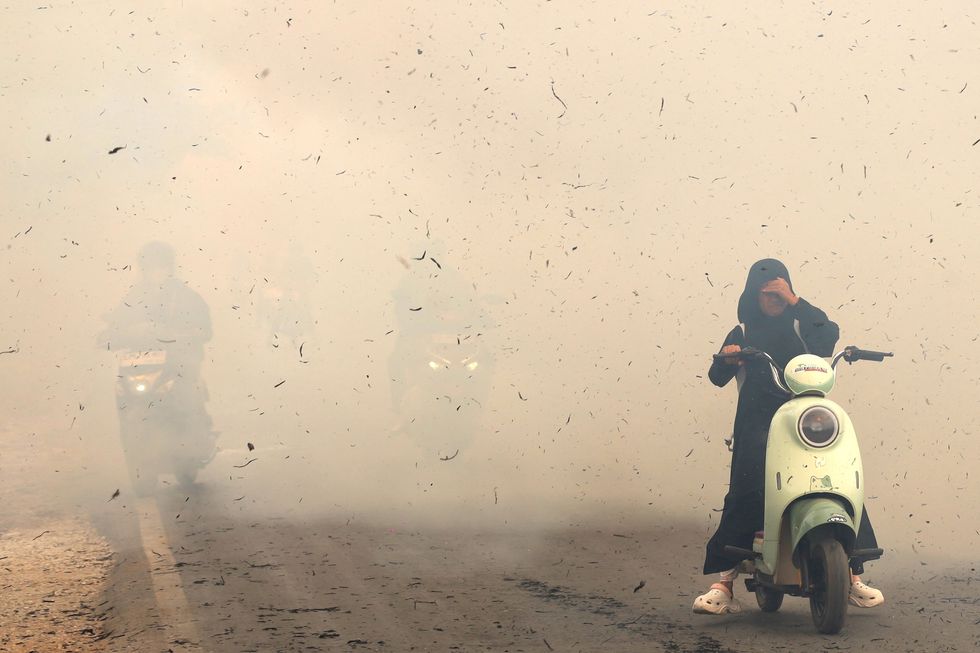
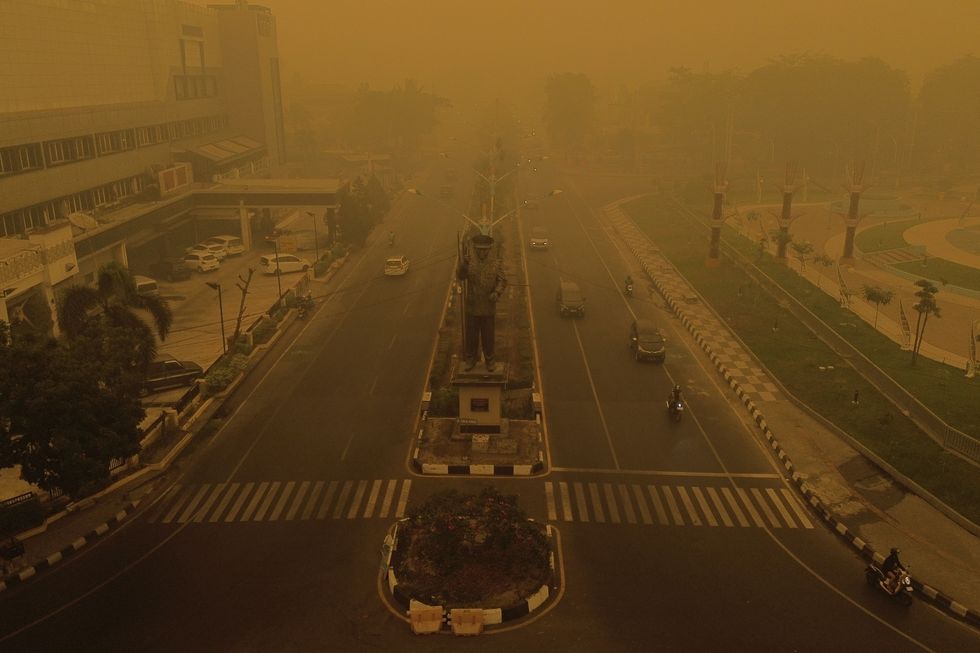
That’s certainly the case in Indonesia, where photos show people going about their lives in a cloud of yellow smoke, and in Singapore, where run clubs have moved their workouts into malls to try to avoid the pollution. But while a smoke-exacerbated heart attack isn’t a front-page image, to Hayden’s point, the pictures do reveal something else: just how ill-prepared our infrastructure and public health systems are for dramatic smoke events like these.
What can be done about wildfire smoke? You can invest in a really good air purifier — and use it correctly — which works so long as you can afford it, and if your home isn’t drafty to begin with, and if it isn’t too hot out that you need to open a window to stay cool at the same time. You can wear the right kind of mask, too, but it needs to fit properly and it won’t filter out gases or the smallest toxic particles. And while you can evacuate to protect yourself from an encroaching wildfire, outrunning the smoke might require you to travel hundreds of miles or, as is the case for those in Southeast Asia, literally leave your country.
In that sense, we are thinking about wildfire impacts wrong, too. Fires aren’t a hazard contained neatly within evacuation zones; the “wildland-urban interface” and “wildfire-prone landscape” describe an environment fires may erupt in, but not what they’re contained to. Whether you’re in Los Angeles or New York City, Minneapolis or Madrid, Jakarta or Kuala Lumpur, the smoke will find you.

This Halloween, get 20% off using code ADVANCED
Log in
To continue reading, log in to your account.
Create a Free Account
To unlock more free articles, please create a free account.
We need a ratepayer protection pledge for natural gas, too, argue two energy systems experts.
Everyone is talking about high energy prices, which were a major factor in the midterm elections. And it’s not just electricity: Families are paying 16% more for natural gas now than they were just two years ago. Within a few more years, the boom in electricity demand from data centers could add enough natural gas power plants to expand America’s gas power generation capacity by a third. Some back of the envelope math shows that the additional costs to regular customers from this expansion could total more than $23 billion across all retail gas and electricity prices by 2030.
Large users choosing gas will raise costs for the more than 70 million households in America paying a gas bill every month. It’s simple supply and demand. Some data center developers are working with utilities to connect to the grid, but many others are building their own off-grid power plants that would burn natural gas to power their operations. That would require a massive gas infrastructure build-out on top of the supply pressure, raising costs still further.
Earlier this year, hyperscalers and AI companies signed the Ratepayer Protection Pledge, committing to pay the full costs of their energy and infrastructure, “no matter what,” to avoid increasing energy costs for other customers. Agreeing to limit cost increases for energy is a good start, but the details of that pledge focused only on electricity customers, and it’s not enough to solve the problem. Almost nothing has been said on what that means for natural gas customers, or how data centers should help contain gas costs for families. As the 120th Congress, newly elected governors, and state legislators across the country consider the fastest ways to tackle volatile energy prices, they should consider a Gas Customer Protection Pledge to protect consumers from data centers contributing to surging natural gas bills.
All this new gas demand from data centers could increase costs for the rest of us in at least three ways. First, if history is any indication, the sheer volume of increased gas use will both raise gas prices and make them more volatile. Price volatility hurts poorer consumers more, with surprisingly high bills derived from market dynamics over which they have little control. Second, the pipelines, compressor stations, and other infrastructure needed to bring gas to these new facilities will cost money. Because the vast majority of utilities in America pass through both the cost of the fuel itself and the investments required to build and maintain infrastructure, these additional costs will be borne by all customers, not just the data centers.
And third — perhaps most importantly — during periods of peak system stress like winter storms or summer heat waves, all this additional gas going to data centers will make price shocks more severe. In the case of Winter Storm Fern last January, for example, natural gas prices from Chicago to Boston were 19 to 42 times higher than the national average price from the prior year.
So, how can government officials prevent all this from happening? A Gas Customer Protection Pledge would fill the gaps in the already agreed upon objective not to raise energy cost for average customers. Mirroring the points from the Ratepayer Protection Pledge, here’s how that might work.
To address energy affordability in the long run, finite resources are best spent moving energy systems off fossil fuels to improve public health and reduce greenhouse gas emissions. In the meantime, we must make efforts today to control natural gas costs. America’s energy affordability crisis needs answers today, not down the road.
Now is the time for a Gas Customer Protection Pledge that builds out the other half of the commitment already made by hyperscalers and AI companies not to increase energy bills for other customers.
X-energy is vying against CNNC and Canada’s AtkinsRéalis.
For years now, the United States has watched anxiously as its nuclear industry stagnated while those of its biggest geopolitical adversaries boomed. Russia, America’s top 20th century rival, dominated exports, securing deals to build virtually every nuclear newcomer nation’s first reactors. China, meanwhile, took the lead in domestic construction, with three dozen large-scale reactors under construction right now; Beijing even dabbled briefly in exporting its technology with a deal to build half a dozen reactors in Pakistan. It’s already made an offer to build Serbia’s first nuclear plant, and it’s expected to bid on more deals soon.
Now, for the first time, an American company is going head to head with a Chinese state-owned champion for one of Asia’s most sought-after nuclear deals.
X-energy, the Amazon-backed reactor startup based in Maryland, is one of three companies to take part in a program with Singapore to the country’s regulators in its licensing department so they can see how an atomic power project goes from planning to approval. The goal is to help train the “nuclear manpower” needed to design a reactor buildout that matches Singapore’s unique needs, according to the name of the program. By observing the process to license reactors, the regulators from Singapore’s Ministry of Energy, Trade, and Industry and its Energy Market Authority hope to lay the groundwork for the city-state to import reactor technology and build its first nuclear plant.
Singapore spans less land area than the city of Memphis, Tennessee, yet the Southeast Asian city-state has plans to expand its electricity generating capacity by more than a quarter in the coming years to around 15 gigawatts — more than four times the U.S. city’s all-time high power demand. The country’s Ministry of Energy, Trade, and Industry and its Energy Market Authority will pay the salaries of its embedded workers for the full length of the program, anywhere from six months to two years. Aside from the free labor, the host companies receive an inside track to sell reactors to Singapore if the country moves forward with a nuclear project.
“They need to pick a technology that suits their very, very specific needs and constraints,” Miriam D'Onofrio, X-energy’s senior director of international markets, told me. (While the company announced the partnership at the Singapore International Energy Week summit late last month, X-energy spoke exclusively with Heatmap about the agreement.)
“We’re proud to be the only American entity — and one that wasn’t facilitated by the U.S. government at all,” she added. “That was something that Singapore evaluated for itself and made a central decision to pursue. That’s a testament to the strength of our technology and the trust that they have in us as a company.”
Another company vying for Singapore’s business is AtkinsRéalis, the Montreal-based nuclear company behind Canada’s homegrown CANDU reactor technology. But a source with direct knowledge of the Singaporean government’s thinking told me the country is already sold on the benefits of building a high-temperature gas-cooled reactor, an expensive option that promises a relatively small footprint on land and minimal risk of a meltdown. The CANDU, by contrast, is a pressurized heavy water reactor, which uses a special kind of water as a coolant to use raw uranium as a fuel and avoid enrichment altogether.
That means the real competition is between X-energy and the China National Nuclear Corporation. CNNC, the second of China’s two state nuclear companies, which currently operates the world’s only commercial high-temperature gas-cooled reactor. Located at Shidao Bay Nuclear Power Plant on the tip of the Shandong Peninsula that juts from northern China into the Yellow Sea, the demonstration reactor came online in December 2023. The completion of the 210-megawatt reactor, which runs on a specialized and fuel known as TRISO that’s specifically engineered for safety, vaulted China to the front of the global race for what are called fourth-generation technologies that use coolants other than water.
While the U.S., Britain, Germany, and Japan all built experimental high-temperature gas-cooled reactors (America also briefly operated a commercial plant in Colorado before shutting it down in the early 1990s due to high costs), China is the first in decades to actually pump its electricity onto the grid. Construction began earlier this month on a second such unit.
That could afford CNNC some advantages. “China has an HTGR that’s been operating,” D'Onofrio told me. “But it is demonstrably more difficult to get information out of China and on that program.”
The trouble is, countries that “are embarking on new nuclear programs want to learn and absorb themselves,” she said. “They don’t just want to buy something off the shelf,” she said. “That’s unfortunately not how nuclear works.” With the Xe-100, an 80-megawatt small modular reactor cooled with helium, D'Onofrio said, “we tried our best to optimize constructability, to optimize manufacturability, to optimize efficiencies in the core.”
X-energy is making progress. On Monday, the U.S. Nuclear Regulatory Commission granted the company a permit to begin construction on its first plant, a small facility on Texas’ Gulf coast to funnel electricity and heat to Dow’s second-largest chemical plant. X-energy has also inked at least two deals with American utilities for full-scale plants in Washington State, with Energy Northwest, and in Indiana with American Electric Power.
Though the company has yet to fully build one of its reactors, she said, “I am confident that once we do, there will be a wave that we’re excited to see of interest from industry, from data centers, and from customers all over the world.”
If China’s edge is having an actual operating reactor, the strongest argument for X-energy may be its plans to manufacture its own fuel.
Both the Chinese and the American reactors run on TRISO. Rather than slotting pellets of enriched uranium into PEZ dispenser-like fuel assemblies that go into conventional reactors, TRISO producers ball the enriched uranium into poppyseed-sized spheres coated in ceramic material. That coating absorbs the dangerous materials produced during fission and makes a meltdown physically impossible, eliminating the need for the massive steel and concrete domes that serve as containment in traditional nuclear plants.
While China fills its TRISO kernels with conventional low-enriched uranium, X-energy is manufacturing its own fuel out of a more potent type of fuel. That fuel, known as high-assay low-enriched uranium or HALEU, burns through more of the energy in the uranium, but it’s also more expensive, and the only major commercial vendor in the world today is Russia’s Rosatom.
“We have the [intellectual property] on some of the most reliable TRISO fabrication that’s ever been invented,” D'Onofrio said.
Some experts doubt that Singapore will actually commission a nuclear plant anytime soon. “The Singaporeans are treating nuclear energy as a long-term risk-monitoring exercise rather than an active engineering [project],” François Morin, the World Nuclear Association’s director in Beijing, told me in a text message. “For now, the state’s priority is maintaining a superficial, multi-directional radar so they aren’t blindsided if regional neighbors like Indonesia or Malaysia move forward with their own nuclear plans.”
While the appeal of a TRISO-fueled high-temperature gas-reactor is the absence of a multi-mile emergency planning zone like those that surround water-cooled plants, Morin said the Singaporean government is “ignoring the reality that no international regulator has universally codified a ‘zero-EPZ’ standard for a hyper-dense metropolitan area.”
X-energy said it doesn’t need to ultimately build a reactor in Singapore for the effort to be worthwhile.
“Even if Singapore doesn’t pursue an HTGR program — we’d love them to — they’re going to play a role in regional development,” D'Onofrio said. “We want to play a role in regional development, and the strength of Singaporean institutions — the ease of doing business here — makes it a really, really interesting option for us for a future footprint.”
On Guterres naming a villain, how Masayoshi Son ‘overdid it,’ and Vance’s Venezuela trader
Current conditions: A major Atlantic storm called Storm Charles is bearing down on Portugal, which closed schools, canceled all non-essential services, and called off the second day of the WebSummit in Lisbon • A potential nor’easter is threatening New York City with heavy rain and flooding • Jackson, Mississippi — where Democrat Scott Colom declared victory last night to become the state’s first Black senator in nearly 150 years — is set to reach a warm, sunny, 71 degrees Fahrenheit today before dropping off by nearly 20 degrees overnight.
When the Intergovernmental Panel on Climate Change released its landmark report on the closing window to keep global warming within the range set by the Paris Agreement in 2018, António Guterres was just a year into the job as the United Nations’ secretary-general. The left-wing former Portuguese prime minister quickly developed a knack for delivering speeches that contained exactly the kind of rousing soundbites that blared in headlines across the world. That year, he proclaimed climate change “the defining issue of our time – and we are at a defining moment.” As emissions continued to grow, he ratcheted up his language. In 2022, he warned of a world in “great peril.” In 2023, he lamented that “humanity has opened the gates of Hell.” In his likely final speech before the annual global climate summit as the UN chief, Guterres raged against a world still on “the path to mutually assured destruction.”As “heat records keep shattering,” he said, “fossil fuel interests keep making a killing — while killing our planet.”
Meanwhile, at the summit formally known as the 31st Conference of the Parties to the UN Framework Convention on Climate Change, advocates are pushing for nuclear power to be explicitly acknowledged as clean in any official communiques that emerge from the negotiations. The key theme of this year’s event is Turkey’s goal of getting the world to increase the share of end-use energy that comes from electricity from 21% to 35% by 2035. Groups such as the Clean Air Task Force are pushing for the COP31 to name nuclear power as a resource to reach that goal, NucNet reported.
Exxon Mobil filed a confidential legal challenge to the European Union’s carbon capture rules in what the Financial Times called “the latest attempt by the U.S. energy group to row back Brussels’ flagship green regulations.” In a memo, the European Commission told its trade authorities it was preparing a response to the Texas giant’s argument that requiring the company to build out infrastructure to capture and store carbon dioxide emissions violates its rights against discrimination and expropriation under a 1994 investor protection treaty. The EU left the treaty last year, but is still bound by it.
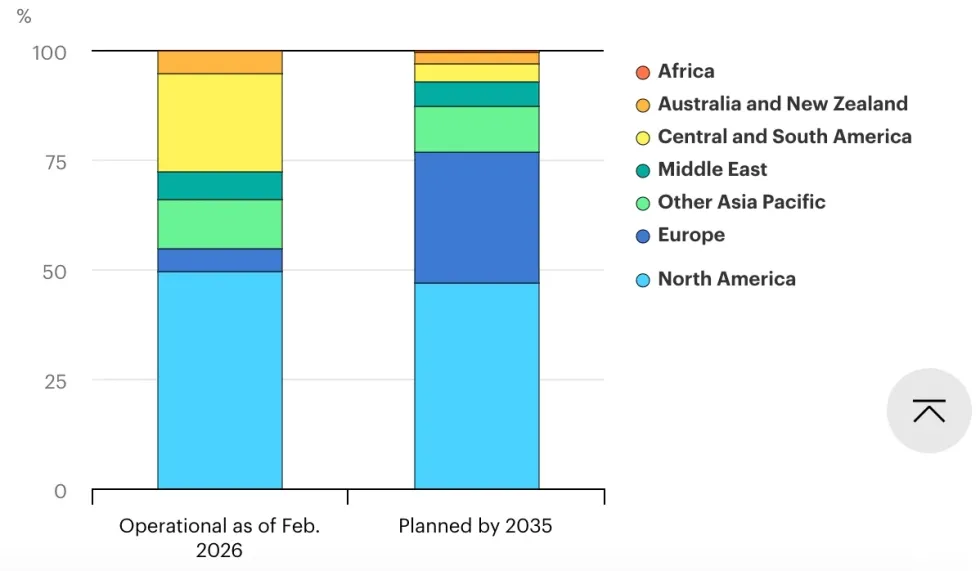
Europe operates just 5.2% of the world’s operational carbon capture capacity as of this year, according to data from the International Energy Agency, putting the continent in a distant third place behind North America and South America. But that figure is on track to top 30% by 2035, easily leapfrogging into the No. 2 spot.

Last year, Japanese billionaire Masayoshi Son reserved a big portion of the U.S. market for gas turbines in hopes of making his SoftBank Group a top power equipment supplier for the data center boom. But reserving 13 gigawatts of turbines — equivalent to more than six Hoover Dams — drove a $3.7 billion loss in the company’s earnings.
“Like an overeager miner who tries to corner the market for picks and shovels in a gold rush,” The Wall Street Journal wrote in a scoop on the earnings hit, “Son’s SoftBank Group ordered so many turbines that even after fully supplying the world’s largest gas power plant, it was left with reservations for far more than it could possibly use.” It’s a sign, my colleague Robinson Meyer wrote last night, that “data centers may have already peaked as an economic and energy trend.”
Sign up to receive Heatmap AM in your inbox every morning:
Add this to Democrats’ list of potential investigations into conflicts of interests in the Trump administration’s energy deals. A week before the U.S. invaded Venezuela, a plane linked to John Addison, a gasoline trader at the commodities giant Vitol and a friend and early financier of JD Vance’s political career, spent time on the tarmac of Bozeman Yellowstone International Airport alongside the vice president’s jet. Just two days after the capture of Nicolás Maduro, Addison received a call from Secretary of Energy Chris Wright with what Reuters described as “an irresistible offer.” In a blockbuster investigation, the newswire reported that Vance told Wright to trust Addison despite the fact that he “wasn’t the obvious choice to receive such a call from” the Department of Energy chief. Typically such outreach would go to the company’s regional chief executive, not a senior trader. “And his specialty was buying and selling U.S. gasoline, not Latin American crude oil,” Reuters wrote.
Offshore wind may be out to sea in the U.S. But Britain and Japan just signed a new Offshore Wind Industrial Compact in a bid to increase cooperation on supply chains for all kinds of seaward turbines. The pact encourages joint investments between British developers such as the state-backed Great British Energy and Japanese financiers, offshoreWIND.biz reported.
Mr. Wonderful isn’t the only male celebrity getting into the data center craze. New England Patriots owner Robert Kraft’s Kraft Group is now seeking to build a 900-megawatt data center campus in Sutton, Massachusetts, an historic, rural enclave roughly an hour southwest of Boston. If completed, The Boston Globe reported, it would be the fourth-largest data center in the U.S.