I wrote this story from inside a cloud of smoke. Owing to some funky meteorology in the Seattle area this week — a pressure ridge paired with a thermal trough — the region’s usual westerly winds reversed, causing smoke from the fires burning in the eastern half of the state to pour through the mountain passes and river valleys of the Cascades and pool over the populous Puget Sound lowlands, where I live.
Though it’s cleared up some today, I’m still running my air purifier on full blast because I know what’s in the lingering smoke. Unlike the still blazing wildfires in Ontario that are burning through mostly uninhabited forests, the smoke in the Seattle area this week came to us partially from Spokane, where the Old Trails fire razed at least 700 buildings and homes last weekend. That means that beyond the usual organic matter associated with wildfire smoke, the pollution that has hung over Seattle has likely also contained particles and chemicals from burned plastics, batteries, cars, and household appliances.
But how can the average person be sure whether their wildfire smoke is the bad kind or the worse kind? (At least assuming that well-adjusted people do not obsessively watch the animations on AirNow.Gov, as I do.) I turned to Coty Jen, an associate professor of chemical engineering, and Albert Presto, a research professor of mechanical engineering, both of Carnegie Mellon University, to learn more about the chemistry of wildfire smoke.
Not all smoke is created equal — but it’s all nasty
“There is no safe smoke,” Jen said, setting me straight immediately. “It’s all bad. It will piss your body off.”
While it’s true that some smoke is more toxic than other smoke, what you might call the “all natural, organic” variety will still spike hospital emission rates and exacerbate pre-existing respiratory diseases, even if it is mostly burning trees.
Under ideal conditions, when cellulose or lignin — the main structural components of trees and plants as well as leaf litter and soil, the largest sources of carbon during a forest fire — heat up and combust, the chemical reaction creates carbon dioxide, water, heat, and light. But wildfires don’t burn cleanly, and the chemical reactions often stall midway through that process due to things like oxygen availability and temperature variation, producing intermediate products like carbon monoxide or partially broken-down bits of carbon, often called soot. The tiniest of these particles can be smaller than 2.5 micrometers across — 30 or more could fit across the width of a human hair — and are measured collectively as PM2.5, a catch-all term that refers to the size of the particle rather than what it is. What’s important, though, is that these particles are small enough to penetrate deep into our lungs and potentially enter our bloodstream, factors that add to the known mortality associated with PM2.5 exposure.
Different kinds of forests create different emissions — heavy duff, or leaf litter, which is common in pine forests, creates some of the densest smoke conditions. Wetter fuels also burn “dirtier,” creating more pollution. Different topographies also impact air quality in myriad ways; it’s no surprise that some of the worst pollution from the Spokane wildfires pooled in mountain valleys as a warm overhead layer of air trapped the particles near the ground.
Even “natural” wildfires can be extra toxic; burning eucalyptus, which grows in Southern California, is not something you want to inhale. Pine smoke can cause mutations in bacterial DNA, a common lab test for a substance’s potential to cause cancer. Wildfires that smolder are worse than those that burn fast; researchers have found that PM2.5 can be up to 70 times higher when fuels aren’t actively on fire. “You can even see this if you’ve ever built a fire yourself,” Presto explained. “There’s a period where everything is big and flaming, and then, if you’re burning a log, it eventually goes down to smoldering. The emissions are different.”
In the case of something like a house burning down in a wildfire, however, it’s not only cellulose and lignin combusting. “We’re good at engineering materials that are extremely robust, but when they burn, they release very exotic compounds,” Jen said. She pointed to the common plastic PVC, which is used for everything from exterior siding to plumbing and window frames. When it combusts, PVC releases chlorine, “which is very bad for you,” Jen told me. “It’s like how bleach is bad for you — it’s a pretty nasty chlorine compound. PVC isn’t releasing bleach, but it is releasing radical chlorine molecules that produce some crazy compounds.”
Can we tell how “bad” the PM2.5 in a wildfire plume is?
If you’re following a smoke event at home, the answer is “not really.” PM2.5 is measured in micrograms per cubic meter, which tells us how much small stuff is floating around, but not what that small stuff is. “It is pretty difficult to measure all the different compounds that wildfires, or broadly any pollution, will emit,” Jen said. “The easiest way to quantify it is to literally suck air onto a filter and measure how heavy it got.”
Measuring what exactly is in that mass requires instruments that cost in the ballpark of half a million dollars, which is not financially feasible at every air monitoring station, Jen went on. But while there are certainly academic applications for that kind of knowledge, a person trying to decide whether or not to go for their run in wildfire smoke doesn’t need that level of granularity.
“Some smoke is definitely more dangerous,” Jen said. “But as innocent bystanders, it’s not like we can pick and choose what smoke floats over to us. You just have to live with it, so the best mentality is to treat all smoke as bad.”
In a 2026 Science Advances study that attributed more than 24,000 deaths per year to wildfire smoke in the U.S., researchers found no safe threshold for PM2.5 exposure. Every 0.1 microgram per cubic meter increase in a county’s average annual PM2.5 from smoke was associated with nearly 5,600 excess deaths nationwide, even though most counties saw only trace amounts of smoke — about 0.4 micrograms per cubic meter a year. While it’s “orange sky” days, when the pollution spikes into triple-digit AQI numbers, that get the most media attention, even low exposure that you can’t smell or even see can be affecting your health.
What about gases?
PM2.5 is just one component of wildfire smoke — the other is gases, including benzene and formaldehyde. Many gases chemically transform as they move from where the fire is to where you inhale them. “The atmosphere is extremely oxidizing — it likes to add oxygen molecules onto compounds,” Jen said.
Some of those compounds react faster than others, “so it depends how downwind you are,” Jen went on. That’s why people closer to a wildfire — maybe a day or less downwind — get the distinctive campfire smell, mainly from the “young” vapors and volatile organic compounds. But for people on the East Coast who were subject to the Ontario smoke several weeks ago, the smoke had to travel several days to reach places like Pittsburgh and New York, and by then the sharper-smelling compounds had transformed into new pollutants like ozone.
The AQI only measures a few specific gases that are considered “criteria pollutants” under the Clean Air Act, which means, as Presto told me, “during these fires, you could emit a whole bunch of different other gases that don’t have an AQI number.”
Instead, you can look at the PM2.5 number to get the gist of how prevalent wildfire gases are. “If your PM 2.5 is high, it’s impossible for the bad gasses to be low,” Jen said. “The way we think about it is, there’s a bunch of junk on the particle, and if the same junk’s not also in the gas, it will evaporate off the particle into the gas. They always exist together.”
What the AQI tells us (and doesn’t)
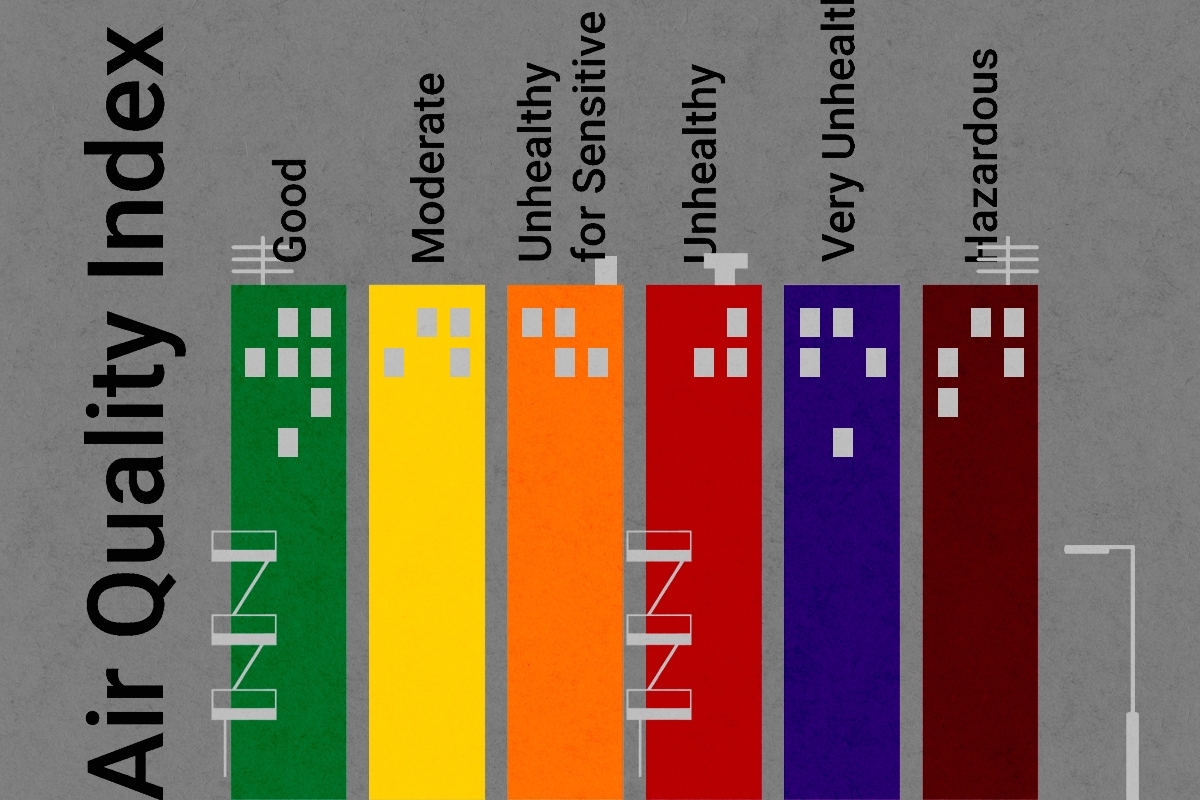
You might notice by now that I’ve written little about the actual AQI number, that score that appears on your weather app and runs from zero to 500 (or, confusingly, even higher). That’s because while the AQI is a great communication tool, it doesn’t offer us much in the way of the science of wildfire smoke.
The AQI measures five different pollutants — PM2.5, ozone, carbon monoxide, sulfur dioxide, and nitrogen dioxide — with the EPA setting specific concentration thresholds for each one, as my colleague Emily Pontecorvo has explained. “If local concentrations of any one of them tick up above those protective standards, the AQI will jump from green to a more alarming color,” she wrote. “The higher the level of pollution is, the higher the AQI and the darker the color will be.”
If you want to impress your friends, though, you ought to zero in specifically on the PM2.5 concentration — again, because the prevalence of the tiniest particulates is a good indicator of all the other gunk you can assume is in the air, too. (You can find the specific PM2.5 concentration usually by clicking for more information about the AQI on your weather app or checking IQ Air’s widget.) For example, at the time of this writing, my local PM2.5 concentration is 50 micrograms per cubic meter, more than triple the World Health Organization’s 15 micrograms per cubic meter threshold for 24-hour exposure. (The EPA’s 24-hour threshold is much more lenient, at 35 micrograms per cubic meter.)
How to keep yourself safe
When I asked Jen how she stays sane knowing all she knows about smoke exposure, she laughed. “I have just generally become more terrified of all campfires and all barbecues, but people already think I’m weird, so I might as well add to it,” she told me.
In all seriousness, though, she told me the answer is air filters, and her confidence in their ability to work. When wildfire smoke rolled through Pittsburgh, she had two running that she moved from room-to-room with her family, as well as a whole-house air filter. “We were getting PM2.5 concentrations in our house of about 80 micrograms per cubic meter when it was 150 outside,” she said. “But with the air filter on, we could drop that down to less than eight.”
Jen pointed out, though, that many people do not run their air filters properly. Filters are rated at their highest blower level, “so for them to be effective, you need to crank them to their highest setting to get all the air through,” she said. Most people keep their filters on auto or low because they’re so loud — myself included, until I learned otherwise.
Additionally, while an air filter is a rather large appliance, it really ought to be placed in the center of your room to be the most efficient, rather than up against a wall. (Again, my bad.) “When these wildfire events happen, the most effective place for the air filter is where you are, and you have to run it loud, which kind of sucks,” Jen said. “But it is better than breathing in gross air.”