Why now? The consensus among climate scientists about our ability to mitigate warming is growing more dire by the day. The United Nations now acknowledges that limiting temperature to 1.5 degrees Celsius above pre-industrial levels is out of reach, putting more drastic adaptation solutions in play.
“It is increasingly clear to anyone who’s paying any attention that we are screwed, right? That we have blown past every possible reasonable threshold at which our existing theory of change can possibly lead to a safe and equitable climate future,” Joshua Elliott, chief scientist at Renaissance Philanthropy, told me. He directs the two-year-old nonprofit’s Advanced Research for Climate Emergencies initiative, which organized the event. “I feel like the second election of Trump was such a nail in the coffin.”
The three-day Global Risk and Stabilization Summit brought together scientists, engineers, funders, insurers, and at least one venture-backed startup to talk about everything from thickening Arctic sea ice to shielding Antarctic glaciers with underwater curtains to spraying reflective particles into the stratosphere to bounce a portion of incoming sunlight back into space. That last approach, a method of solar geoengineering known as stratospheric aerosol injection, tends to dominate geoengineering discussions, as it could theoretically cool the planet quickly and relatively cheaply.
That doesn’t mean it’s generally accepted, however. Far from it. The sessions at the ARC summit ran under Chatham House Rules, i.e. no reporting who said what — or even whether they were there at all — without explicit permission. ARC plans to release a synthesis report on the state of field next year, but in the meantime the conference website made clear: “Attending the summit does not imply that you endorse the report, any particular intervention, or the stabilization framing. Attending means you are taking part in the conversation and nothing more.”
This type of careful distancing is par for the course in geoengineering circles. Just as many mainstream climate advocates once viewed adaptation — and later carbon removal — as distractions from the need to cut emissions, geoengineering has suffered under the same criticisms. Its oftentimes sci-fi sounding interventions are already ripe conspiracy fodder. Add to that its underresearched environmental impacts and side effects, and some of these strategies could prove truly disastrous in the wrong hands.
But at least people are finally talking about it. In the weeks since the summit, attendees have published dozens of Substack and Linkedin posts about what they saw, heard, and took away from the conference. I talked to many of them about this first attempt to intentionally gather and grow the sector.
The who’s who of whatever it’s called
Naturally, they don’t all agree on the best path forward. Seemingly everyone acknowledges that conducting more research and designing better Earth monitoring systems is a no-lose situation. But big questions remain unresolved: what role private capital should play; how openly to discuss the possibility of near-term deployment; the somewhat uncomfortable overlap between climate engineering, defense, and national security; and how to educate policymakers and the general public about interventions that sound to some like nefarious overlords trying to control the weather.
The field doesn’t even yet agree on what to call itself. The conference organizers prefer “Earth systems stabilization” to “geoengineering,” arguing that a sector like this should be defined by its goal rather than how it gets there. The terminology remains unsettled, however, with one critic, University of Waterloo economist and former geoengineering researcher Juan Moreno-Cruz telling me in an email that the renaming “feels like a campaign” with the “objective of moving more towards action.”
At this nascent stage, any one individual can have an outsized voice. Based on the published speaker list, as well as various recaps posted during and after the event, the guest list featured some of the field’s biggest names. That included David Keith, founder of the direct air capture company Carbon Engineering and a pioneer of solar geoengineering, which involves releasing aerosols like sulfates into the atmosphere to reflect a small portion of sunlight back into space. Also in attendance were Columbia University climate economist Gernot Wagner, Paris Agreement architect Sue Biniaz, and J.P. Morgan climate advisor Sarah Kapnick, alongside delegates from some of the big environmental NGOs, including the Environmental Defense Fund and Natural Resources Defense Council.
More potentially polarizing attendees included Yanai Yedvab, the CEO of solar geoengineering startup Stardust Solutions — one of the first for-profit entities to enter the space — and Lowercarbon Capital, the climate tech venture firm that led its Series A round.
The function that private sector funding and venture-style startups could or should play in this field remains one of the biggest points of tension. Many strongly believe that the only appropriate customer for a globally consequential intervention like stratospheric aerosol injection is a coalition of national governments. But there seems to be a preemptive acknowledgement among those I spoke with that getting the United Nations itself to align on research and potential terms of deployment is unlikely.
Paul Gambill, an ARC fellow and co-founder of Nori, an early carbon removal marketplace, told me that one session at the summit was titled “The Future is Minilateral,” a nod to the growing interest in a small bloc of countries — “maybe six or so” — working together on the issue. Several people I spoke with described a model in which governments would buy technology from a company like Stardust, but retain control over if, when, and how to deploy it.
But even within the ARC set, that framing seems to have skeptics. Noah Deich, another ARC fellow and carbon removal veteran who co-founded the nonprofit Carbon180, sees the profit motive as inherently dangerous. There’s no guarantee that the science will ever advance to the point where governments are comfortable becoming customers, but investors always want to see returns. That disconnect, he argues, creates the incentive to commercialize the technology before either the research or the public is ready.
“That to me is very, very concerning, and shows a lack of judgment at a first order for the people who have invested in this, and for the people who have accepted that private sector money,” Deich told me. “That makes me very, very wary about what they’re going to do when faced with the choice of, hey no government wants to do this. Or these governments have said it is illegal, and this one says it’s fine. Like, will they actually respect the ones that say it’s illegal?”
Others see private capital as all but inevitable. Susan Su, a climate tech investor and analyst, thinks the sector would do best to engage with the private sector strategically rather than fearfully. “Money in general comes with ideas, and in my view, that’s okay,” she told me. If a venture backer has their own notions about how and where to deploy stratospheric aerosol injection, for instance, that need not dictate the agenda. “It’s the entrepreneur’s or the initiative’s job to push back against those ideas and to shape them.”
Su also thinks the field ought to be more open to discussing deployment as a possible outcome from both the research and conditions on the ground, rather than treating it as the third rail. “There’s a sentiment of caution that I think is rooted in a previous era, where it’s been a long road to reach whatever limited consensus there is today that we should even research this,” she explained to me in an email. “With that much caveating, it’s hard to imagine why a funder would get excited to back something that everyone’s saying shouldn't exist.”
Still, it’s not hard to imagine a near-term future in which climate change presents an increasingly urgent national security concern, and the instant governments start treating geoengineering as a defense priority, the money could be practically limitless. Private geoengineering companies could function essentially as defense contractors, with militaries as their primary customers.
The comparison makes some understandably uneasy, as it risks framing climate interventions as weapons to be wielded by states with the resources to develop and deploy them. But however you look at it, “people are starting to realize, there’s no scenario where this stuff doesn’t become geopolitical very very fast,” Gambill told me. And that makes an already controversial field considerably messier.
Beyond solar geoengineering
One way to sidestep some of the thorniest questions around global governance could be to start with a focus on more localized interventions. In the Arctic, for example, companies such as Real Ice and Arctic Reflections are testing ways to thicken sea-ice by pumping seawater onto its surface during the winter. In Antarctica, researchers are studying the feasibility of underwater “seafloor curtains” in front of the Florida-sized Thwaites Glacier to keep warm ocean water from melting it from below. If that glacier were to fully collapse, it could raise global sea levels by up to two feet. There are also some truly low-tech options on the table, too: One calls for reintroducing bison to the Alaskan tundra, where their heavy footsteps would compact the snow and help keep the underlying permafrost frozen.
There’s even a more localized version of solar geoengineering. Called marine cloud brightening, it involves spraying a fine mist of seawater into low-lying clouds over the ocean. The salt particles encourage the formation of smaller cloud droplets, making the clouds brighter and more reflective, cooling the ocean and surface below. Unlike stratospheric aerosol injection, the impacts of which could persist for a year or more, a single deployment of marine cloud brightening lasts mere days, making it readily reversible and easier to test. Australian researchers have piloted this tech over the Great Barrier Reef.
"It feels like people read Kim Stanley Robinson’s novels and are trying to actually figure out if any of that stuff makes sense,” Deich told me. In Robinson’s acclaimed 2020 novel The Ministry for the Future, he imagines efforts at stratospheric aerosol injection, glacier stabilization, and large-scale rewilding in response to a fictional — but readily imaginable — catastrophic heat wave.
Deich worries, however, that he didn’t hear enough emphasis at the summit on the ongoing role carbon removal — not just emissions cuts — would have to play in a world even temporarily reliant on an intervention like stratospheric aerosol injection. That’s because of the risk of “termination shock”: If scientists suddenly halted solar geoengineering, the warming it had been masking would likely return within just a few years unless carbon removal efforts could draw down significant CO2 in the interim.
“The [carbon dioxide removal] community from the very early days tried very hard to say, first priority is obviously stopping emissions, but we also need to do removal, and we can’t wait for one to do the other,” Deich told me. “And I don’t see that same type of drumbeat being articulated by the SRM crowd.”
He and others are well aware of the moral hazard argument that has long dogged carbon removal: that this tech will give fossil fuel companies cover to keep emitting, and politicians an excuse to avoid the harder work of decarbonization. With carbon removal, however, that concern is generally simple to rebut. All recent IPCC reports have concluded that removals will be necessary to keep warming anywhere near safe levels. And in many cases, cutting emissions is still far cheaper than removing carbon after the fact.
But it’s a different calculus for an intervention like stratospheric aerosol injection, which is cheap by comparison and could lower global temperatures without doing anything to address the underlying emissions buildup. It’s easy to see how policymakers and the public could say, “Let’s let future generations deal with this building up of greenhouse gasses. We don’t really have to care about that now, we can just keep the temperatures a bit lower and buy ourselves time,” Robert Höglund, a carbon removal advisor and co-founder of the market tracker CDR.fyi, told me. “I think that’s fair. It’s a real risk.”
For its part, ARC plans to publish a report early next year bringing together the work of roughly 40 authors to lay out the state of the field’s science, governance, and social legitimacy. This will come alongside an open map of the interventions being studied and tested as well as funding and research gaps that remain. Rather than immediately holding another global summit, the organization plans to convene regional meetings next year primarily in low- and middle-income countries to explore possibilities for local research efforts in climate vulnerable nations. The next global gathering might then be scheduled for 2028.
In the meantime, many hope ARC and others will help shepherd along myriad research and communications efforts. Because if any message dominated the inaugural summit, it was: Geoengineering isn’t yet ready for prime time. There’s much more research to do, and significant stakeholder groundwork to lay, especially as the field considers how to best invite policymakers into the conversation.
“You cannot create a field. Nobody can declare it into existence,” ARC director Joshua Elliott told me of the effort to bring together the disparate experts working on climate stabilization. What organizations like ARC can do is build the infrastructure for it to emerge. That looks like convening researchers, advocates, and even skeptics; synthesizing siloed knowledge; opening the arguments to debate; establishing academic journals; and creating funding streams within governments and other institutions. But from there, the big decisions belong to others.
“That’s where our theory of change stops,” Elliott told me. ARC won’t decide whether the aerosols are injected into the atmosphere or Arctic ice is thickened. “It is the governments and the multilateral institutions that we have charged with making these decisions, despite however functional you think those institutions might be.”



 The main control panel at Fort St. Vrain in 1977. Photo: Denver Post, Inc. via Getty Images
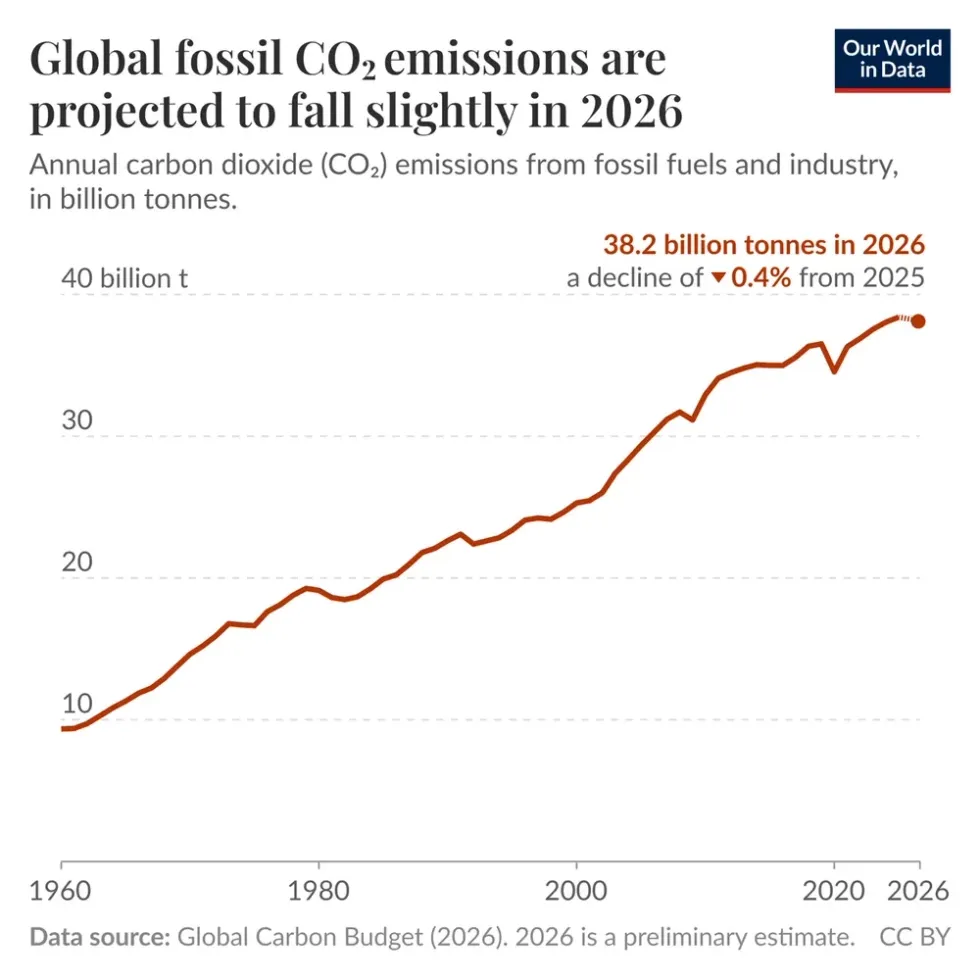 Chart: Our World in Data / Global Carbon Project