Wildfires in Sumatra and Kalimantan have burned more than 7 million acres in what is likely a record year for the fire-prone islands. The blazes have destroyed critical wildlife habitats, including rainforests occupied by orangutans, Sunda pangolins, and Javan leopards. But it’s not the direct human deaths from the fires, the habitat loss, or the historic acreage burned — those being the typical headline numbers for gauging how “bad” a given fire or fire season is — that best tell the story of the impacts, in this case.
Rather, it is the toxic smoke blanketing Indonesia, Singapore, Malaysia, and Timor-Leste. For months, those emissions have been in every breath taken by the region’s 12.5 million inhabitants, about 4% of the world’s population.
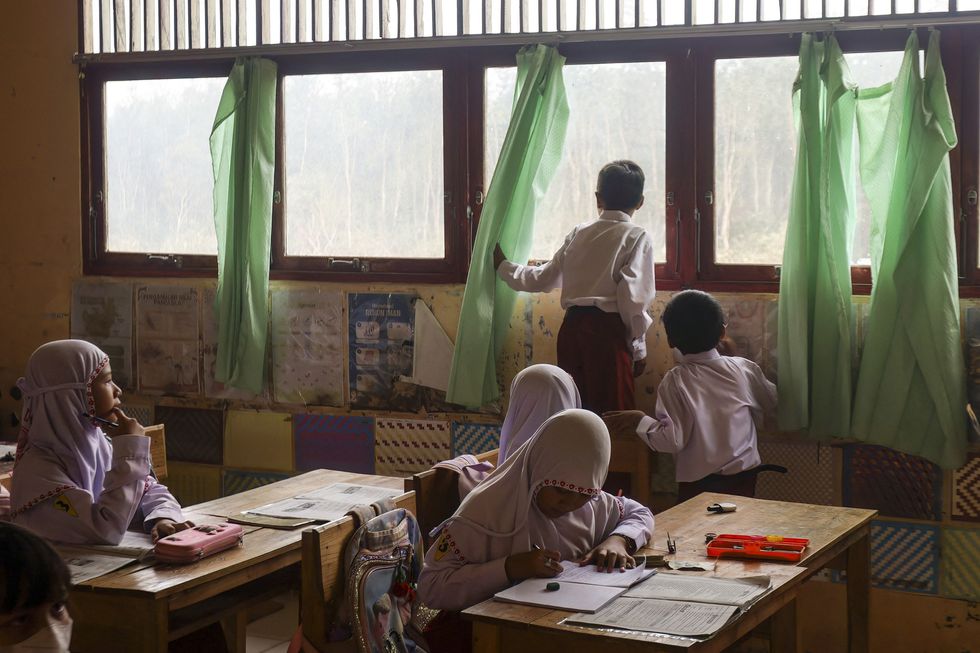
In Indonesia alone, authorities estimate the smoke has caused 400,000 respiratory infections. As of a few weeks ago, more than 75,000 cases had been recorded in children between birth and age 5. “Behind those numbers are worried families, parents keeping watch, and children struggling to breathe,” Herawati Supolo-Sudoyo, a trustee of the Indonesian Open Science Voice Foundation and chair of the Indonesian Academy of Sciences’ Commission on Medical Sciences, said during a recent public health webinar. “Babies certainly cannot say, ‘My chest feels tight.’ They rely on us to protect their breath.” (That’s according to an automated YouTube translation of her remarks.)
 MUDA SAGALA / AFP via Getty Images
Children are especially vulnerable to wildfire smoke because their lungs are not fully developed, and they breathe in more air relative to their body weight than adults. Reports from local hospitals are harrowing. “Yesterday, in the inpatient ward, I saw three toddlers struggling to breathe,” one mother, whose 14-month-old died suddenly after experiencing shortness of breath, told BBC Indonesia (as translated by Mongabay). The Indonesian Philanthropy Association, a nonprofit, has taken to describing the children of Indonesia as the “lost generation” due to the suspected physical and cognitive toll of the relentless smoke exposure. Timor-Leste, which borders Indonesia to the west, has one of Asia’s youngest populations, with about 44% of its inhabitants under 18.
“We must not wait until these children are adults to calculate the losses,” Supolo-Sudoyo said.
There seems little doubt that the smoke is a climate-change-fueled public health crisis. A new study by World Weather Attribution, released Thursday, found that while the super El Niño is the primary cause of the severe reduction in rainfall that helped fuel the fires, Indonesia’s drought was “then exacerbated by record heat throughout the fire season, which was made possible due to human-caused climate change,” Theodore Keeping, a research associate with WWA, said during a press call about the findings. (The study, which uses peer-reviewed methods, has not yet been peer-reviewed itself.)
Indonesia’s fire season was about 1.6 degrees Celsius hotter due to climate change, compared to about a third of a degree Celsius hotter due to the current El Niño, WWA reports. “We also found that this year’s record-breaking heat would have been virtually impossible without climate change, even in a similar El Niño state,” Keeping said.
MUDA SAGALA / AFP via Getty Images
Smoke is still a relatively new way of quantifying the impact of a wildfire. Alistair Hayden, an assistant professor of practice in Cornell’s Department of Public and Ecosystem Health and creator of the school’s wildfire smoke mortality estimation tool, told me that though researchers have been studying smoke toxicity for years, the bad U.S. fire seasons in 2018 and 2020 helped accelerate interest and urgency. “Really high visibility and growing interest leads to a lot more studies that then enhance our knowledge about the details of this hazard,” he said of the recent spike in smoke-related research.
For example, new research released just last month by researchers at Harvard indicates that wildfire smoke exposure during pregnancy is related to higher instances of autism in children. Separately, a study about chronic wildfire smoke exposure linked the pollution to an estimated 24,100 deaths in the lower 48 states every year — more than twice the number killed in drunk-driving accidents. Looking only at Indonesia, researchers linked smoke exposure in the womb during the region’s severe 1997 fire season to poorer health outcomes by age 17.
Still, coverage of wildfires largely focuses on how many people were killed by direct flame impacts, or how many acres or buildings burned. A “megafire,” for example, is a nonscientific term used by the media to describe how large a fire is physically, but not the thousands of miles further its smoke will travel. The National Interagency Coordination Center’s Wildland Fire Summary and Statistics Annual Report, the end-of-year summary of fire season impacts in the United States, doesn’t even mention smoke exposure. Deadly and destructive fires in Maui and Los Angeles stand out in memory, but the hazardous air quality in the Midwest this season from the Canadian wildfires may turn out to cost as many or more lives. (Smoke toxicity and chronic exposure also complicate the cost-benefit analysis of a favorite tool of progressive fire managers: prescribed burns.)
In fact, research about smoke toxicity and widespread exposure to particulate pollution increasingly suggests that emissions might be the marquee impact of wildfires. While 30 people died directly from the 2025 Palisades and Eaton fires in L.A., one research paper estimated the loss of life was closer to 440, partially due to the deaths attributable to wildfire smoke in addition to stress, disruptions to the health-care infrastructure, and mental health impacts.
Afan Anugerah / AFP via Getty Images
“The difficulty with all of this is that the smoke deaths are difficult to track,” Hayden told me. “They’re not, for instance, showing up on death certificates. While the smoke itself is very visible in the air and leads to nice photos, the impacts are much harder to take photos of.”
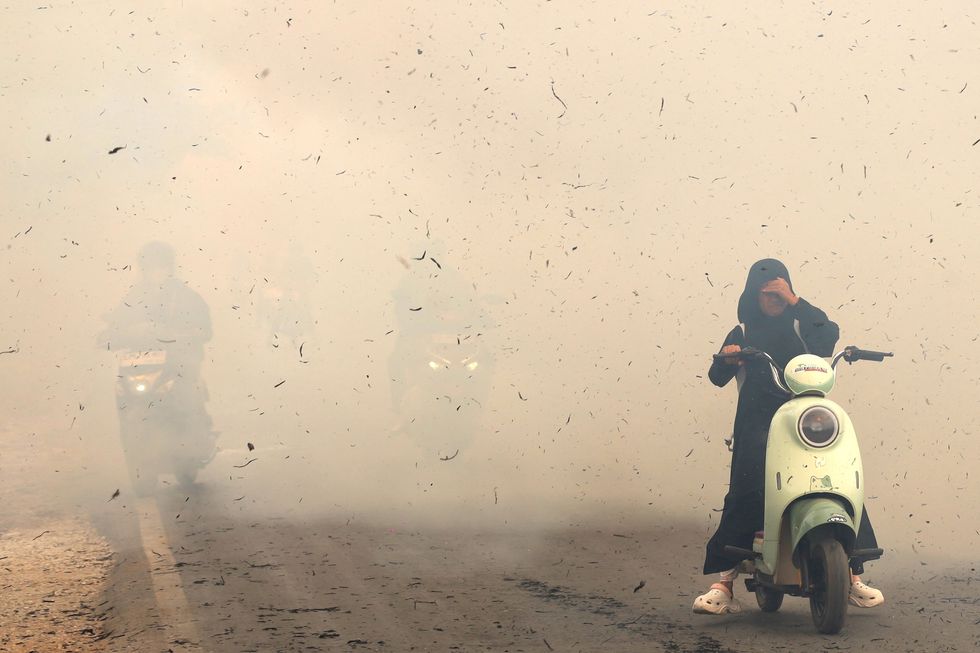
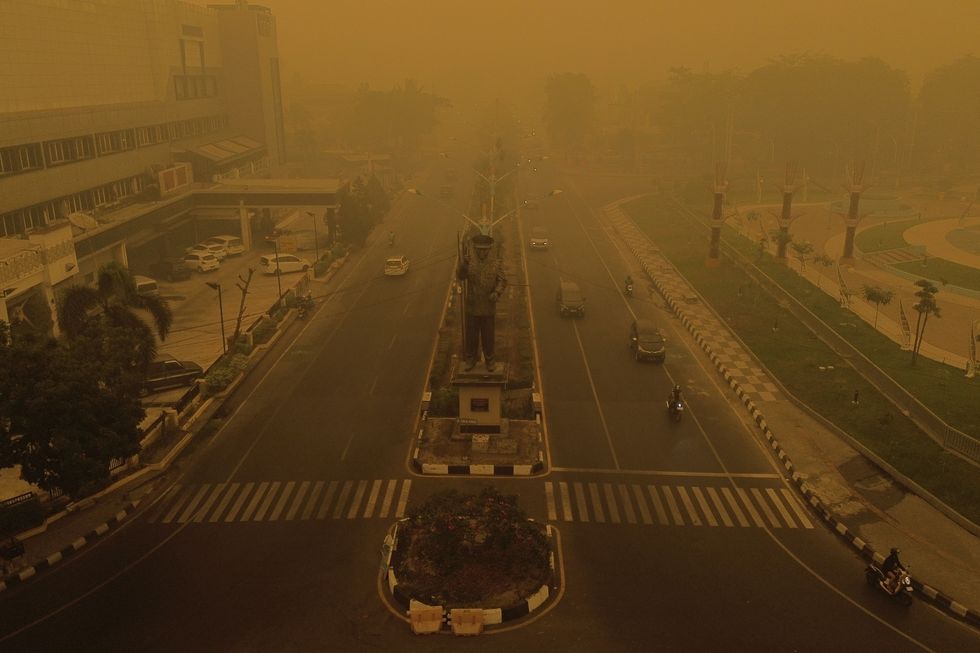
That’s certainly the case in Indonesia, where photos show people going about their lives in a cloud of yellow smoke, and in Singapore, where run clubs have moved their workouts into malls to try to avoid the pollution. But while a smoke-exacerbated heart attack isn’t a front-page image, to Hayden’s point, the pictures do reveal something else: just how ill-prepared our infrastructure and public health systems are for dramatic smoke events like these.
What can be done about wildfire smoke? You can invest in a really good air purifier — and use it correctly — which works so long as you can afford it, and if your home isn’t drafty to begin with, and if it isn’t too hot out that you need to open a window to stay cool at the same time. You can wear the right kind of mask, too, but it needs to fit properly and it won’t filter out gases or the smallest toxic particles. And while you can evacuate to protect yourself from an encroaching wildfire, outrunning the smoke might require you to travel hundreds of miles or, as is the case for those in Southeast Asia, literally leave your country.
In that sense, we are thinking about wildfire impacts wrong, too. Fires aren’t a hazard contained neatly within evacuation zones; the “wildland-urban interface” and “wildfire-prone landscape” describe an environment fires may erupt in, but not what they’re contained to. Whether you’re in Los Angeles or New York City, Minneapolis or Madrid, Jakarta or Kuala Lumpur, the smoke will find you.





 MUDA SAGALA / AFP via Getty Images
 MUDA SAGALA / AFP via Getty Images
 Afan Anugerah / AFP via Getty Images