Current conditions: The wildfires in France and Europe are slowing, but three firefighters have died and the looming heat wave could bring yet more disaster • New York and New Jersey are facing flash floods as a storm system makes its way across the Northeast United States • Days of thunderstorms are causing floods across Vientiane, Laos’ sprawling capital.
THE TOP FIVE
1. Commonwealth Fusion Systems raises another $1 billion
Last month, I toured Commonwealth Fusion Systems’ headquarters in small-town central Massachusetts. The place was abuzz in activity. On the factory floor side, workers were assembling the magnets needed to ultimately form the torus-shaped reactor — think a giant doughnut with an interior that curves like the core of an apple — called the tokamak. On the actual reactor side, SPARC — the prototype that CFS expects will make history next year as the first private enterprise and only tokamak to ever generate more energy that it took to start the fusion reaction — was starting to look like a functional machine from my view on a second-story walkway overlooking the sterile assembly room. The old joke that fusion is the energy source of tomorrow — and always will be — certainly didn’t ring as funny now. I’ll tell you who isn’t laughing: All the new investors that just poured another $1 billion into CFS. The company announced its latest funding round early this morning, which brings the startup’s total fundraising since its launch as a spinout from the Massachusetts Institute of Technology in 2018 to $4 billion. CFS now accounts for 30% of all the private capital that has flowed into fusion. What distinguishes this round, my colleague Katie Brigham wrote, is that the money is coming from a bunch of institutional investors, such as pension funds and sovereign wealth funds, rather than venture capitalists. On a call with reporters this week, CFS’s newly-named chief financial officer, Lorence Kim, said it’s the first-time institutional investors comprised the majority of the new funding. When I asked the company’s spokeswoman for a percentage estimate breaking down the new versus old investors in this round, she declined to comment. Kim cautioned that the funding isn’t the kind of capital you raise before launching on a stock market. But his hire is notable. The former Goldman Sachs banker famously helped take the pharmaceutical giant Moderna public and held the top financial role through the start of the Covid-19 pandemic.
Meanwhile, a federal Superfund site at a facility in Kentucky once used to enrich uranium for atomic bombs is being transformed into a data center. On Wednesday, the Department of Energy announced a deal between investment giant Brookfield, utility behemoth NextEra Energy, and three local power providers to redevelop portions of the Paducah site into a $100 billion data center campus. “By transforming former DOE sites into engines of innovation and economic growth, we can revitalize communities with increased tax revenue and thousands of jobs, while also strengthening America’s energy security,” Secretary of Energy Chris Wright said in a press release.
2. Fed holds rates steady as U.S. oil stockpiles fall ‘precariously low’
The Federal Reserve held the country’s benchmark interest rate steady at Wednesday’s meeting of the U.S. central bank’s top brass. But three bank presidents voted to increase rates as renewed fighting in Iran sent energy prices upward. The dissent “underscored officials’ fraying patience with looking past another price shock on the heels of tariff-related increases last year and with robust demand stemming from the artificial-intelligence buildout,” The Wall Street Journal reported. That is, of course, bad news for renewables and other clean energy developers who rely on cheap upfront money to build, as my colleague Matthew Zeitlin has written.
But there are potentially bigger problems afoot for American energy consumers. U.S. crude stockpiles fell sharply last week as American refineries ramped up production to seize on surging fuel prices as fighting erupted in Iran. The stocks have now reached “precariously low” levels, analysts told the Financial Times, meaning there’s far less cushion if the war worsens the supply shock.
3. Exclusive: What Americans’ opposition to data centers is really about
Last month, the energy team at the liberal policy shop Third Way assembled 100 swing voters from across the country to talk about the data centers that poll after poll shows are becoming less and less popular, to put it mildly. The conclusion of the discussions was this: “America’s opposition to data centers has less to do with their feelings about artificial intelligence and more to do with their anger and distrust of large corporations and government.” The findings, shared with me exclusively in advance, showed that most participants were open to a new data center if they believed it would come with tangible benefits for their communities. While some investors, such as “Shark Tank” star Kevin O’Leary, have tried to present those offerings, “the trust isn’t there.” While Emily Becker, the director of Communications for Third Way’s Climate and Energy Program, told me she was “not surprised by how much opposition there was, what was heartening is people understood that benefits were possible. They just didn’t think they would receive them.”
Speaking of data centers and the public trust: NV Energy has accused one of the biggest developers of data centers in Nevada of attempting to illegally bypass state regulators to determine through private arbitration how and when the Berkshire Hathaway-owned utility should provide power to its operations. The lawsuit, filed Friday in Washoe County’s Second Judicial District Court, alleges that the developer, Tract, is trying to skirt the usual process by which the state Public Utilities Commission determines what share of the utility’s electricity should go to the large power user. Tract, according to the complaint, “wants NV Energy to reserve and provide enormous amounts of power for Tract's private development while shifting the infrastructure and energy costs to Nevada families, small businesses, and existing customers who did not cause them.” Sorting out those questions through arbitration would help to “keep these issues hidden” from state regulators and the public, NV Energy said, according to The Nevada Independent.
Sign up to receive Heatmap AM in your inbox every morning:
4. Trump mulls changing Biden-era transformer rules
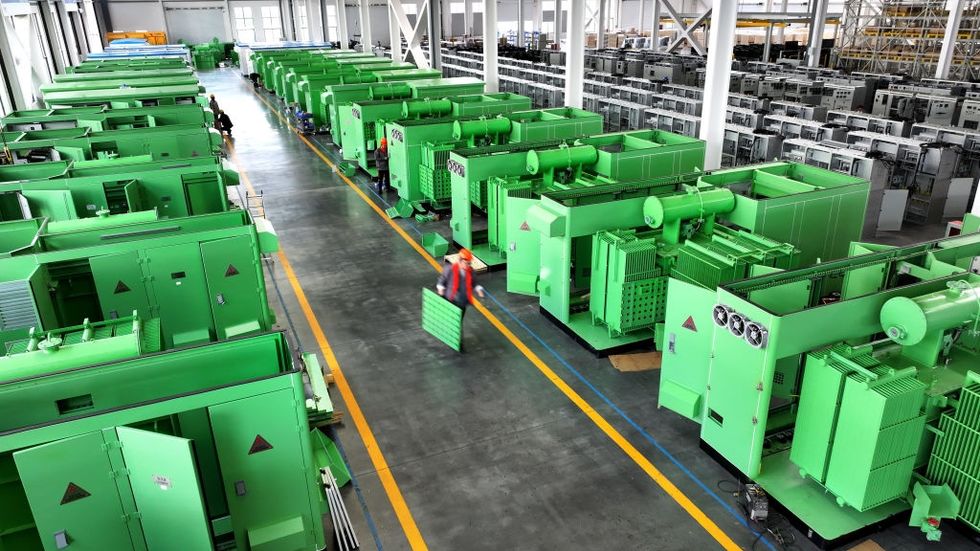
 A transformer factory in Jiangsu Province, China. Costfoto/NurPhoto via Getty Images
When the Biden administration attempted to overhaul regulations on electrical transformers to make the key grid components more efficient, the proposal drew fierce bipartisan pushback amid a years-long nationwide shortage of the equipment. Ultimately, the Biden administration backed down and changed the proposal after receiving public comments. That would have seemed to provide some certainty for factories. But just two years after the final rule won acclaim from across the industry, the Trump administration is now considering revising the requirements for rules set to take effect in 2029. “We’re not aware of anyone asking for this,” Andrew deLaski, executive director of the Appliance Standards Awareness Project, told Utility Dive. The group supported the 2024 transformer rule and other stricter efficiency requirements DOE finalized during the Biden administration.
5. China says it’s ready to ‘constructively lead’ global climate efforts
China has signaled it’s planning to take on what Bloomberg described as a bigger role in steering global negotiations over climate change. The 15th five-year plan published Monday by the Ministry of Ecology and Environment and other key agencies outlines how Beijing “will constructively lead the multilateral governance process to address climate change” and states that “China’s influence, guiding capacity, shaping power, and moral appeal in global climate governance will be significantly enhanced” through the end of the decade. Beijing is already looking to increase how much renewable energy it consumes, as I told you last week.
As you may recall, China is going all in on figuring out how to make green hydrogen work, especially now that the People’s Republic is throwing everything at the wall to diversify its domestic supply of fuels as the Iran War chokes off its regular supply of hydrocarbons. One of the trickier questions with green hydrogen is how to ship the world’s small molecules without leaks. A popular solution is to convert the hydrogen into green ammonia. On Tuesday, SPIC Green Energy announced the successful loading of 3,750 metric tons of green ammonia produced in Jilin Province onto a vessel at the Lianyungang Port in Jiangsu Province and shipped to South Korea. “The shipment represents the world’s largest single-batch delivery of green ammonia,” analyst Jian Wu wrote in his China Hydrogen Bulletin newsletter. “It marks China’s transition from technical demonstration to large-scale international commercial delivery.”
THE KICKER
A company promising to put an expiration date on so-called forever chemicals just raised a bunch of money to bring its technology to market. Claros Technologies is developing a proprietary system that can break down the per- and polyfluoroalkyl substances, or PFAS, contaminating millions of Americans’ drinking water systems. This week, the startup closed a $55 million Series B financing round. “Over the past year, Claros has crossed the threshold from breakthrough technology to successful commercial reality,” CEO Michelle Bellanca said in a statement.



 A transformer factory in Jiangsu Province, China. Costfoto/NurPhoto via Getty Images