Current conditions: The powerful earthquake that killed at least 61 people in the Philippines last week raised the seabed by as much as 7 feet • Raja Ampat, the archipelago off Indonesia’s Southwest Papua province, is enduring days of intense thunderstorms • The Gulf Coast of Texas is bracing for what could become a tropical cyclone set to dump heavy rain across the region.
THE TOP FIVE
1. ConocoPhillips becomes the first U.S. oil company to reenter Syria
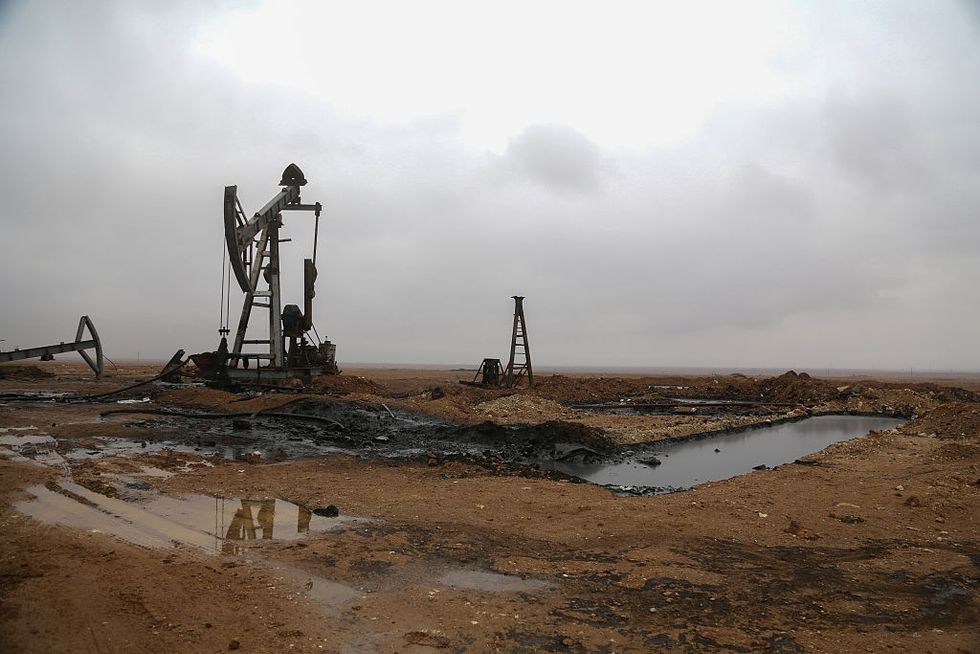
 A Syrian oil field. Kasim Yusuf/Anadolu via Getty Images
On Tuesday, the Financial Times reported that ConocoPhillips was on the brink of announcing a deal to become the first U.S. oil company to reenter Syria since President Ahmed al-Sharaa officially took office last year. The deal, expected to be formalized this week, would be a sign of regrowth after 14 years of brutal civil war that finally ended with the surrender of longtime president and de facto dictator Bashar al-Assad. The Syrian government said last year that a potential deal could increase output of gas by up to 5 million cubic meters per day within a year, a major leap toward restoring an industry that once produced a prewar high of 30 million cubic meters per day in 2011.
2. Carbon removal market Frontier gets a $900 million boost
When Frontier launched in 2022 as a vehicle for those who want to fund carbon removal from the atmosphere, there were barely a dozen companies working to crack the technology. Now there are hundreds of startups taking nearly two dozen different approaches. And Frontier is pulling in more money to spread among them. The company said Wednesday that its buyers committed $915 million to invest in carbon removal companies. Anthropic, one of the leading developers of artificial intelligence models, is among the new buyers. Neither Anthropic nor OpenAI, Anthropic’s peer and rival, has made any kind of public climate-related commitment, making the AI giant’s entry into the group particularly notable.
It’s a sign, perhaps, that the old way of thinking about corporate climate actions — a single-minded focus on carbon accounting — is giving way to more substantive solutions.
As Heatmap’s Emily Pontecorvo put it this week, a growing chorus of experts says that carbon accounting is “not just inadequate, but actively harmful to bringing about the systems-level change required to decarbonize the economy.”
3. Justice Department defends Elon Musk’s xAI against the NAACP
The Department of Justice has officially weighed in to defend Elon Musk’s artificial intelligence startup against a lawsuit in which the NAACP accused the company of building its Colossus Gas Plant in mostly Black neighborhoods between Tennessee and Mississippi. In court papers filed Monday and covered by E&E News and Wired, the Justice Department said the civil rights group’s litigation threatened the U.S. military’s ability to “meet its national security mission and keep pace with adversaries” using xAI’s Grok chatbot. Grok’s ability to operate “is a matter of paramount national security” because it is one of only four cutting-edge AI models that can support national security applications, and one of just three suitable for “mission-critical operations across Secret and Top-Secret classified networks,” the agency told U.S. District Judge Debra Brown, who is presiding over the lawsuit in federal court in Mississippi.
Sign up to receive Heatmap AM in your inbox every morning:
4. Yet another Chinese reactor hits a milestone
Regular readers of this newsletter know that I like to cover the major steps in any reactor’s construction, but especially those in China. When I think back to previous newsletters and the specific updates in them, I struggle to pinpoint exactly when I wrote what, given how frequently the basic facts of the stories repeat themselves. The effect of this, I hope, is to leave you with the accurate impression that China is building a lot of reactors very quickly and efficiently — and to give you pause about how seldom you hear about similar milestones coming out of any other countries. Well, in that spirit, here’s the latest. On Monday, World Nuclear News reported that China General Nuclear Power, the country’s biggest state-owned reactor firm, just lifted the outer dome into place at its fifth reactor at the Ningde Nuclear Power Plant in Fujian province. The 270-metric-ton dome will cap off the containment vessel for the latest Hualong One, China’s flagship reactor with a domestic design.
5. Hawaii governor saves solar tax credits
Last month, Hawaii passed a law that slashed tax credits for both utility-scale and residential solar projects, limiting the amount available each year until a phase-out in 2030. Those changes were set to apply retroactively to projects built in 2026. But Governor Josh Green, a Democrat, just signed an executive order preserving the solar tax credit throughout the end of the year. “Distributed solar energy has been, and will continue to be, a leading contributor to the state’s sustainability and resiliency goals,” the executive order states, according to KHON-2, a local TV station.
THE KICKER
Tesla is expanding its VPP efforts. The company said Tuesday that its Powerwall battery leasing program would now include a built-in participation in a virtual power plant. That’s without any additional enrollment or management by the customer. The pilot is rolling out first in Massachusetts and Connecticut.


 A Syrian oil field. Kasim Yusuf/Anadolu via Getty Images