Current conditions: China has triggered emergency warnings across six provinces as heavy rainfall floods the countryside • A magnitude 7.8 earthquake struck the Philippines, leaving at least 32 dead and more than 100 injured in building collapses • Temperatures in Albuquerque, New Mexico, are rising near 100 degrees Fahrenheit.
THE TOP FIVE
1. Tennessee becomes the first state to officially regulate fusion energy
On Tuesday, Tennessee is set to become the first state in the nation with its own regulatory framework for nuclear fusion plants. You may be wondering, why Tennessee? The two-word answer: Oak Ridge. The Volunteer State has operated as a hub for nuclear energy research and development for more than 60 years, feeding off both the Oak Ridge National Laboratory and the Tennessee Valley Authority’s capacity to help commercialize new technologies. Now state regulators are establishing the first dedicated rulebook for building future fusion plants. “Tennessee has been named the top state in the nation for nuclear energy industry growth, and for good reason,” David Salyers, the commissioner of the Tennessee Department of Environment and Conservation, said in a statement. “This latest step supercharges our reputation as the global hub for nuclear innovation and positions us as the most responsive state to new advanced nuclear companies clamoring to call Tennessee home.”
It’s not the only government betting that the various attempts to commercialize fusion as an energy source will pan out in the near future. On Monday, NucNet reported that the British government had drafted legislation to “create conditions” for deploying fusion technology.
2. Could we see the breakup of PJM?
Typically, the rule of thumb in journalism is that the answer to a question headline is almost always “no,” otherwise the headline would simply state the fact. But this one is a genuine open question that climate-tech investor Shanu Mathew raised Monday in a post on X: Could PJM Interconnection, the nation’s largest grid operator, break apart? The speculation traces back to a Bloomberg article from last week in which unnamed federal officials suggested that the operator, which runs the grid from the Illinois prairie to the Jersey Shore, could split up as data centers put strain on the 13-state system’s electricity supplies.
The talks are happening as two of the largest utilities in PJM, NextEra and Dominion, discuss a potential $420 billion megamerger that would create, among other things, a storage giant, as Heatmap’s Matthew Zeitlin reported. The discussions are also occurring against the backdrop of major artificial intelligence companies going public, with ChatGPT-maker OpenAI following Claude-developer Anthropic in filing a confidential S-1 with the Securities and Exchange Commission this week.
3. China’s nuclear power capacity nearly doubled in a decade
 Nuclear is booming in China.EIA
In the United States, you can’t build a single commercial nuclear reactor in a decade. In China, you can apparently double the size of your entire fleet in that time. Between 2016 and 2024, China’s nuclear generation capacity soared by 76%, according to a new Energy Information Administration analysis. That’s equal to 24 gigawatts. In 2025, China added another 1.1 gigawatts, followed by 2.2 gigawatts more this year just through May. The country has at least 36 other reactors under construction, accounting for nearly half of the world’s ongoing nuclear projects.
Sign up to receive Heatmap AM in your inbox every morning:
4. Global climate goals for aviation are ‘fading fast’
Just five years ago, the global aviation industry made a landmark pledge to achieve net zero emissions by 2050. Now the head of the industry’s global body says that goal is likely already out of reach. Willie Walsh, the director of the International Air Transport Association, told The Guardian that “hope was fading fast” and a new “realistic timeline” needed to be established. More than half of the planned decarbonization of air travel relied on the development of sustainable aviation fuels that remain nascent at best. Money is pouring into the technology, as Heatmap’s Katie Brigham reported. But uptake so far “is about 0.2% of fuel,” Nicole Cerulli, a research associate for transportation and logistics at the market research firm Cleantech Group, told her.
5. Mongolia’s big uranium project breaks ground
One cold autumn morning three years ago, I made my way across downtown Ulaanbaatar to an American-style diner called Millie’s Espresso to meet with a Mongolian mining executive who was thrilled about Western countries’ recent investments in his industry. Landlocked between Russia and China, the geographically huge but sparsely populated democracy hoped to shore up its sovereignty by forging deals with the U.S., Europe, South Korea, and Japan to satisfy soaring demand for minerals. Already Oyu Tolgoi, one of the world’s largest copper mines, was underway in the country’s Gobi desert south, and that year the French government inked a deal to start producing lithium and uranium in Mongolia. Now the uranium part of that agreement is moving forward. On Monday, World Nuclear News reported that the French state-backed nuclear fuel producer Orano had broken ground on its first mine in the Central Asian nation. The project raised some eyebrows among Mongolians who complained that Soviet-era Russian uranium mining left behind nasty pollution, and the terms of Ulaanbaatar’s deal with Rio Tinto over the new copper mine have been politically contentious. But the sprawling, smog-choked capital city — the only major urban development in the rural nation — is in need of more power.
Russia had promised to help meet that power by building Mongolia’s first nuclear power plant. A politically well-connected businessman from Ulaanbaatar, whom I caught up with last night over text to ask about the mood in the country, said Moscow’s bid had drawn more positive attention than France’s plans to mine fuel for their own reactors. “In Ulaanbaatar, we experienced electricity shortages last winter that caused apartment heating to stop during the winter. It was crazy,” the executive told me. While he’s typically a critic of the ruling Mongolian People’s Party, which formed out of the old Communist Party apparatus following the fall of the Soviet Union, the executive told me the government’s actions were “good and brave” steps to “diversify investment in Mongolia.”
THE KICKER
I hate to close out on a bad note, but this one felt important to include: America’s screwworm problem is getting worse. On Monday, the U.S. Department of Agriculture confirmed the first case of the flesh-eating parasite in a dog in New Mexico, in addition to four cases in total in Texas. “This situation is evolving, and we expect new information to emerge as our investigation continues,” Dudley Hoskins, USDA’s under secretary for marketing and regulatory programs, said in a statement.



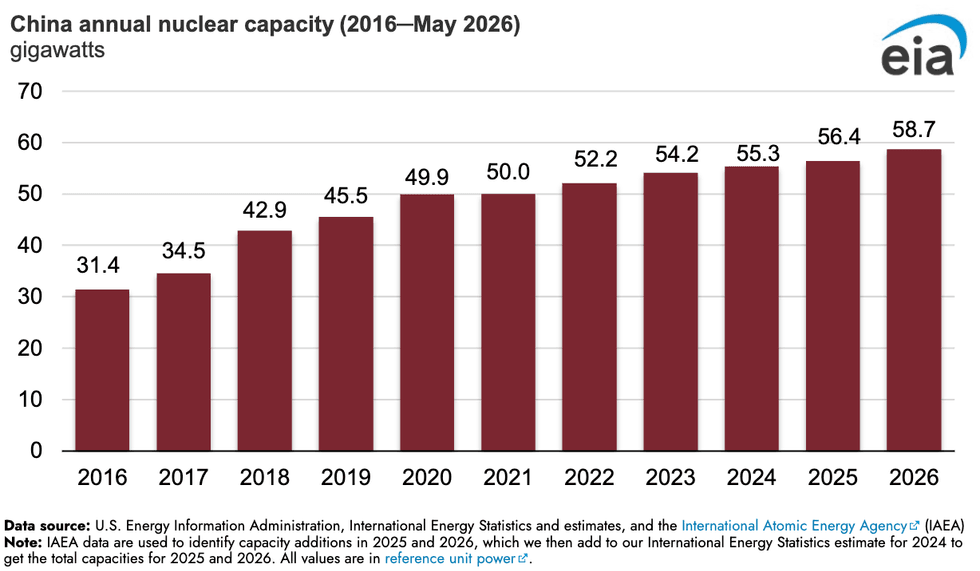 Nuclear is booming in China.EIA




 The aftermath. Prabin RANABHAT / AFP via Getty Images
 Bougainville President Ishmael Toroama.DAVID GRAY/AFP via Getty Images