You’re out of free articles.
This Halloween, get 20% off using code ADVANCED
Log in
To continue reading, log in to your account.
Create a Free Account
To unlock more free articles, please create a free account.
Sign In or Create an Account.
By continuing, you agree to the Terms of Service and acknowledge our Privacy Policy
Welcome to Heatmap
Thank you for registering with Heatmap. Climate change is one of the greatest challenges of our lives, a force reshaping our economy, our politics, and our culture. We hope to be your trusted, friendly, and insightful guide to that transformation. Please enjoy your free articles. You can check your profile here .
subscribe to get Unlimited access
Offer for a Heatmap News Unlimited Access subscription; please note that your subscription will renew automatically unless you cancel prior to renewal. Cancellation takes effect at the end of your current billing period. We will let you know in advance of any price changes. Taxes may apply. Offer terms are subject to change.
Subscribe to get unlimited Access
Hey, you are out of free articles but you are only a few clicks away from full access. Subscribe below and take advantage of our introductory offer.
subscribe to get Unlimited access
Offer for a Heatmap News Unlimited Access subscription; please note that your subscription will renew automatically unless you cancel prior to renewal. Cancellation takes effect at the end of your current billing period. We will let you know in advance of any price changes. Taxes may apply. Offer terms are subject to change.
Create Your Account
Please Enter Your Password
Forgot your password?
Please enter the email address you use for your account so we can send you a link to reset your password:
On methane rules, nuclear uprates, and Ethiopian electricity

Current conditions: For the first time, Miami’s king tide — a periodic exceptionally high tide brought by on astronomical alignment — crossed the threshold for “major” flooding without a hurricane, notching the highest level in 11 years • America’s Northern Mariana Islands are hunkering down as Typhoon In-Fa is set to brush past its northern reaches • India has evacuated tens of thousands from its eastern coast as Tropical Cyclone Arnab makes landfall.

Israelis voted in record numbers Tuesday in the first election held since the October 2023 attacks by Hamas, which ignited the ongoing multifront conflict been Israel and militias in Gaza and southern Lebanon. While Prime Minister Benjamin Netanyahu’s conservative Likud party looked projected to win the most seats in the Knesset, the opposition coalition led by centrist former military chief of staff Gadi Eisenkot appeared positioned as of Wednesday morning New York time to form an alliance that holds at least 61 of the parliament’s 120 seats — if anyone can broker a governing bloc at all. What that means for energy and climate policy in the Jewish State remains even less clear than what kind of government may form out of the election results. Eisenkot ran on cost of living, democracy, and holding Netanyahu accountable for the October 7 disaster. In 2021, he became chairman of StorageDrop, a long-duration energy storage startup based just south of Tel Aviv. At the time, he said dealing with climate change and creating green alternatives to fossil fuels was “of great importance,” and that Israel should “be at the forefront of the global effort in this field.”
Netanyahu has also supported renewables, which grew to 16% of Israel’s electricity share last year. In May, his government set a target of a more than threefold increase in renewables in the next decade. Just last week, as you may recall, the Ministry of Energy and Infrastructure put out a new plan to invest more into fusion. But his signature policy has been brokering an historic $35 million deal to drill gas offshore in the Mediterranean to sell the fuel to Egypt. While Israel has pledged to cut its economy-wide emissions 27% below 2015 levels, the State Comptroller, an independent watchdog within the government, warned in June that the country’s failure to pass a law enforcing the reductions meant it had, according to The Jerusalem Post, “still not built a functioning national system to prepare for climate change.”
President Donald Trump plans to loosen a Biden-era regulation requiring oil and gas drillers to cut emissions of methane. Speaking at a campaign rally for Texas Republican Senate hopeful Ken Paxton, Trump said he’s “officially terminating Biden’s expensive and unnecessary methane regulations to save consumers and energy producers $45 billion in costs.” The move aims to spur more gas production at a moment when, as we saw from the megamerger this week set to create the nation’s biggest gas producer, the industry is consolidating. But it comes as methane emissions in the U.S. oil and gas sector are actually flattening, despite growing production. Earlier this month, as I reported, a study by Johns Hopkins University found that “companies have built more infrastructure needed to better capture methane” and “transport it for sale as a fuel, providing a financial incentive to limit the amount escaping into the atmosphere.” But the researchers cautioned that “oil and gas production is still a large percentage of U.S. methane emissions, and we do not find any evidence that a flurry of federal legislation had an impact on emissions.”
Meanwhile, the former Biden senior climate advisor, John Podesta, has warned that passing the permitting reform bill as is could hand Trump “a loaded Howitzer,” my colleague Jael Holzman reported yesterday.
If you can’t buy an as-yet-unbuilt small modular reactor, you go for an existing large-scale technology like the Westinghouse AP1000 or the Canadian CANDU. If you can’t line up the financing for a whole new nuclear megaproject, you squeeze a little more juice out of the reactors you already have. That’s why Amazon and Google inked deals earlier this month with Constellation, the nation’s largest operator of nuclear plants, which estimates it can generate nearly 1.1 gigawatts of new power simply from “uprating” its existing plants. At the time, I called it “big tech’s nuclear hedge.” The Department of Energy is backing the bet. On Tuesday, the Office of Energy Dominance Financing announced a $5 billion loan to support the uprates. “These investments will add more reliable baseload power to the grid, help lower electricity costs, strengthen our nation’s energy security, and fuel long-term American prosperity,” EDF Director Gregory Beard said in a statement.
The U.S. is on track to rise from about 101 gigawatts of nuclear today to 111 gigawatts in 2040 and 132 gigawatts in 2050, according to Wood Mackenzie forecasts. Behind-the-meter plants, particularly for data centers, could add another 11 gigawatts in 2040 and 19 gigawatts in 2050. “If the US government, under the current administration or another pro-nuclear administration in the future, wants to accelerate the pace of that growth, building capacity in the workforce and supply chain should be an urgent priority,” Ed Crooks, Wood Mackenize’s vice chair of the Americas, wrote in a blog post.
Sign up to receive Heatmap AM in your inbox every morning:
Trump’s deal to import Russian diesel has largely been discussed for its for its potential to ease prices on the global market. But 140,000 metric tons of Russian fuel is now headed for the U.S. market. The fuel will arrive in three tankers, including one blacklisted by U.S. authorities and another by the European Union, according to the Financial Times. The shipments are the first licensed by the U.S. since Trump’s recent deal with President Vladimir Putin to exempt Russian diesel from sanctions. The goal is to achieve a perceptible reduction in costs ahead of next week’s midterm election, in which energy prices have been a major factor.
Insurance is often described as the canary in the coal mine for climate change as the industry is expected to raise prices on assets increasingly under threat from extreme weather. But the analysts tasked with assessing risk are facing pressure to downplay climate dangers in their models to help cut the price of coverage and make it easier for brokers and underwriters to sell more policies. That’s according to five whistleblowers’ testimony to the Financial Times. The United Kingdom’s Financial Conduct Authority told the newspaper the allegations were “exceptionally serious” and could amount to significant breaches of financial and prudential regulation. “Every single person I work with all say the same thing — that we shouldn’t be altering the numbers for these accounts in the way we do,” one whistleblower said.
The deadliest conflict of the 21st century is restarting in Ethiopia’s war-torn north. But in the country’s fast-industrialized capital, business is booming. Addis Ababa’s “Made in Ethiopia” initiative has spurred a manufacturing boom of 1,115 factories. As of last year, TOYO, a major U.S.-Japanese solar manufacturer, has capacity to produce 2 gigawatts of solar cells at its Ethiopian factory. Officially inaugurated last year, the Grand Ethiopian Renaissance Dam added more than 5 gigawatts of power to the grid. A new International Energy Agency report highlights how far the country has come — and how far it has yet to go. Just 12% of the country had electricity access in the early 2000s. By 2024, that figure hit 35%. But around 85 million Ethiopians remain without steady access to power. The country has a target of 75% access by 2030 and universal access by 2035. That, the IEA said, “will require continued grid expansion, greater deployment of off-grid solutions, and measures to make connections more affordable.”

This Halloween, get 20% off using code ADVANCED
Log in
To continue reading, log in to your account.
Create a Free Account
To unlock more free articles, please create a free account.
How senators voted didn’t just come down to party, ideology, or geography.
This is Heatmap Daily, a weekday digest written by our executive editor. Subscribe here.
The Senate will vote tonight on amendments to the permitting reform bill, officially known as the Bipartisan American Affordability and Jobs Act.
It will then vote on the bill itself — which only needs a bare majority to pass. The House of Representatives will then take up the bill.
The permitting bill, in other words, appears to have survived that peculiar phase of Senate process where legislation requires 60 votes to pass. (That magic number isn’t due to anything in the Constitution, but because Senate procedure technically allows unlimited and silent “debate” on a measure, and it takes a three-fifths majority to end that “debate.” Changing this is what people mean when they talk about “ending the filibuster.”)
All of this is to say that the bill’s Senate coalition might be as large now as it has ever been. Senators have now taken a handful of these 60-vote-threshold cloture votes on BAAJA, and we can see who voted for the measure last week at the beginning of the debate and who had peeled off by the end.
As we await final votes on the amendments and the bill itself, here’s some brief game-time analysis:
Almost every Republican voted yes. Since the first cloture vote on November 9, almost everyone in the Senate GOP caucus has voted in favor of the bill. Mike Rounds, the junior senator from South Dakota, is the only Republican to vote no in every roll call. Missouri’s Josh Hawley, who opposes the bill’s transmission provisions, started out voting yes but voted no today.
Democratic support has eroded somewhat. Fourteen Democrats (or those who caucus with them) never voted against the bill, while 25 have voted against it at every opportunity. The latter group includes Senators Bernie Sanders, Elizabeth Warren, Ed Markey, and Ron Wyden.
But some Democrats who started off supporting cloture on the bill peeled off as the politics have developed — or as they jockey to add amendments or shape the bill during its final passage. Senators Jon Ossoff of Georgia, Gary Peters of Michigan, and Jeanne Shaheen of New Hampshire voted yes on the initial cloture vote last week, but no on the final vote today about moving to passage. The bill contains Cathy Cortez Masto’s mining measure, and she voted yes on it for its first cloture vote, but no today. Richard Blumenthal of Connecticut and Andy Kim of New Jersey also voted no today.
There’s a surprising amount of same-state splits. BAAJA’s politics have been quite geographic at times — as Julian NoiseCat observed on Shift Key, Western senators with close tribal ties have clearly approached the law differently than those from the East Coast or Midwest — but it’s also revealed surprising splits in the Democratic caucus that don’t necessarily come down to ideology or location. Senator Raphael Warnock of Georgia voted yes on every cloture vote, for instance, but Senator Jon Ossoff started out yes and then switched to no. Senator Martin Heinrich of New Mexico helped write the bill, but his same-state colleague Senator Ben Ray Lujan voted against cloture. Arizona’s Mark Kelly is a no, but Ruben Gallego is a yes. Cory Booker in New Jersey is a yes, but his colleague Andy Kim started out yes … and then became a no.
Among Democrats, there’s something of a “new school” vs “old school” divide on how to fight climate change. I thought it was notable that Senator Brian Schatz of Hawaii, a self-described climate hawk, has evidently signaled he will vote yes on final passage, according to Josh Siegel of Punchbowl. Schatz is part of the group that once called themselves “the three climateers,” a troika of Democratic senators who worked on climate change and decarbonization through the bad old days of the 2010s. The other two members of that group? Senators Martin Heinrich and Sheldon Whitehouse, who led the Democratic side of the negotiations over this bill.
Whitehouse and Heinrich argue that this bill — because it will speed up permitting, especially for transmission lines, and put clean energy to something closer to an even footing with fossil fuels — is good for the climate. They also argue that it will allow future climate policy to go even faster. But BAAJA is also opposed by a handful of senators who have defined themselves by their support for aggressive climate policy, including Senators Ed Markey of Massachusetts and Bernie Sanders of Vermont. You could see this as a new-school climate hawk vs. old-school environmentalist fight, but the divide isn’t total. I find it interesting that Senator Tina Smith of Minnesota — an aggressive climate and clean energy advocate — says she’s “firmly opposed” to the bill because of what she worries it could mean for mining projects near the Boundary Waters Canoe Area Wilderness.
Lots more to say but we’ll leave it there for now.
The company is attempting to commercialize a novel processing method, with the help of a former NRC commissioner.
If you were born the year the United States gave up on finding a place to store its spent nuclear fuel, you’d almost be eligible to vote. Since 2009, when the Obama administration halted work on Yucca Mountain, the Nevada site designated under federal law as the nation’s first nuclear waste repository, the country has had no formal plan in place.
Russia, France, China, and Japan all reprocess highly radioactive spent fuel that comes out of reactors to extract usable materials and recycle them into more fuel. The process still leaves behind some nasty, dangerous radioisotopes that form during fission, but there remains a lot less that needs to be stored for centuries. The U.S. attempted to set up a commercial nuclear recycling industry in the 1970s, before President Jimmy Carter pulled the plug as a sop to the nonproliferation movement. No one has really attempted to invest in the industry since.
Over the past decade, a new slate of startups has promised to revive the dream — or, to some, nightmare — of recycling spent fuel. The Biden administration put up funding. The Trump administration proposed “nuclear lifecycle campuses” where recycling would be just one part of future complexes that process, enrich, and reprocess reactor fuel, and dozens of states stepped up to serve as hosts. In a sign of growing momentum, one such company formed last year in Washington, D.C., with former Nuclear Regulatory Commission Chairman Chris Hanson as its head of implementation.
Now that company, Project Omega, has taken a big step toward actually commercializing its technology, Heatmap can exclusively report. The company submitted its “letter of intent” to the NRC, giving the agency a formal heads up that it plans to submit a full application within the next few years.
“Waste is the biggest challenge in the nuclear industry,” Staff Sheehan, Project Omega’s chief executive, told me. “We exist to take the amount of nuclear waste and the hazard of that nuclear waste and drastically decrease it.”
The NRC has, over the past year, ramped up efforts to streamline and modernize its regulatory process, and has greenlit permits for new reactors in record time. But the most successful applications have largely come from companies that carried out a lot of legwork with the NRC before submitting paperwork, so that the formal documents provide answers to questions the regulators expect to ask.
Since the NRC has never permitted or licensed a commercial nuclear reprocessing facility, companies are lining up to engage with the agency early. Oklo, the Silicon Valley startup seeking to deploy its own small modular reactors and reprocess the fuel its future power stations will run on, held a “pre-application meeting” with the NRC just last month. Curio, another Washington-based company specializing in nuclear waste reprocessing, submitted its letter of intent to the NRC in May.
Reprocessing, as a concept, draws fierce opposition from nonproliferation advocates who say the technology lays the groundwork for greater production of materials for bombs. Plutonium, which is used in some of the most powerful nuclear weapons, does not occur in nature, but forms during fission. The world’s only commercial nuclear recycling facilities, such as La Hague in France or the Mayak Production Association in Russia’s Ural Mountains, rely on a technology called aqueous reprocessing, which involves dissolving spent nuclear fuel in acid, then using a solvent to separate reusable uranium and plutonium from the other waste products. What little remains is then typically put into glass through a process called vitrification, which keeps the radiation from emanating, and stored long term. But the issue for policymakers and advocates seeking to thwart the growth of the world’s nuclear arsenal is that plutonium is among the key extracted materials.
Project Omega, by contrast, is pursuing an approach called pyroprocessing. Under that technology, developed in U.S. national laboratories and pursued by Oklo as well, spent fuel is chopped up and dunked in a bath of molten salt, often heated to temperatures around 930 degrees Fahrenheit. An electrical current then separates out useful materials, such as uranium and various isotopes that can be used for medical purposes.
“You can’t separate out pure plutonium, so you don’t get any streams that are usable for weapons,” Sheehan said. “That’s a big regulatory advantage, I would say.”
The biggest disadvantage, he admitted, is that nobody has tried to do pyroprocessing at scale. La Hague in France “has been operational for 50 years or something like that.”
“The disadvantage going in with a new technology is you have to educate regulators, and you have to get them comfortable with some of the novelties about it. It hasn’t been done before,” Sheehan said. “But the advantage of using a new technology is you can do things way more efficiently, way more safely, and way more economically.
Project Omega emerged from stealth back in February. Sheehan founded the company after leaving his previous startup, Air Company, where he had invented a novel process to convert carbon dioxide into hydrocarbons and alcohols that could be used for sustainable aviation fuel. Among the early hires to the new company was Hanson, whom President Donald Trump fired from the NRC last year in a dramatic show of control over an independent federal agency.
That doesn’t mean the company has faced the Trump administration’s wrath. Since then, Project Omega has won funding from the Department of Energy to carry out work at the Idaho National Laboratory and the U.S. military to conduct research with the Pacific Northwest National Laboratory. Last week, Project Omega raised $80 million in a Series A, pitching its reprocessing facilities as “nuclear refineries for the next industrial revolution.”
“I believe Project Omega is addressing one of the most critical gaps in our nuclear industrial base,” Tommy Hendrix, general partner at the venture firm Decisive Point, which invested in the Series A, told me over email. “Omega is taking a fundamentally different approach by transforming used nuclear fuel into valuable resources for advanced reactors and long-duration power systems.”
Asked whether he would pitch his company differently to Democrats, who traditionally opposed nuclear reprocessing and will command sizable majorities in Congress next year, Sheehan swiftly answered, “Not at all.”
“They call me the climate guy in all the circles I have walked in. Whether it was the White House under the Trump administration or D or R offices in Congress,” Sheehan said. “And I have a reputation for sticking to my guns.”
Current conditions: Tropical Cyclone Xavier has strengthened into a Category 5 storm after battering the Cook Islands with winds of up to 184 miles per hour • In the Bay of Bengal, Cyclone Akvan is barreling toward India’s Andhra Pradesh just weeks after the state suffered another deadly cyclone • Today is the last day of any sunlight in Utqiaġvik, Alaska, which enters polar night until January 23.
On Tuesday afternoon, Jensen Huang, Nvidia’s disgraced founder who stepped down from his chief executive role last week amid a ballooning scandal over his extramarital affairs with multiple employees and a Chinese spy, began mounting his comeback. “Nvidia is a once-in-a-generation company,” he wrote in a post on X. “If the Board of Directors decides that my return is in the best interest of our shareholders, our employees, the company, and America, I would be honored to answer these calls and return as CEO.” A new website launched late last week, purportedly built by some of the investors and supporters who have been blowing up Huang’s phone with encouragement in recent days, calls on the board to “stand with Jensen.” When the market closed yesterday evening, Huang’s camp got yet more ammunition to bring to the battle: The company doubled its earnings in the third quarter of this year compared to the same time last year, it reported Tuesday. The chip designer reported revenue of $116 billion for the three months that ended in October, a year-over-year increase of 103%, besting Wall Street’s estimates of $109 billion. The earnings may help quell concerns over the soaring debt hyperscalers are incurring to build out data centers, which, as I wrote last month, investors worry may not pay for itself.
The company also projected that its revenue would reach $130 billion for the fourth quarter, ahead of analysts’ bets, which seemingly puts the company — which the Financial Times described as “a bellwether for the health of the AI industry” — on a solid trajectory.
If the Senate voting overwhelmingly to advance the bipartisan permitting reform bill was supposed to help put an end to the Trump administration’s targeting of the offshore wind industry, it hasn’t yet. On Tuesday, Bloomberg reported that the U.S. Army Corps of Engineers has started to reassess a permit for EDF REnewables North America’s Atlantic Shores South project, which would total as many as 200 wind turbines sited roughly 9 miles off the coast of Atlantic City. The move fits a pattern. Despite the Trump administration’s promise to ease its blockade on renewables as part of negotiations over the Bipartisan American Affordability and Jobs Act, my colleagues Jael Holzman and Emily Pontecorvo reported last month that the only projects advancing were upgrades to existing wind farms.
Speaking of Trump, on a trip to China for a trilateral summit with Chinese President Xi Jinping and Russian President Vladimir Putin, the president waved off the national anxiety piqued by a string of major network outages across the U.S., one of which being the National Security Agency’s highly classified communications channels, according to CNN. “It’s life,” he said. “When you're big and powerful and have all the money, things like that happen — it’s fine.”

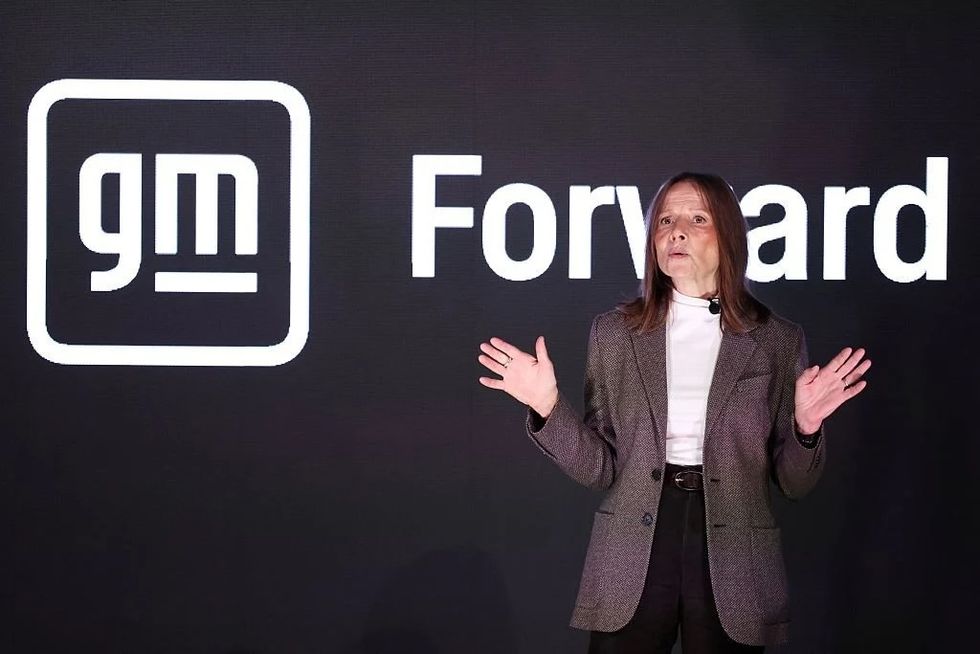
General Motors made history in December 2013 when it named Mary Barra, previously the company’s executive in charge of supply chains and human resources, as the first woman to lead one of the automotive industry’s big manufacturers. Now GM has begun the search to succeed its longest-serving leader in modern times. While the company is “eyeing a crop of internal candidates,” The Wall Street Journal reported Tuesday, it’s working with a headhunting firm to identify outside contenders. Barra herself, whose tenure is about twice that of an average chief executive at a S&P 500 company, kicked off the process months ago. Among the internal contenders, named by the Journal are “finance chief Paul Jacobson; Sterling Anderson, a high-profile Silicon Valley hire who serves as Chief Product Officer; and Mark Reuss, a 40-year GM veteran and Barra’s No. 2.”
GM’s next top dog will grapple with the company’s evolving battery business. As Heatmap contributor Andrew Moseman wrote last year, Trump’s elimination of the electric vehicle tax credit cost GM $1.6 billion. But it also gave rise to a new standalone battery business that Kurt Kelty, the former Panasonic executive and current GM battery guru, told my colleague Robinson Meyer on our Shift Key podcast, might just turn GM into an “American battery juggernaut.”
Sign up to receive Heatmap AM in your inbox every morning:
Researchers at Harvard University on Monday released a landmark study breaking down carbon emissions linked to U.S. data center operations, concluding that grid-connected data center operations were linked to more greenhouse gas pollution from May 2024 to April 2025 than the entire country of Denmark. That would be interesting on its own, and yet it’s also likely that number is a serious lowball. Gianluca Guidi, lead author of the study, told Heatmap that the research only accounted for data centers attached to the power grid, meaning it doesn’t take into account diesel generators or behind-the-meter power plants. “It does show how incomplete our understanding remains because the numbers are quite sizable and policy is quite lagging behind,” Guidi said. “We’re still struggling to imagine the environmental consequences of the infrastructure that’s already been built.” — Jael Holzman
Quaise Energy has locked down the first customer for its futuristic approach to vaporizing stone and drilling deep into hot rocks for geothermal power. Conveniently, it is also one of the deepest-pocketed and most sophisticated energy buyers on the market today. On Tuesday, The Wall Street Journal broke the news that Google has signed a power purchase agreement for 50 megawatts of electricity from Quaise’s Project Obsidian, its flagship first plant in Central Oregon and the world’s first superhot geothermal plant, operating with rocks at temperatures greater than 572 degrees Fahrenheit. The project, expected to come online as early as 2030, is on track to cost about $350 million. “Google is officially our first customer at Quaise Energy,” Kathryn Hite de Sousa, Quaise’s chief operating officer, wrote in a post on LinkedIn. “With our millimeter wave drilling technology, we are bringing superhot geothermal to commercial scale, so we can deliver always-on, zero-carbon power to the grid from anywhere on Earth.”
The market is clearly down with VPPs — in a good way. The capacity of North America’s virtual power plants grew by nearly 26% this year compared to 2025, reaching 47.2 gigawatts of behind-the-meter flexible capacity, according to a new analysis by Wood Mackenzie. “Escalating turbine costs, affordability concerns, and slow supply response to large loads are driving more interest in VPPs,” Elham Akhavan, principal analyst at the consultancy, said in a statement. Residential VPPs alone more than doubled.