You’re out of free articles.
This Halloween, get 20% off using code ADVANCED
Log in
To continue reading, log in to your account.
Create a Free Account
To unlock more free articles, please create a free account.
Sign In or Create an Account.
By continuing, you agree to the Terms of Service and acknowledge our Privacy Policy
Welcome to Heatmap
Thank you for registering with Heatmap. Climate change is one of the greatest challenges of our lives, a force reshaping our economy, our politics, and our culture. We hope to be your trusted, friendly, and insightful guide to that transformation. Please enjoy your free articles. You can check your profile here .
subscribe to get Unlimited access
Offer for a Heatmap News Unlimited Access subscription; please note that your subscription will renew automatically unless you cancel prior to renewal. Cancellation takes effect at the end of your current billing period. We will let you know in advance of any price changes. Taxes may apply. Offer terms are subject to change.
Subscribe to get unlimited Access
Hey, you are out of free articles but you are only a few clicks away from full access. Subscribe below and take advantage of our introductory offer.
subscribe to get Unlimited access
Offer for a Heatmap News Unlimited Access subscription; please note that your subscription will renew automatically unless you cancel prior to renewal. Cancellation takes effect at the end of your current billing period. We will let you know in advance of any price changes. Taxes may apply. Offer terms are subject to change.
Create Your Account
Please Enter Your Password
Forgot your password?
Please enter the email address you use for your account so we can send you a link to reset your password:
Will America be the land of opportunity for AtkinsRéalis’ tried-and-true CANDU?

Unruffled by President Trump’s taunts of turning Canada into the 51st state, Canadian Prime Minister Mark Carney has vowed to regain leverage over Washington by remaking his nation as an “energy superpower.” Instead of building pipelines from the oil fields of Alberta to American refineries, Ottawa will run them to its West Coast ports to sell crude directly to Asia. Rather than importing electricity from offshore wind farms in the American Northeast, Nova Scotia will build its own turbines and sell the power back to energy-starved New England as the Trump administration thwarts the region’s own buildout.
But Canada’s path to reviving its nuclear industry may run — counterintuitively — through the United States.
Last week, Montreal-based AtkinsRéalis inked a deal with utility Hoosier Energy and the Indiana government to explore building up to 6 gigawatts of reactors in the state. The agreement is only a memorandum of understanding to kick off a study examining potential sites across the state. But it marks the first real effort to export Canada’s unique pressurized heavy-water reactors, called CANDUs, to the U.S., and highlights how America’s domestic nuclear industry has atrophied to the point that foreign developers of large-scale units are racing to establish a beachhead in the world’s largest atomic power market.
“If the Americans had created the CANDU, everyone in the world would know about it,” Joe St. Julian, the American-born president of AtkinsRéalis, told me. “There’s just a cultural difference in the way that the Canadians go about things and the way the Americans do.”
Pronounced “CAN-do,” the upbeat acronym stands for Canada Deuterium Uranium and evokes the government’s post-war, can-do spirit, mustered to help protect its sovereignty during the bipolarity of the Cold War. Developed in the 1950s by Canadian government scientists and now used across the country’s entire nuclear fleet, CANDUs rely on deuterium, a version of hydrogen with an extra neutron, as their “heavy water” coolant to sustain their chains of split atoms. Uranium powers virtually all commercial nuclear reactors, but CANDUs are distinct in that they can run on the raw stuff, rather than enriched uranium. That’s their real advantage: By forgoing the costly and heavily scrutinized enrichment process, Canada can tap its vast resources of mined uranium without facing the bottleneck of the expensive enrichment facilities or attracting the intensive oversight of global regulators monitoring for the production of atomic weapons.
The 17 reactors that provide 15% of Canada’s electricity today are all CANDUs. India’s fleet largely borrowed the technology, and Argentina, China, Romania, and South Korea have all imported their own CANDUs. But the buildout largely stopped in the last century. Canada built its last CANDU in Romania in 2007. The last Canadian CANDU — Unit 4 of the Darlington nuclear plant in Ontario — came online in 1993.
Two years ago, Canada sought to restart its reactor buildout by commissioning its first American-designed unit. Construction began last year on the world’s first BWRX-300, a small modular reactor that uses enriched uranium as fuel. The U.S. plans to build the second version of the same reactor at the Tennessee Valley Authority’s Clinch River site. Whether it can deliver the cost savings SMRs promise remains an open question, given that nuclear developers have historically improved economics by making reactors bigger, not smaller.
But Chris Keefer, a Toronto physician-cum-nuclear advocate who hosts the in-depth energy podcast Decouple, told me he believes Canada’s real error is in benching the CANDU. While Ontario’s government-owned utility “got their backs slapped endlessly for having the courage to go first” in building the inaugural SMR on the continent, “they’re idiots to be investing $21 billion of Canadian ratepayers’ money to prop up an American company with American technology,” he said, colorfully characterizing the move as a massive error and “the result of dis-coordinated decision-making.” (Converted from loonies to U.S. dollars, that figure is about $14.9 billion.)
While Keefer added that he opposes the trade war between Washington and Ottawa, he also recognizes it as a potential opening. “Part of me loves it and this deglobalization moment we’re in, where strategic autonomy and national interest matter,” he said.
The Carney administration has yet to set clear rules on what kind of reactor technology it will support domestically, but it could, in theory, limit access to federal subsidies for provinces and utilities that opt for non-CANDU technologies. For now, however, there appears to be quiet agreement between the U.S. and Canada on bringing the technology south. St. Julian said the Canadian Ministry of Energy has been “very supportive” in talks about providing financing for CANDU exports to the U.S. AtkinsRéalis is also in talks with the U.S. Department of Energy, though a source familiar with that agency’s thinking cast doubt over the possibility that the Trump administration would ultimately fund a Canadian project in the U.S.
None of this was a part of AtkinsRéalis’ long game, St. Julian told me. “The U.S. had four or five of its own reactor technologies,” he said. “Why would it build a foreign technology?” But shortly after Trump returned to office, “We looked at it and realized the U.S. is down to a single large reactor technology: Westinghouse. The other three or four are no longer in business.”
That was the opening AtkinsRéalis needed. “The U.S. made clear it had the aspiration to build 300 new nuclear power stations,” St. Julian went on. “Between Westinghouse and new technologies coming online with SMRs, we said they couldn’t possibly reach their aspiration no matter how optimistic they are about the capacity and supply chain of first-of-a-kind technologies.”
So the company applied to the U.S. Nuclear Regulatory Commission for approval of the CANDU. In June, AtkinsRéalis sent the regulator a formal heads-up about its plans to file an application this past summer, and it expects to complete its second topical report for the NRC by the end of this month.
The CANDUs aren’t the only foreign reactors making a play in the U.S., though. Last month, South Korea unveiled a deal with the Trump administration to fund construction of up to six AP1000s and two APR1400s.
The CANDU does have some drawbacks that the APR1400 doesn’t. The same characteristics that let its reactors sustain fission using raw uranium also cause wear and tear that requires a significant refurbishment every 35 years. (Canada is already funding a campaign of repairs domestically.) And while a typical refueling outage for a light water reactor lasts up to two months and renovations ahead of a relicensing can take up to a year, the refurbishment process for a CANDU can take the unit offline for two years or more.
AtkinsRéalis declined to comment on its internal estimates of the cost of such a refurbishment, which is — among industry experts — widely criticized as costly. But St. Julian said the company believes at least two refurbishments are possible in a CANDU’s lifetime, giving each unit a 105-year lifespan. Amortizing the costs over more than a century of electricity production, not to mention the company’s experience building units all over the world, means a CANDU is “a lot less expensive” than rival technologies, he said.
“The APR1400’s biggest advantage is the Korean industrial ecosystem,” Nana Menya Ayensu, a non-resident senior fellow at the Atlantic Council who worked on energy policy in the Biden White House, told me. “But the CANDU has lots of advantages that are specific to the technology in terms of not needing enriched fuel.”
Keefer highlighted another upside he’s acutely aware of due to his day job as an emergency-room doctor: CANDUs are particularly well-suited to batch-producing “enormous amounts” of medical isotopes, such as cobalt-60, used in cancer chemotherapy and the sterilization of surgical instruments, among other uses.
The technology is certainly attracting attention. Last month, Argentina and Romania agreed to work together on more CANDU projects. Weeks later, as I reported, Poland’s state-backed nuclear developer approved a tender for a second nuclear power station, for which it’s considering the CANDU. Last week, Turkey signed an agreement with Carney to cooperate on civilian nuclear energy, putting the CANDU in contention for the country’s second atomic power station.
And earlier this month, Atlas Atomics, a startup backed by Ohio’s Republican gubernatorial candidate Vivek Ramaswamy, raised $400 million in a Series A to commercialize its own pressurized heavy water reactor, in what Keefer dubbed in his newsletter the “AmeriCANDU.”
St. Julian said the new competition shows the unique value of the CANDU. “The difference is, we’ve been doing it for 70 years, and we spent tens of millions of dollars to perfect this technology; they’re just starting,” he said. Then he cracked a half smile. “They have the benefit of being a second movement,” he added. “But, man, we have a big head start.”
This Halloween, get 20% off using code ADVANCED
Log in
To continue reading, log in to your account.
Create a Free Account
To unlock more free articles, please create a free account.
Current conditions: Tropical Cyclone Xavier has strengthened into a Category 5 storm after battering the Cook Islands with winds of up to 184 miles per hour • In the Bay of Bengal, Cyclone Akvan is barreling toward India’s Andhra Pradesh just weeks after the state suffered another deadly cyclone • Today is the last day of any sunlight in Utqiaġvik, Alaska, which enters polar night until January 23.
On Tuesday afternoon, Jensen Huang, Nvidia’s disgraced founder who stepped down from his chief executive role last week amid a ballooning scandal over his extramarital affairs with multiple employees and a Chinese spy, began mounting his comeback. “Nvidia is a once-in-a-generation company,” he wrote in a post on X. “If the Board of Directors decides that my return is in the best interest of our shareholders, our employees, the company, and America, I would be honored to answer these calls and return as CEO.” A new website launched late last week, purportedly built by some of the investors and supporters who have been blowing up Huang’s phone with encouragement in recent days, calls on the board to “stand with Jensen.” When the market closed yesterday evening, Huang’s camp got yet more ammunition to bring to the battle: The company doubled its earnings in the third quarter of this year compared to the same time last year, it reported Tuesday. The chip designer reported revenue of $116 billion for the three months that ended in October, a year-over-year increase of 103%, besting Wall Street’s estimates of $109 billion. The earnings may help quell concerns over the soaring debt hyperscalers are incurring to build out data centers, which, as I wrote last month, investors worry may not pay for itself.
The company also projected that its revenue would reach $130 billion for the fourth quarter, ahead of analysts’ bets, which seemingly puts the company — which the Financial Times described as “a bellwether for the health of the AI industry” — on a solid trajectory.
If the Senate voting overwhelmingly to advance the bipartisan permitting reform bill was supposed to help put an end to the Trump administration’s targeting of the offshore wind industry, it hasn’t yet. On Tuesday, Bloomberg reported that the U.S. Army Corps of Engineers has started to reassess a permit for EDF REnewables North America’s Atlantic Shores South project, which would total as many as 200 wind turbines sited roughly 9 miles off the coast of Atlantic City. The move fits a pattern. Despite the Trump administration’s promise to ease its blockade on renewables as part of negotiations over the Bipartisan American Affordability and Jobs Act, my colleagues Jael Holzman and Emily Pontecorvo reported last month that the only projects advancing were upgrades to existing wind farms.
Speaking of Trump, on a trip to China for a trilateral summit with Chinese President Xi Jinping and Russian President Vladimir Putin, the president waved off the national anxiety piqued by a string of major network outages across the U.S., one of which being the National Security Agency’s highly classified communications channels, according to CNN. “It’s life,” he said. “When you're big and powerful and have all the money, things like that happen — it’s fine.”

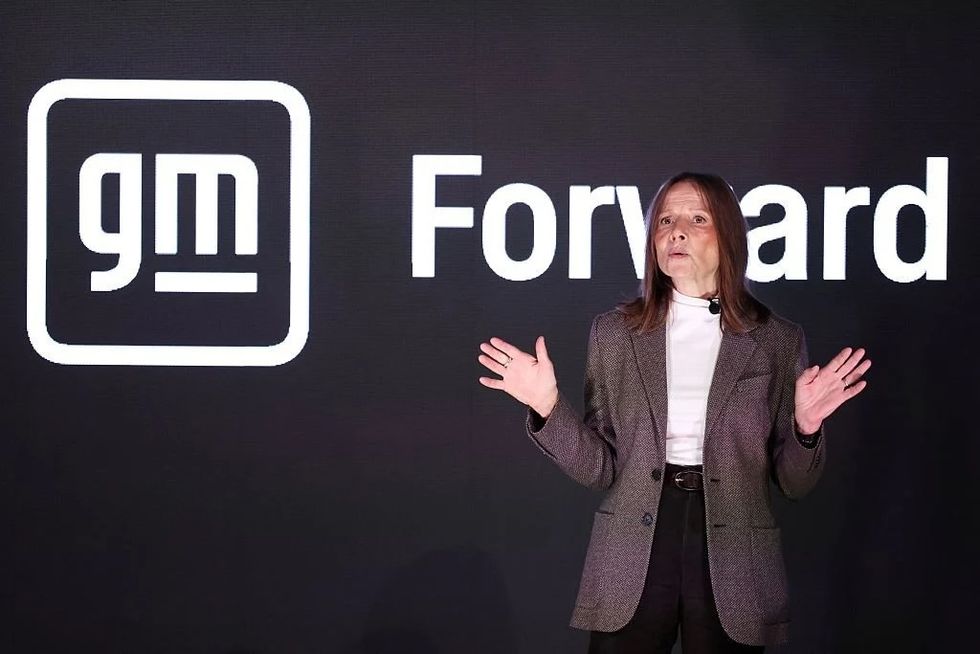
General Motors made history in December 2013 when it named Mary Barra, previously the company’s executive in charge of supply chains and human resources, as the first woman to lead one of the automotive industry’s big manufacturers. Now GM has begun the search to succeed its longest-serving leader in modern times. While the company is “eyeing a crop of internal candidates,” The Wall Street Journal reported Tuesday, it’s working with a headhunting firm to identify outside contenders. Barra herself, whose tenure is about twice that of an average chief executive at a S&P 500 company, kicked off the process months ago. Among the internal contenders, named by the Journal are “finance chief Paul Jacobson; Sterling Anderson, a high-profile Silicon Valley hire who serves as Chief Product Officer; and Mark Reuss, a 40-year GM veteran and Barra’s No. 2.”
GM’s next top dog will grapple with the company’s evolving battery business. As Heatmap contributor Andrew Moseman wrote last year, Trump’s elimination of the electric vehicle tax credit cost GM $1.6 billion. But it also gave rise to a new standalone battery business that Kurt Kelty, the former Panasonic executive and current GM battery guru, told my colleague Robinson Meyer on our Shift Key podcast, might just turn GM into an “American battery juggernaut.”
Sign up to receive Heatmap AM in your inbox every morning:
Researchers at Harvard University on Monday released a landmark study breaking down carbon emissions linked to U.S. data center operations, concluding that grid-connected data center operations were linked to more greenhouse gas pollution from May 2024 to April 2025 than the entire country of Denmark. That would be interesting on its own, and yet it’s also likely that number is a serious lowball. Gianluca Guidi, lead author of the study, told Heatmap that the research only accounted for data centers attached to the power grid, meaning it doesn’t take into account diesel generators or behind-the-meter power plants. “It does show how incomplete our understanding remains because the numbers are quite sizable and policy is quite lagging behind,” Guidi said. “We’re still struggling to imagine the environmental consequences of the infrastructure that’s already been built.” — Jael Holzman
Quaise Energy has locked down the first customer for its futuristic approach to vaporizing stone and drilling deep into hot rocks for geothermal power. Conveniently, it is also one of the deepest-pocketed and most sophisticated energy buyers on the market today. On Tuesday, The Wall Street Journal broke the news that Google has signed a power purchase agreement for 50 megawatts of electricity from Quaise’s Project Obsidian, its flagship first plant in Central Oregon and the world’s first superhot geothermal plant, operating with rocks at temperatures greater than 572 degrees Fahrenheit. The project, expected to come online as early as 2030, is on track to cost about $350 million. “Google is officially our first customer at Quaise Energy,” Kathryn Hite de Sousa, Quaise’s chief operating officer, wrote in a post on LinkedIn. “With our millimeter wave drilling technology, we are bringing superhot geothermal to commercial scale, so we can deliver always-on, zero-carbon power to the grid from anywhere on Earth.”
The market is clearly down with VPPs — in a good way. The capacity of North America’s virtual power plants grew by nearly 26% this year compared to 2025, reaching 47.2 gigawatts of behind-the-meter flexible capacity, according to a new analysis by Wood Mackenzie. “Escalating turbine costs, affordability concerns, and slow supply response to large loads are driving more interest in VPPs,” Elham Akhavan, principal analyst at the consultancy, said in a statement. Residential VPPs alone more than doubled.
Proposed changes to the National Historic Preservation Act risk disturbing the fragile relationship between the U.S. and Native governments.
In spite of some loud voices both for and against it, the Bipartisan American Affordability and Jobs Act has so far cruised through the Senate. That could change as soon as today as lawmakers begin to consider amendments ahead of a final vote.
One of the main outstanding issues is how the bill’s changes to the National Historic Preservation Act would affect tribal sovereignty. Nevada Senator Catherine Cortez Masto, a Democrat, warned before the initial motion to proceed on the proposed legislation last week that she would not vote for the final bill unless lawmakers struck that section entirely. Since then, nearly 30 Democrats have signed onto an amendment proposed by California Senator Adam Schiff that would do just that.
One of the lead authors of BAAJA, Democrat Martin Heinrich of New Mexico, has dismissed this approach, arguing it would forfeit Republican support. On Tuesday, Punchbowl News reported that Senate Indian Affairs Committee Chair Lisa Murkowski, a Republican, was working on a more targeted amendment with Democrat Brian Schatz. Republican senator Alan Armstrong of Oklahoma has also reportedly sought changes to the bill that would clarify some of the language without stripping it.
The debate over the NHPA primarily concerns a process known as a Section 106 review. Under current statute and regulations, federal agencies are required to consult with state and tribal historic preservation offices before funding or approving projects that stand to affect cultural resources such as sacred spaces, burial grounds, and ceremonial sites. Altering this process is emotionally charged because it is one of few federal mechanisms through which the U.S. government recognizes and gives shape to tribes’ sovereign status.
Proponents of permitting reform complain that the Section 106 process takes too long, however, as there are no deadlines built into either the law or the regulations designed to implement it, and the tribal offices involved often have limited financial and staff capacity. The process is especially lengthy for linear projects like power lines, pipelines, and highways, which typically cross multiple jurisdictions that each have their own preservation offices.
Consultation is not the same as the notice and comment periods that accompany most federal decisionmaking, in which the government gives the public a set amount of time to submit a response and often has a duty to explain why it did or did not incorporate the comments it received. Tribal consultation, by contrast, is “a meaningful dialogue that is intended to resolve differences,” according to Wesley Furlong, a senior staff attorney for the Native American Rights Fund, “It doesn't have to resolve them,” he said, “but the purpose of it is to try to resolve differences when possible.”
BAAJA lays out a new Section 106 review process with fewer opportunities for this dialogue and stricter time limits each step of the way. It also gives agencies broad discretion to determine that a project doesn’t have the potential to cause any effects to historic properties before conducting any public process at all, and thereby forgo NHPA review altogether.
If an agency decides a project does qualify for a review, it must put together a comprehensive report that defines the project’s “area of potential effects,” identifies historic properties within that area, and describes any adverse effects the project may have on those properties. Under the existing statute, those three activities are distinct processes that each require consultation. Under BAAJA, they would be lumped together, with a mandate for agencies to “solicit information” from tribes and tribal historic preservation offices in developing this report. Stakeholders would have just 30 days to respond.
To Furlong, this is equivalent to cutting tribes out of the process. “Generally, soliciting information from a tribe and then either incorporating it or not into a report is not consultation,” he told me.
The next step would require consultation, at least in theory. BAAJA gives agencies 60 days to complete their report, at which point they would have to “initiate consultation” with preservation offices. Tribes would then have 45 days to raise any objections to the report’s findings, but if they miss the deadline, the agency can proceed to make a determination without their participation. If there are objections, the agency would have 30 days to respond and explain how it considered them.
Alternatively, the federal government could forge an agreement with the relevant preservation offices that lays out how the project will avoid adverse effects to historic properties, but it is not required to do so. So long as the agency simply provides a response to objections, its consultation obligations “shall be considered fulfilled,” the bill says.
Even though the bill nominally requires consultation, Furlong argued, the deadlines and procedure it describes don’t support meaningful dialogue. “The idea that handing off a report in a final draft version and asking for comments on it, and then saying, ‘Well, we don't actually have to consider your comments’ — to say that that is consultation is a real affront to Indian country,” he said.
An earlier version of the bill contained a more extreme provision that would have given the Interior Department the authority to take over a tribal historic preservation office if it was out of compliance with the law — i.e. failing to meet deadlines or other required metrics. To some Native critics of the legislation, the provision echoed the termination era, a period in the 1950s and 1960s when the U.S. enacted a series of policies to roll back tribes’ rights to self-governance. The current version of the bill moves away from that, requiring the department instead to offer technical assistance and give time for tribes to come back into compliance. It does still allow the Department to take away the office’s funding, however.
To Ira Matt, the executive director of the National Association of Tribal Historic Preservation Offices, any changes made to the NHPA without tribe involvement are unacceptable. “What began as a termination-era approach of cutting tribal nations out has shifted to an assimilation-era tactic of telling us how and when we can participate, what matters to our cultures, and which harms we must accept,” he wrote in a memo to the association’s members.
Tribes generally support of permitting reform, Mayane Chavez Barudin, the executive director of the nonprofit Sovereign Energy, told me. But she told me this legislation misses the mark. “There is no doubt that tribes are understaffed, and there is a huge demand on them to be responsive to all of the different projects and different permits that need attention,” she said. “Rather than trying to work with tribes and meeting their needs, we see this as just completely sidestepping them in a very harmful way.”
The bill does authorize $200 million per year to be divided between state and tribal preservation offices, which is more than they have received in most recent years. But that is not the same as a commitment to actually appropriate that money, Furlong pointed out to me. Congress would still have to put the money into the Historic Preservation Fund every year in order for it to be made available.
The other major change the bill would make to the NHPA is that it would bar courts from issuing injunctions on projects or vacating permits if agencies do not follow the law. If a federal court found that an agency failed to consider an eligible historic site, for example, the court’s only available remedy would be to instruct the agency to correct the deficiencies on paper. It would not be able to order the agency to halt the project’s construction. BAAJA also makes the same change to the National Environmental Policy Act. Some legal scholars have argued that this change effectively renders both laws toothless, as it removes a powerful incentive to challenge agency decisions, and therefore weakens the incentive for agencies to conduct thorough reviews.
“If litigants know that courts can never grant them meaningful relief, there would be little incentive to ever bring another NEPA case,” David Tatel, a retired judge for the U.S. Court of Appeals for D.C. Circuit, wrote in a recent piece for Bloomberg Law. “And without the potential for litigation, there would be little constraint on agencies and project sponsors that would prefer not to consider environmental consequences and not to hear the public’s views.”
A group of western Democrats led by California Senator Alex Padilla have proposed an amendment to the bill that would exempt claims brought by tribal governments from this limit on judicial review under NHPA. Such a fix would be awkward, however, as it raises the question of why the same exemption shouldn’t apply to tribal NEPA claims.
BAAJA proponents argue that the Trump administration is already proposing sweeping changes to the federal regulations that govern how agencies implement the NHPA that would strip tribal consultation in more explicit ways than this bill does, and that BAAJA would protect consultation by enshrining it in law. When I put this to Furlong, he did not agree that the draft regulations were worse than what was in the bill, and noted that at least regulations could be challenged in court or changed by a future administration. “Even if this permitting reform bill was theoretically better, it will become law, and that is permanent, and the only way that can change is if Congress amends it,” he said.
To be clear, the NHPA is not the only section of the bill that critics say impinges on tribal sovereignty. “Many tribes retain off-reservation treaty-reserved rights, whether it's hunting, fishing, gathering,” Daniel Cordalis, a staff attorney at the Native America Rights Fund, told me. They rely on NEPA, the Endangered Species Act, and the Clean Water Act to assert those rights. The Clean Water Act’s Section 401 certification process, for example, enables tribes to protect their water from upstream polluters. BAAJA “significantly narrowed the way the tribes can engage in that now,” Cordalis said.
To some, the way BAAJA was negotiated violates the precarious trust between tribes and the U.S. government, regardless of what is actually in the bill. The four authors of the bill — Senators Martin Heinrich and Sheldon Whitehouse on the Democrat side, and Mike Lee and Shelley Moore Capito on the Republican side — brokered it behind closed doors, without any of the hearings, committee markups, or reports typical to the lawmaking process. An October 23 letter from dozens of indigenous-led nonprofits and their allies called the exclusion of tribes from the development of the legislation “unacceptable” and stated that “Congress should not rewrite the processes through which sovereign tribe governments defend their cultural survival without their meaningful involvement from the outset of legislative drafting.”
Despite all of this, not all indigenous-led groups are advocating for Congress to reject BAAJA. The National Tribal Energy Association and the Apsåalooke Nation/Crow Tribe both submitted letters of support for the bill. The Coalition of Large Tribes, an advocacy group representing 12 tribes with large land bases, submitted a “discussion paper” offering a series of redlines “necessary to protect tribal sovereignty.” The National Association of Tribal Historic Preservation Offices is calling for the removal of the NHPA section of the bill “so Congress can start over with a process that includes tribe consultation.”
As of now, even the more targeted fixes submitted by the Coalition of Large Tribes look unlikely. The amendment filed by Senators Murkowski and Schatz on Tuesday would make one small change, ensuring that all projects that receive federal funding go through NHPA reviews instead of just those that also require some form of federal approval.
While Murkowski suggested that the text of their amendment was still in flux, NHPA-related concerns may not constitute a real threat to the bill’s passage in the Senate. The most recent procedural vote saw 70 senators agree to advance the bill, and many of the lawmakers advocating for NHPA-related changes — Cortez-Masto, Schiff, Padilla, Mark Kelly, and others — were not among them.

Now the question is, how many of them are actually good?
I am, I confess, a bit of a climate media skeptic.
The literary sub-genre of “cli-fi” has become so bogged down by tropes that even the judges of a prize for the best climate fiction of the year made reading the contenders sound like a slog. (“So many small groups of humans roaming a post-apocalyptic landscape,” bemoaned one adjacent novelist.) On TV, climate protagonists frequently serve as mouthpieces for big ideas, backgrounded by cartoonishly greedy capitalists and bad CGI. At least watching a disaster movie, you get to enjoy the spectacle of a firenado taking out the Golden Gate Bridge before sitting through a moralizing speech at the end about “coming together” and “protecting the planet.”
My skepticism about Hollywood’s penchant for turning liberal consensus causes into “important,” “urgent,” and narratively and artistically hollow products is part of why I still haven’t seen the marquee climate movie of the year, Digger. (Having a 13-month-old is, admittedly, the other part). But there is no denying that climate movies are having a moment: Spotlight director Tom McCarthy’s adaptation of Nathaniel Rich’s book Losing Earth, A Statement, is due out early next year, and premiered this fall at festivals to generally positive reviews (though a trio of adjectives from The Daily Beast suggests it hasn’t entirely escaped the pitfalls of the genre, with the outlet’s critic calling it “preachy, humorless, and unenlightening”).
“Five years ago, I could not have imagined that back-to-back, with that level of talent and that level of investment,” Bruno Olmedo Quiroga, the director of strategy at Good Energy, a nonprofit consultancy that supports climate change narratives on screen, told me of the double-whammy of Digger and A Statement coming out within six months of each other. “That is really amazing.” Heck, climate change even made it into Coyote vs. Acme as a plot point.
It’s not just vibes — data supports the uptick. In collaboration with the USC Norman Lear Center, Good Energy on Tuesday released its latest report about the portrayal of climate change on screen. In it, the researchers found that “climate-inclusive” films and television — that is, scripts that included one or more of 36 keywords or phrases that include “fracking,” “save the planet,” “carbon dioxide,” and “sea level” — increased from appearing in 2.8% of all English-language scripts aired from 2016 to 2020 to 3.2% of all scripts from 2021 to 2024, the latest year of data available.
“Let’s be honest, it’s still a modest number,” Olmedo Quiroga said. “But the rate of change” — 14% over five years — “is significant.”
In addition to the updated frequency analysis of the original set of keywords, the USC and Good Energy researchers broadened their keyword range to capture what they describe as a “wider vocabulary of the ways climate shows up on screen.” Those results, which added an additional 69 keywords including “air pollution,” “heat pump,” “Greta Thunberg,” and “vegetarian,” appeared in 4,992 of the 35,120 scripts that aired from 2021 to 2024 — about one in seven scripts. “We can actually see how it is that writers are reflecting the actual experience of living in a world where climate change touches every aspect of our lives,” Olmedo Quiroga explained.
He offered another example. In the original analysis of scripts that aired between 2016 and 2020, 10% of the movies and episodes that included the word “climate change” also included some kind of extreme weather event. In the latest study, the number of scripts that included the word “climate change” and an extreme weather event dropped to 7%. “At first, we were very concerned about that data,” Olmedo Quiroga said. “But as I layer my interpretation of it, I’m thinking, How is it that climate change is growing but extreme weather events are decreasing in the presence of climate change? And I think it’s because storytellers are diversifying climate stories.”
In other words, climate change is no longer just an explanation offered by an ignored and bespectacled scientist for why Afghanistan has frozen solid, or why a cargo ship is drifting down New York’s Fifth Avenue, but also the reason why people are showing up in the ER with heat stroke in The Pitt — even if “climate change” doesn’t actually appear in that script in so many words. (The study also breaks out 100 films for a closer narrative analysis to account for when climate change is referenced as, say, a joke, or for something like Landman, which disparages renewable energy resources.)
My recent examples also don’t appear in the new study, which only runs through 2024, and therefore doesn’t offer the most current picture. That excludes, off the top of my head, the data center plot of Eddington, the reveal at the end of Bugonia, and the furry subplot that unfolds in Dr. Robby’s ER. The report also doesn’t account for the quality of a story, a potential shortcoming I raised with Olmedo Quiroga, given the divisiveness over Digger. After all, what’s the good of having climate stories on screen if they mostly, as I contend, suck?
“This idea that climate stories are too moralizing and this and that — it is not a climate-specific issue,” he pushed back. “I think every time a storyteller tries to tell a story about something that is systemic, that matters, you run into the same issue and the same risk.” Love it or hate it, Digger is “not forgettable,” he argued, and even as a “quote-unquote ‘box office failure,’ as people are saying online, it still reached more people in box office than the most-watched climate documentary ever,” An Inconvenient Truth. (Approximately 4 million people saw Al Gore’s documentary during its original theatrical run; exact numbers have not been released for Digger.)
To that point, Good Energy’s report doesn’t capture some of the exciting things happening in tandem in the documentary space. I recently enjoyed Gasland director Josh Fox’s latest, The Welcome Table; John Wilson danced around the environmental implications of his subject matter in The History of Concrete, which sold out nearly every night at my local theater; and I’m especially hopeful that Weather Under Fire, which Yale Climate Connections’ Jeff Masters described as “the best climate change documentary I’ve ever seen,” gets picked up by festivals next year.
Maybe I’m also missing the point by focusing on movies that don’t make me want to bash my head against a wall with their familiar dystopias, their obvious metaphors, or their kumbaya final notes about community and mutual aid. Olmedo Quiroga pointed me to research that suggests a heat wave storyline without direct mention of climate change doesn’t actually increase support for climate-related policies.
Then again: So what?
To me, the bigger takeaway from the Good Energy and Norman Lear Center report isn’t just that we’re telling more climate stories than ever before; without subjective or critical analysis, it’s not even clear that we’re necessarily telling better ones. Rather, it seems that “climate,” in all that word now encompasses and means, touches everything more and more, including in the imagined lives of fictional characters. A heat wave or a smoke event or an EV aren’t even necessarily key tells of a “climate movie”; they’re just how we live now. A cool car might just be a cool car; the appearance of a passive house is not some treatise on how we should all live, it’s also just really funny.
“Climate change reaches us in every aspect of our lives,” Olmedo Quiroga said, declining to get into the merits of one film or another and taking the big picture view. “Why decide that one story is better than another?”