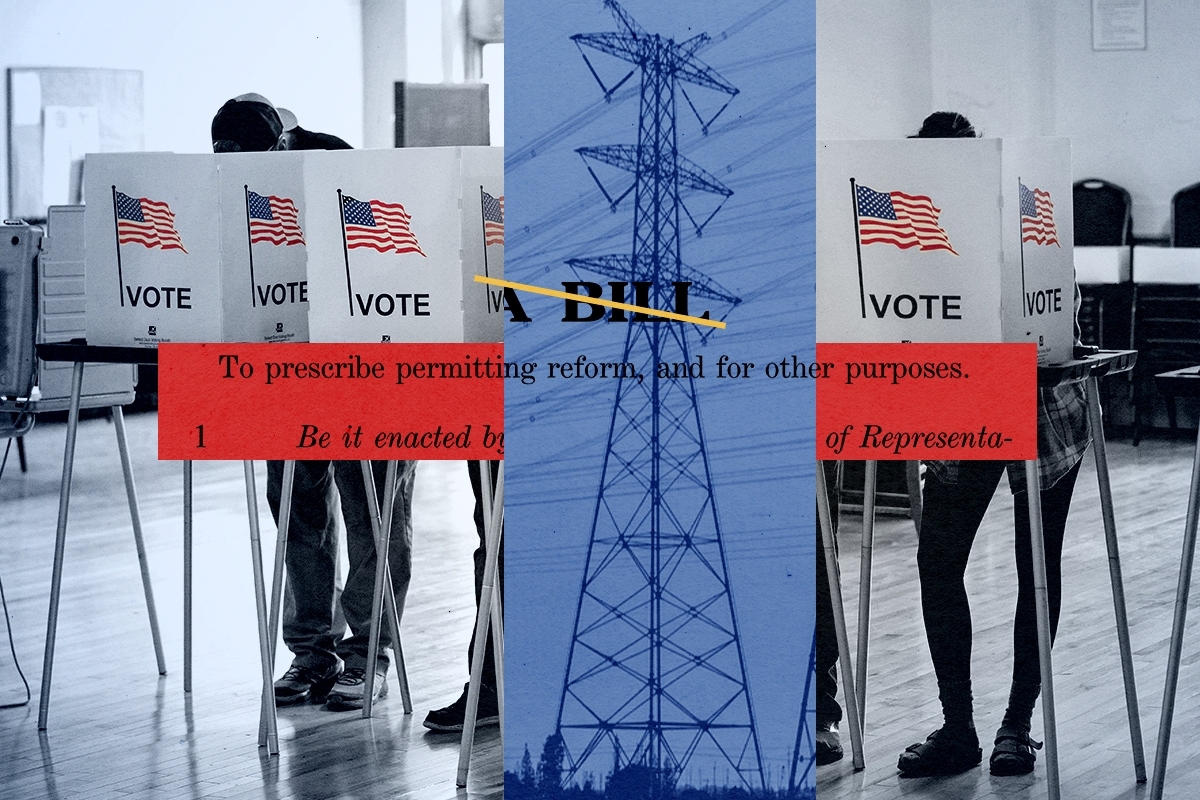
But the newest result beggared belief: 75% of Americans now said they would oppose a data center in their town. Most would strongly oppose it. When was the last time, I thought, that 75% of Americans agreed about anything? Was this real?
Sure looks like it. As Michigan’s newest senator-elect Abdul El-Sayed said earlier this year: People really effing hate data centers. And they apparently really hate Donald Trump, too, and the Iran War, and higher gas prices.
On Tuesday night, Democrats … well, pick your synonym. They routed Republicans. Annihilated them. Crushed them, broke them, and heard the lamentations of their donors. Democrats captured at least 54 seats in the Senate and could take more than 260 seats in the House. The national House vote snapped more than 15 points in their favor, and key demographic groups whose preferences have defined the Trump era — such as Hispanics, young men, and white voters without a college degree — all swung in the double digits to Democrats.
For millennials like me, the wave elections par excellence have been 2006, when liberals took back Congress from a desperately unpopular George W. Bush, and 2010, when the Tea Party caroused against Barack Obama. This election was bigger than either, on par with the anti-Watergate tsunami of 1974 that shaped the Democratic Party for a generation and put a new class of professional-minded reformers at its helm. Unlike in 1974, though, the new Democratic majority will not rely on an old guard of state’s rights conservatives. The South turned indigo on Tuesday night, it’s true, but that was thanks to the normal politics of booming American cities and suburbs, not century-old polarization left over from the Civil War. This is a new kind of Democratic mega-majority.
It will usher in a new kind of energy and climate politics. From the moment he rode down the escalator 11 years ago, Donald Trump has defined himself by his climate change denial. His antipathy for decarbonization and clean energy reached new heights in his second term, as his administration waged a war on renewables and dismantled the government’s already-weak ability to regulate greenhouse gas pollution. At the same time, it embraced the artificial intelligence boom and gave some of the world’s wealthiest companies a blank check to pollute.
Now that is all over. Although Trump still has two years left in the White House, he will limp to 2029 without a pliant Congress, a supportive public, or an aura of invincibility. We should, to be sure, expect at least a few Cabinet resignations in the next few weeks, so the expiring GOP Senate can confirm their replacements; and federal agencies will still roll their regulatory agendas uphill in case the GOP wins the White House in 2028. Some Trump policies — like his nuclear plan — may even meet with Democratic approval. But the administration’s fossil fuel revolution is over. And everything that Trump has done on climate and energy since taking office, especially his family’s penetration of favored mining firms, will soon face scrutiny in the new year.
That will all be good for the fight against climate change. And yet it would be wrong to presume that this new era will look like the last one — or that these new congressional Democrats will be Green New Dealers or even ardent environmentalists. “We cannot change anything unless we accept it,” Jung wrote, and Democrats have finally overturned Trumpism in part by accepting its real force in American politics. I don’t mean their willingness to accept Trump’s conduct, to be clear: The No Kings rallies and the Minneapolis rebellion saw to that. But since Kamala Harris lost, Democrats have for the first time treated Trump as a normal Republican opponent — and their fight against him not as a “battle for the soul of the nation,” as President Biden liked to put it, but as a simple verdict on a powerful establishment politician.
That has meant learning from Trump, and from his energy and affordability politics in particular. Chief among those lessons: Voters really, really care about low prices; they especially really, really care about cheap energy; and they will reward politicians who share their concerns. Zohran Mamdani, Mikie Sherill, and Abigail Spanberger pioneered these appeals last year, playing down their respective climate goals and (in Sherill’s case) running on cheaper power bills. State and congressional Democrats in 2026 picked up that strategy and ran with it.
They had help. Inexplicably, Trump undercut his promises to start no new foreign wars and cut energy bills in half by launching a new Iran war that nearly doubled some energy prices. By one estimate, Americans have paid more than $100 billion in higher fuel costs since March. Trump’s compact with voters broke in that moment. Tuesday is the result.
Democrats know it. Look at Annie Andrews, for instance, the new Democratic senator from South Carolina (!). She wants to “suspend the gas tax, unleash American energy, and get gas prices down” — in other words, she seeks to cut taxes on fossil fuels. But Andrews also wants to restore the solar and wind tax credits and increase public transit spending. And she devotes an entire paragraph of her policy brochure to the need for bipartisan permitting reform.
What distinguishes Andrews isn’t her toughness on fossil fuels, but her opposition to data centers. She wants a two-year nationwide moratorium on the facilities, to end their tax breaks, and force them to stop passing on higher electricity costs to ratepayers. Almost every single Senate Democrat who won on Tuesday, in fact, promised to make data centers pay for their full cost of electricity service — it might be the caucus’s most unifying policy. (The bipartisan permitting bill, whose fate remains uncertain as of writing, would mandate it.)
Much like Andrews, this new class of congressional Democrats sought to embrace every kind of energy source except for coal. Senator-elect James Talarico, a Democrat of Texas — get used to saying that — promised voters that “we can add to our hundreds of thousands of oil, gas, wind, solar, and battery jobs by creating new jobs” in geothermal and hydrogen. Mary Peltola, who seems likely to clinch her Alaska Senate race, argued for oil and gas’s ongoing importance, too. Adam Hamilton of Kansas, Scott Colom of Mississippi, and Andrews of South Carolina all spoke of their “all of the above” energy policy. None of these candidates are climate deniers — they all want to restore the wind and solar tax credits, and many spoke of increasing climate resilience funding — but they all have vowed to grow the energy system, not revolutionize it. Even Abdul El-Sayed, who wrote a 2019 Guardian op-ed advocating for the Green New Deal, disavowed that policy and opposed a government EV mandate.
The new state-level Democrats will push the party even further in this direction. Had Talarico alone won in Texas, he might have been able to walk a careful line on fossil fuels, recognizing oil and gas as the status quo without seeking to expand their reach. But Gina Hinojosa will also be the state’s next governor, with a much more direct role in managing the Permian Basin. To keep her job, she will have to accept that Texans' livelihoods depend on oil and gas, in the same way that Mamdani has had to recognize the reality of Wall Street's centrality to the economy of New York City. Democrats will face tough trade-offs.
They also won’t be any more radical about the 10% of U.S. emissions that come from American agriculture. If the Democrat Scott Colom holds out and wins Mississippi’s senate seat, it will be in no small part thanks to a viral commercial chiding the Republican incumbent for telling voters to choose a cheaper protein than beef. “Pick another protein?” an everyman griller asked the camera. “I’d rather pick another senator instead.”
This is one reason why Tuesday’s victory might feel a smidge bittersweet for some climate defenders. Democrats have finally trounced Trumpism at the ballot box. Progressives like El-Sayed have shown they can win in battleground states, provided a favorable national environment, and moderates have stormed the heart of MAGA America.
But doing so required everyone, liberals and progressives alike, to articulate more moderate views on energy and climate policy. As recently as 2020, belief in the climate crisis unified the Biden coalition. Now, Democrats have tacitly accepted — as a price of winning big majorities — some cognitive dissonance between what they think the science says (that climate change is an urgent and worsening problem) and what domestic politics demands (that voters still care more about cheap energy).
In other words, more than just the Trump era ended on Tuesday. The old Obama dream finally died too. In the wake of the 2012 election, Democrats dreamed of a permanent progressive majority shorn of right-leaning white voters. Now they have built a new congressional coalition with energy moderates at its core.
Which is not to say that Democrats will give up on decarbonizing the economy. We can expect this new congressional class to expand clean energy, push for more transmission lines, and revive electric vehicle subsidies as a solution to high gas prices. Senator Jon Ossoff of Georgia, who won one of the night’s most convincing victories, repeatedly mentioned microplastics and “forever chemicals” in his speeches, linking the contamination of human bodies to the corruption of the body politic. The fight against conventional air and water pollution, I suspect, will come back big.
The next era of American climate politics, in other words, will look different from the last one. Fossil fuel companies have long been climate advocates’ primary foil. At the national level, data centers and Big Tech could eclipse them. At least one former climate activist won on Tuesday by running against data centers and large-scale solar. Artificial intelligence, after all, is the country’s fastest growing form of industrial energy use, and it creates far fewer jobs than a chip fab or steel mill. For these reasons, you can imagine a kind of reformed normie environmentalism with anti-AI characteristics taking root in the next administration. Perhaps it already has.
Decarbonizing the economy is steady and long-term work, “a slow boring of hard boards,” to quote the political thinker Max Weber, and the politicians who next turn the screws hardest may not sit on Capitol Hill. The historic size of Tuesday’s swell means Democrats won key state offices that they haven’t held in a generation — on public utility commissions, fossil fuel regulators, and in state legislatures. They will be eager to wield their powers. With its new Democratic trifecta, for instance, Pennsylvania could allow community solar, mandate battery storage, and restrict utility profits. Decades of low-hanging climate policy will soon be plucked.
Amid all of this excitement, Democrats should keep failure in mind — the president’s and their own. Since 2020, Democrats have tried to revolutionize the energy system, reindustrialize the country, and overhaul the economy without recognizing the existence of any trade-offs between those goals. They failed, and voters hated it. President Trump and Republicans tried to reinthrone fossil fuels, give birth to a “superior intelligence,” and otherwise bring back a gloomy spoof of the midcentury American economy — without accepting any trade-offs. They failed too, and as we learned last night, voters hated them even more than they hated Biden.
The United States really does need to get better at commercializing batteries and making electric vehicles; it really must cut pollution, lower energy prices, and significantly boost its electricity generation. Both parties have failed to make progress on those goals so far. Democrats have shown they can learn from Donald Trump’s mistakes. Now we’ll see if they can learn from their own, too.