You’re out of free articles.
Log in
To continue reading, log in to your account.
Create a Free Account
To unlock more free articles, please create a free account.
Sign In or Create an Account.
By continuing, you agree to the Terms of Service and acknowledge our Privacy Policy
Welcome to Heatmap
Thank you for registering with Heatmap. Climate change is one of the greatest challenges of our lives, a force reshaping our economy, our politics, and our culture. We hope to be your trusted, friendly, and insightful guide to that transformation. Please enjoy your free articles. You can check your profile here .
subscribe to get Unlimited access
Offer for a Heatmap News Unlimited Access subscription; please note that your subscription will renew automatically unless you cancel prior to renewal. Cancellation takes effect at the end of your current billing period. We will let you know in advance of any price changes. Taxes may apply. Offer terms are subject to change.
Subscribe to get unlimited Access
Hey, you are out of free articles but you are only a few clicks away from full access. Subscribe below and take advantage of our introductory offer.
subscribe to get Unlimited access
Offer for a Heatmap News Unlimited Access subscription; please note that your subscription will renew automatically unless you cancel prior to renewal. Cancellation takes effect at the end of your current billing period. We will let you know in advance of any price changes. Taxes may apply. Offer terms are subject to change.
Create Your Account
Please Enter Your Password
Forgot your password?
Please enter the email address you use for your account so we can send you a link to reset your password:
On EPA’s microplastics push, Puerto Rican solar, and Jonathan the tortoise

Current conditions: Heavy thunderstorms are pummeling the central United States with rain through the weekend • Once Good Friday’s rainclouds clear over Vatican City, the Catholic capital is set for sun and 70-degree Fahrenheit temperatures on Easter Sunday • Just days after Cyclone Narelle turned the skies over Western Australia blood red, the country is bracing for another storm brewing in the Coral Sea that could make landfall on the Christian holiday.
The Environmental Protection Agency vowed Thursday to attempt to lower the levels of microplastics and pharmaceuticals in the drinking water of hundreds of millions of Americans. At a press conference, EPA Administrator Lee Zeldin said his agency would propose adding both categories to a list of priority pollutants, a move that could free up more federal research dollars for examining how the substances get into the environment, how they harm human health, and what treatment solutions exist for contaminated reservoirs. The effort could lead to what The New York Times called “costly new standards that water utilities would need to meet.” But the environmental litigators at Earthjustice dismissed the announcement as “a PR stunt that doesn't require a single test, set a single drinking water standard, or protect a single community.”
Critics of plastic pollution point to the groundswell of new single-use materials made from petrochemicals, which have been some of the fastest-growing divisions within major oil companies.
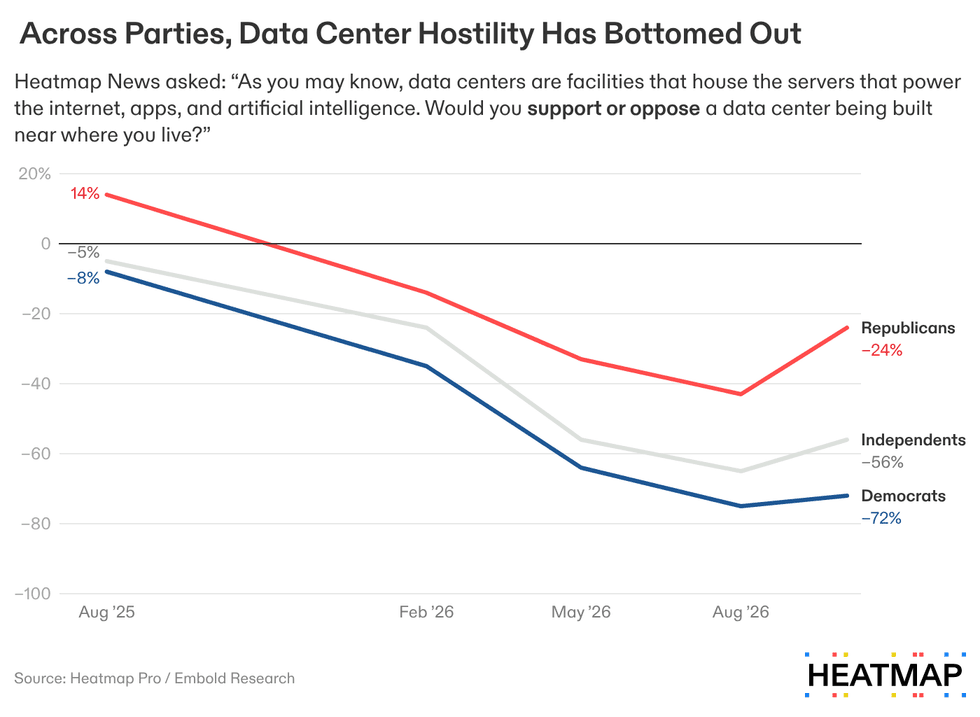
Maine is one of the last states to maintain a ban on nuclear reactors, and its voters sided with local fossil fuel producers just a few years to block construction of a power line connecting New England’s grid to Quebec’s hydroelectric system. Now the state is poised to freeze construction of large data centers. A new bill would put a moratorium in place until November 2027, so the state can assess the impact the artificial intelligence boom is having on its environment and the power grid. The freeze would apply to data centers of at least 20 megawatts, which The Wall Street Journal noted was enough to power more than 15,000 homes. The legislation picked up a few Republican votes when it passed a floor vote last month in the Democratic-controlled Maine House of Representatives. Governor Janet Mills, a Democrat running for U.S. Senate, has endorsed the bill.
Overall, Maine saw a nearly 60% spike in the total cost of electricity bills between 2021 and 2026, according to data from Heatmap and the Massachusetts Institute of Technology’s new Electricity Price Hub. With Maine’s Senate race captivating Democrats amid Mills’ showdown with left-wing populist Graham Platner, it’s worth remembering that, as Heatmap’s Jael Holzman wrote last November, the “data center backlash is swallowing American politics.”
Get Heatmap AM directly in your inbox every morning:
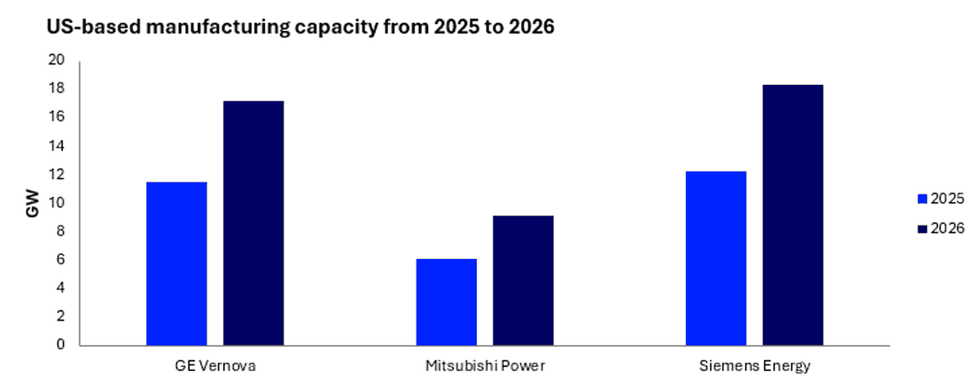
You know that demand for gas turbines to power data centers and power plants is so high that manufacturers are backordered through the end of the decade. Let me put a price on that supply and demand mismatch for you. New data from the consultancy Wood Mackenzie shows that turbine prices are headed to $600 per kilowatt by the end of next year. That’s up 195% since 2019. Global orders today sit at 110 gigawatts as of the end of 2025, but global manufacturing capacity is only capable of about 65 gigawatts. But as this chart shows and Heatmap’s Matthew Zeitlin predicted would happen last year, U.S.-based manufacturing capacity is expanding:

Sign up to receive Heatmap AM in your inbox every morning:
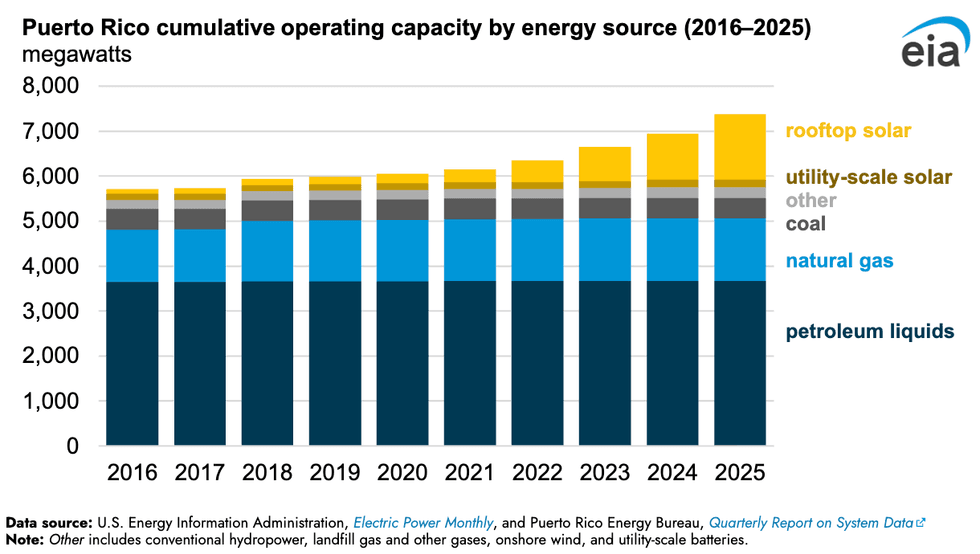
Puerto Rico’s grid is a disaster. When Governor Jenniffer González Colón, a pro-statehood Republican, took power earlier this year, one of her first moves was to extend the life of the island’s lone coal plant and step up efforts to get more gas infrastructure operating in America’s most populous territory. But one bright spot has been rooftop solar, as thousands of Puerto Ricans — frustrated by weekly if not daily outages and bleeding dry from the cost of keeping diesel generators fueled — install solar panels on their roofs. A virtual power plant set up to tap many of those systems is already making a big impact. And new data from the Energy Information Administration shows why. Rooftop solar made up 81% of all new generating capacity installation in Puerto Rico between 2016 and 2025, totaling 1,456 megawatts:

Commonwealth Fusion Systems, a spinout from MIT, is considered the top fusion startup racing to commercialize the holy grail of clean energy in the U.S., raising more money than any other firm in the space so far. Now the company is teaming up with another fusion startup, Realta, which is looking to make small, scalable reactors. Both startups vowed to work together in a strategic partnership on the design and manufacturing of high-temperature conducting magnets. “This partnership allows Realta to tap into the world-class supply chain we built to support our advanced manufacturing capabilities, and that will help it to bring commercial fusion energy to the grid faster,” Commonwealth Fusion Systems CEO and co-founder Bob Mumgaard said in a statement. In an interview with Axios, Rick Needham, Commonwealth’s chief commercial officer, said the Iran War “really does open the world’s eyes to what could be a solution that doesn’t rely on those geopolitically fraught supply chains.”
U.S. companies are also facing more competition. As I told you last year, China is now outspending the entire world on fusion — right as, as Heatmap’s Katie Brigham put it two years ago, “it is possibly, finally, almost time” for the energy source to become a real thing.

Reports of Jonathan the tortoise’s death have been greatly exaggerated. An account on X that was impersonating Joe Hollins, the veterinarian who serves the world’s oldest land animal, claimed on Wednesday that the giant tortoise had died at age 193. But the real Joe Hollins told USA Today: “Jonathan the tortoise is very much alive. I believe on X the person purporting to be me is asking for crypto donations, so it’s not even an April Fool joke. It’s a con.” May Jonathan survive to see the rapid evolution of even more new kinds of online hucksters.
Log in
To continue reading, log in to your account.
Create a Free Account
To unlock more free articles, please create a free account.
On offshore mining, New Jersey’s offshore wind, and China’s oil breakthrough
Current conditions: Severe thunderstorms are pummeling the Mississippi Valley, particularly in Arkansas • Heavy rain has deluged much of the Somali capital of Mogadishu • Temperatures in the northern Indian state of Uttar Pradesh are reaching 110 degrees Fahrenheit.

Let’s, for a moment, recast The Simpsons’ role in nuclear energy discourse. Rather than fearmongering with a pseudoscientific depiction of fission energy, imagine if that sign in the scene from the opening credits that reads “days without an accident” instead tracked how long it’s been since the United States started work on building newer, sleeker, and more efficient reactors. Until last week, the sign would have clocked 4,539 days — 13 years since construction began on the AP1000 reactor known as Plant Vogtle’s Unit 4. But last Friday, the next-generation reactor startup Kairos Power broke ground on its demonstration plant in Tennessee. Then this week, the Bill Gates-founded reactor company TerraPower started construction on its debut power plant in Wyoming. “This isn’t a test reactor,” Chris Levesque, president and chief executive of TerraPower, told The Wall Street Journal. “This is a grid-scale nuclear reactor that will be built in 42 months.” While there’s plenty of ambition to build more reactors in the U.S., the country has a very, very long way to go to even catch up with China’s actual construction output.
California won’t be the site of any new plants anytime soon, at least until the state lifts its legislative ban on building new reactors. But keeping the state’s last operating nuclear station, Diablo Canyon, running from 2030 to 2045 could offer net savings of capital and operating costs totaling more than $7.6 billion, or more than $500 million per year of continued operations, according to a new analysis by the Massachusetts Institute of Technology’s Center for Energy and Environmental Policy Research. The savings “more than double when calculated relative to the current portfolio of alternatives mandated” in a state bill that lays out the renewable energy options for meeting Sacramento’s 2045 climate goals. “In that case,” the report states, “the total present value of savings for extending the life of” the plant “exceeds $20 billion, or more than $1.3 billion per year.”
If the Trump administration achieves its goal of siring a nuclear renaissance, we’re going to need a lot more reactor fuel than we currently have available. Much of that supply has come in recent years from Russia, but a U.S. law will fully ban imports in 2028. Both the Biden and Trump administrations have lavished funding on fuel enrichers. But on Thursday, the Department of Energy tapped a new tool: the Defense Production Act, the once-obscure Korean War-era statute that gives the federal government more powers to direct manufacturing. Under a newly launched Nuclear Fuel Cycle Consortium, the agency assembled representatives of more than 90 companies in the nuclear industrial base to “address all facets of the nuclear fuel supply chain including milling, conversion, enrichment, deconversion, fabrication, recycling, and reprocessing.” The Energy Department also kicked off a campaign it’s calling “Nuclear Dominance — 3 by 33.” The program aims by 2033 to “catalyze a secure and cost competitive domestic fuel supply chain,” speed up deployment of advanced reactors and reprocessing facilities, and find ways to use the DPA to speed up the buildout.
Get Heatmap AM directly in your inbox every morning:
The Department of the Interior is creating a new office called the Marine Minerals Administration to manage oil drilling and seabed mining in America’s territorial waters. The new office, formed by reunifying two offices that had been split up after the 2010 Deepwater Horizon oil spill, threatens to weaken the environmental oversight of both the traditional oil and gas industry and the emerging mining sector. The move is “worrisome because it has the potential of bringing things back where they were, where there was this inherent conflict of interest between promotion of offshore oil and gas, and oversight safety,” Donald Boesch, emeritus professor at the University of Maryland Center for Environmental Science, told The New York Times. On Wednesday, Secretary of the Interior Doug Burgum said “these unification efforts will streamline bureaucracy.”
Sign up to receive Heatmap AM in your inbox every morning:
The New Jersey Board of Public Utilities has canceled the agreement it reached with PJM Interconnection in 2021 to develop wires and substations needed to send electricity from offshore wind turbines across the state. The board terminated the deal, Heatmap’s Jael Holzman wrote, “because much of New Jersey’s expected offshore wind capacity has either been canceled by developers or indefinitely stalled by President Donald Trump.” Despite soaring electricity prices, “New Jersey is now facing a situation in which there will be no identified, large-scale in-state generation projects under active development that can make use of [the agreement] on the timeline the state and PJM initially envisioned,” the board wrote in a letter to PJM requesting termination of the agreement. Newly-inaugurated Governor Mikie Sherrill has vowed to build new nuclear capacity in the state. As I wrote earlier this month, New Jersey became the latest state to lift its ban on new atomic energy plants.
Heatmap House kicked off San Francisco Climate Week with a day of conversations and roundtables with leading policymakers, executives, and investors. Two talks in particular are worth highlighting.
China is going all in on hydrogen as Beijing seeks ways to free itself from imported fossil fuels. Now the Dalian Institute of Chemical Physics has announced a facility in Xinjiang to use 1.5 gigawatts of wind power to produce green hydrogen mixed with an engineered material in a slurry bed reactor to transform solid asphalt into synthetic crude oil. If successful, the new process would allow China to import heavy oil and asphalt very cheaply from Central Asia and convert it into crude oil, the technology blogger TP Huang wrote on X, adding: “China is continuing work to turn crap into useful energy source by applying green electricity derivatives in its bid for energy independence.”
Co-founder Mateo Jaramillo described how the startup’s iron-air battery could help address the data center boom — and the energy transition
Well before the introduction of ChatGPT and Claude, Ireland underwent a data center construction boom similar to the one the U.S. is experiencing today.
That makes it a fitting location for Form Energy’s first project outside the U.S. Mateo Jaramillo, the CEO of the long-duration energy storage startup, described Ireland as “a postcard from the future” at Heatmap House, a day of conversations and roundtables with leading policymakers, executives, and investors at San Francisco Climate Week.
In a one-on-one interview with Robinson Meyer, Jaramillo went on to explain the potential of a 100-hour battery, calling it the duration at which you can “functionally replace thermal resources on the grid or compete with them.” Such storage capacity would not only bolster data centers’ power reliability but also speed up the transition from oil and gas to renewables.
Form Energy, which Jaramillo co-founded in 2017, is best known for its iron-air battery that can continuously discharge energy for 100 hours. In February, the startup announced a partnership with Google and the utility Xcel Energy to build the highest-capacity battery in the world, capable of storing 30 gigawatt-hours of energy, as Heatmap’s Katie Brigham reported.
Despite the troublesome state of renewables deployment in the U.S., energy storage firms like Form appear to be doing well, thanks to record load growth. “When we founded the company, we didn’t anticipate the boom of data center demand that we’re currently experiencing,” said Jaramillo. “But we did bet on the overall mega-trend being pretty firmly in place, which is electricity growth.”
In addition to load growth, battery manufacturers are still benefiting from the Inflation Reduction Act’s energy storage tax credits, which survived the deep cuts Republicans made to the signature climate law last summer. Jaramillo noted that customers can still claim a tax credit for purchasing energy systems, while a manufacturing protection credit also remains in place. “We absolutely qualify for both those things,” Jaramillo said. “In fact, 100 hours as a duration is written into the legislative text for the manufacturing [tax credit].”
Though batteries can help accelerate the retirement of natural gas plants by providing firm energy to supplement renewables’ generation, politicians’ fear of load growth seems to have forged a bipartisan consensus supporting batteries. For its part, Form Energy is focused on continuing to drive down the cost of its iron-air battery.
From “where we sit today,” Form Energy is “quite confident that we will hit that roughly $20 a kilowatt-hour cost within a very short period of time,” Jaramillo said.
At San Francisco Climate Week, John Reynolds discussed how the state is juggling wildfire prevention, climate goals, and more.
Blessed with ample sun and wind for renewables but bedeviled by high electricity prices and natural disasters, California encapsulates the promise and peril of the United States’ energy transition.
So it was fitting that Heatmap House, a day of conversations and roundtables with leading policymakers, executives, and investors at San Francisco Climate Week, kicked off with John Reynolds, president of the California Public Utilities Commission.
The CPUC oversees the most-populous state’s utilities and has the power to approve or veto electricity and natural gas rate increases. At Heatmap House, Reynolds — “one of California’'s most important climate policymakers,” as Heatmap’s Robinson Meyer called him — affirmed that affordability has been top of mind as power bills have risen to become a mainstream political issue across the country. California’s electricity prices are the second-highest in the nation, behind only Hawaii, according to the Electricity Price Hub.
“I’d really like to see us drive down the portion of household income that is consumed by energy prices,” Reynolds said in a one-on-one interview with Rob. “That’s a really important metric for making sure that we’re doing our job to deliver a system that’s efficient at meeting customer needs and is able to support the growth of our economy.”
The Golden State’s power premium has been exacerbated by the fallout from multiple wildfires that have devastated various parts of the state in recent years, which have necessitated costly grid upgrades such as undergrounding power lines. California-based utility PG&E has also invested in more futuristic fire solutions such as “vegetation management robots, power pole sensors, advanced fire detection cameras, and autonomous drones, with much of this enhanced by an artificial intelligence-powered analytics platforms,” as Heatmap’s Katie Brigham wrote shortly after last year’s fires in Los Angeles.
Affordability affects not just Californians’ financial wellbeing, but also the state’s ability to decarbonize quickly. “The affordability challenge that we’re seeing in electric and gas service is one that is going to make it more difficult to meet our climate goals as a state,” Reynolds said.
One contentious — and somewhat byzantine — aspect of California’s energy transition is how much of a financial incentive the CPUC should offer for residents to install rooftop solar. Net metering is a billing system that rewards households with solar panels for sending excess generation back to the grid. Three years ago, the CPUC adopted a new standard that substantially lowered the rate at which solar panel users were compensated.
“We had to slow the bleeding,” Reynolds said, referring to the greater financial burden paid by utility customers without solar panels. “The net billing tariff did slow the bleeding, but it didn’t stop it.”
Asked whether he is focused more on electricity rates (the amount a customer pays per kilowatt-hour) or bills (the amount a utility charges a ratepayer), Reynolds said both are important.
“If we can drive down electric rates, we’re going to enable more electrification of transportation and of buildings,” Reynolds said. “It’s really important to look at bills, because that is fundamentally what hits households. People’s wallets are limited by their bills, not by their rates.”