Last week, Montreal-based AtkinsRéalis inked a deal with utility Hoosier Energy and the Indiana government to explore building up to 6 gigawatts of reactors in the state. The agreement is only a memorandum of understanding to kick off a study examining potential sites across the state. But it marks the first real effort to export Canada’s unique pressurized heavy-water reactors, called CANDUs, to the U.S., and highlights how America’s domestic nuclear industry has atrophied to the point that foreign developers of large-scale units are racing to establish a beachhead in the world’s largest atomic power market.
“If the Americans had created the CANDU, everyone in the world would know about it,” Joe St. Julian, the American-born president of AtkinsRéalis, told me. “There’s just a cultural difference in the way that the Canadians go about things and the way the Americans do.”
Pronounced “CAN-do,” the upbeat acronym stands for Canada Deuterium Uranium and evokes the government’s post-war, can-do spirit, mustered to help protect its sovereignty during the bipolarity of the Cold War. Developed in the 1950s by Canadian government scientists and now used across the country’s entire nuclear fleet, CANDUs rely on deuterium, a version of hydrogen with an extra neutron, as their “heavy water” coolant to sustain their chains of split atoms. Uranium powers virtually all commercial nuclear reactors, but CANDUs are distinct in that they can run on the raw stuff, rather than enriched uranium. That’s their real advantage: By forgoing the costly and heavily scrutinized enrichment process, Canada can tap its vast resources of mined uranium without facing the bottleneck of the expensive enrichment facilities or attracting the intensive oversight of global regulators monitoring for the production of atomic weapons.
The 17 reactors that provide 15% of Canada’s electricity today are all CANDUs. India’s fleet largely borrowed the technology, and Argentina, China, Romania, and South Korea have all imported their own CANDUs. But the buildout largely stopped in the last century. Canada built its last CANDU in Romania in 2007. The last Canadian CANDU — Unit 4 of the Darlington nuclear plant in Ontario — came online in 1993.
Two years ago, Canada sought to restart its reactor buildout by commissioning its first American-designed unit. Construction began last year on the world’s first BWRX-300, a small modular reactor that uses enriched uranium as fuel. The U.S. plans to build the second version of the same reactor at the Tennessee Valley Authority’s Clinch River site. Whether it can deliver the cost savings SMRs promise remains an open question, given that nuclear developers have historically improved economics by making reactors bigger, not smaller.
But Chris Keefer, a Toronto physician-cum-nuclear advocate who hosts the in-depth energy podcast Decouple, told me he believes Canada’s real error is in benching the CANDU. While Ontario’s government-owned utility “got their backs slapped endlessly for having the courage to go first” in building the inaugural SMR on the continent, “they’re idiots to be investing $21 billion of Canadian ratepayers’ money to prop up an American company with American technology,” he said, colorfully characterizing the move as a massive error and “the result of dis-coordinated decision-making.” (Converted from loonies to U.S. dollars, that figure is about $14.9 billion.)
While Keefer added that he opposes the trade war between Washington and Ottawa, he also recognizes it as a potential opening. “Part of me loves it and this deglobalization moment we’re in, where strategic autonomy and national interest matter,” he said.
The Carney administration has yet to set clear rules on what kind of reactor technology it will support domestically, but it could, in theory, limit access to federal subsidies for provinces and utilities that opt for non-CANDU technologies. For now, however, there appears to be quiet agreement between the U.S. and Canada on bringing the technology south. St. Julian said the Canadian Ministry of Energy has been “very supportive” in talks about providing financing for CANDU exports to the U.S. AtkinsRéalis is also in talks with the U.S. Department of Energy, though a source familiar with that agency’s thinking cast doubt over the possibility that the Trump administration would ultimately fund a Canadian project in the U.S.
None of this was a part of AtkinsRéalis’ long game, St. Julian told me. “The U.S. had four or five of its own reactor technologies,” he said. “Why would it build a foreign technology?” But shortly after Trump returned to office, “We looked at it and realized the U.S. is down to a single large reactor technology: Westinghouse. The other three or four are no longer in business.”
That was the opening AtkinsRéalis needed. “The U.S. made clear it had the aspiration to build 300 new nuclear power stations,” St. Julian went on. “Between Westinghouse and new technologies coming online with SMRs, we said they couldn’t possibly reach their aspiration no matter how optimistic they are about the capacity and supply chain of first-of-a-kind technologies.”
So the company applied to the U.S. Nuclear Regulatory Commission for approval of the CANDU. In June, AtkinsRéalis sent the regulator a formal heads-up about its plans to file an application this past summer, and it expects to complete its second topical report for the NRC by the end of this month.
The CANDUs aren’t the only foreign reactors making a play in the U.S., though. Last month, South Korea unveiled a deal with the Trump administration to fund construction of up to six AP1000s and two APR1400s.
The CANDU does have some drawbacks that the APR1400 doesn’t. The same characteristics that let its reactors sustain fission using raw uranium also cause wear and tear that requires a significant refurbishment every 35 years. (Canada is already funding a campaign of repairs domestically.) And while a typical refueling outage for a light water reactor lasts up to two months and renovations ahead of a relicensing can take up to a year, the refurbishment process for a CANDU can take the unit offline for two years or more.
AtkinsRéalis declined to comment on its internal estimates of the cost of such a refurbishment, which is — among industry experts — widely criticized as costly. But St. Julian said the company guarantees at least two refurbishments in a CANDU’s lifetime, giving each unit a 105-year lifespan. Amortizing the costs over more than a century of electricity production, not to mention the company’s experience building units all over the world, means a CANDU is “a lot less expensive” than rival technologies, he said.
“The APR1400’s biggest advantage is the Korean industrial ecosystem,” Nana Menya Ayensu, a non-resident senior fellow at the Atlantic Council who worked on energy policy in the Biden White House, told me. “But the CANDU has lots of advantages that are specific to the technology in terms of not needing enriched fuel.”
Keefer highlighted another upside he’s acutely aware of due to his day job as an emergency-room doctor: CANDUs are particularly well-suited to batch-producing “enormous amounts” of medical isotopes, such as cobalt-60, used in cancer chemotherapy and the sterilization of surgical instruments, among other uses.
The technology is certainly attracting attention. Last month, Argentina and Romania agreed to work together on more CANDU projects. Weeks later, as I reported, Poland’s state-backed nuclear developer approved a tender for a second nuclear power station, for which it’s considering the CANDU. Last week, Turkey signed an agreement with Carney to cooperate on civilian nuclear energy, putting the CANDU in contention for the country’s second atomic power station.
And earlier this month, Atlas Atomics, a startup backed by Ohio’s Republican gubernatorial candidate Vivek Ramaswamy, raised $400 million in a Series A to commercialize its own pressurized heavy water reactor, in what Keefer dubbed in his newsletter the “AmeriCANDU.”
St. Julian said the new competition shows the unique value of the CANDU. “The difference is, we’ve been doing it for 70 years, and we spent tens of millions of dollars to perfect this technology; they’re just starting,” he said. Then he cracked a half smile. “They have the benefit of being a second movement,” he added. “But, man, we have a big head start.”


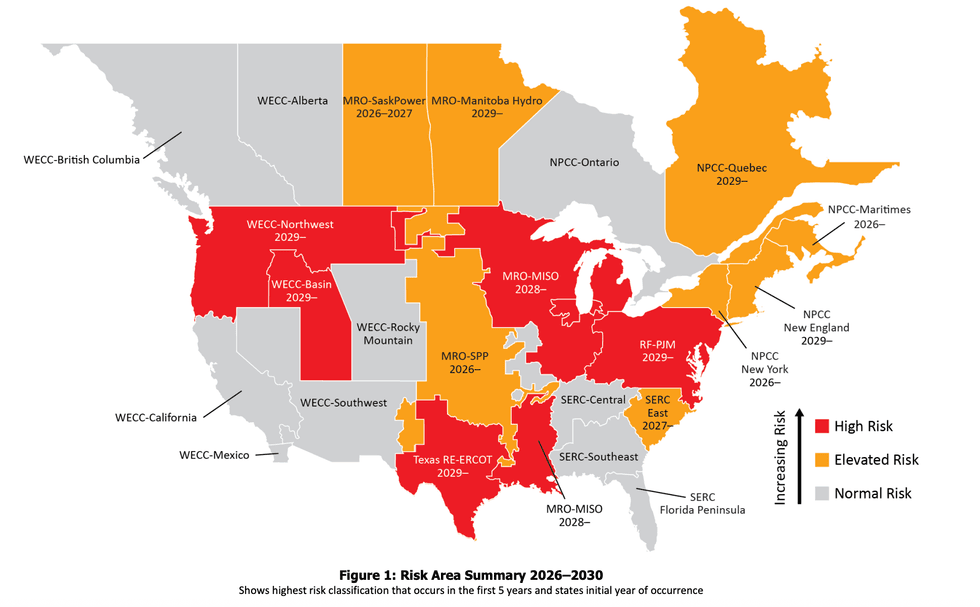 A chart from the NERC report showing the grids most at risk between now and 2030. NERC
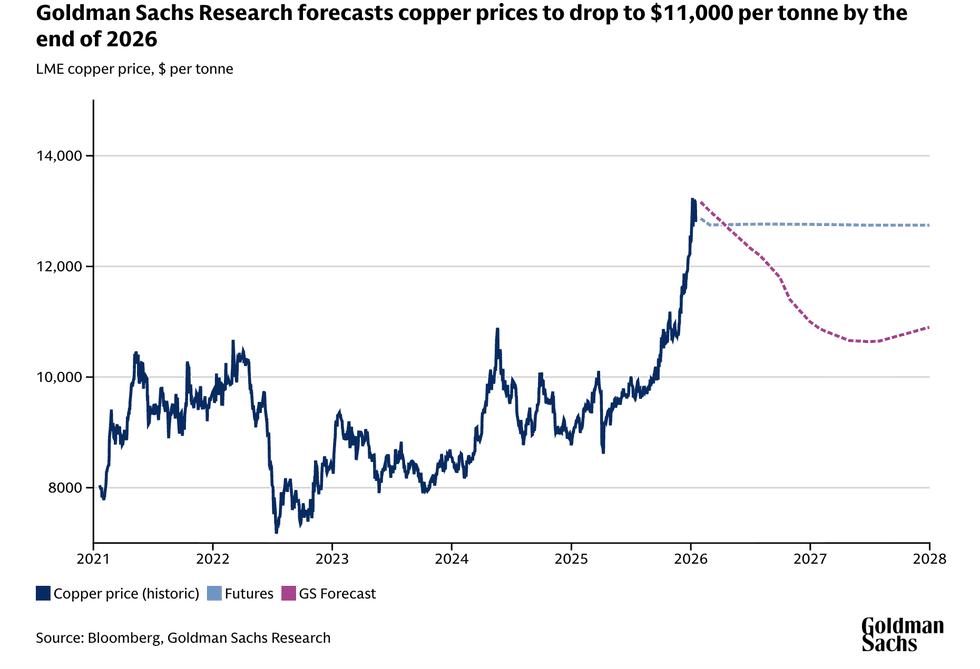 While this chart from last week didn't predict Thursday's record spike, it does forecast a return to a lower level in the near future. Goldman Sachs
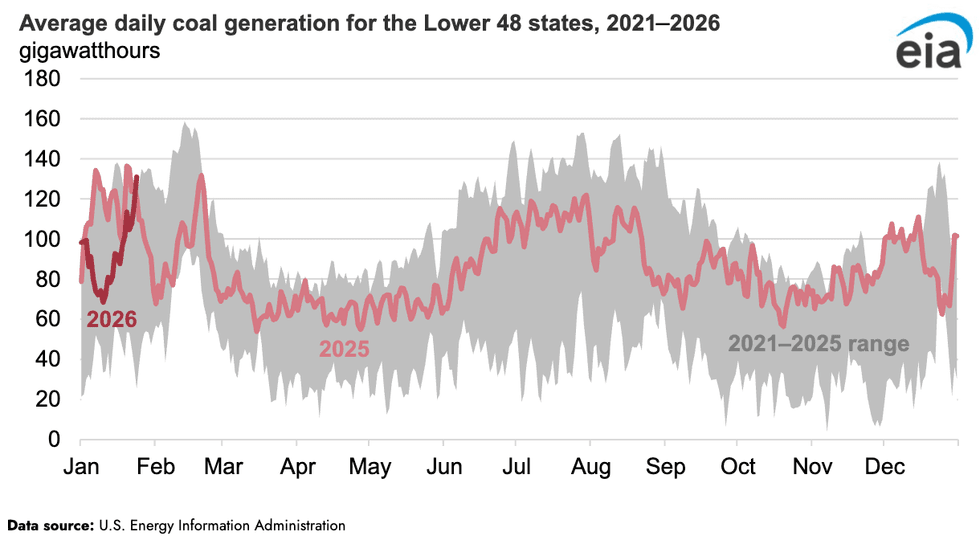 The V-shaped maroon-colored line representing 2026 shows how quickly coal consumption just jumped. EIA