Current conditions: Tropical Storm Cristobal formed in the Atlantic yet poses no real threats to land, unlike another budding storm gathering strength in the southern Caribbean • Powerful storms spurred derecho winds that spawned tornadoes across the Midwest and left 800,000 without power yesterday morning • Britain’s Met Office issued an amber weather warning as temperatures across eastern England soared to nearly 100 degrees Fahrenheit.
THE TOP FIVE
1. Energy Department cancels three federal transmission corridor
 Lost connections. DOE
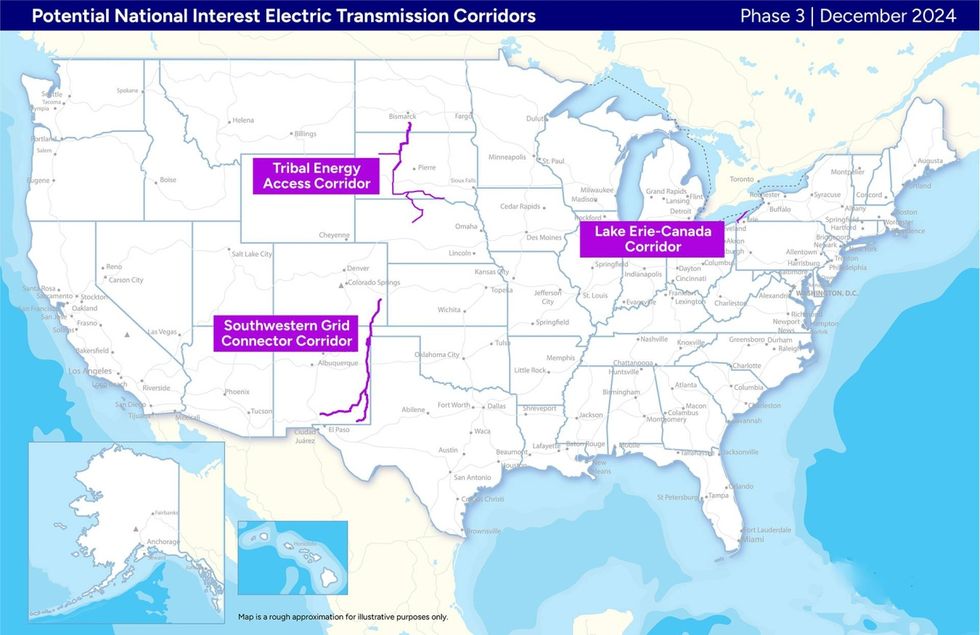
In the waning days of the Biden administration, the Department of Energy set about clearing one of the biggest bottlenecks to expanding America’s aging electrical grid: Literally expanding the grid. You don’t need to have read excellent books like Russell Gold’s Superpower or features like my colleague Robinson Meyer’s deep dive into the SunZia saga to know that building transmission lines is a huge challenge in the United States. To address this, the Biden-era agency proposed three National Interest Electric Transmission Corridors — essentially a series of projects in mostly red and purple states that could now enlist the federal government’s help to speed through the typical hurdles in getting approvals from so many jurisdictions and landowners across hundreds of miles of a power line’s route. Not anymore. On Wednesday evening, the Trump administration announced the cancellation of all three corridors, declaring projects that would likely have helped shore up the grid amid surging demand from data centers to be part of Democrats’ “Green New Scam.”
“Transmission policy must serve the American people — not special interests or a climate-alarmist agenda that drives up costs, worsens reliability, and disregards the concerns of local communities,” Secretary of Energy Chris Wright said in a statement. Still, his agency pointed to billions in loans it’s offered to utilities for grid upgrades and a study, released last month, highlighting what the Trump administration sees as the country’s future transmission needs. The rescission doesn’t necessarily mean the projects linked to the corridors are dead. When the Energy Department first announced the corridors in December 2024, the agency stressed that the designation didn’t guarantee federal approvals, merely speed projects on the pathway to getting answers. Those include NextEra Energy’s 73-mile Lake Erie Connector between Canada and Pennsylvania, two projects in the Southwestern Grid Connector Corridor, and the Transmission and Renewables Interstate Bulk Electric Supply Project in the Tribal Energy Access Corridor.
2. Tesla is planning a $10 billion solar factory in Texas
When Elon Musk announced plans last year to build out 100 gigawatts of solar manufacturing capacity, analysts and industry watchers scratched their heads. That’s more than double the amount of panels the U.S. installs each year at a time when photovoltaic factories face fierce competition from overseas competitors — namely China — and withering support domestically with the end of the federal tax credit designed to spur demand for American-made solar. Yet Musk is charging ahead with what Tesla has dubbed Project Crystal Sun. In a document submitted to Texas regulators, the company said it was “currently evaluating the feasibility of constructing its solar cell manufacturing facility at various locations across multiple U.S. states.” That includes the Lone Star State, to which Musk decamped from California. “Should Tesla make the decision to develop the proposed project in another state, Texas would miss the opportunity to attract billions of dollars in investment, help create thousands of full-time jobs for its residents, and become a hub for domestic solar cell manufacturing in the U.S.,” Tesla stated in the filing.
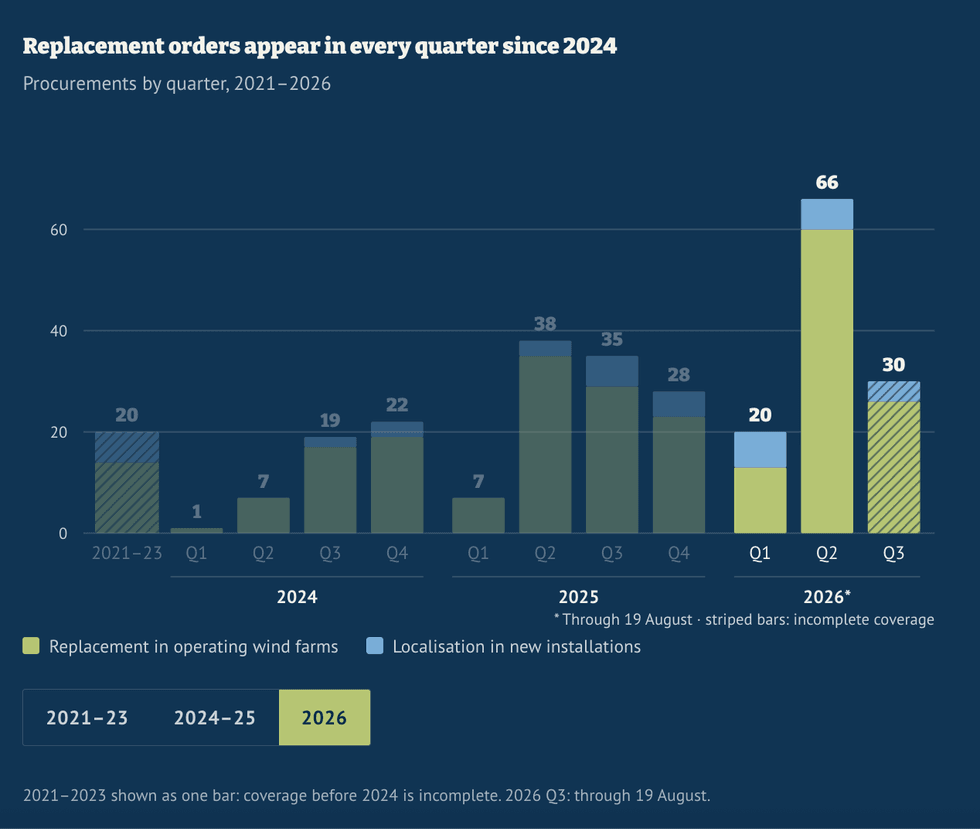
Things were also looking rosy for wind turbine manufacturers. Shares in Vestas closed nearly 20% higher on Wednesday after turbine orders bounced back, giving the company the liquidity to buy back its own stock. New orders for its turbines climbed from 2 gigawatts during the second quarter of 2025 to 3.35 gigawatts during the same period this year, the Financial Times reported.
3. Midwest storms strand northwest Indiana without fuel
The storms that barreled across the Midwest this week not only downed power for more than 800,000 people, they also left drivers without access to fuel. On Wednesday, the Northwest Indiana Times reported that gas stations in the region were running dry. “Today, we heard that this was open, and this is like the only thing that is open,” Mike Siedentopf, a resident of the Northwest Indiana town of Munster, told CBS News.
Sign up to receive Heatmap AM in your inbox every morning:
4. Another day, another Chinese nuclear milestone
The flagship reactors in China’s nuclear buildout are the Hualong One and the CAP1400, each of which borrows heavily from America’s Westinghouse AP1000. But it’s useful to remember that Beijing is diversifying its atomic fleet. One of the next reactors likely to enter into commercial operations is now Unit 7 at the Tianwan nuclear power station on China’s Yellow Sea coast. On Wednesday, NucNet and World Nuclear News reported that the plant had loaded its first fuel assembly into position in the core of the new reactor. This marks the first time fuel has been loaded into a next-generation Russian reactor in China. Like the AP1000 and China’s versions of it, Rosatom’s VVER-1200 is a third-generation pressurized water reactor, meaning it uses the standard technology for fission with state-of-the-art safety and cooling upgrades. CNNC, the plant’s operator, said it expects to begin commercial operation later this year.
5. Nearly $1 billion pours into two long-duration storage startups
With the battery market booming, the race to commercialize long-duration storage technologies has yielded plenty of attention-grabbing ideas. Form Energy’s approach is proving particularly magnetic for investors. The West Virginia-based startup is seeking to bring rust-powered batteries that last 100 hours to market. On Wednesday, the company unveiled a $750 million Series G financing round, bringing the total equity it’s raised so far to over $2 billion. Its iron-air batteries, which charge through a “reversible rusting” process, have already attracted deals with Google, utility Xcel Energy, and data center giant Crusoe.
Meanwhile, a company commercializing compressed air storage technology just raised another $230 million. Hydrostor uses electricity to compress air and store it in underground hard-rock caverns using water displacement. When the grid needs power, the stored air is reheated and expands, spinning a turbine that generates emissions-free electricity. The Canadian startup pulled in more funding from the Canadian government’s investment fund, Goldman Sachs, and Canada’s pension funds. Another backer in this round is the oilfield services giant Baker Hughes. “The grid needs bankable long-duration energy storage that can be deployed today to enable affordable and reliable electricity for all, and Hydrostor’s continued fundraising success is a testament to the potential of our A-CAES technology to get us there,” Hydrostor CEO Curtis VanWalleghem said in a statement.
THE KICKER
A Dr. Phil-linked expedition to find oil in Greenland has been delayed as the island nation’s government rejects the consortium’s right to drill. On Wednesday, the United Kingdom’s 80 Mile exploration company announced the delay in its plans. “While we are disappointed that the timing of the Jameson drilling program has been impacted, the company remains fully committed to advancing this highly prospective project,” 80 Mile executive director Rod McIllree told the Financial Times.


 Lost connections. DOE
 The great localization push of 2026. OSW
  The 1990s are back. EIA