You’re out of free articles.
This Halloween, get 20% off using code ADVANCED
Log in
To continue reading, log in to your account.
Create a Free Account
To unlock more free articles, please create a free account.
Sign In or Create an Account.
By continuing, you agree to the Terms of Service and acknowledge our Privacy Policy
Welcome to Heatmap
Thank you for registering with Heatmap. Climate change is one of the greatest challenges of our lives, a force reshaping our economy, our politics, and our culture. We hope to be your trusted, friendly, and insightful guide to that transformation. Please enjoy your free articles. You can check your profile here .
subscribe to get Unlimited access
Offer for a Heatmap News Unlimited Access subscription; please note that your subscription will renew automatically unless you cancel prior to renewal. Cancellation takes effect at the end of your current billing period. We will let you know in advance of any price changes. Taxes may apply. Offer terms are subject to change.
Subscribe to get unlimited Access
Hey, you are out of free articles but you are only a few clicks away from full access. Subscribe below and take advantage of our introductory offer.
subscribe to get Unlimited access
Offer for a Heatmap News Unlimited Access subscription; please note that your subscription will renew automatically unless you cancel prior to renewal. Cancellation takes effect at the end of your current billing period. We will let you know in advance of any price changes. Taxes may apply. Offer terms are subject to change.
Create Your Account
Please Enter Your Password
Forgot your password?
Please enter the email address you use for your account so we can send you a link to reset your password:

Jason Fenske loved his Lucid. Or at least, the idea of it.
Fenske is the proprietor of the influential Engineering Explained channel on YouTube, which digs into the mechanical minutiae of both combustion and electric vehicles. While he regularly test-drives all sorts of cars, Fenske last year bought himself a Lucid Air, the big, beautiful sedan from the California EV startup.
The choice was no surprise. Fenske called the Air “one of the most impressive feats of engineering in the automotive world.” Technologically, it is indeed a car without compromise. Despite delivering 600-plus horsepower and a 0-60 mph time of barely more than 3 seconds, it was also the most efficient car in America, a fact that helped push its driving range above 400 miles per charge. But after a year of Fenske’s Air struggling with seemingly incurable software glitches, the company bought back his car and gave him a long-term loan of the Gravity, its new electric SUV. When that, too, suffered software bugs, he finally moved on to a Ford.
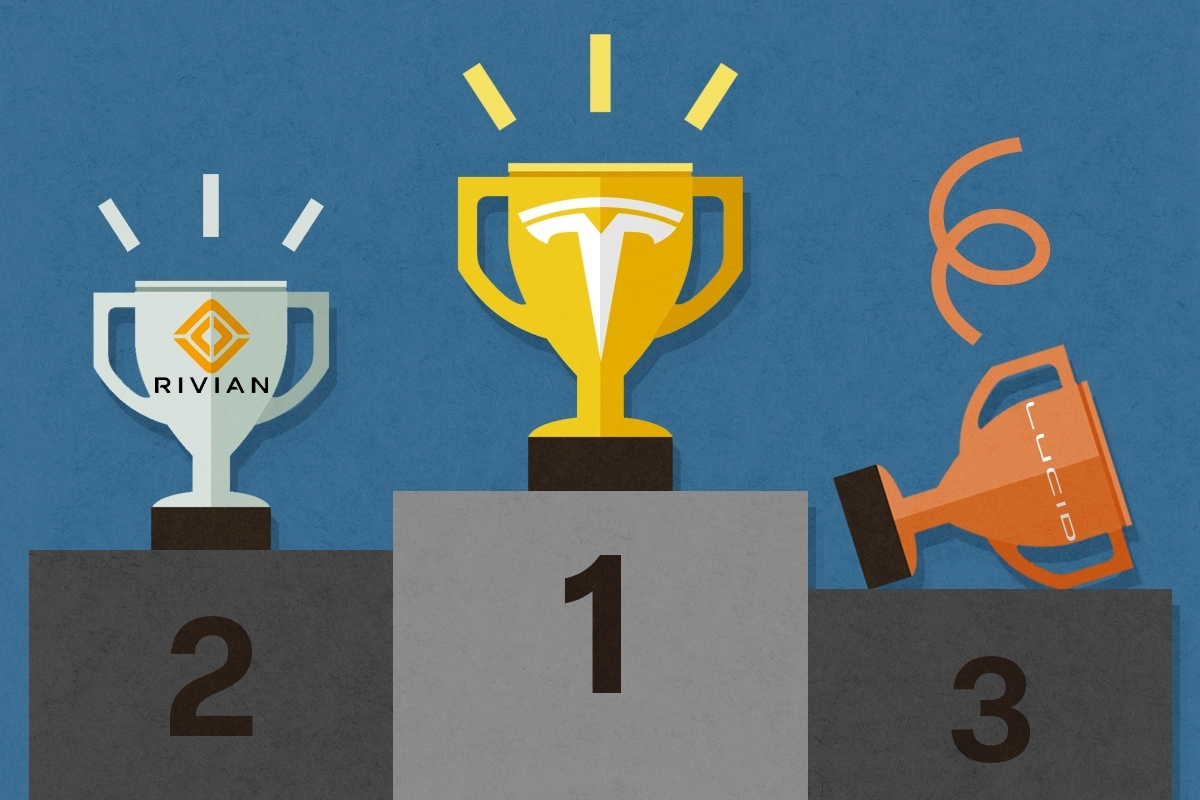
The episode encapsulates what has been a trying time for the automaker. Alongside Tesla and Rivian, Lucid looked to be the third successful EV startup to spring out of California. Tesla, once it overcame the trials of “manufacturing hell” to produce the Model 3 and Model Y, seized control of the American EV market and has yet to let go. Rivian, buoyed through the bad years by investments from the likes of Volkswagen and Amazon, appears poised to reach a sustainable future now that the more affordable R2 is out and thriving. Lucid, though, is stuck in an earlier stage in startup evolution — reportedly burning through cash as it struggles with both the software side of its vehicles and with the state of the U.S. EV market. The mood grew so grim this summer that the company announced a full operational reset to try to restore investor confidence, which included CEO Peter Rawlinson, formerly the man in charge of the Tesla Model S, stepping down.
Things started off much more promising in 2021, when the Air established Lucid as the efficiency nerd’s EV. Today, the rear-wheel-drive version gets the equivalent of 146 miles per gallon — tops in the U.S., and good enough for the Air to get 420 miles of range. The most expensive Air, with a supersized battery to match, delivers an eye-popping figure of 512 miles.
The obvious next step for the American market is to build an SUV, which Lucid has done with the Gravity. We tested it this past weekend in a seven-seat configuration, ferrying five people and three dogs up to Oak Glen, California, the mountain town of apple orchards and pumpkin patches where Angelenos come to cosplay autumn. (Bibi, one of the four-legged passengers who doesn’t care for cars, loved the Lucid). Despite its length, which gives it the proportions of a svelte minivan, the Gravity’s ample power makes it drive like a lighter vehicle. And despite its size, the Lucid’s efficiency obsession gives the car 400-plus miles of range, allowing us to drive a three-hour round trip and still have half the battery capacity left over. I can’t tell you how luxurious that feels compared to everyday life in a standard-range Tesla Model 3.
Inside, the Gravity is truly deluxe and inviting. Where Tesla embraced a fully minimalist interior and Rivian projects more of an REI, gentrified outdoorsy aesthetic, Lucid tilts more toward being the electric black car. The sprawling curved screen across the dashboard and secondary large touchscreen in the central console, combined with the elegant approach to its UI, is just so much more sophisticated than what you’d see in a legacy carmaker’s EV.
The setup offers a refined way to use all the car’s basic functions like climate, music, and navigation, as well as search for charging stations and view all of the car’s energy and efficiency stats. The array of settings and options allows an EV enthusiast to tweak a thousand things about their car. Take charge planning on road trips, a sore spot I often gripe about: In the Lucid, a bevy of options lets you select and deselect whichever charging networks you want, tell the computer whether to prioritize total time versus number of charging stops, and lots more. Then there are the premium extras meant to justify the Gravity’s price, which starts at $80,000 and rises from there. Wellness and relaxation programs can take over the digital displays and lighting, transforming the cabin into a little spa on wheels for as long as you’d like. The car simply feels like Silicon Valley affluence.
Within that user experience lies the problem, though. Lucid’s EVs are unquestionably mechanically excellent. But in the age of the software-defined car, all the software has to be excellent, too. Fenske’s Air wasn’t the only Lucid beset by bugs. This is an unavoidable fact of life in the 21st century — Tesla and Rivian have certainly had their share — but Lucid appears to have struggled more to cleanse them. Even my test unit would erroneously flash a momentary warning while I was rolling down the freeway (close latch before driving!) that disappeared just as quickly. It made no real difference to the driving experience, yet it’s one of those tiny glitches that saps one’s confidence in a car whose software is also responsible for keeping you safe.
Set aside software woes, and the timeline is troublesome for Lucid, too. Tesla established a pattern for EV startups: it built the very expensive Model S and X first, making just enough revenue from those pricey halo cars to survive until it could build the more affordable Model 3 and Y and generate a reliable revenue stream. Rivian took a similar path, selling R1 pickups and SUVs that cost $70,000, and sometimes much more, before introducing the R2 this year. Lucid’s smaller and cheaper EVs would be called the Cosmos and Earth, but we’ve yet to see those vehicles, and they won’t arrive until at least next year. When they do show up, they’ll have to compete with an improving set of luxury EVsfrom the likes of BMW and Mercedes-Benz.
Once those $50,000 Lucids exist, far more drivers will be exposed to all the things that the brand does right. And maybe — as long as there’s enough investment cash to get there — that will establish Lucid as a brand that is here to stay. Until then, the sticker price of these dream machines means that Lucid is competing in a small slice of an already small market, since not even a year of expensive gas has been enough to tip Americans toward EVs for good.

This Halloween, get 20% off using code ADVANCED
Log in
To continue reading, log in to your account.
Create a Free Account
To unlock more free articles, please create a free account.
SoftBank’s error and Nvidia’s scandal suggest data centers may have already peaked as an economic and energy trend.
This is Heatmap Daily, a weekday digest written by our executive editor. Subscribe here.
Covering energy and climate change sometimes means seeing certain stories in a different light than others. And a particularly vivid hue illuminated The Wall Street Journal’s report today that the Japanese conglomerate SoftBank Group is taking a $3.7 billion loss on several gigawatts’ worth of natural gas turbines.
For the Journal, the big news is that SoftBank and its billionaire founder, Masayoshi Son, are failing to capitalize on the artificial intelligence boom. But at Heatmap, we’re thinking about the turbines.
The data center boom and the return of electricity load growth has depleted the world’s supply of natural gas turbines. SoftBank had purchased reservations for about 13 gigawatts of turbines, according to the Journal. That’s a staggering amount of electricity — it could meet New York City’s maximum power draw on the hottest part of a summer’s day. The conglomerate now seems set to dump reservations for about four gigawatts’ worth. Keeping a reservation, it turns out, really is harder than making it.
Most of those rotors were reportedly from GE Vernova, one of the world’s largest producers of gas turbines. GE Vernova’s order list for gas turbines has been filled for nearly two years and the waiting list now stretches into 2031. That has led data center developers, hungry to get power as soon as possible, to reach for ever dirtier forms of electricity generation, including diesel generators and even old jet engines.
On that front, SoftBank’s failure to sell the turbines to a higher bidder suggests (albeit weakly) that demand for energy-producing assets might not be as strong as the AI boom’s backers once thought. SoftBank was already set to send about 9 gigawatts of turbines to the enormous Trump-backed OpenAI data center in Pike County, Ohio. The roughly remaining four gigawatts will be released back their manufacturers. (One thing this news can’t quite tell us, alas, is what type of turbine set-up will be used in the Pike County facility, which will be the world’s largest gas-fired power plant if it is build to completion. Recent public filings have suggested the facility isn’t planning on using any turbines in the more efficient combined-cycle configuration, which would mean the plant’s carbon intensity will be worse than most other new natural gas plants. But we’d love to hear any tips on this front.)
To zoom out for a second, I’m struck by how the AI bubble has been replaced by an AI muddle. As I wrote this, news emerged that Nvidia is preparing to fire its CEO, Jensen Huang, for his affair with a Chinese woman who is alleged to be a spy. (He had at least one more affair with another Nvidia executive, according to The New York Times.) Under Huang’s leadership, Nvidia has invested in a sprawling and sometimes circular network of energy-related companies, including Emerald AI, a startup that helps data centers flex their electricity consumption, and Redwood Materials, a battery recycler and producer led by the former Tesla executive J.B. Straubel. Huang has used Nvidia’s enormous balance sheet to buy down the risk of other AI and AI-related companies, propelling the overall AI trade to become the biggest story in American markets.
Now that balance sheet is in peril: Nvidia’s stock is already down 11% over the past five days, and it has fallen another 8% in after-hours trading since news broke of Huang’s ouster. If the chip designer’s financial network began to fray — or even if the next CEO had a lower risk appetite than Huang — then its demise could impact a much larger set of firms.
Even before the Huang scandal broke, companies at the center of the AI trade were showing signs of weakness. Alphabet, Meta, and Microsoft are all down on the month. Nvidia was already lagging by about 10% on the month before its hebdomas horribilis began, too. The memory and chip makers Micron and Applied Materials are both down more than 25% in about the same period, and GE Vernova and Oklo have fallen nearly 20%. Although the data center company Coreweave rebounded on an earnings beat today, it’s still down 24% on the month and nearly 50% since May.
The market rout isn’t total — Anthropic seems likely to enjoy one of the largest IPOs ever in the next week (although perhaps not with quite as large a valuation as its investors once imagined). And the underlying technology of AI seems to be getting worryingly better all the time. But even though the politics of data centers and AI seem set to dominate the new Washington, I’m wondering if data centers as a mainstream economic trend might have already peaked. Americans voted for a more subdued AI boom in the midterms. Now it seems like they might get it ahead of schedule.
Lunar Energy’s latest AI-powered system aims to integrate EVs into the automated demand response mix.
In theory, it’s straightforward to assemble the smart energy home: Solar panels, home backup batteries, and electric vehicles, plus smart thermostats, heat pumps, and water heaters — all the individual pieces can be had for the homeowner who can afford the up-front cost. The challenge is getting all those pieces to talk to one another.
Bay Area-based Lunar Energy is one of the tech firms that’s been trying to crack this problem. Today, it announced an upgraded version of its artificial intelligence-powered home energy control system, which not only integrates all those separate systems but also responds tactically to energy markets. CEO Kunal Girotra told me Lunar AI saves its users money by monitoring their home 24/7 and making decisions to charge, not to charge, or discharge so that they save the most money.
“Utilities are all moving to almost-real-time changes of rates,” he said. “You need software to handle that for you. I think that the race is on for who has the best AI machine learning algorithms to save the most amount of money. And so far, we seem to have a head start.”
Lunar’s first-generation system focused on generation, storage, and control. In other words, it connected elements like a home’s rooftop solar panels with the backup battery the residents might keep in the garage, using the AI to decide when to meet the home’s real-time energy needs with solar versus grid energy versus stored power. What it didn’t have was the ability to work with electric vehicles to manage charging and use the car’s battery as a bonus source of energy.
To fix this, Lunar has built its own bidirectional EV charger — one that can charge up the battery or discharge the car’s battery for a secondary use, like backing up the home’s power supply. Girotra, formerly the head of Tesla Energy, told me the problem with that functionality to this point has been the connection point between the car and the home electrical system. Carmakers and other companies in the space didn’t have the deep experience with electrical certifications to make the process seamless, he tells me. That led to setups like the original Ford Charge Station Pro, which required several different wall-mounted electrical boxes to connect the F-150 Lightning EV to the home.
Lunar’s charger is built to connect to its customers’ existing home Lunar energy system, which includes a microgrid interconnect device they call Lunar Bridge that islands the home in case of a power outage on the grid. In that way, the power stored in the EV battery is ready to back up the home in case of a blackout without any additional work — or to be optimized as part of a fully smart home that’s making money as part of a virtual power plant.
The company’s setup allows for another fun feature: “slow” charging that’s not slow at all, but actually two or three times as fast as the Level 2 charging most EV owners use to recharge their batteries overnight. Electric cars in the U.S. can typically take on only about 11 kilowatts of AC power from one’s home because of the limitations of their on-board hardware. Because Lunar’s system is fully DC, however, Girotra said the company decided to build a DC home charger, one that — like a Tesla Supercharger or other DC fast chargers out in the world — isn’t limited by that power cap. Lunar said it could use a combination of power from the grid, home solar, or home batteries to charge an EV at up to 25 kilowatts. That’s enough to recharge an EV in three to four hours rather than six to eight.
“If the standards get high, and if everybody sees cars can get charged in three hours, then all of a sudden people are like, ‘Wow, this is how I want it,’” he said. “Especially for 25% of the users who are like me, who always are running low on charge and they don’t mind a boost every now and then.”
Some of the other improvements in the second-gen system are more incremental. An inverter that’s 40% more powerful helps Lunar get its system up to enterprise scale. That’s crucial, as the world moves toward a place where more homes and businesses employ battery backup systems. Lunar’s new batteries come in modular 5 kilowatt-hour blocks ranging from 10 kilowatt-hours to 30 kilowatt-hours in a single unit and scale up to 300 kilowatt-hours for home or small commercial use; there’s also new pad-mounted configurations with capacity up to 1 megawatt-hour.
Batteries, though, are the simple part. Everyone from EV makers like Rivian to utilities like Octopus Energy is racing to make a person’s or a business’s batteries and solar panels and electric cars work for them, using the power of AI to account for moment-to-moment changes in energy prices and supply. Lunar’s new tech makes the case that the most important element is a single brain to integrate every last smart, electrified thing in your house.
The fundraise comes on the heels of a $50 million grant from the Department of Energy.
Almost all lithium-ion batteries on the market rely on graphite for their anodes, more than 90% of which is processed in China. That concentration has created a chokepoint in the Pentagon’s supply chain as the military increasingly turns to batteries to help its transportation network operate more quietly and reduce reliance on complex refueling logistics.
So when Congress passed the latest National Defense Authorization Act at the end of 2025, barring Chinese-linked battery materials from military use starting in 2028, Coreshell saw an opening. While the California-based silicon-anode battery startup had previously focused on automakers as its beachhead customers, it’s now shipping its first battery cells to the military for use on Navy ships and Army ground vehicles. On Wednesday, Coreshell announced a $30 million Series B to scale up manufacturing operations to meet the needs of this growing customer base.
“We’re entering a new stage where we’re no longer, I would say, demand limited,” Coreshell’s CEO Jonathan Tan told me. “This year we’ve had to put on second and third shifts, work nights and weekends, just to get the product out the door.”
Coreshell sets itself apart by going a step further than the NDAA requires. The law doesn’t make suppliers trace battery materials all the way back to the mine, which would be exceedingly difficult given China’s dominance across the battery supply chain. But Coreshell has nevertheless eliminated Chinese sourcing from its anodes by replacing graphite with silicon mined and refined in the U.S. by Ferroglobe, one of its Series A investors.
Ferroglobe and global investment firm Access Industries led the latest round, with defense contractor ADS also joining as a new strategic investor. The financing comes on the heels of a $50 million Department of Energy grant that Coreshell secured in August as part of a program to strengthen the domestic battery supply chain. That funding will support the company’s first commercial-scale facility, a 2-gigawatt-hour factory.
That’s about 20 times the size of the 100-ish-megawatt-hour plant the startup had originally envisioned, as the DOE grant has allowed Coreshell to “expand much further than we were originally expecting,” according to Tan. The company is now evaluating several potential U.S. sites and expects to announce its selection early next year. For now, it relies on unnamed contract manufactures, along with its small pilot line in San Leandro, to produce its cells. But once the gigafactory gets up and running, the startup plans to bring electrode production in house by 2028, followed by full cell assembly in 2029.
Building this plant will ultimately require significant additional capital. But Tan believes this latest vote of confidence from the federal government will help Coreshell to diversify its capital stack as it continues to fundraise. “That’s one of the great things about having such a notable DOE award is that it also allows us to attract multiple forms of capital,” he told me.
Silicon has long been recognized as a promising alternative material for battery anodes, as it can store far more energy than graphite. The catch is that it tends to swell during charging, causing it to break down quickly and ultimately leading to a much shorter cycle life. Coreshell says it’s extended its anode’s lifespan by giving it a proprietary coating, which Tan told me back in April essentially means “painting the inside of your battery” with an ultra-thin protective layer.
Other companies, such as Sila Nanotechnologies and Group14 Technologies, are also working to commercialize silicon anodes. But Coreshell says many of its competitors rely on more highly engineered, expensive forms of silicon, such as silane gas. By contrast, Coreshell uses metallurgical silicon, a cheap, raw commodity already widely used in aluminum alloys. That, Tan argues, gives the company a cost advantage not only over its competitors, but potentially Chinese graphite too.
Coreshell hasn’t yet demonstrated that its cells can meet the performance demands of the automotive industry, however. When the company raised its Series A in early 2025, it said it expected its automotive cells to exceed 1,000 charge cycles while retaining 80% of their original capacity. But Tan told me many defense applications don’t require such demanding performance targets, as Navy ships and ground vehicles are “not intending to have as many miles or missions or use cases on that same battery” as a consumer EV would.
That doesn’t mean the company is abandoning its automotive ambitions. As Tan pointed out, electric vehicles remain by far the largest source of global and domestic battery demand. “It’s natural for us to obviously utilize the security supply chain first,” he told me. “That allowed us to really get to commercialization, revenue, and production faster, because automotive qualification is this longer journey. But ultimately, we want to do both of those and more.”