Current conditions: The record-breaking heat roasting the Southwest is spreading eastward through the Plains, sending temperatures to levels historically reached in June • The snowpack out West has all but disappeared this week, which is typically the annual peak • At least four people have died in Oman as a low-pressure system known as an Al-Masarrat trough deluges the Persian Gulf nation with heavy rain.
THE TOP FIVE
1. TotalEnergies takes up Trump’s $1 billion offer to kill its offshore wind project
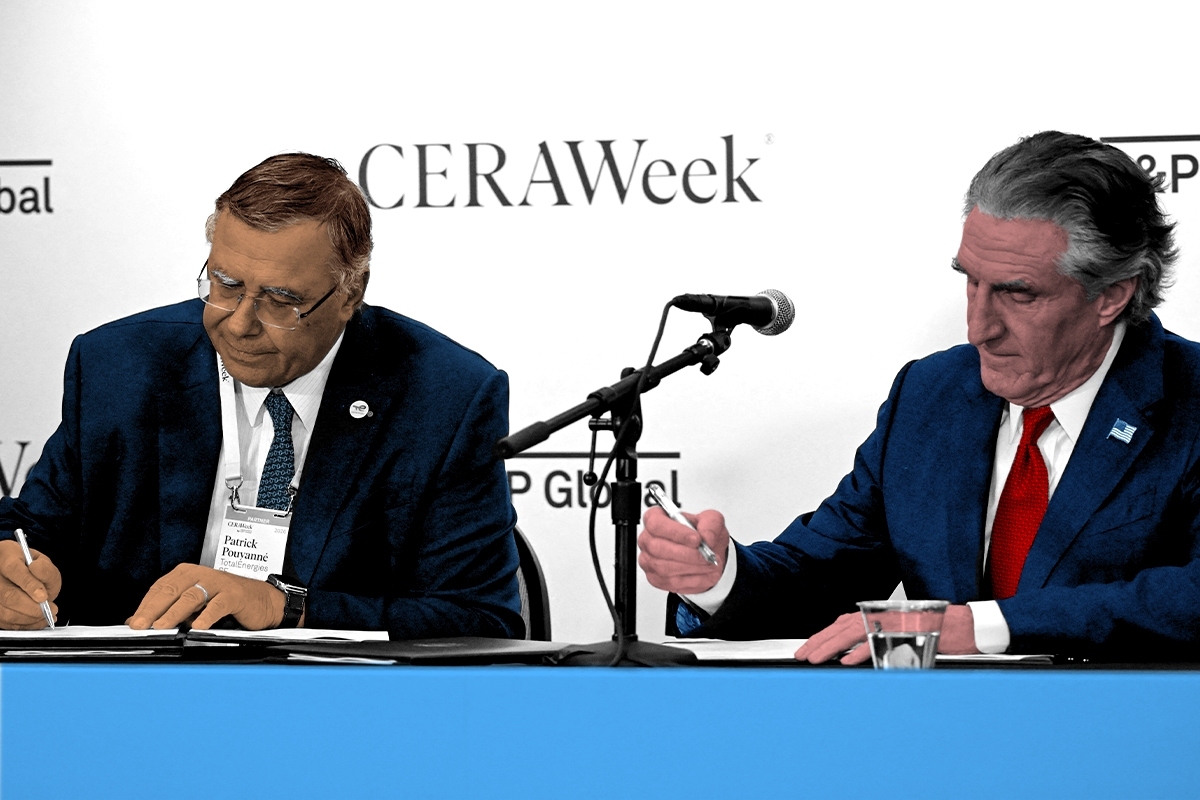
President Donald Trump couldn’t stop any already-permitted offshore wind farms in court. But the White House has managed to kill at least two projects by offering the developer $1 billion to quit. On Monday, the French energy giant TotalEnergies announced a deal with the Trump administration to abandon two offshore wind projects in exchange for a seven-figure payout and preferential treatment when investing in U.S. oil and gas projects. Under the deal, TotalEnergies — which has always operated primarily as an oil and gas business — will return to its roots by financing the construction of a liquified natural gas plant in Texas, in addition to other drilling for hydrocarbons. In a statement to the Associated Press, TotalEnergies CEO Patrick Pouyanné said the company renounced offshore wind development in the U.S. in exchange for the reimbursement of its lease fees, “considering that the development of offshore wind projects is not in the country’s interest” and oil and gas operations are a “more efficient use of capital” in America.
2. Trump backed off threat to bomb Iran’s power plants to ease the market
In case this dynamic wasn’t obvious, Bloomberg confirmed Monday that Trump backed off his threat to bomb Iran’s power plants this week in a bid to ease surging oil prices as allies warned that the nearly month-old war “was quickly becoming a disaster.” Stocks and U.S. Treasury bonds rallied, and futures contracts for Brent crude — the European benchmark most directly affected by Iran’s halt to all tankers passing through the Strait of Hormuz — fell sharply. America’s allies in the Gulf reportedly urged Trump in private not to destroy Iranian infrastructure “that will be crucial to keeping it from becoming a failed state after the conflict ends.” The Iranian government, meanwhile, hailed Trump’s retreat as a victory and told the semi-official Fars news agency that Trump backed down “after hearing that our targets would be all power plants in West Asia.” That could include hitting the United Arab Emirates’ first and only atomic power station, the Barakah nuclear plant in Abu Dhabi.
Even if the war ends soon, the energy crisis caused by the conflict is already worse than the combined effect of the oil shocks in the 1970s, and it will take years to fix. That’s according to Fatih Birol, the executive director of the International Energy Agency, who accused global leaders of not appreciating the severity of the crisis in a speech in Canberra, Australia, on Monday. Less than two weeks ago, the IEA coordinated the biggest release of its global oil stockpile in history, and Birol confirmed that the agency was in talks with members about releasing more. “If it is necessary, of course, we will do it,” he said, according to The New York Times. The market, he said, will not recover quickly from the war. “It will take some time to come back to the abnormal days we had before the war was started,” Birol said.
3. China unveils a ‘stunning’ new critical minerals find
Yes, China’s grip over critical minerals largely centers on its control over global refining capacity that turns ore into useful industrial materials. And yes, China has made up for what it doesn’t mine domestically by forging deep commercial ties with mineral-rich countries across Africa, Asia, and Latin America. That doesn’t mean China isn’t endowed with vast riches under its people’s own feet. At the Maoniuping mine in Sichuan’s Mianning county, Chinese officials announced the discovery of 9.7 million metric tons of rare earth oxides, raising the proven reserves at the site to 10.4 million metric tons. The find also includes deposits of 27.1 million tons of fluorite, a mineral used in fluorescent lighting, and 37.2 million tons of baryte, which is used in plastic making, oil and gas drilling, and chemical production. Both deposits qualify as “super-large,” making them truly “stunning,” Wang Denghong, the director of the Institute of Mineral Resources at the Chinese Academy of Geological Science, said, according to the South China Morning Post.
The U.S., meanwhile, plans to contribute $250 million toward an investment consortium aimed at redirecting mineral supply chains away from China. On Monday, Under Secretary of State for Economic Affairs Jacob Helberg told Bloomberg the U.S. would administer a fund with as much as $1 trillion in commitments from sovereign wealth funds and institutional investments. Then, early Tuesday morning, the European Union announced a deal with Australia to invest in four critical mineral projects to produce rare earths, lithium, and tungsten.
Sign up to receive Heatmap AM in your inbox every morning:
4. Upstate New York towns raise hands for a new nuclear power plant
Last summer, New York Governor Kathy Hochul ordered her government-owned utility, the New York Power Authority, to build the first new reactor in the state in half a century, adding at least 1 gigawatt of new nuclear capacity to the grid. In January, the Democrat quintupled that target, calling for a total of 5 gigawatts. So far, more than 20 companies have submitted design concepts, and eight towns in the Upstate regions of New York have offered to host new reactors. The communities that have expressed interest so far include: the Finger Lakes, the Binghamton area, St. Lawrence County across the border from Ottawa, Dunkirk on Lake Erie, and the city of Rochester. Three sites on Lake Ontario also expressed interest, including Oswego County, where the state already produces 20% of its power at the Constellation-owned Nine Mile Point Nuclear Generating Station. “Oswego County has a long history of hosting nuclear power stations and is uniquely positioned as the best region for the state to develop new nuclear projects,” James Weatherup, the chairman of Oswego’s county legislature, told Gothamist.
New York’s nuclear expansion is a key test of whether NYPA, the nation’s second-largest government-owned power company after the federal Tennessee Valley Authority, can help make building reactors possible again in a state with a liberalized electricity market. Like much of the rest of the country starting in the 1990s, New York broke up its vertically-integrated monopoly utilities. But without larger businesses to help offset the high upfront costs of building a megaproject like a reactor, utilities instead stuck to cheaper, easier to build forms of generation that didn’t always provide reliable enough electricity to keep prices down. If NYPA is successful, it may be further proof that, as Heatmap’s Matthew Zeitlin wrote last year, electricity markets “aren’t working anymore.”
5. Dozens of hyperscalers and utilities call for standardizing flexible demand
More than 30 hyperscalers, utilities, and grid operators have signed onto an open letter calling for industry-wide collaboration to create a standardized approach to bringing large, flexible loads onto the grid. Organized by the Electric Power Research Institute and promoted at this week’s CERAWeek energy conference in Houston, the letter warns that today’s “interconnection and planning processes rely heavily on worst case assumptions about load behavior,” such as data centers that constantly draw from the grid even when the supply of electricity on the wires is low, like during a heat wave. “These assumptions could change when planning with flexibility in mind.” Signatories already include tech giants Google, Meta, and Nvidia, as well as utilities such as Southern Company, Exelon, and Constellation.
The letter, highlighted on X by the Google energy researcher Tyler Norris, goes on to call for:
- “Utilities and system operators to engage with shared flexibility framework as a tool to unlock capacity and reduce interconnection friction.”
- “Load developers and operators to design for flexibility and adopt common performance definitions.”
- “Regulators and policymakers to enable pathways that recognize flexibility as a legitimate, reliability enhancing resource.”
- “Industry consortia and standards bodies to align efforts and avoid fragmentation.”
THE KICKER
 Russian Prime Minister Mikhail Mishustin (center), Vietnamese Prime Minister Pham Minh Chinh (left) and Director General of Russia's state atomic energy corporation Rosatom Alexei Likhachev (right) at this week's deal-signing ceremony in Moscow. Alexander Miridonov / POOL / AFP via Getty Images
Russia has won the bid to build yet another country’s first nuclear power plant. On Monday, Vietnam announced a deal with the Kremlin’s state-owned Rosatom to build two VVER-1200 pressurized water reactors. The units would mark fast-growing Vietnam’s first foray into atomic energy and highlight the West’s continued struggle to compete to build nuclear power plants in newcomer nations. Russia is currently building the first nuclear plants in Bangladesh, Egypt, and Turkey.


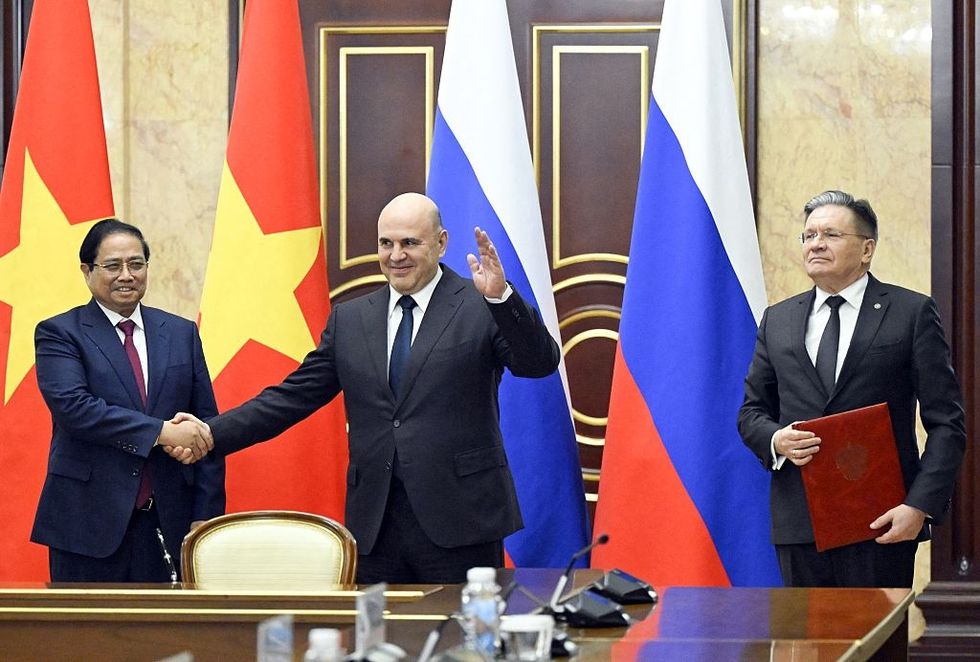 Russian Prime Minister Mikhail Mishustin (center), Vietnamese Prime Minister Pham Minh Chinh (left) and Director General of Russia's state atomic energy corporation Rosatom Alexei Likhachev (right) at this week's deal-signing ceremony in Moscow. Alexander Miridonov / POOL / AFP via Getty Images



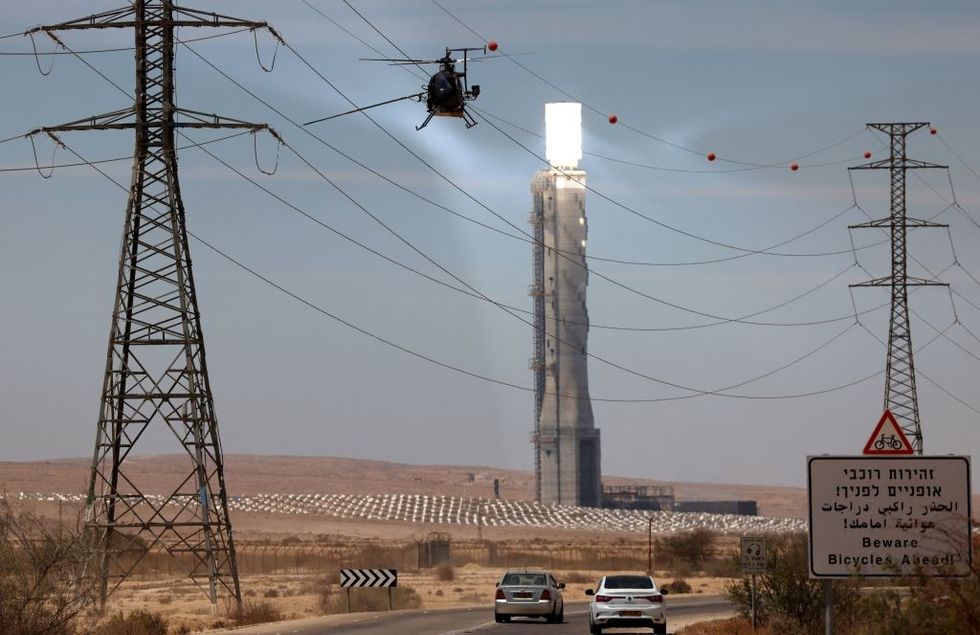 A crew cleans power lines at Israel’s Ashalim solar plant.EMMANUEL DUNAND/AFP via Getty Images