Current conditions: A geomagnetic storm triggered by what’s known as a coronal mass ejection in space could hit severe levels and disrupt critical infrastructure from southern Alabama to northern California • After weekend storms blanketed the Northeast in snow, Arctic air is pushing more snow into the region by midweek • Extreme heat in South America is fueling wildfires that have already killed 19 people in Chile.
THE TOP FIVE
1. Trump ramps up Greenland pressure with threat of EU tariffs
Over the weekend, President Donald Trump once again ratcheted up pressure on Denmark and the European Union to consider his bid to seize Greenland. In a post on Truth Social, the president announced punitive 10% tariffs on Denmark, Norway, Sweden, France, Germany, the United Kingdom, the Netherlands, and Finland starting on February 1, with plans to raise the levies to 25% by June. “We have subsidized Denmark, and all of the Countries of the European Union, and others, for many years by not charging them Tariffs, or any other forms of remuneration,” he wrote. “Now, after Centuries, it is time for Denmark to give back — World Peace is at stake!” In response, the EU has threatened to deploy its economic “big bazooka.” Known formally as the anti-coercion instrument, the policy came into force in 2023 to counter China’s attacks on Lithuania, and involves the imposition of sweeping trade sanctions, ousting the aggressor nation’s companies from the world’s second-largest market, and ending intellectual property protections. Economists told the Financial Times that a trade war over Greenland would risk sparking the worst financial crisis since the Great Recession.
2. Solar power poised for a 50% increase in the U.S. over the next two years
 If you look at the second chart, solar is on a clear incline.EIA
Electricity generation is set to grow 1.1% this year and 2.6% in 2027, according to the latest short-term energy outlook report from the federal Energy Information Administration. Despite the Trump administration’s attacks on the industry, solar power will provide the bulk of that growth. The U.S. is set to add 70 gigawatts of new utility-scale solar in 2026 and 2027, representing a 49% increase in operating solar capacity compared to the end of 2025. While natural gas, coal, and nuclear combined accounted for 75% of all generation last year, the trio’s share of power output in 2027 is on track to slip to 72%. Solar power and wind energy, meanwhile, are set to rise from about 18% in 2025 to 21% in 2027.
Still, the solar industry is struggling to fend off the Trump administration’s efforts to curb deployments of what its top energy officials call unreliable forms of renewable power. As Heatmap’s Jael Holzman wrote last month, the leading solar trade association is pleading with Congress for help fending off a “near complete moratorium on permitting.”
3. Brazil is in talks with the U.S. for a rare earths deal
Everybody wants to invest in critical minerals — including the Western Hemisphere’s second center of power. Brazil is angling for a trade deal with the U.S. to mine what the Financial Times called its “abundant but largely untapped rare earth deposits.” With tensions thawing between Trump and the government of leftwinger Luiz Inácio Lula da Silva, officials in the Brazilian administration see a chance to broker an agreement on the metals Washington needs for modern energy and defense technologies. “There’s nothing but opportunity here,” one official told the newspaper. “Brazil’s government is open to a deal on critical minerals.”
Northwest of Brazil, in Bolivia, the new center-right government is stepping up efforts to court foreign investors to develop its lithium resources. The country’s famous salt flats comprise the world’s largest known reserve of the key battery metal. But the leftist administration that ruled the Andean nation for much of the past two decades made little progress toward exploiting the resource under state-owned companies. The new pro-Washington government that took power after the October election has vowed to bring in the private sector. In what Energy Minister Mauricio Medinaceli last week called the government’s “first message to investors,” the administration vowed to honor all existing deals with Chinese and Russian companies, according to Mining.com.
Sign up to receive Heatmap AM in your inbox every morning:
4. The British are getting into the maritime nuclear race
Last month, I told you about how swapping bunker fuel-burning engines for nuclear propulsion units in container ships could shave $68 million off annual shipping costs. That’s got real appeal to the British. Five industrial giants in the United Kingdom — Rolls-Royce, Babcock International Group, Global Nuclear Security Partners, Stephenson Harwood, and NorthStandard — have formed a new group called the Maritime Nuclear Consortium to boost British efforts to commercialize nuclear-powered cargo ships. “Without coordinated U.K. action, the chance to define the rules, create high-skilled jobs and anchor a global supply chain could be lost to faster competitors,” Lloyd's Register, a professional services company in London that provides maritime certifications, said in a statement to World Nuclear News. “Acting now would give the U.K. first-mover advantage, and ensure those standards, jobs and supply chains are built here.”
On the more standard atomic power front, the U.S. has officially inked its nuclear partnership deal with Slovakia, which I wrote about last week.
5. Solar giant Sunrun backs a ban on deep-sea mining
Sunrun has come out against the nascent effort to harvest the minerals needed for panels and batteries from metal-rich nodules in the pristine depths of the ocean. Last week, America’s largest residential solar and storage company signed onto a petition calling for a moratorium on deep-sea mining. The San Francisco-based giant joins Google, Apple, Samsung, BMW, Volvo, Salesforce, and nearly 70 other corporations in calling for a halt to the ongoing push at a little-known United Nations maritime regulator to establish permitting rules for mining in international waters. As Heatmap’s Jeva Lange has written, there are real questions about whether the potential damage to one of the few ecosystems on Earth left untouched by human development is really worth it. Trump has vowed to go it alone on deep-sea mining if global regulators can’t come to agreement, as I wrote last year. But it’s unclear how quickly the biggest developer in the space, The Metals Company, could get the industry started. As You Sow, the advocacy group promoting the moratorium, said Sunrun’s signature “brings an important voice from the clean energy sector.”
THE KICKER
The home electrification company Jetson, which makes smart thermostats and heat pumps, has raised $50 million in a Series A round. Founded less than two years ago, the company pulled in first-time funding from venture firms including Eclipse, 8VC, and Activate Capital, and saw at least two existing investors put in more money. “Heat pumps have worked for decades, but their cost and complexity have put them out of reach of most homeowners,” Stephen Lake, Jetson’s co-founder and chief executive, said in a statement. “We’re removing the friction by making the process digital, fast, and affordable while fully managing the purchase from start to finish. This funding will help us quickly bring this experience to more homeowners across the U.S. and Canada.”


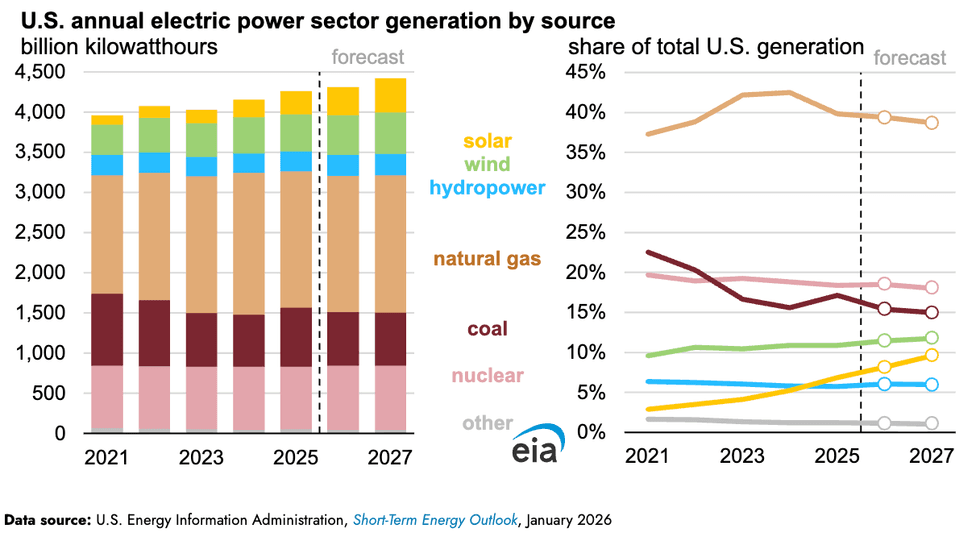 If you look at the second chart, solar is on a clear incline.EIA

 Turning over a new leaf on overcapacity? Xu Changliang/VCG via Getty Images