As I walked participants through Heatmap’s end-of-year survey, there was one question that consistently elicited thoughtful sighs, nervous laughs, and cautious qualifications from the 55 climate researchers, policymakers, scientists, innovators, business leaders, and other prominent voices that we spoke with.
On its face, the question was simple: Is China more of a hero or villain on climate?
Some said the country is a hero, full stop. Only four tilted toward villain. One investor told me I should write a book about this question. And 13 couldn’t quite decide — perhaps both? Maybe neither? As Mijin Cha, an environmental studies professor at the University of California, Santa Cruz put it to my colleague, “Is China doing more on decarbonization than other countries? Yes. Are they doing it in a way that I think is just? Unlikely.”
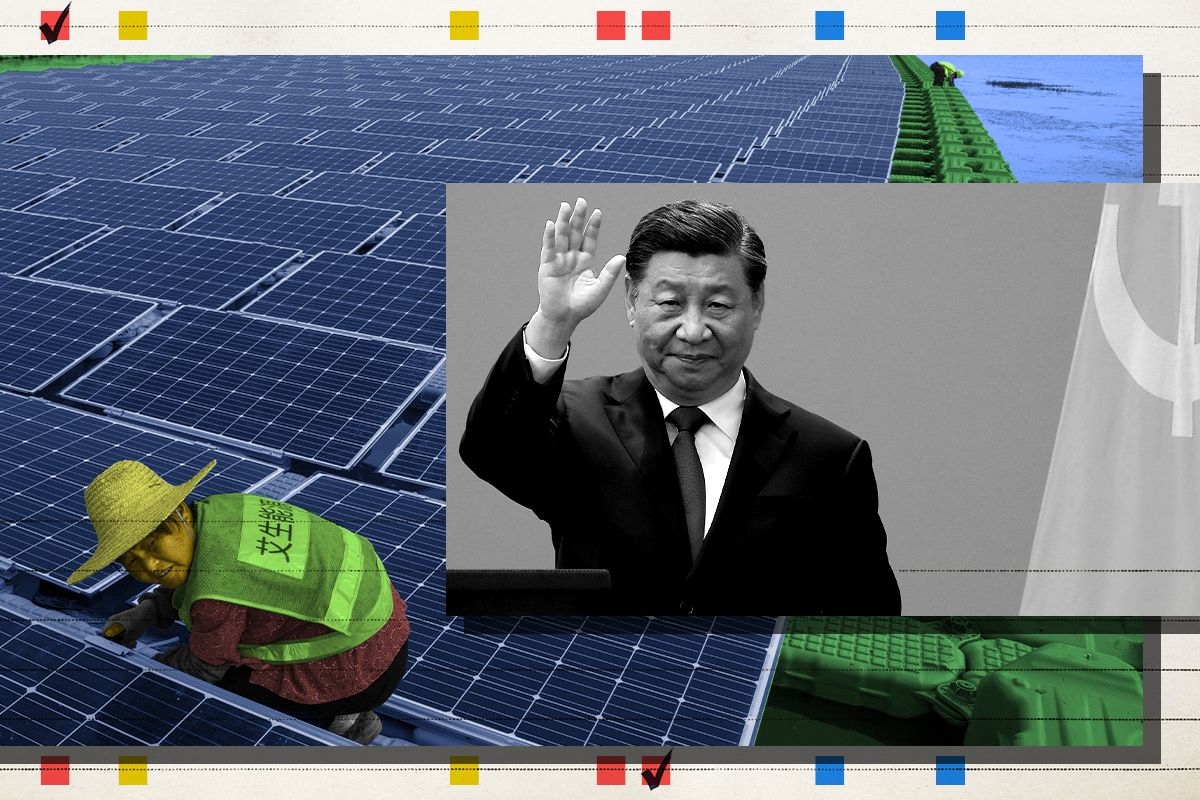
In the final tally, nearly three quarters of our survey respondents viewed China as more of a hero overall. The general vibe was one of conflicted but reluctant appreciation for a nation that’s building more new coal capacity than any other country on Earth but also magnitudes more solar, wind, and batteries. Not to mention the way that it’s cleaning America’s clock on manufacturing electric vehicles, especially the more affordable models. In China, over 50% of all new cars sold this year were EVs compared to only about 10% in the U.S.
“If you’re looking at scaling the production of clean energy, infrastructure, and assets, they’re a hero,” one climate tech investor told me. “We blew that one.”
Perhaps it’s unsurprising that many of the “innovators” I spoke with — a category largely comprised of U.S.-based climate tech investors — were especially gung-ho about China, with 14 out of 16 saying that it’s a hero. After all, the country builds stuff, and fast. In the U.S., construction on our two most recently completed nuclear reactors took roughly 15 years and over $35 billion. China is home to nearly half of the world’s reactors under construction, building them for an average of about $3 billion each.
Even when it comes to fusion — long dominated by American national labs, universities, and entrepreneurs — China is catching up quickly, as the government pours billions into its new state-owned fusion company.
Whereas Tom Chi of At One Ventures told me that there’s a narrative in the U.S. that clean energy is “this huge economic drag, just for these liberal elites trying to go push their agenda,” China’s actions offer a wordless rebuttal best summarized as, “you might have that wrong, because we’re making crazy money on green technologies.”
“It’s like the Nike commercial — they just do it,” a former Department of Energy employee told my colleague. By contrast, the U.S. can look litigious and regulation-heavy, with layers of environmental review, permitting, and lawsuits routinely stalling domestic projects. China’s blend of technocratic authoritarianism gives it the freedom to sidestep red tape and override local opposition, respondents told us.
Not to say that the country’s advances are solely the product of its own ingenuity. As another climate-focused venture investor told me, “A lot of Chinese companies are just taking what American companies do and then copying or short-circuiting or stealing IP.” On net, however, they still felt that China tilted toward the hero side of the ledger.
The one person I spoke with who categorized China as a villain — an investor focused on first-of-a-kind projects — argued that it’s important to consider not just what China does at home, but also “what they’re going to do to everyone else.”
Indeed, research shows that the country is still financing the construction of coal plants abroad, despite a 2021 pledge to stop doing so, and it’s deeply entwined with Africa’s oil and gas industry. China also outsources some of the dirtiest links in its battery supply chain — think cobalt mining in the Democratic Republic of the Congo and nickel mining in Indonesia — to low-income countries with exploitative labor practices and lax environmental standards.
“I think China will increase other countries’ emissions substantially while reducing their own,” this investor told me.
Part of what seemed to make this question so messy was the overall perception that on climate, China’s actions are mostly driven by self-interest rather than any grander, “heroic” sense of global responsibility. The nation’s latest round of emissions reductions targets — which all Paris Agreement countries are required to update every five years — were widely seen as underwhelming and insufficient, reinforcing the perception that the country is more interested in being an economic powerhouse than a climate leader.
Thus, China’s role in the energy transition will "entirely hinge” on whether it views “the market opportunity to enhance decarbonization with Chinese technology as advantageous or disadvantageous,” another climate tech VC told me. Naturally, they predict that China will continue to see this moment as an opportunity to fuel economic growth and expand its global reach.
“China is more like water flowing downhill. There’s no value to it, they’re just doing what’s smart and strategic,” one lawmaker told my colleague, landing on the same conclusion that most eventually accepted. “The effect of it will be, on balance, heroic."
The Heatmap Insiders Survey of 55 invited expert respondents was conducted by Heatmap News reporters during November and December 2025. Responses were collected via phone interviews. All participants were given the opportunity to record responses anonymously. Not all respondents answered all questions.




 The great localization push of 2026. OSW
  The 1990s are back. EIA