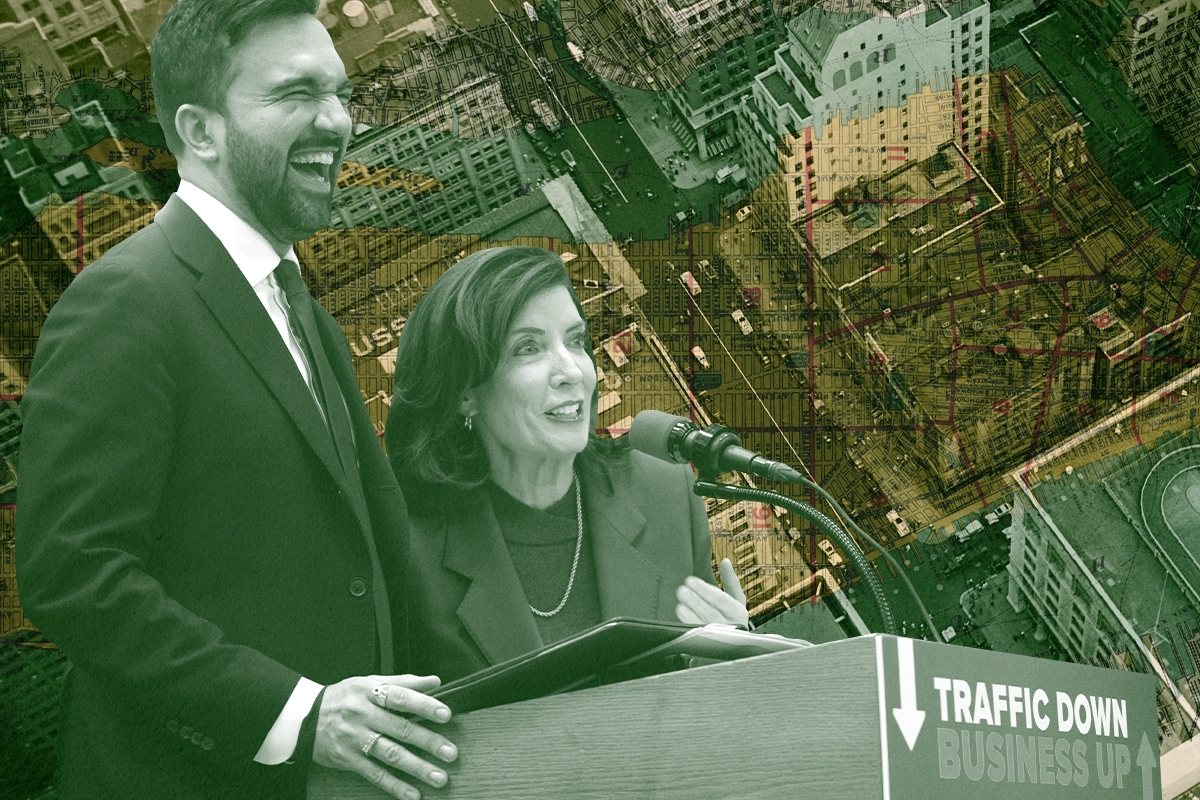
A federal court shot down President Trump’s attempt to kill New York City’s congestion pricing program on Tuesday, allowing the city’s $9 toll on cars entering downtown Manhattan during peak hours to remain in effect.
Judge Lewis Liman of the U.S. District Court for the Southern District of New York ruled that the Trump administration’s termination of the program was illegal, writing, “It is difficult to imagine more arbitrary and capricious decisionmaking than that at issue here.”
So concludes a fight that began almost exactly one year ago, just after Trump returned to the White House. On February 19, 2025, the newly minted Transportation Secretary Sean Duffy sent a letter to Kathy Hochul, the governor of New York, rescinding the federal government’s approval of the congestion pricing fee. President Trump had expressed concerns about the program, Duffy said, leading his department to review its agreement with the state and determine that the program did not adhere to the federal statute under which it was approved.
Duffy argued that the city was not allowed to cordon off part of the city and not provide any toll-free options for drivers to enter it. He also asserted that the program had to be designed solely to relieve congestion — and that New York’s explicit secondary goal of raising money to improve public transit was a violation.
Trump, meanwhile, likened himself to a monarch who had risen to power just in time to rescue New Yorkers from tyranny. That same day, the White House posted an image to social media of Trump standing in front of the New York City skyline donning a gold crown, with the caption, "CONGESTION PRICING IS DEAD. Manhattan, and all of New York, is SAVED. LONG LIVE THE KING!"
New York had only just launched the tolling program a month earlier after nearly 20 years of deliberation — or, as reporter and Hell Gate cofounder Christopher Robbins put it in his account of those years for Heatmap, “procrastination.” The program was supposed to go into effect months earlier before, at the last minute, Hochul tried to delay the program indefinitely, claiming it was too much of a burden on New Yorkers’ wallets. She ultimately allowed congestion pricing to proceed with the fee reduced from $15 during peak hours to $9, and thereafter became one of its champions. The state immediately challenged Duffy’s termination order in court and defied the agency’s instruction to shut down the program, keeping the toll in place for the entirety of the court case.
In May, Judge Liman issued a preliminary injunction prohibiting the DOT from terminating the agreement, noting that New York was likely to succeed in demonstrating that Duffy had exceeded his authority in rescinding it.
After the first full year the program was operating, the state reported 27 million fewer vehicles entering lower Manhattan and a 7% boost to transit ridership. Bus speeds were also up, traffic noise complaints were down, and the program raised $550 million in net revenue.
The final court order issued Tuesday rejected Duffy’s initial arguments for terminating the program, as well as additional justifications he supplied later in the case.
“We disagree with the court’s ruling,” a spokesperson for the Transportation Department told me, adding that congestion pricing imposes a “massive tax on every New Yorker” and has “made federally funded roads inaccessible to commuters without providing a toll-free alternative.” The Department is “reviewing all legal options — including an appeal — with the Justice Department,” they said.