This is what Span’s smart panel does — it manages the energy drawn by household appliances to help homeowners integrate electric vehicle chargers and heat pumps without triggering the need for electrical upgrades.
Now the age of AI has opened up new opportunities for the company. Last month, Span announced the launch of XFRA, a device that works with Span’s smart panel to power AI applications by tapping into the unused electrical capacity available to homes and businesses.
The company refers to XFRA as a “distributed data center.” It’s sort of like if you chopped up a full-scale data center into washing machine-sized boxes and plugged them into peoples’ homes; Span’s smart panel then acts as a conductor, orchestrating XFRA’s energy consumption to take advantage of unused power capacity without stepping on the home’s other energy needs. In exchange for hosting one of these XFRA “nodes,” Span will offer homeowners and tenants deeply discounted, if not free electricity and internet service.
The idea sounded audacious, verging on fantastical, until I watched the economics play out in real time at one of Span’s labs in a warehouse south of San Francisco. Ryan Harris, the company’s chief revenue officer, showed me an XFRA prototype — a metal box about the size of a freezer chest stuffed with Dell servers and Nvidia liquid-cooled GPUs. Span was renting out the processing power from this node and six others to AI users through an online marketplace. On a computer screen next to the unit, a dashboard showed the revenue flowing in from the fleet — $500 over the past 24 hours, and more than $21,000 in the previous three weeks. The numbers continued to tick up as I stood there.
When I first planned to write about Span, XFRA was still a secret. I reached out because its smart panel business, which debuted in 2019, seemed to suddenly take off.
In February, Span announced that PG&E, the largest utility in California, would be installing its devices in thousands of homes beginning this summer. Then in March, the company revealed a partnership with Eaton, one of the biggest legacy electrical equipment companies in the world. Eaton is investing $75 million in Span and will begin selling co-branded electrical panels to its extensive network of distributors, installers, and homebuilders later this year. With the launch of XFRA, Span is becoming something like a utility itself. To date, the company has raised more than $400 million, and will soon close a nearly $200 million Series C.
Of course it will take more than smart electrical panels to serve data centers’ soaring power needs. In this era of unprecedented energy demand growth, building a bigger electrical system is unavoidable — but the size of the investment, and the cost impacts on everyday electricity customers, are malleable. Several recent studies have shown just how big the opportunity is to get more energy out of our existing infrastructure if the entire system can become a bit more flexible.
Last year, Duke University researchers found that on average, the U.S. is utilizing only about half of our electricity generation capacity. Nationwide, they estimated, the grid could accommodate at least 76 gigawatts of new load — close to the total generation capacity installed in California — without having to upgrade the electrical system or build new power plants, so long as those new end-users were somewhat flexible with when and how much electricity they used.
More recently, in a report commissioned by a coalition called Utilize, of which Span is a member, the Brattle Group found that milking just 10% more from our existing grid infrastructure on an annual basis could reduce electricity rates for all end users by 3.4%. Utilities can sell more energy, faster, and spread the fixed costs of running the system across more customers.
What all this meant in practice did not fully click for me until I saw a demonstration of Span’s panel at the lab a few weeks ago. Harris, the CRO, led me to a free-standing wall lined with household appliances, a stripped-down version of an all-electric home. A minisplit heat pump whirred while a high-speed electric vehicle charger was juicing up a Rivian parked on the warehouse floor. A TV screen displayed the amount of power going to each device, as measured by Span’s electric panel.
Together, the heat pump and charger were using about two-thirds of the electric capacity of this demonstration home, which was running on a 100-amp utility service connection. The charger alone was using 48 amps.
The owner of this theoretical home would typically not have been allowed to install such an energy-intensive EV charger without upgrading to 200-amp service. Electric codes require that residential electrical systems have room for the rare scenario that a home’s major appliances all run at once, for safety reasons. Otherwise, the occupants might accidentally try to draw more power than their utility connection can deliver, overheat their wires, and start a fire. 100-amp connections are exceedingly common in homes designed to use gas or propane for cooking and heating, but once you replace those appliances with electric versions, or add an EV charger, you start to push the limit.
A service upgrade to 200 amps can take many months and cost several thousands of dollars. The utility typically has to run new wiring to the house, and might even have to augment the grid infrastructure serving the neighborhood.
Span’s smart panel offers an alternative.
“Shall we turn on some load?” Harris said. An engineer on Span’s product team turned on the demo home’s electric water heater, and I watched as the chart on the screen adjusted. The water heater jumped from zero to 22 amps, while the EV charger’s amperage decreased from 48 to 33. When the engineer switched on the clothes dryer, drawing 24 amps, the EV charger’s amperage dropped further.
The electrical panel was tracking how much power was flowing to each of its circuits and throttling the EV charger in response. When the team dialed up the electric stove to heat a pot of water, the EV charger shut off altogether.
Next, Harris requested a boost to the “garage” sub-panel, simulating a hot tub or some power tools kicking on. Soon, the water heater shut off, too. “You have 50 gallons of hot water, so it’s not going to have any negative impact on the customer in that moment,” Harris told me. He showed me an alert that appeared on the Span phone app notifying the homeowner that the system was temporarily limiting power to the EV charger and water heater in order to power other devices.
Users can choose which appliances the system bumps first. While some devices, such as EV chargers, water heaters, and heat pumps, have the ability to be ramped up and down, others will simply shut off.
At $2,550 excluding labor for the smallest, most basic smart panel, and just over $4,000 for the biggest one, Span is more expensive than the average dumb panel, which can come in under $1,000. Depending on the home and the complexity of a service upgrade, however, it’s often cheaper to install Span than to move to 200 amps. It’s also almost certainly faster.
Span’s first generation product couldn’t do any of this. Initially, the company’s value proposition was just to give people more control over their energy usage. The original Span panel gave homeowners with batteries the ability to select which devices they wanted to power during an outage and ensure they didn’t accidentally lose charge on non-essentials. The company had to build an initial customer base and validate the technology in the real world, Rao told me, before it could earn the credibility (and the capital) to deploy the fully realized version of the product.
In 2023, Span debuted “PowerUp,” the software that makes what I witnessed at the lab possible. With PowerUp, Span’s smart panel went from being a cool gadget to a money-saver, helping homeowners skip utility service upgrades. The success of PowerUp opened the door for Span to engage with larger partners, starting with homebuilders.
“We had to demonstrate that we were safe and scalable in the home retrofit category to then get homebuilders — who are typically very, very cost sensitive, are not often at the tip of the spear in terms of technology adoption — to say, this is a proven technology, and it saves you money,” said Rao.
Residential developers face similar problems as homeowners, but on a bigger scale. While 200-amp connections have become more standard over the past few decades, new electrical codes that require either fully electric or electric-ready construction are pushing the limits.
“Now the load calculations will put them at 300 or 400 amps of service per home,” Rao told me. “Multiply that by a community of 500 homes, and suddenly you’ve doubled the amount of interconnection you need to bring from the utility.”
This raises the cost of development, and it can also increase the wait time — potentially by years — to get hooked up to the grid. Again, Span offers an alternative. To date, nearly half of the top 20 homebuilders across the U.S. have used the company’s technology, Rao told me. More broadly, its electrical panels have been installed in tens of thousands of homes in all 50 states.
I should note that Span is not the only solution on the market for homeowners or homebuilders to avoid service upgrades — the main alternative is just choosing appliances that don’t use so much power. There are water heaters, clothes dryers, and EV chargers on the market that run on lower amperage, and startups like Copper and Impulse Labs are making stoves with integrated batteries that enable them to do the same. There are also Span-adjacent technologies such as smart circuit splitters that let you plug two power-hungry devices, like an EV charger and a clothes dryer, into the same circuit, and the device will safely modulate power between the two.
“You can hack your way around both problems — one, of a panel upgrade, and two, a Span upgrade, which is also expensive — with cheaper solutions,” Brian Stewart, the co-founder of Electrify Now, a group that provides education and advocacy on home electrification, told me. “But it’s less elegant, let’s just say, than the Span solution.”
Though he started at the home level, Rao has always had his sights set on a much bigger customer — utilities. Several Span executives I spoke to referenced an “infamous” Powerpoint slide from the early days of the company with a bar chart that showed how the company would scale in three phases. First came “back-up,” referring to Span’s initial home battery management product. Next was “power-up,” the software that enabled electrification by avoiding service upgrades. The third was “fleet.”
The same safety principles that trigger service upgrades at individual homes also apply upstream at the neighborhood level. For example, the size of a neighborhood’s transformer, the equipment that changes the voltage of the electricity as it moves along the grid, depends on the combined amperage of the homes it serves. If all those homes are installing EV chargers or heat pumps or whatever else and starting to use more electricity, the utility will have to upgrade the transformer — a cost that gets spread across all of its customers. If a critical mass of the homes have Span panels, however, they can avoid this.
Partnering with major homebuilders earned Span “the right to sit at the table with utilities,” Rao told me, “and say, look, we’ve done this at the home level, at the community level. Imagine if you could do this at the grid level, where the benefit doesn’t just accrue to individual customers or home builders, it can accrue to all rate payers?”
I got a taste of what this looks like back at the lab, where Harris showed me Span’s “fleet capability.” There were actually three demonstration homes set up on the warehouse floor, and Harris showed me how a utility could coordinate a response across multiple Span panels to keep a neighborhood within its safe energy limits.
Imagine it’s a really hot day, and the utility is on the verge of having to institute rolling blackouts. Instead, it can implement what’s called a dynamic service rating event, sending a signal out to the Span panels served by a given transformer to reduce their electrical limit from 100 amps to 60, for example. Rather than the entire neighborhood losing power, a few homes would see their EV charging cut back or their thermostats go up by a few degrees. Of course, not everybody will want to give this kind of control to the utility; customers often cite concerns about comfort and convenience as reasons they are skeptical of these kinds of programs. When I asked Harris whether participating would require that Span customers opt in, he said it was more likely to be opt-out.
Span has done several pilot projects testing this capability. Installing electrical panels is too complex for utilities to do en masse, though. So the company developed Span Edge, a smaller version of its panel that can be installed at a building’s electricity meter. It does all the same things the larger electrical panel does, without needing to serve as the home’s central nervous system. It still enables homeowners to avoid service upgrades by throttling EV chargers or whatever other devices are hooked up to it, but it’s much simpler to install.
This is the device that the California utility PG&E will begin deploying in homes later this summer. The company will offer Span Edge to homeowners who are installing appliances that might trigger an electrical upgrade, or are considering doing so in the future, through a program called PanelBoost. It’s entirely voluntary, and while participants will have to pay for installation, the panel itself comes gratis.
“This is the first time that there’s a large-scale direct purchase of Span equipment by a utility,” Alex Pratt, Span’s vice president of business development, told me. “This has long been the North Star for the company.”
Paul Doherty, the manager for clean energy and innovation communications at PG&E, told me the company saw Span Edge as a “win, win, win for PG&E, for our customers, and for the environment.” It enables customers to electrify their homes more quickly and affordably, and for PG&E to sell more electrons without raising rates.
“We’re very bullish about the opportunity for this technology and the benefit that it will bring for the grid and for our customers here in California,” Doherty told me.
Rao sees XFRA as a natural evolution of Span’s basic premise. The company has found that 98% of its customers that have 200-amp service connections have about 80 amps available at any given time, Harris told me. Hosting an XFRA node enables homeowners to monetize that unused capacity.
To start, Span is prioritizing getting XFRA into newly built homes, where the developer handles customer acquisition and installing at scale is straightforward since every home is roughly the same. The company has partnered with the developer PulteGroup to roll out a 100-home pilot program for a total of over 1.2 megawatts of compute capacity. The partners have not specified where it will be yet or whether there will be a single offtaker for the compute.
In the longer term, Rao told me, XFRA could be the “unlock” that makes electrification more affordable for people. “There is a utopian end state in my mind where XFRA allows more of our customers to get free energy, free backup, and free internet,” he said.
First, the company will have to find out if anyone is actually willing to let XFRA into their home. During my final conversation with the CEO, after my lab visit, he showed me the infamous slide forecasting the company’s growth from “back-up to power-up to fleet.” The y-axis on the chart showed the number of homes per year the company could address at each stage. The bar for back-up systems landed at 5,000 per year, Power-up came to nearly 100,000. Suffice it to say, Span hasn’t hit these numbers.
“Are you where you want to be today?” I asked him.
Of course, he wasn’t going to say no. “We have contracts in place for hundreds of thousands of homes already with utilities,” he said. “Right now our focus is on execution — delivering on that scale, as opposed to finding that scale. It’s a deployed product, it’s not a downloadable app, so it takes time to physically deploy hundreds of thousands of endpoints. So I think that scale is coming.”



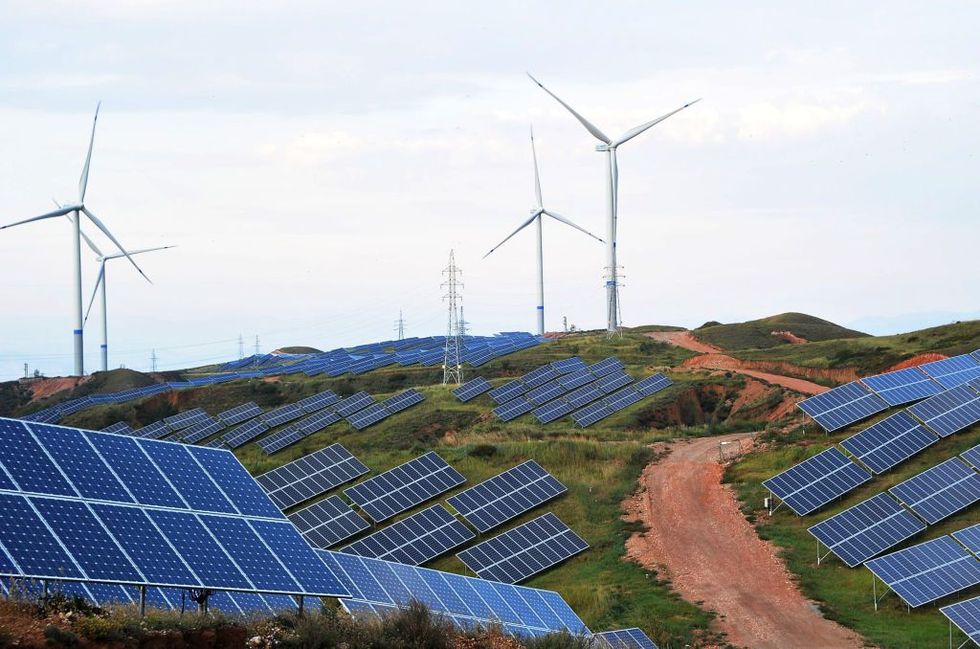 Solar panels and wind turbines in Zhangjiakou in China's Hebei province.Photo by VCG




 The Kudankulam nuclear power plant, India’s largest atomic station. Pallava Bagla/Corbis via Getty Images