You’re out of free articles.
Log in
To continue reading, log in to your account.
Create a Free Account
To unlock more free articles, please create a free account.
Sign In or Create an Account.
By continuing, you agree to the Terms of Service and acknowledge our Privacy Policy
Welcome to Heatmap
Thank you for registering with Heatmap. Climate change is one of the greatest challenges of our lives, a force reshaping our economy, our politics, and our culture. We hope to be your trusted, friendly, and insightful guide to that transformation. Please enjoy your free articles. You can check your profile here .
subscribe to get Unlimited access
Offer for a Heatmap News Unlimited Access subscription; please note that your subscription will renew automatically unless you cancel prior to renewal. Cancellation takes effect at the end of your current billing period. We will let you know in advance of any price changes. Taxes may apply. Offer terms are subject to change.
Subscribe to get unlimited Access
Hey, you are out of free articles but you are only a few clicks away from full access. Subscribe below and take advantage of our introductory offer.
subscribe to get Unlimited access
Offer for a Heatmap News Unlimited Access subscription; please note that your subscription will renew automatically unless you cancel prior to renewal. Cancellation takes effect at the end of your current billing period. We will let you know in advance of any price changes. Taxes may apply. Offer terms are subject to change.
Create Your Account
Please Enter Your Password
Forgot your password?
Please enter the email address you use for your account so we can send you a link to reset your password:
A trio of powerful climate hawks are throwing their weight against the SPEED Act.

Key Senate Democrats are opposing a GOP-led permitting deal to overhaul federal environmental reviews without assurances that clean energy projects will be able to reap the benefits. Winning these lawmakers’ support will require major concessions to build new transmission infrastructure and greater permitting assistance for renewable energy projects.
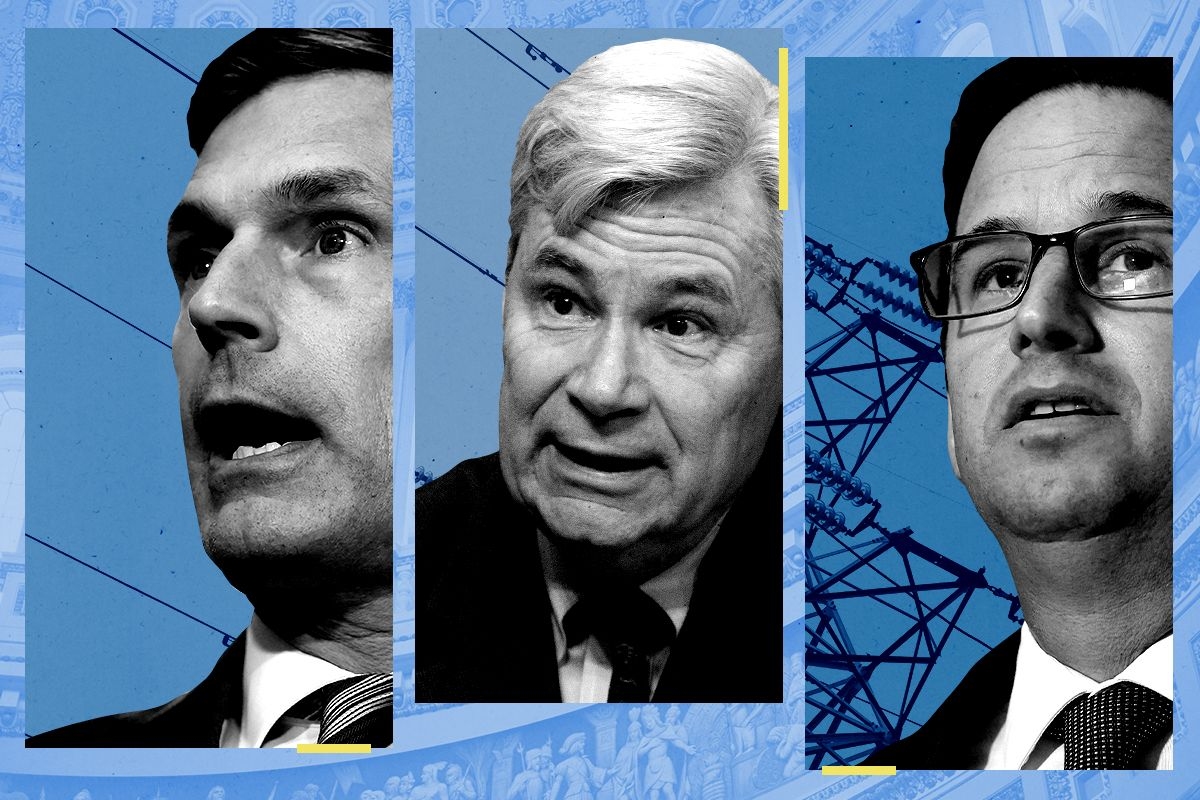
In an exclusive joint statement provided Tuesday to Heatmap News, Senate Energy and Natural Resources ranking member Martin Heinrich, Environment and Public Works ranking member Sheldon Whitehouse, and Hawaii senator Brian Schatz came out against passing the SPEED Act, a bill that would change the National Environmental Policy Act, citing concerns about how it would apply to renewable energy and transmission development priorities.
“We are committed to streamlining the permitting process — but only if it ensures we can build out transmission and cheap, clean energy. While the SPEED Act does not meet that standard, we will continue working to pass comprehensive permitting reform that takes real steps to bring down electricity costs,” the statement read.
As I wrote weeks ago, there’s very little chance the SPEED Act could become law without addressing Senate climate hawks’ longstanding policy preferences. Although the SPEED Act was voted out of committee in the House two weeks ago with support from a handful of Democratic lawmakers, it has yet to win support from even moderate energy wonks in that legislative body, including Representative Scott Peters, one of the Democratic House negotiators in bipartisan permitting talks. Peters told me he would need to see more assurances dealing with the renewables permitting freeze, for example, in order for him to support the bill.
Observers had initially expected a full House vote on the SPEED Act as soon as this week, but an additional hurdle arose in recent days in the form of opposition from House conservative Republicans, led by Representative Chip Roy. The congressman from Texas had requested additional federal actions targeting renewables projects in exchange for passage of the One Big Beautiful Bill Act, which effectively repealed the Inflation Reduction Act. What followed was a set of directives from the Interior Department that all but halted federal solar and wind permitting. Roy’s frustration with the SPEED Act concerns a relatively milquetoast nod to renewables permitting problems that would block presidents from rescinding already issued permits. This upset appears to have delayed a vote on the bill in the House.
There’s an eerie familiarity to this moment: Almost exactly one year ago, the last major attempt at a permitting deal, authored by Senators Joe Manchin and John Barrasso, died when then-Majority Leader Chuck Schumer declined to bring it up for a vote in the face of opposition from the House. Unlike the SPEED Act, that bill offered changes to transmission siting policy that even conservative estimates said would’ve hastened the pace of national decarbonization.
Having Schatz, Heinrich, and Whitehouse — the three most powerful climate hawks in Congress — throw their weight against the SPEED Act casts serious doubt on the prospects for that legislation becoming the permitting deal this Congress. It also exposes an intra-energy world conflict, as it appears to position these lawmakers in opposition to American Clean Power, an energy trade group that represents a swath of diversified energy companies and utilities, as well as solar, wind, and battery storage developers.
Last week, ACP joined with the American Petroleum Institute and gas pipeline advocacy organizations to urge Congress to pass the SPEED Act. In a letter to House Speaker Mike Johnson and Minority Leader Hakeem Jeffries, ACP and the fossil fuel industry trade groups said that the legislation “directly addresses” the challenges facing their interests and “represents meaningful bipartisan progress toward a more stable and dependable permitting framework.” The only reference to potential additions came in a single, vague line: “While the SPEED Act makes important progress, there are additional ways Congress can facilitate the development of reliable and affordable energy infrastructure as part of a broader permitting package.”
This letter was taken by some backers of the renewable energy industry to be an endorsement without concessions. It was also a surprise because just days earlier, American Clean Power responded to the bill’s passage with a vaguely supportive statement that declared “additional efforts” were needed for “transmission infrastructure,” without which “energy prices will spike and system reliability will be threatened.” (It’s worth noting that the committee behind the SPEED Act, House Natural Resources, has no authority over transmission siting. No other proposal has yet emerged from Republicans in that chamber for Republicans to address the issue, either.)
One of the renewables backers taken aback was Schatz, who took to X to sound off against the organization. “Congratulations to ‘American Clean Power’ for cutting a deal with the American Petroleum Institute, but to enact a law both the house and the Senate have to agree, and Senators are finding out about this for the first time,” Schatz wrote in a post, which Whitehouse retweeted from one of his official X accounts.
In a subsequent post, Schatz said: “I am not finding out about the bill’s existence for the first time, I am tracking it all very closely. I am finding out that ACP endorsed it as is without anything on transmission, for the first time.”
By contrast, the statement from the three senators aligns them with the Solar Energy Industries Association, which sent a letter from more than 140 solar companies to top congressional leaders requesting direct action to fix a bureaucratic freeze on permit-related activity that has already helped kill large projects, including Esmeralda 7, which was the largest solar mega-farm in the United States.
In its message to Congress, the trade association made plain that while the SPEED Act was a welcome form of permitting changes, it was nowhere close to dealing with Trumpian chicanery on the group’s priority list.
We’ll have more on this unfolding drama in the days to come.
Log in
To continue reading, log in to your account.
Create a Free Account
To unlock more free articles, please create a free account.
One longtime analyst has an idea to keep prices predictable for U.S. businesses.
What if we treated lithium like oil? A commodity so valuable to the functioning of the American economy that the U.S. government has to step in not only to make it available, but also to make sure its price stays in a “sweet spot” for production and consumption?
That was what industry stalwart Howard Klein, founder and chief executive of the advisory firm RK Equities, had in mind when he came up with his idea for a strategic lithium reserve, modeled on the existing Strategic Petroleum Reserve.
Klein published a 10-page white paper on the idea Monday, outlining an expansive way to leverage private companies and capital markets to develop a non-Chinese lithium industry without the risk and concentrated expense of selecting specific projects and companies.
The lithium challenge, Klein and other industry analysts and executives have long said, is that China’s whip hand over the industry allows it to manipulate prices up and down in order to throttle non-Chinese production. When investment in lithium ramps up outside of China, Chinese production ramps up too, choking off future investment by crashing prices.
Recognizing the dangers stemming from dysfunction in the global lithium market constitutes a rare area of agreement between both parties in Washington and across the Biden and Trump administrations. Last year, a Biden State Department official told reporters that China “engage[s] in predatory pricing” and will “lower the price until competition disappears.”
A bipartisan investigation released last month by the House of Representatives’ Select Committee on Strategic Competition between the United States and the Chinese Communist Party found that “the PRC engaged in a whole‐of‐government effort to dominate global lithium production,” and that “starting in 2021, the PRC government engaged in a coordinated effort to artificially depress global lithium prices that had the effect of preventing the emergence of an America‐focused supply chain.”
Klein thinks he’s figured out a way to deal with this problem
“They manipulated and they crushed prices through oversupply to prevent us from having our own supply chains,” he told me.
It’s not just that China can keep prices low through overproduction, it’s also that the country’s enormous market power can make prices volatile, Klein said, which scares off private sector investment in mining and processing. “You have two years, up two years down, two years up, two years down,” he told me. “That’s the problem we’re trying to solve.
His proposal is to establish “a large, rules-based buffer of lithium carbonate — purchased when prices are depressed due to Chinese oversupply, and released during price spikes, shortages, or export restrictions.”
This reserve, he said, would be more than just a stockpile from which lithium could be released as needed. It would also help to shape the market for lithium, keeping prices roughly in the range of $20,000 per ton (when prices fall below that, the reserve would buy) and $40,000 to $50,000 per ton, when the reserve would sell. The idea is to keep the price of lithium carbonate — which can be processed as a material for batteries with a wide range of defense (e.g. drones) and transportation (e.g. electric vehicles) applications — within a range that’s reasonable for investors and businesses to plan around.
“Lithium has swung from like $6,000 [per ton] to $80,000, back down to $9,000, and now it’s at $11,000 or $12,000,” Klein told me. “But $11,000 or $12,000 is not a high enough price for a company to build a plan that’s going to take three to five years. They need $20,000 to $25,000 now as a minimum for them to make a $2 billion dollar investment.” When prices for lithium get up to “$50,000, $60,000, or $70,000, then it becomes a problem because battery makers can’t make money.”
Both the Biden and Trump administrations have taken more active steps to secure a U.S. or allied supply chain for valuable inputs, including rare earth metals. But Klein’s proposed reserve looks to balance government intervention with a diverse, private-sector led industry.
The reserve would be more broad-based than price floor schemes, where a major buyer like the Defense Department guarantees a minimum price for the output from a mine or refining facility. This is what the federal government did in its deal with MP Materials, the rare earths miner and refiner, which secured a multifaceted deal with the federal government earlier this year.
Klein estimates that the cost in the first year of the strategic lithium reserve could be a few billion dollars — on the scale of the nearly $2.3 billion loan provided by the Department of Energy for the Thacker Pass mine in Nevada, which also saw the federal government take an equity stake in the miner, Lithium Americas.
Ideally, Klein told me, “there’s a competition of projects that are being presented to prospective funders of those projects, and I want private market actors to decide, should we build more Thacker Passes or should we do the Smackover?” referring to a geologic formation centered in Arkansas with potentially millions of tons of lithium reserves.
Klein told me that he’s trying to circulate the proposal among industry and policy officials. His hoped is that as the government attempts to come up with a solution to Chinese dominance of the lithium industry, “people are talking about this idea and they’re saying, Oh, that’s actually a pretty good idea.”
Current conditions: After a two-inch dusting over the weekend, Virginia is bracing for up to 8 inches of snow • The Bulahdelah bushfire in New South Wales that killed a firefighter on Sunday is flaring up again • The death toll from South and Southeast Asia’s recent floods has crossed 1,750.

President Donald Trump’s Day One executive order directing agencies to stop approving permitting for wind energy projects is illegal, a federal judge ruled Monday evening. In a 47-page ruling against the president in the U.S. District Court for the District of Massachusetts, Judge Patti B. Saris found that the states led by New York who sued the White House had “produced ample evidence demonstrating that they face ongoing or imminent injuries due to the Wind Order,” including project delays that “reduce or defer tax revenue and returns on the State Plaintiffs’ investments in wind energy developments.” The judge vacated the order entirely.
Trump’s “total war on wind” may have shocked the industry with its fury, but the ruling is a sign that momentum may be shifting. Wind developers have gathered unusual allies. As I wrote here in October, big oil companies balked at Trump’s treatment of the wind industry, warning the precedents Republican leaders set would be used by Democrats against fossil fuels in the future. Just last week, as I reported here, the National Petroleum Council advised the Department of Energy to back a national permitting reform proposal that would strip the White House of the power to rescind already-granted licenses.
Back in October, I told you about how the head of the world’s biggest metal trading house warned that the West was getting the critical mineral problem wrong, focusing too much on mining and not enough on refining. Now the Energy Department is making $134 million available to projects that demonstrate commercially viable ways of recovering and refining rare earths from mining waste, old electronics, and other discarded materials, Utility Dive reported. “We have these resources here at home, but years of complacency ceded America’s mining and industrial base to other nations,” Secretary of Energy Chris Wright said in a statement.
If you read yesterday’s newsletter, you may recall that the move comes as the Trump administration signals its plans to take more equity stakes in mining companies, following on the quasi-nationalization spree started over the summer when the U.S. military became the largest shareholder in MP Materials, the country’s only active rare earths miner, in a move Heatmap's Matthew Zeitlin noted made Biden-era officials jealous.
NextEra Energy is planning to develop data centers across the U.S. for Google-owner Alphabet as the utility giant pivots from its status as the nation’s biggest renewable power developer to the natural gas preferred by the Trump administration. The Florida-based company already had a deal to provide 2.5 gigawatts of clean energy capacity to Facebook-owner Meta Platforms, and also plans gas plants for oil giant Exxon Mobil Corp. and gas producer Comstock Resources. Still, NextEra’s stock dropped by more than 3% as investors questioned whether the company’s skills with solar and wind can be translated to gas. “They’ve been top-notch, best-in-class renewable developers,” Morningstar analyst Andy Bischof told Bloomberg. “Now investors have to get their head around whether that can translate to best-in-class gas developer.”
Sign up to receive Heatmap AM in your inbox every morning:
In October, Google backed construction of the first U.S. commercial installation of a gas plant built from the ground up with carbon capture. The project, which Matthew wrote about here, had the trappings to work where other experiments in carbon capture failed. The location selected for the plant already had an ethanol facility with carbon capture, and access to wells to store the sequestered gas. Now the U.S. could have another plant. In a press release Monday, the industrial giant Babcock and Wilcox announced a deal with an unnamed company to supply carbon capture equipment to an existing U.S. power station. More details are due out in March 2026.
Executives from at least 14 fusion energy startups met with the Energy Department on Monday as the agency looks to spur construction of what could be the world’s first power plants to harness the reaction that powers the sun. The Trump administration has made fusion a priority, issuing a roadmap for commercialization and devoting a new office to the energy source, as I wrote in a breakdown of the agency’s internal reorganization last month. It is, as Heatmap’s Katie Brigham has written, “finally, possibly, almost time for fusion” as billions of dollars flow into startups promising to make the so-called energy source of tomorrow a reality in the near future. “It is now time to make an investment in resources to match the nation’s ambition,” the Fusion Industry Association, the trade group representing the nascent industry, wrote in a press release. “China and other strategic competitors are mobilizing billions to develop the technology and capture the fusion future. The United States has invested in fusion R&D for decades; now is the time to complete the final step to commercialize the technology.” Indeed, as I wrote last month, China has forged an alliance with roughly a dozen countries to work together on fusion, and it’s spending orders of magnitude more cash on the energy source than the U.S.
Founded by a former Google worker, the startup Quilt set out to design chic-looking heat pumps sexy enough to serve as decor. Investors like the pitch. The company closed a $20 million Series B round on Monday, bringing its total fundraising to $64 million. “Our growth demonstrates that when you solve for comfort, design, and efficiency simultaneously, adoption accelerates,” Paul Lambert, chief executive and co-founder of Quilt, said in a statement. “This funding enables us to bring that experience to millions more North American homes.”
Adorable as they are, Japanese kei cars don’t really fit into American driving culture.
It’s easy to feel jaded about America’s car culture when you travel abroad. Visit other countries and you’re likely to see a variety of cool, quirky, and affordable vehicles that aren’t sold in the United States, where bloated and expensive trucks and SUVs dominate.
Even President Trump is not immune from this feeling. He recently visited Japan and, like a study abroad student having a globalist epiphany, seems to have become obsessed with the country’s “kei” cars, the itty-bitty city autos that fill up the congested streets of Tokyo and other urban centers. Upon returning to America, Trump blasted out a social media message that led with, “I have just approved TINY CARS to be built in America,” and continued, “START BUILDING THEM NOW!!!”
He’s right: Kei cars are neat. These pint-sized coupes, hatchbacks, and even micro-vans and trucks are so cute and weird that U.S. car collectors have taken to snatching them up (under the rules that allow 25-year-old cars to be imported to America regardless of whether they meet our standards). And he’s absolutely right that Americans need smaller and more affordable automotive options. Yet it’s far from clear that what works in Japan will work here — or that the auto execs who stood behind Trump last week as he announced a major downgrading of upcoming fuel economy standards are keen to change course and start selling super-cheap economy cars.
Americans want our cars to do everything. This country’s fleet of Honda CR-Vs and Chevy Silverados have plenty of space for school carpools and grocery runs around town, and they’re powerful and safe enough for road-tripping hundreds of miles down the highway. It’s a theme that’s come up repeatedly in our coverage of electric vehicles. EVs are better for cities and suburbs than internal combustion vehicles, full stop. But they may never match the lightning-fast road trip pit stop people have come to expect from their gasoline-powered vehicles, which means they don’t fit cleanly into many Americans’ built-in idea of what a car should be.
This has long been a problem for selling Americans on microcars. We’ve had them before: As recently as a dozen years ago, extra-small autos like the Smart ForTwo and Scion iQ were available here. Those tiny cars made tons of sense in the United States’ truly dense urban areas; I’ve seen them strategically parked in the spaces between homes in San Francisco that are too short for any other car. They made less sense in the more wide-open spaces and sprawling suburbs that make up this country. The majority of Americans who don’t struggle with street parking and saw that they could get much bigger cars for not that much more money weren’t that interested in owning a car that’s only good for local driving.
The same dynamic exists with the idea of bringing kei cars for America. They’re not made to go faster than 40 or 45 miles per hour, and their diminutive size leaves little room for the kind of safety features needed to make them highway-legal here. (Can you imagine driving that tiny car down a freeway filled with 18-wheelers?) Even reaching street legal status is a struggle. While reporting earlier this year on the rise of kei car enthusiasts, The New York Times noted that while some states have moved to legalize mini-cars, it is effectively illegal to register them in New York. (They interviewed someone whose service was to register the cars in Montana for customers who lived elsewhere.)
If the automakers did follow Trump’s directive and stage a tiny car revival, it would be a welcome change for budget-focused Americans. Just a handful of new cars can be had for less than $25,000 in the U.S. today, and drivers are finally beginning to turn against the exorbitant prices of new vehicles and the endless car loans required to finance them. Individuals and communities have turned increasingly to affordable local transportation options like golf carts and e-bikes for simply getting around. Tiny cars could occupy a space between those vehicles and the full-size car market. Kei trucks, which take the pickup back to its utilitarian roots, would be a wonderful option for small businesses that just need bare-bones hauling capacity.
Besides convincing size-obsessed Americans that small is cool, there is a second problem with bringing kei cars to the U.S., which is figuring out how to make little vehicles fit into the American car world. Following Trump’s declaration that America should get Tokyo-style tiny cars ASAP, Transportation Secretary Sean Duffy said “we have cleared the deck” of regulations that would prevent Toyota or anyone else from selling tiny cars here. Yet shortly thereafter, the Department of Transportation clarified that, “As with all vehicles, manufacturers must certify that they meet U.S. Federal Motor Vehicle Safety Standards, including for crashworthiness and passenger protection.”
In other words, Ford and GM can’t just start cranking out microcars that don’t include all the airbags and other protections necessary to meet American crash test and rollover standards (not without a wholesale change to our laws, anyway). As a result, U.S. tiny cars couldn’t be as tiny as Japanese ones. Nor would they be as cheap, which is a crucial issue. Americans might spend $10,000 on a city-only car, but probably wouldn’t spend $20,000 — not when they could just get a plain old Toyota Corolla or a used SUV for that much.
It won’t be easy to convince the car companies to go down this road, either. They moved so aggressively toward crossovers and trucks over the past few decades because Americans would pay a premium for those vehicles, making them far more profitable than economy cars. The margins on each kei car would be much smaller, and since the stateside market for them might be relatively small, this isn’t an alluring business proposition for the automakers. It would be one thing if they could just bring the small cars they’re selling elsewhere and market them in the United States without spending huge sums to redesign them for America. But under current laws, they can’t.
Not to mention the whiplash effect: The Trump administration’s attacks on EVs left the carmakers struggling to rearrange their plans. Ford and Chevy probably aren’t keen to start the years-long process of designing tiny cars to please a president who’ll soon be distracted by something else.
Trump’s Tokyo fantasy is based in a certain reality: Our cars are too big and too expensive. But while kei cars would be fantastic for driving around Boston, D.C., or San Francisco, the rides that America really needs are the reasonably sized vehicles we used to have — the hatchbacks, small trucks, and other vehicles that used to be common on our roads before the Ford F-150 and Toyota RAV4 ate the American car market. A kei truck might be too minimalist for mainstream U.S. drivers, but how about a hybrid revival of the El Camino, or a truck like the upcoming Slate EV whose dimensions reflect what a compact truck used to be? Now that I could see.