A surge in demand for coolants, water treatments, specialized fire suppressants, and coatings for semiconductors, among other chemicals, has paralleled the data center boom. One market research firm projects that the market for immersion-cooling fluids alone will grow from just shy of $4.9 billion to $11.1 billion by 2030. The industry has seized on the opportunity, with the American Chemistry Council running sponsored content in Beltway publications like Politico and Axios last year pushing for regulatory easements. “AI and other breakthroughs depend on chemistry,” one such headline reads.
Then last summer, President Trump issued an executive order to streamline the federal permitting and regulatory processes around artificial intelligence. EPA Administrator Lee Zeldin followed that move with an announcement that the agency would henceforth prioritize TSCA reviews for any data center-related chemicals and compounds, bypassing what is often a years-long bottleneck. In the eight months since, I’ve counted four new filings for chemicals with purported data center cooling uses, including a rival coolant to Opteon 2P50 from Schimmer & Schwarz.
But Opteon 2P50 stands out for a few reasons. The biggest is that the compound is a polyfluoroalkyl substance, which, along with perfluoroalkyl substances, are referred to as PFAS, or colloquially as “forever chemicals.” Opteon 2P50’s fast-track request has alarmed environmental, public health, and watchdog groups, who fear that the Trump administration’s regulatory shortcut has created a fast lane for approving new PFAS, which can be nearly impossible to remove from the environment once contamination occurs.
So far, two data center-related PFAS are under review by the EPA, Maria Doa, the chemicals policy senior director at the Environmental Defense Fund, told me: a heat transfer fluid with an “almost completely redacted” filing, and Opteon 2P50. While the latter filing is also heavily redacted, it left enough of a paper trail of lab work and toxicology studies that Earthjustice felt it had the grounds to build a credible opposition. “There was a lot of information for us to comment on and make an opinion on the chemical,” Adriana Antezana, a staff scientist at Earthjustice, told me. “It was also one of the few chemicals so far that have been submitted for the EPA to do a priority review under the executive order to prioritize data center infrastructure. That’s why we flagged it.”
It’s fairly common for premanufacture notices, or PMNs, to include heavy redactions as companies argue they need to shield confidential business information; about two-thirds of TSCA filings from 1979 to 2009 did so in the name of protecting trade secrets, according to a review by the Environmental Working Group, a nonpartisan public health and accountability organization. Still, an Earthjustice-fronted coalition of 17 environmental groups has formally asked the EPA to deny the premanufacture notice for Opteon 2P50 because they say it presents “unreasonable risk” to human health and the environment as a PFAS. They also contend that the full information on the risks to people who’ve been exposed to Opteon 2P50 is “unlawfully” redacted from the filing.
“It seems like chemical companies that create PFAS are hopping on the opportunity to create them for electrical industries,” Antezana said. “Obviously this administration is very supportive of semiconductor manufacturing and data centers, and it seems like, unfortunately, there is an opportunity there for a lot of them to get their chemicals approved and used widely.”
Also at play: The company 3M ceased manufacturing PFAS at the end of last year, leaving a vacuum that Chemours appears eager to fill with Opteon 2P50. The new liquid could replace 3M’s Novec immersion-cooling fluid, the previous industry standard, because it also doesn’t conduct electricity. The appeal of such a chemical is obvious: Many data centers currently use water-intensive evaporative cooling or chilling systems to keep their electronics from overheating. (This is why some opponents describe AI as “thirsty.”) Opteon 2P50, on the other hand, facilitates a completely closed-loop system. Because it doesn’t conduct electricity, electronic equipment can be submerged directly into the fluid, which boils off the heat. The vapors cool and condense back into a liquid — the referent in “two-phase immersion cooling” — and recirculate into the tanks.
Chemours has said that Opteon 2P50 can lead to a 90% reduction in cooling energy, a 60% reduction in a data center’s physical footprint, and “nearly eliminate water use,” all with minimal leakage into the environment — the estimated upper-bound emission rate is 2% per year, a company spokesperson told me. (Chemours declined to make a spokesperson available for an interview for this story and provided a statement about its filing via email. The EPA did not respond to a request for comment.)
Chemours has also insisted that Opteon 2P50 is not, in fact, a PFAS. On its face, that is a dubious argument. Per the internationally used structural definition of a PFAS, it's right in the compound’s long formal name, with the initial string of 10 numbers describing the location of 10 fluorine atoms bonded to carbon — the strongest common single bond in organic chemistry and the reason “forever” chemicals are so difficult to break down and remove once they enter the environment. (It’s also why they make great water-resistant coatings.)
But if a PFAS designation is intended to characterize the persistence of a compound — a narrower definition used by the EPA — then Opteon 2P50 doesn’t fit the bill. After a lifespan of only about 70 days in the atmosphere, it reacts and breaks apart into perfluorinated aldehyde, which in turn breaks down into two ultra-short-chain PFAS: perfluoropropanoic acid (PFPrA) and trifluoroacetic acid (TFA).
It might seem like splitting hairs — if Opteon 2P50 eventually breaks down into PFAS, shouldn’t that be all that matters? — but the company’s aversion to the label is understandable. Concern around PFAS has ballooned in recent years as awareness of the difficulty (and in some cases, near impossibility) of removing such compounds from drinking water has increased. The known and suspected health effects of some PFAS, such as PFOA, can also be alarming, including cancers, fertility issues, and pregnancy complications. The issue has created a rift in Trumpworld, dividing the Make America Healthy Again contingent from regulatory reform advocates and industry lobbyists.
While a minority of data centers across the country use closed-loop cooling systems at this point, and of those an even smaller subset use immersion cooling that requires a specialized dielectric fluid like a PFAS, new facilities are already facing public opinion headwinds that a PFAS association could compound. (In a statement, the American Chemistry Council told me: “Not all PFAS are the same. Individual chemistries have differing properties, uses, and environmental and health profiles, and should be evaluated based on their specific characteristics and the best available science rather than treated as a single class.”)
While Chemours argues that leakage isn’t an issue with Opteon 2P50, the fact that it shared an estimated emission rate with me at all acknowledges the realistic possibility that some will reach the outside world. That may be during manufacturing — Chemours said in its filing that it will make Opteon 2P50 outside the United States and import it to its headquarters, but if the PMN is approved, it will also have legal grounds to produce it stateside — or during its disposal, after an estimated 20 years of use in a data center, as confirmed to me by a company spokesperson. But there are few clues to what that end-of-life disposal process would look like. Antezana of Earthjustice told me that in Chemours’ filing, there is “virtually no acknowledgment of disposal” at all. Chemours’ marketing also suggests it is interested in exploring the use of Opteon 2P50 outside data centers, including in electric vehicle batteries, where leaks would presumably be more difficult to contain.
“The rule of thumb is that refrigerants leak,” Lenny Siegel, the director of Chips Communities United, a CHIPS Act watchdog group that also opposes the approval of Opteon 2P50, explained to me. “They can leak when they’re being made; they can leak when they’re being stored; they can leak when they’re being transported; they can leak when they’re being installed in tanks or removed from tanks. My refrigerator might last 20 years, but the electronics in a data center will probably be obsolete in a few years, and there’s been no discussion of how they’re going to make sure that there’s no release [of Opteon 2P50].”
Siegel mentioned his refrigerator because Opteon 2P50 is also a hydrofluoroolefin, or HFO — a class of compounds that break down in the atmosphere in a matter of weeks and are used as alternatives to older CFCs and HFCs, refrigerants that deplete the ozone. In addition to fueling the argument that it isn’t a PFAS, this characteristic is also why the company goes further to say it can actually help fight global warming. It has a far lower warming potential than traditional coolants, which Chemours said in its sustainability report released last week is helping it to reduce its scope 3 emissions.
But this is also where things start to get tricky. Remember those two ultra-short-chain PFAS Opteon 2P50 breaks down into: PFPrA and TFA? The pair are “known for their high mobility in water and difficulty to contain and remediate, resulting in their ubiquitous presence, widespread contamination, and substantial risks to human health and the environment,” Earthjustice said in its public comment. The organization further cites the European Chemicals Agency’s June decision to classify TFA as a reproductive toxin that “may damage fertility.”
“Assuming [Opteon 2P50 is] used, it will be released into the environment, go into the upper atmosphere, and break down and spread TFA on the landscape,” Siegel told me. Its main pathway into humans is through uptake by plants that we or other animals eat; TFA has been detected across food types, one study found, including in bananas, tomatoes, muffins, chicken breast, and wheat.
But Mads Sulbaek Andersen, a professor of chemistry at California State University, Northridge, whose research on TFA Earthjustice cites in its filing to the EPA, told me he thinks the opposition has blown the danger way out of proportion. “You will find people in industry saying sometimes that TFA is not a problem because it is not toxic,” he said. “I would say that’s not quite correct. Everything is toxic [in large enough amounts], but the risk that we see from TFA is not worth worrying about.”
Sulbaek Andersen is a panel member for the United Nations Environmental Program under the Montreal Protocol, which recently concluded an update to the parties on the state of the environment and the gases being used as replacements for the old ozone-depleting CFCs. During its review, which projected how TFA is likely to accumulate in the environment through 2100, “the conclusion is that the risk to environmental health and human health is de minimis,” he told me. He further told me that he thinks the European Chemicals Agency made a mistake in defining TFA as toxic at all, basing its decision on what he described as a “problematic study” with “laboratory issues,” and that Earthjustice, by extension, is overreacting to the Opteon 2P50 filing. (Some research has linked TFA exposure to eye and skeletal abnormalities in rabbit offspring, though animal studies are not necessarily indicative of toxicity to humans.)
“They’re saying that the EPA shouldn’t approve it because it’s a PFAS? That statement is nonsense,” he told me when I asked him about it. “You can decide that you don’t want any PFAS [approved], but that’s not founded in science — that’s just opinion.”
Not everyone in his field agrees. Hans Peter Arp, an environmental chemist at the Norwegian Geotechnical Institute, is the lead author of a 2024 paper that describes the buildup of TFA as an irreversible “global threat.” “It’s just a matter of time before PFAS from different sources accumulate to levels that are more concerning,” he told me. The pharmaceutical and semiconductor industries are other sources of atmospheric TFA, and it’s yet unclear how a compound like Opteon 2P50 could add to that contamination if it is widely adopted in data centers. A single immersion tank holds around 1,270 liters of fluid, and a hyperscale data center could house hundreds of tanks.
“That’s what I’m worried about in all my discussions of TFA and PFAS,” Arp went on. “That this new Opteon will be one more source, of many sources, that will lead to an accumulation that is a permanent, fixed thing. It’s not like we stop using it and it goes away. It doesn’t work like that.”
Real questions remain about the practical use of Opteon 2P50, too. As Earthjustice’s filing notes, all the data from Chemours about its use and efficiency are based on small-scale tests, and there is still “no indication it can be used at scale in data centers.” A 2016 study by the Lawrence Berkeley National Laboratory that assessed a different dielectric heat transfer fluid that was functionally analogous to Opteon 2P50, though chemically distinct, and found “significant issues with the substance and deemed its use ‘not viable at this time,’” Earthjustice’s report notes.
Chemours faces substantial competition. PFAS-free hydrocarbon, CO2 and ammonia chillers, and CO2 CRAC units “are already cooling data centers in Europe and North America efficiently,” ATMOsphere, a market accelerator for clean cooling, writes in its 2025 report. Though there are some concerns that these so-called “natural refrigerants” aren’t as effective as PFAS, “I try to emphasize that if there are safer chemicals that we can use in the production, we should favor those technologies,” Arp told me. “I know I probably can’t do much about limiting data center growth,” he went on. “But we can at least try to make them in as environmentally sustainable a way as possible, such as using geothermal energy — and using cooling systems that do not require PFAS.”
Though Sulbaek Andersen insisted on avoiding the clumsy vilification of PFAS — a term that describes a molecular structure found in millions of compounds — as uniformly “bad” or “dangerous,” several U.S. states and the EU have made moves toward phasing them out. Still, given the prevailing atmosphere, Chemours’ bet on Opteon 2P50 surprised me.
But whether Opteon 2P50 is ultimately deemed unviable or quickly made obsolete by laws or competitors, it appears certain to be among the first of many data center-related chemicals and PFAS for an overtaxed and understaffed EPA to review. “I suspect there will be more chemicals coming along the pipeline,” Antezana, the Earthjustice scientist, told me, sounding weary.
Given the pressure on the EPA from the Trump administration, coupled with business-friendly exceptions for transparency around health impacts that make it difficult for watchdog groups to sound the alarm, now may be a poor time to play fast and loose with a substance that could end up in the environment forever.
As Arp, the environmental chemist, warned, the agency needs to get a decision on a chemical like Opteon 2P50 right the first time; if toxicology studies later confirm serious human health impacts of TFA, it would be too late to backtrack. “This is something we’ve gotten to too late, too often,” he said.










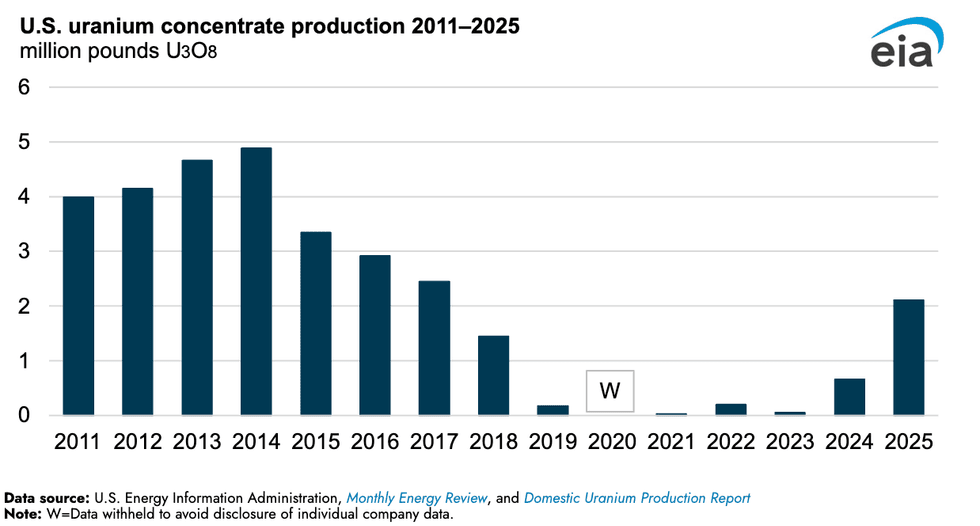 Don’t call it a comeback (yet). EIA
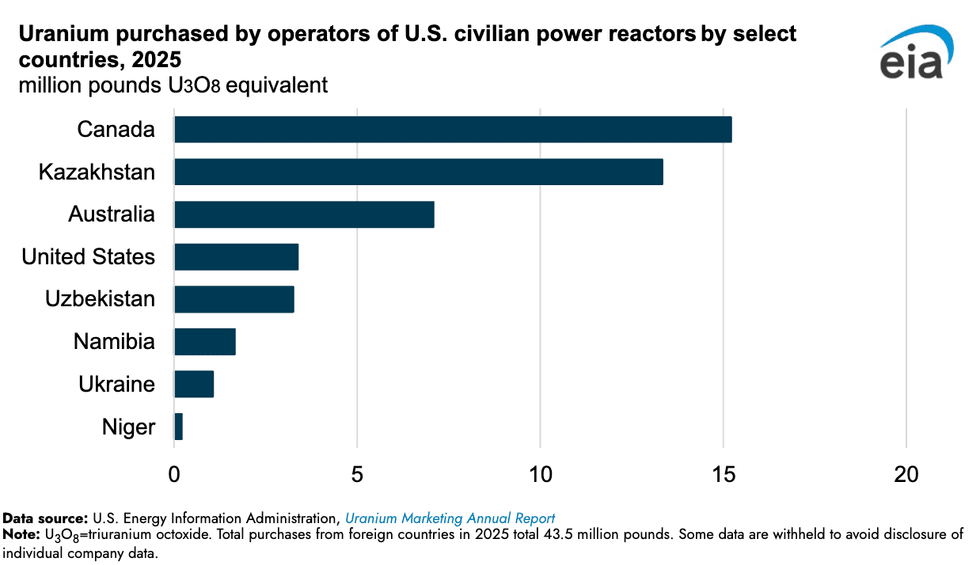 Russia? Never heard of her. EIA