The Trump administration inked two more agreements to cancel offshore wind leases and reimburse the former leaseholders nearly $1 billion on Monday, demonstrating that its previous deals with TotalEnergies was not a one-off legal settlement but rather a new, repeatable strategy to throttle the industry.
Just like the deal with Total, the Interior Department is painting the agreement as a quid pro quo, where the companies will be reimbursed only after they invest an equivalent amount of money into U.S. oil and gas projects. There are a handful of remaining companies sitting on undeveloped offshore wind leases that could conceivably make similar deals. If they do, the cost to taxpayers could exceed $4 billion.
This latest deal will cancel leases for two projects, known as Bluepoint Wind and Golden State Wind. Bluepoint, a project off the coast of New York and New Jersey, was a joint venture between Global Infrastructure Partners, an investment firm owned by asset manager BlackRock, and Ocean Winds, which itself is a joint venture between the French energy company Engie and the developer EDP Renewables. The companies initially paid $765 million to acquire the lease.
The Interior Department announcement states that Global Infrastructure Partners has committed to investing that amount into an unspecified U.S. liquified natural gas facility. The firm is already a major investor in several U.S. LNG projects; alongside TotalEnergies, it reached a final investment decision last September for the expansion of the Rio Grande export terminal. If the lease cancellation agreement resembles the one struck with Total, as the Interior Department’s announcement suggests, Global Infrastructure Partners will be able to count this existing investment toward its total.
Golden State, one of the first leases sold off the Pacific coast, was a joint venture between Ocean Winds and the Canada Pension Plan Investment Board, an investment firm. The companies purchased it for $120 million. The government’s announcement is less specific about who will invest that money into what, noting only that it will be paid back after “an investment has been made of an equal amount in the development of U.S. oil and gas assets, energy infrastructure, and/or LNG projects along the Gulf Coast.” The Canada Pension Plan Investment Board has multiple investments in oil and natural gas pipelines and productions throughout the U.S. While Engie buys LNG from the U.S., the company has generally not been involved in U.S. oil and gas projects. EDP Renewables focuses solely on renewable energy and its parent company, EDP Group, is a Portuguese utility.
The government’s leasing laws generally do not allow companies to walk away from their lease and receive a refund. The government can cancel leases if it determines development would harm the environment or threaten national security — two claims the Trump administration has made — but only after holding a hearing on the matter.
The Trump administration has engineered a different route. In the same vein as the TotalEnergies deal, it has reached legal settlements with the companies and intends to pay them out of the Judgment Fund, a reserve overseen by the Department of Justice that agencies can draw from to pay for settlements arising from litigation or imminent litigation.
“We did not take this decision lightly,” Michael Brown, the CEO of Ocean Winds North America, told me in an emailed statement. “But when the underlying conditions in a market change, we must adapt. In this case, receiving a refund for the lease payments we had invested and exiting on agreed terms was the right outcome for our shareholders and partners.”
As I’ve reported previously, some legal experts are dubious that the circumstances constitute a legitimate use of the Judgment Fund. The agreement with Total was predicated on a series of “what if” scenarios — the Trump administration says it would have paused the company’s projects, which would have led Total to sue for breach of contract. Neither party actually did those things, instead negotiating these tit-for-tat trades with Trump.
Legal experts told me the only parties with the legal standing and the financial means to challenge the agreements are the states. I contacted the attorneys general offices in New York and New Jersey, which declined to comment, and California, which did not reply to my inquiry.
There are at least two remaining offshore wind developers who would be in a position to angle for a similar payout. RWE, a German energy company, paid $1.1 billion in 2022 to purchase a lease off the coast of New York and New Jersey for a project called Community Offshore — the most any company has paid to date for U.S. offshore wind development rights.
RWE, which previously focused its U.S. business on renewable energy, announced in March that it was developing 15 natural gas peaker plants in the U.S. In addition to Community Offshore, the company also bought rights to a lease in the Pacific for $121 million, and another in the Gulf of Mexico for about $4 million. The company did not respond to a request for comment, but its CEO has publicly suggested that it would be interested in getting its money back.
Another potential seller is Invenergy, which purchased a lease off the coast of New York and New Jersey in 2022 for $645 million for its Leading Light project. It also holds the rights to a Pacific lease bought for $112 million, and two in the Gulf of Maine, for which it paid about $9 million. The company is actively expanding its natural gas power plant fleet in the U.S. Invenergy declined to comment for this story.
The remaining companies that might be eligible for such deals paid much less for their offshore wind leases — BP, for example, paid just $135 million to obtain the lease for its Beacon Wind project in the Northeast. Duke Energy paid $130 million for a lease near North Carolina. BP’s offshore wind arm, JERA Nex bp, declined to comment on whether it would be amenable to a deal. Duke did not respond to my inquiry.
A company called EDF, a U.S. subsidiary of the French state-owned utility EDF Group, is sitting on a hefty $780 million lease, but the company is a renewables developer. There are no indications that its parent company is interested in expanding its natural gas pipeline in the U.S.
While Equinor and Dominion both have fossil fuel projects in the U.S., it seems unlikely they would reach similar deals for their remaining leases, given that they have already sued the Trump administration for halting work on offshore wind projects that were already under construction — Equinor’s Empire Wind and Dominion’s Coastal Virginia Offshore project.
Notably, Ocean Winds still has one remaining lease after this week’s deal, which it purchased on its own — not as a joint venture — in 2018, under the first Trump administration. Its SouthCoast Wind project off the coast of Massachusetts has nearly all of its approvals, though Trump’s Day One moratorium on offshore wind permits delayed construction. A subsequent lawsuit in March of last year from the city and county of Nantucket challenged the project’s Construction and Operations permit, typically the final federal approval for offshore wind farms. A federal judge ordered the permit to be sent back to the Bureau of Ocean Energy Management for reconsideration last fall; according to court filings, that process is ongoing.
If RWE, Invenergy, Duke, and BP each reached similar deals with the Trump administration, that would mean a total of just over $4 billion paid out of the Judgment Fund to cancel offshore wind leases, including the four existing deals. For context, the total amount the government paid to parties out of the Judgment Fund across all federal agencies in 2025 was about $4.4 billion, according to Treasury data. Annual totals over the last decade range between $1.7 billion in 2017 and $8.4 billion in 2020.







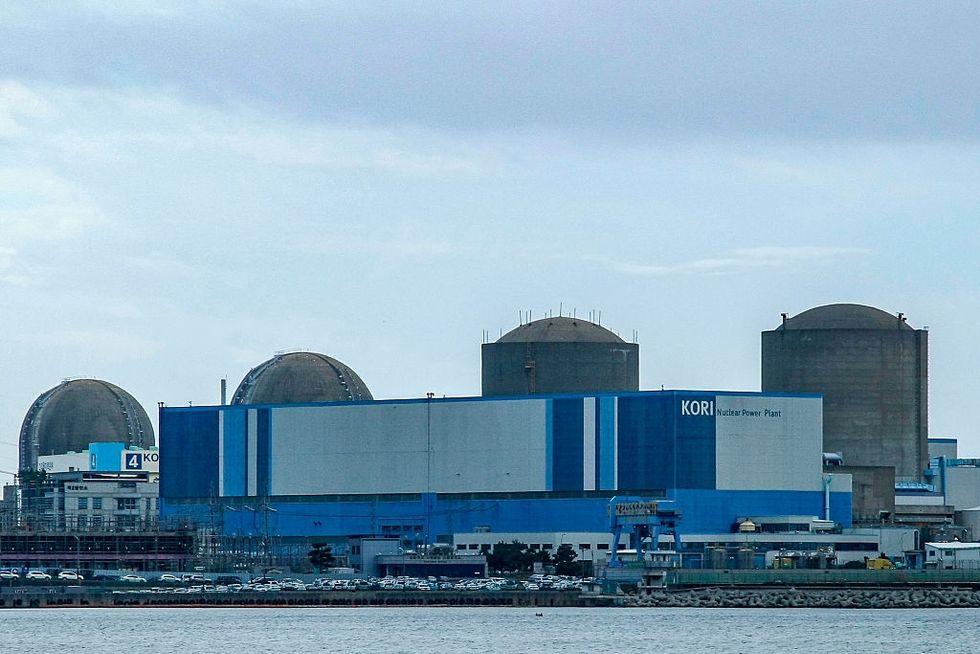 A South Korean nuclear plant in Busan. Seung-il Ryu/NurPhoto via Getty Images