When the Trump administration announced it was paying TotalEnergies nearly $1 billion to cancel the company’s offshore wind leases, it painted the deal as a mutually beneficial trade: The government would reimburse the company for every penny it spent to acquire the leases, and in return, Total would “redirect” the money to U.S. oil and gas development.
Now, the terms of the deal have been made public, and Americans’ side of the bargain appears to be worthless.
The Bureau of Ocean Energy Management posted the settlement agreements for the two cancelled leases to its website on Friday. The documents make it clear that Total did not have to make any new investments to get its check.
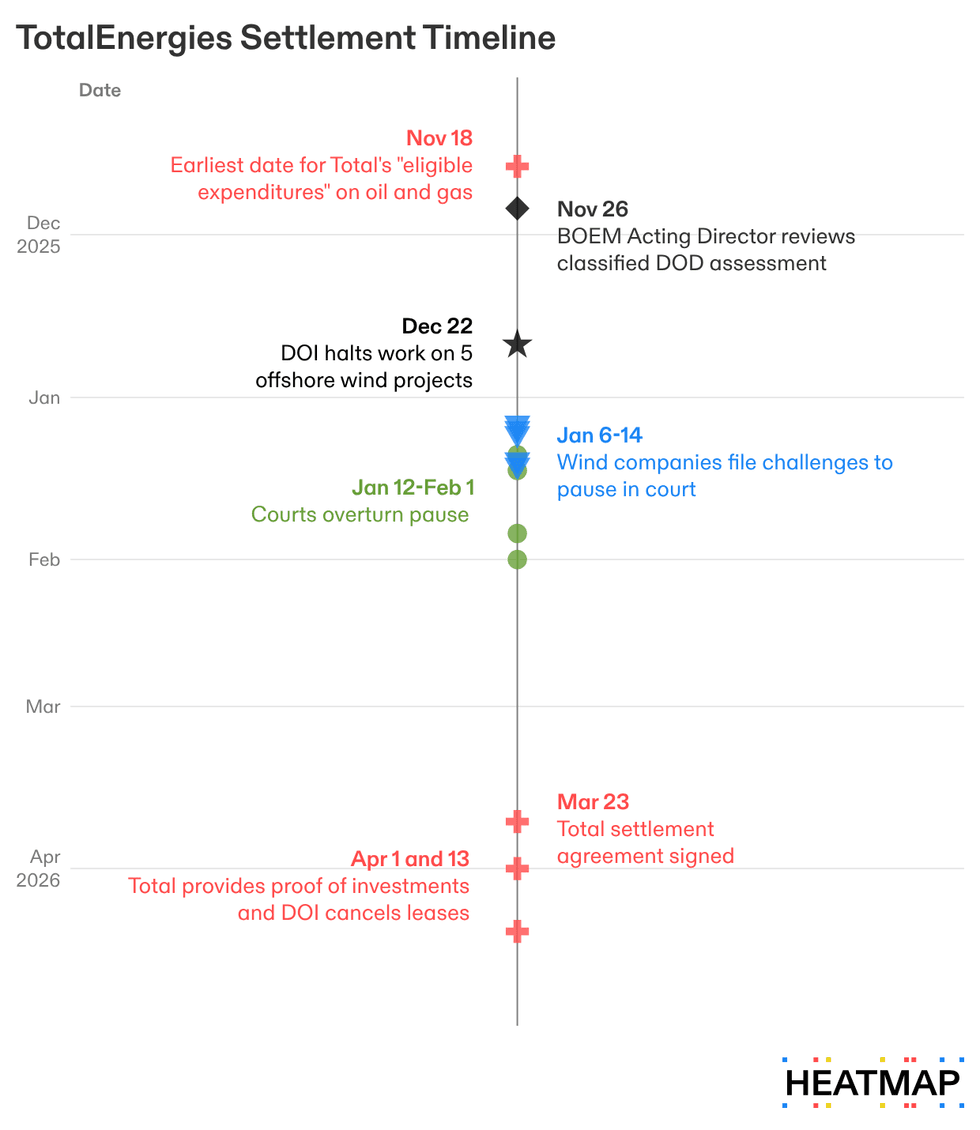
“Following their new investment,” the Interior Department’s March 23 press release had said, “the United States will reimburse the company dollar-for-dollar, up to the amount they paid in lease purchases for offshore wind.” But the settlement allows Total to simply submit receipts for oil and gas investments it was already making, including money spent as far back as last November.
The terms required Total to spend the same amount it had spent on the offshore wind leases on “conventional energy projects” within a specific timeframe — between November 18, 2025 and September 30, 2026. “Eligible expenditures” included direct capital expenditures on its own oil and gas projects as well as money funneled through joint ventures. The terms make clear that Total had to actually deploy cash into projects within the timeframe, not just commit to spending it. Once the company spent the money, it could submit a third party audit of its receipts to the Interior Department, and the agency would cancel the leases.
The settlement is also explicit that Total’s outlays for the Rio Grande LNG export terminal, a project the company had reached a final investment decision on last September, were eligible. In the end, Total spent the money — all $928 million of it — in less than 21 weeks. The smaller Carolina Long Bay lease, just east of Wilmington, North Carolina, was officially cancelled on April 2; the Attentive Energy lease, off the coast of Northern New Jersey, was canceled on April 13.
Kit Kennedy, the managing director for power, climate, and energy at the Natural Resources Defense Council, told me the inclusion of the Rio Grande project is “another way in which the agreement appears to be a sweetheart deal, or a collusive arrangement.”
Kennedy views the settlement as an attempt to justify compensating the company for not building offshore wind in the U.S. “The irony of handing a billion dollars to this developer at a time when Americans are struggling to pay their electricity bills and struggling to keep afloat,” she said. “To be clear, this billion dollars is coming from us taxpayers, and the net result of these agreements will be to increase electricity bills for Americans.”
TotalEnergies did not respond to emailed questions about the settlement. The Department of Interior did not answer questions directly but submitted a statement that said, "As a result of the certainty provided by the settlement agreements, Total voluntarily accelerated its expenditures on reliable and affordable energy projects that will save money for all Americans and not rely on subsidies from tax-payers to virtue signal.”
The opening section of the settlement tells a story about the circumstances that led to this unusual deal. The Department of Defense had “raised classified national security concerns” about the leases, it says, referring to the classified reports that Interior Secretary Doug Burgum cited when he halted five offshore wind projects last December. The Interior Department “would have” suspended TotalEnergies’ leases indefinitely, too, the settlement says, “similar to” that December suspension order on the five wind projects. Had the agency done that, however, Total “would have claimed breach of contract” and filed a lawsuit in the U.S. Court of Federal Claims. The agency determined that canceling the lease, instead, was “in the public interest.”

The settlement does not mention who suggested the idea of canceling and refunding the lease or when. TotalEnergies’ CEO Patrick Pouyanné has repeatedly asserted that it was the company’s idea. “It came from us — we took the initiative,” Pouyanné told Axios this week.
This narrative seems to imply that the Interior Department warned Total that it was going to pause the company’s leases, or that the company otherwise found out, and Total responded by threatening to file a breach of contract claim.
The Interior Department paid Total with money from the Judgment Fund, a reserve overseen by the Department of Justice that agencies can draw from to pay off settlements arising from litigation or imminent litigation. To Kennedy, there’s still no evidence that the situation with Total qualifies on either ground. “This breach of contract litigation by TotalEnergies, that's totally speculative,” she said. “There's nothing imminent about it. I think those clauses are just an attempt to justify handing over a billion dollars of taxpayer funds in an unauthorized fashion.”
It’s also notable that the settlement references the five offshore wind projects that Trump did pause, considering how that turned out for the administration. Each of the five project developers challenged the stop work orders in court, and the federal judges in those cases rapidly overturned the orders, reasoning they did not find the government’s national security concerns convincing. (The specific concerns raised by that Department of Defense have not been disclosed publicly.)
“DOI is essentially admitting: we were going to break the law and lose in court, so how about we pay you a billion dollars instead,” Elizabeth Klein, the former director of the Bureau of Ocean Energy Management, told me.
Jeff Thaler, an energy and environmental attorney at the firm Preti Flaherty, pointed out that the settlement agreement also seems to sidestep a key legal requirement. The U.S. statute governing Total’s offshore wind lease says cancellation of the lease can occur at any time, “if the Secretary determines, after a hearing,” that the project would cause harm to the environment or to national security. (Emphasis added.)
“There's been no hearing here, right?” Thaler told me. “One could argue, if there's litigation, that they haven't followed the process correctly.”
Secretary Burgum will be testifying in front of the House Appropriations Committee on Monday morning, where Democratic lawmakers have said they will question him about the deal.
Editor’s note: This story has been updated to include comment from the Interior Department.





 Solar capacity keeps growing. GoodPower