You’re out of free articles.
Log in
To continue reading, log in to your account.
Create a Free Account
To unlock more free articles, please create a free account.
Sign In or Create an Account.
By continuing, you agree to the Terms of Service and acknowledge our Privacy Policy
Welcome to Heatmap
Thank you for registering with Heatmap. Climate change is one of the greatest challenges of our lives, a force reshaping our economy, our politics, and our culture. We hope to be your trusted, friendly, and insightful guide to that transformation. Please enjoy your free articles. You can check your profile here .
subscribe to get Unlimited access
Offer for a Heatmap News Unlimited Access subscription; please note that your subscription will renew automatically unless you cancel prior to renewal. Cancellation takes effect at the end of your current billing period. We will let you know in advance of any price changes. Taxes may apply. Offer terms are subject to change.
Subscribe to get unlimited Access
Hey, you are out of free articles but you are only a few clicks away from full access. Subscribe below and take advantage of our introductory offer.
subscribe to get Unlimited access
Offer for a Heatmap News Unlimited Access subscription; please note that your subscription will renew automatically unless you cancel prior to renewal. Cancellation takes effect at the end of your current billing period. We will let you know in advance of any price changes. Taxes may apply. Offer terms are subject to change.
Create Your Account
Please Enter Your Password
Forgot your password?
Please enter the email address you use for your account so we can send you a link to reset your password:
Fossil fuel companies colluded to stifle competition from clean energy, the state argues.
A new kind of climate lawsuit just dropped.
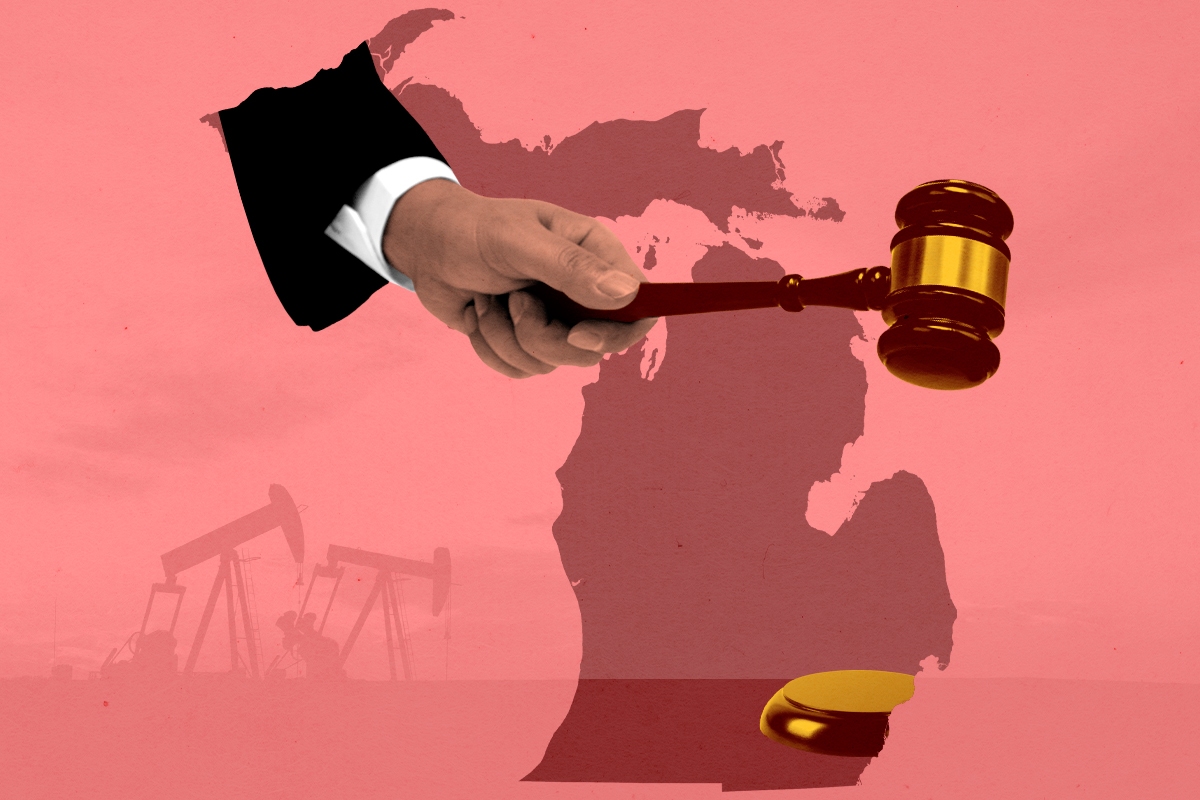
Last week the state of Michigan joined the parade of governments at all levels suing fossil fuel companies for climate change-related damages. But it’s testing a decidedly different strategy: Rather than allege that Big Oil deceived the public about the dangers of its products, Michigan is bringing an antitrust case, arguing that the industry worked as a cartel to stifle competition from non-fossil fuel resources.
Starting in the 1980s, the complaint says, ExxonMobil, Chevron, Shell, BP, and their trade association, the American Petroleum Institute, conspired “to delay the transition from fossil fuels to renewable energy” and “unlawfully colluded to reduce innovation” in Michigan’s transportation and energy markets. This, it alleges, is a key driver of Michigan’s (and the country’s) present-day struggles with energy affordability. If the companies had not suppressed renewable energy and electric vehicles, the argument goes, these technologies would have become competitive sooner and resulted in lower transportation and energy costs.
The framing may enable Michigan to sidestep some of the challenges other climate lawsuits have faced. Ten states have attempted to hold Big Oil accountable for climate impacts, mostly by arguing that the industry concealed the harms their products would cause. One suit filed by the City of New York has been dismissed, and many others have been delayed due to arguments over whether the proceedings belong in state or federal court, and haven’t yet gotten to the substance of the claims. Michigan’s tactic “maybe speeds up getting to the merits of the case,” Margaret Barry, a climate litigation fellow at Columbia University’s Sabin Center for Climate Change Law, told me, “because those jurisdictional issues aren’t going to be part of the court’s review.”
The fossil fuel industry’s primary defense in these suits has been that cities and states cannot fault oil companies for greenhouse gas emissions because regulating those emissions is the job of the federal government, per the Clean Air Act. Making the case about competition may “avoid arguments about whether this lawsuit is really about regulation,” Rachel Rothschild, an assistant professor of law at the University of Michigan, told me.
The biggest hurdle Michigan will face is proving the existence of a coordinated plot. Geoffrey Kozen, a partner at the law firm Robins Kaplan who works on antitrust cases, told me that companies in these kinds of suits tend to argue that they were simply reacting independently to the same market pressures and responding as any rational market actor would.
There are two main ways for a plaintiff to overcome that kind of argument, Kozen explained. In rare cases, there is a smoking gun — a memo that all of the parties signed saying they were going to act together, for example. More often, attorneys attempt to demonstrate a combination of “parallel conduct,” i.e., showing that all of the parties did the same thing, and “plus factors,” or layers of evidence that make it more likely that there was some kind of underlying agreement.
According to Michigan’s lawsuit, the collusion story in this case goes like this. In 1979, the American Petroleum Institute started a group called the CO2 and Climate Task Force. By that time, Exxon had come to understand that fossil fuel consumption was warming the planet and would cause devastation costing trillions of dollars. The company’s scientists had concluded that cleaner alternatives to fossil fuels would have to make up an increasing amount of the world’s energy if such effects were to be avoided.
“A self-interested and law-abiding rational firm would have used this insight to innovate and compete in the energy market by offering superior and cheaper energy products to consumers,” the complaint says. Michigan alleges that instead, Exxon shared its findings with the other companies in the task force and conspired with them to suppress clean alternatives to fossil fuels. They worked together to “synchronize assessments of climate risks, monitor each other’s scientific and industry outlooks, align their responses to competitive threats, and coordinate their efforts to suppress technologies likely to displace gasoline or other fossil fuels through collusion rather than competition,” according to the complaint.
Michigan’s lawyers point to evidence showing that the named companies shut down internal research programs, withheld products from the market, and used their control of patents to stifle progress away from fossil fuels. The companies were all early leaders in developing clean technologies — with innovations in rechargeable batteries, hybrid cars, and solar panels — but began to sabotage or abandon those efforts after the formation of the task force, the lawsuit alleges.
The case will likely turn on whether the judge finds it credible that these actions would have been against the companies’ self-interest had they not known their peers would be doing the same thing, Kozen told me.
“The actions differ between defendants. They are over a wide range of time periods. And so the question is, is that pursuant to an actual agreement? Or is it pursuant to a bunch of oil executives who are all thinking in similar ways?” he said. “I think that’s going to be the number one point where success or failure is probably going to tip.”
Another challenge for Michigan will be to prove what the world would have looked like had this collusion not taken place. In the parlance of antitrust, this is known as the “but-for world.” Without the Big Oil conspiracy, the lawsuit says, electric vehicles would be “a common sight in every neighborhood,” there would be ubiquitous “reliable and fast chargers,” and renewable energy would be “supplied at scale.” It argues that economic models show that Michigan’s energy prices would also have been significantly lower. While such arguments are common in antitrust cases, it’s a lot more difficult to quantify the effects of stifled innovation than something more straightforward like price fixing.
The companies, of course, reject Michigan’s narrative. A spokeswoman for Exxon told the New York Times it was “yet another legally incoherent effort to regulate by lawsuit.”
If the state can gather enough plausible evidence of harm, however, it may be able to get past the companies’ inevitable motion to dismiss the case and on to discovery. While the case is built on heaps of internal emails and leaked memos that have been made public over the years through congressional investigations, who knows how much of the story has yet to be revealed.
“It’s, in my experience, almost impossible, if someone is actually a member of a cartel, to hide all the evidence,” said Kozen. “Whatever it is, it always comes out.”

Log in
To continue reading, log in to your account.
Create a Free Account
To unlock more free articles, please create a free account.
Current conditions: Temperatures as low as 30 degrees Fahrenheit below average are expected to persist for at least another week throughout the Northeast, including in New York City • Midsummer heat is driving temperatures up near 100 degrees in Paraguay • Antarctica is facing intense katabatic winds that pull cold air from high altitudes to lower ones.

The United States has, once again, exited the Paris Agreement, the first global carbon-cutting pact to include the world’s two top emitters. President Donald Trump initiated the withdrawal on his first day back in office last year — unlike the last time Trump quit the Paris accords, after a prolonged will-he-won’t-he game in 2017. That process took three years to complete, allowing newly installed President Joe Biden to rejoin in 2021 after just a brief lapse. This time, the process took only a year to wrap up, meaning the U.S. will remain outside the pact for years at least. “Trump is making unilateral decisions to remove the United States from any meaningful global climate action,” Katie Harris, the vice president of federal affairs at the union-affiliated BlueGreen Alliance, said in a statement. “His personal vendetta against clean energy and climate action will hurt workers and our environment.” Now, as Heatmap’s Katie Brigham wrote last year, at “all Paris-related meetings (which comprise much of the conference), the U.S. would have to attend as an ‘observer’ with no decision-making power, the same category as lobbyists.”
America has not yet completed its withdrawal from the United Nations Framework Convention on Climate Change, the overarching group through which the Paris Agreement was negotiated, which Trump initiated this month. That won’t be final until next year. That Trump is even planning to quit the body shows how much more aggressive the administration’s approach to climate policy is this time around. Trump remained within the UNFCCC during his first term, preferring to stay engaged in negotiations even after quitting the Paris Agreement.
Just weeks after a federal judge struck down the Trump administration’s stop work order on the Revolution Wind project off Rhode Island’s shores, another federal judge has overturned the order halting construction on the Vineyard Wind project off Massachusetts. That, as Heatmap’s Emily Pontecorvo wrote last night, “makes four offshore wind farms that have now won preliminary injunctions against Trump’s freeze on the industry.” Besides Revolution Wind, Dominion Energy’s Coastal Virginia offshore wind project and Equinor’s Empire Wind plant off Long Island have each prevailed in their challenges to the administration’s blanket order to abandon construction on dubious national security grounds.
Meanwhile, the White House is potentially starving another major infrastructure project of funding. The Gateway rail project to build a new tunnel under the Hudson River between New Jersey and New York City could run out of money and halt construction by the end of next week, the project manager warned Tuesday. Washington had promised billions to get the project done, but the money stopped flowing in October during the government shutdown. Officials at the Department of Transportation said the funding would remain suspended until, as The New York Times reported, the project’s contracts could be reviewed for compliance with new rules about businesses owned by women and minorities.
Sign up to receive Heatmap AM in your inbox every morning:
A new transmission line connecting New England’s power-starved and gas-addicted grid to Quebec’s carbon-free hydroelectric system just came online this month. But electricity abruptly stopped flowing onto the New England Clean Energy Connect as the Canadian province’s state-owned utility, Hydro-Quebec, withheld power to meet skyrocketing demand at home amid the Arctic chill. Power plant owners in New England and New York, where Hydro-Quebec is building another line down the Hudson River to connect to New York City, complained that deals with the utility focused on maintaining supplies during the summer, when air conditioning traditionally surges power to peak demand. Hydro-Quebec restored power to the line on Monday.
The storm represented a force majeure event. If it hadn’t, the utility would have needed to pay penalties. But the incident is sure to fuel more criticism from power plant owners, most of which are fossil fueled, who oppose increased competition from the Quebecois. “I hate to say it, but a lot of the issues and concerns that we have been talking about for years have played out this weekend,” Dan Dolan — who leads the New England Power Generators Association, a trade group representing power plant owners — told E&E News. “This is a very expensive contract for a product that predominantly comes in non-stressed periods in the winter,” he said.
Europe has signed what the European Commission president Urusula von der Leyen called “the mother of all deals” with India, “a free trade zone of 2 billion people.” As part of the deal, the world’s second-largest market and the most populous nation plan to ramp up exports of steel, plastics, chemicals, and pharmaceuticals. But don’t expect Brussels to give New Delhi a break on its growing share of the global emissions. The EU’s carbon border adjustment mechanism — the first major tariff in the world based on the carbon intensity of imports — just took effect this month, and will remain intact for Indian goods, Reuters reported.
The Department of the Interior has ordered staff at the National Park Service to remove or edit signs and other informational materials in at least 17 parks out West to scrub mentions of climate change or hardship inflicted by settlers on Native Americans. The effort comes as part of what The Washington Post called a renewed push to implement Trump’s executive order on “restoring truth and sanity to American history.” Park staff have interpreted those orders, the newspaper reported, to mean eliminating any reference to historic racism, sexism, LGBTQ rights, and climate change. Just last week, officials removed an exhibit at Independence National Historical Park on George Washington’s ownership of slaves.
Tesla is going trucking. The electric automaker inked a deal Tuesday with Pilot Travel Centers, the nation’s largest operator of highway pit stops, to install Tesla’s Semi Chargers for heavy-duty electric vehicle charging. The stations are set to be built at select Pilot locations along Interstate 5, Interstate 10, and several other major corridors where heavy-duty charging is highest. The first sites are scheduled to open this summer.
Rob talks with McMaster University engineering professor Greig Mordue, then checks in with Heatmap contributor Andrew Moseman on the EVs to watch out for.
It’s been a huge few weeks for the electric vehicle industry — at least in North America.
After a major trade deal, Canada is set to import tens of thousands of new electric vehicles from China every year, and it could soon invite a Chinese automaker to build a domestic factory. General Motors has also already killed the Chevrolet Bolt, one of the most anticipated EV releases of 2026.
How big a deal is the China-Canada EV trade deal, really? Will we see BYD and Xiaomi cars in Toronto and Vancouver (and Detroit and Seattle) any time soon — or is the trade deal better for Western brands like Volkswagen or Tesla which have Chinese factories but a Canadian presence? On this week’s Shift Key, Rob talks to Greig Mordue, a former Toyota executive who is now an engineering professor at McMaster University in Hamilton, Ontario, about how the deal could shake out. Then he chats with Heatmap contributor Andrew Moseman about why the Bolt died — and the most exciting EVs we could see in 2026 anyway.
Shift Key is hosted by Robinson Meyer, the founding executive editor of Heatmap, and Jesse Jenkins, a professor of energy systems engineering at Princeton University. Jesse is off this week.
Subscribe to “Shift Key” and find this episode on Apple Podcasts, Spotify, Amazon, or wherever you get your podcasts.
You can also add the show’s RSS feed to your podcast app to follow us directly.
Here is an excerpt from our conversation:
Robinson Meyer: Over the weekend there was a new tariff threat from President Trump — he seems to like to do this on Saturday when there are no futures markets open — a new tariff threat on Canada. It is kind of interesting because he initially said that he thought if Canada could make a deal with China, they should, and he thought that was good. Then over the weekend, he said that it was actually bad that Canada had made some free trade, quote-unquote, deal with China.
Do you think that these tariff threats will affect any Carney actions going forward? Is this already priced in, slash is this exactly why Carney has reached out to China in the first place?
Greig Mordue: I think it all comes under the headline of “deep sigh,” and we’ll see where this goes. But for the first 12 months of the U.S. administration, and the threat of tariffs, and the pullback, and the new threat, and this going forward, the public policy or industrial policy response from the government of Canada and the province of Ontario, where automobiles are built in this country, was to tread lightly. And tread lightly, generally means do nothing, and by doing nothing stop the challenges.
And so doing nothing led to Stellantis shutting down an assembly plant in Brampton, Ontario; General Motors shutting an assembly plant in Ingersoll, Ontario; General Motors reducing a three-shift operation in Oshawa, Ontario to two shifts; and Ford ragging the puck — Canadian term — on the launch of a new product in their Oakville, Ontario plant. So doing nothing didn’t really help Canada from a public policy perspective.
So they’re moving forward on two fronts: One is the resetting of relationships with China and the hope of some production from Chinese manufacturers. And two, the promise of automotive industrial policy in February, or at some point this spring. So we’ll see where that goes — and that may cause some more restless nights from the U.S. administration. We’ll see.
Mentioned:
Canada’s new "strategic partnership” with China
The Chevy Bolt Is Already Dead. Again.
The EVs Everyone Will Be Talking About in 2026
This episode of Shift Key is sponsored by …
Heatmap Pro brings all of our research, reporting, and insights down to the local level. The software platform tracks all local opposition to clean energy and data centers, forecasts community sentiment, and guides data-driven engagement campaigns. Book a demo today to see the premier intelligence platform for project permitting and community engagement.
Music for Shift Key is by Adam Kromelow.
A federal judge in Massachusetts ruled that construction on Vineyard Wind could proceed.
The Vineyard Wind offshore wind project can continue construction while the company’s lawsuit challenging the Trump administration’s stop work order proceeds, judge Brian E. Murphy for the District of Massachusetts ruled on Tuesday.
That makes four offshore wind farms that have now won preliminary injunctions against Trump’s freeze on the industry. Dominion Energy’s Coastal Virginia offshore wind project, Orsted’s Revolution Wind off the coast of New England, and Equinor’s Empire Wind near Long Island, New York, have all been allowed to proceed with construction while their individual legal challenges to the stop work order play out.
The Department of the Interior attempted to pause all offshore wind construction in December, citing unspecified “national security risks identified by the Department of War.” The risks are apparently detailed in a classified report, and have been shared neither with the public nor with the offshore wind companies.
Vineyard Wind, a joint development between Avangrid Renewables and Copenhagen Infrastructure Partners, has been under construction since 2021, and is already 95% built. More than that, it’s sending power to Massachusetts customers, and will produce enough electricity to power up to 400,000 homes once it’s complete.
In court filings, the developer argued it was urgent the stop work order be lifted, as it would lose access to a key construction boat required to complete the project on March 31. The company is in the process of replacing defective blades on its last handful of turbines — a defect that was discovered after one of the blades broke in 2024, scattering shards of fiberglass into the ocean. Leaving those turbine towers standing without being able to install new blades created a safety hazard, the company said.
“If construction is not completed by that date, the partially completed wind turbines will be left in an unsafe condition and Vineyard Wind will incur a series of financial consequences that it likely could not survive,” the company wrote. The Trump administration submitted a reply denying there was any risk.
The only remaining wind farm still affected by the December pause on construction is Sunrise Wind, a 924-megawatt project being developed by Orsted and set to deliver power to New York State. A hearing for an injunction on that order is scheduled for February 2.