You’re out of free articles.
Log in
To continue reading, log in to your account.
Create a Free Account
To unlock more free articles, please create a free account.
Sign In or Create an Account.
By continuing, you agree to the Terms of Service and acknowledge our Privacy Policy
Welcome to Heatmap
Thank you for registering with Heatmap. Climate change is one of the greatest challenges of our lives, a force reshaping our economy, our politics, and our culture. We hope to be your trusted, friendly, and insightful guide to that transformation. Please enjoy your free articles. You can check your profile here .
subscribe to get Unlimited access
Offer for a Heatmap News Unlimited Access subscription; please note that your subscription will renew automatically unless you cancel prior to renewal. Cancellation takes effect at the end of your current billing period. We will let you know in advance of any price changes. Taxes may apply. Offer terms are subject to change.
Subscribe to get unlimited Access
Hey, you are out of free articles but you are only a few clicks away from full access. Subscribe below and take advantage of our introductory offer.
subscribe to get Unlimited access
Offer for a Heatmap News Unlimited Access subscription; please note that your subscription will renew automatically unless you cancel prior to renewal. Cancellation takes effect at the end of your current billing period. We will let you know in advance of any price changes. Taxes may apply. Offer terms are subject to change.
Create Your Account
Please Enter Your Password
Forgot your password?
Please enter the email address you use for your account so we can send you a link to reset your password:
The seminal global climate agreement changed the world, just not in the way we thought it would.

Ten years ago today, the world’s countries adopted the Paris Agreement, the first global treaty to combat climate change. For the first time ever, and after decades of failure, the world’s countries agreed to a single international climate treaty — one that applied to developed and developing countries alike.
Since then, international climate diplomacy has played out on what is, more or less, the Paris Agreement’s calendar. The quasi-quinquennial rhythm of countries setting goals, reviewing them, and then making new ones has held since 2015. A global pandemic has killed millions of people; Russia has invaded Ukraine; coups and revolutions have begun and ended — and the United States has joined and left and rejoined the treaty, then left again — yet its basic framework has remained.
Perhaps you can tell: I am not among those who believe that the treaty has been a failure, although it would be difficult — in this politically arid moment — to call it a complete success. Yet the ensuing decade has seen real progress in limiting global temperature rise. When negotiators gathered to finalize the agreement, it seemed likely that global average temperatures could rise by 4 degrees Celsius by 2100, as compared to their pre-industrial level. Today, a rise from 2.5 to 3 degrees Celsius seems more likely.
And for a document that is often described as non-binding, or even as hortatory, Paris has had a surprisingly material influence on global politics in the ensuing years. During the negotiations, the small-island states — the three dozen or so countries most affected by near-term sea-level rise — successfully got the final text to recognize a “stretch goal” of limiting warming to just 1.5 degrees above pre-industrial levels. They also tasked the United Nations’ advisory scientific body to prepare a special report on the virtues of avoiding 1.5 degrees of warming. When that report was released in 2018, it catalyzed a new wave of global climate action, spawning the European Green Deal — and eventually the U.S. Inflation Reduction Act.
Yet there is at least one way that Paris did not go as imagined.
Cast your mind back to Paris 10 years ago, right as diplomats filed in and began to applaud the final text’s completion. “This is a tremendous victory for all of our citizens — not for any one country or any one bloc, but for everybody here who has worked so hard to bring us across the finish line,” John Kerry, then the U.S. secretary of state, declared to his fellow diplomats.
It was a strange kind of victory. After decades in which western liberals had attempted to secure a globally binding climate treaty — an agreement that would limit each country’s greenhouse gas emissions — the world finally won a non-binding alternative. Under the Paris Agreement, each country would pledge to cut its emissions by as much as it could manage. Countries would then meet regularly to review these pledges, encourage each other to get more ambitious, and gradually ratchet the world into a lower-carbon future.
Kerry was reasonably direct about how such a mechanism would work: capital markets. “We are sending literally a critical message to the global marketplace,” he said. “Many of us here know that it won’t be governments that actually make the decision or find the product, the new technology, the saving grace of this challenge. It will be the genius of the American spirit.”
He was right, in a way: The Paris Agreement did send a signal to the global marketplace— and it did so in part because governments did shape policy and investment outcomes, not because they resisted doing so. But it did not reveal the genius of the American spirit, per se.
In the years running up to and following the Paris Agreement, China rolled out a series of important policies to boost its new energy sectors — a roadmap encouraging “new energy vehicle” sales in 2012, billions of consumer subsidies beginning in 2014, and a domestic content mandate for electric-vehicle batteries in 2015. These programs — along with canny decisions made by Chinese entrepreneurs and engineers, and no small amount of demand pull from companies and policies in the West — have transformed the world’s approach to decarbonization. They have begun to change even what decarbonization means — in the United States, in the western democracies, and around the world.
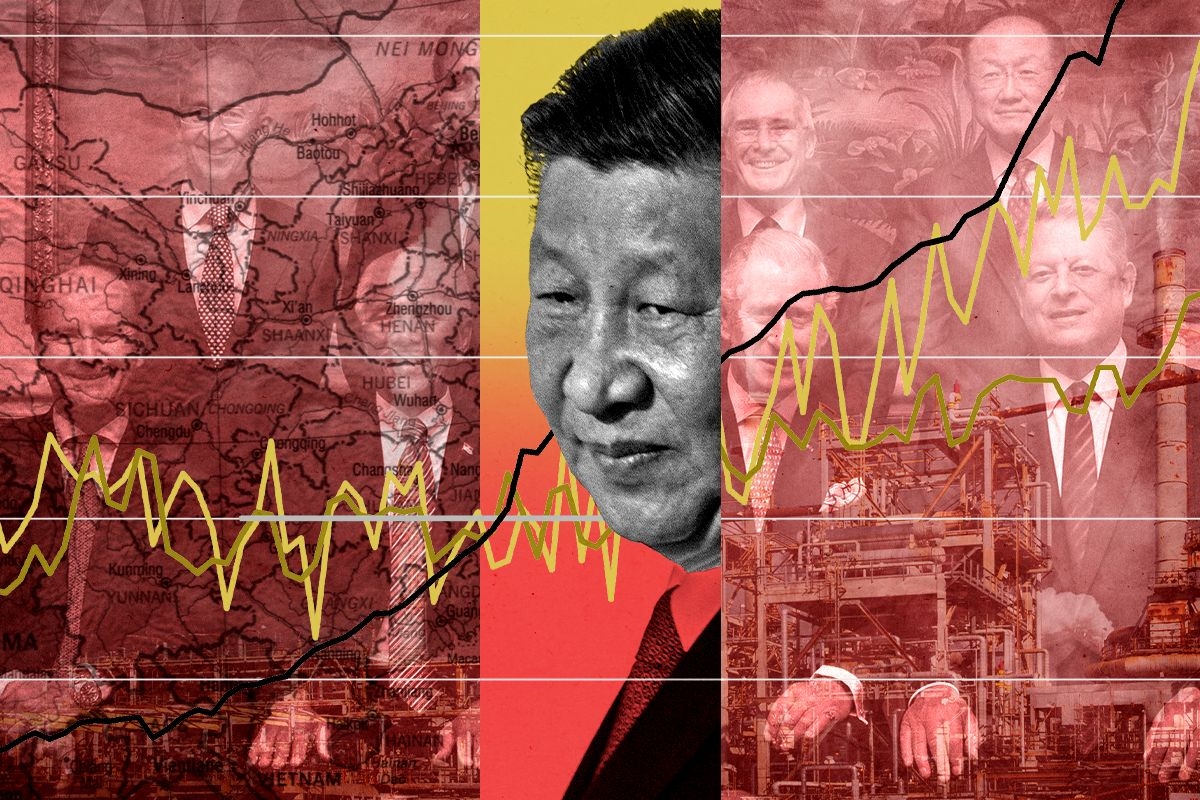
Ten years ago, Kerry could assume that any eventual solution to climate change would be geopolitically neutral, if not advantageous to the United States. But in 2025, to a degree that commentators still hesitate to describe, the climate story has become the China story. Across a range of sectors, how a country approaches its near-term decarbonization goals depends on how it understands and relates to the Chinese government and Chinese companies.
Consider the power sector, which generates just under a third of all greenhouse gas emissions globally. For many countries, the best way to cut carbon pollution — and to add more power generation to the grid — will be to build new utility-scale solar and battery projects. That will all but require working with Chinese firms, which dominate 80% of the solar supply chain. (They command up to 98% market share for some pieces of equipment, according to the International Energy Agency.)
It is much the same story in the grid-scale battery industry. China produces more than three-quarters of the world’s batteries, and it refines most of the minerals that go into those batteries. Its batteries are at least 20% cheaper than those made in Europe or North America. Most of the world’s top battery firms are Chinese — in part because they have more experience than anyone else; the country’s firms have manufactured 70% of all lithium-ion batteries ever produced. Nearly two dozen countries have bought at least $500 million in Chinese-made batteries this year, according to the think tank Ember.
What if a country wants to build wind turbines, not batteries? Even then, it will have to work to buy non-Chinese products. Although European and American firms have long led among turbine makers, six of the top 10 wind turbine manufacturers are now in mainland China, according to BloombergNEF. And for the first time since analysts’ rankings began in 2013, none of the world’s top three turbine makers are North American or European.
Transportation generates another 13% of global climate emissions. If a country wants to tackle that sector, then it will find itself (again) working with China — which made more than 70% of the world’s EVs in 2024. Thanks to the country’s sprawling battery and electronics-making ecosystem, its home-grown automakers — BYD, Geely, Xiaomi, and others — can produce more affordable, innovative, and desirable EVs at greater scale and at lower cost than automakers anywhere else. “The competitive reality is that the Chinese are the 700-pound gorilla in the EV industry,” Jim Farley, the CEO of Ford, said recently. As the scholar Ilaria Mazzocco put it in a recent report: “Chinese companies are ubiquitous in the value chain for EVs and battery components, meaning that for most countries, climate policy is now at least in part linked to policy toward China, and more specifically trade with China.”
That insight — that climate policy is now linked to policy toward China — will apply more and more, even when countries wish to tackle the remaining third of emissions that come from energy-related sources. Earlier this year, China approved a plan to build roughly 100 low-carbon industrial parks by 2030, where its firms will develop new ways to capture carbon, make steel, and refine chemicals without carbon pollution. (The Trump administration revoked funding for similar low-carbon projects in the U.S. earlier this year.) At the same time, China is building more conventional nuclear reactors than the rest of the world combined, and it may be pulling ahead of the United States in the race to develop commercial fusion.
This wasn’t inevitable. It happened because Chinese politicians, executives, and engineers decided to make it happen — choices owing as much to the government’s focus on energy security as to its concern for the global environmental commons. But it was also the result of American business leaders and politicians squandering this country’s leadership in climate technologies — and especially the result of choices made by Trump administration officials, who at nearly every opportunity have regarded batteries and electric vehicles as a technological sideshow to the more profitable oil and gas sector.
It was the Trump administration, after all, that licensed and then eventually gave U.S.-funded research on flow batteries to a Chinese company in 2017. It was the Trump administration that gutted fuel economy and clean car rules in 2018 and 2019, setting the American car industry back compared to its Chinese and European competitors. And it was the Trump administration and congressional Republicans that killed electric vehicle tax credits earlier this year, further choking off investment.
For progressives, this all might suggest a pleasant parable: China embraced the energy transition, and America didn’t, and now America is paying for it. Nowadays, commentators often invoke China’s clean energy dominance to inspire awe at its accomplishments. And how can you not, in truth, be impressed? China’s industrial miracle — its move to the frontier of global technological development — is the most important story of the past quarter century. The scale of the Chinese consumer market and the success of Chinese industrial policy (or, at least, its success so far) has wrenched world history in new directions. And Chinese companies have done humanity a great service by bringing down the cost of solar panels, batteries, and EVs on the supply side, even if they did so at first with demand-side assistance from policies in California or Europe.
But climate advocates in North America and Europe cannot be completely sanguine about what this development means globally. For environmentalists and other western liberals who have worked in decarbonization for decades, it will in particular require some rhetorical and political adjustment. We cannot pretend that we are playing by the 1990s’ rules, nor that environmental activism is but one part of a post-1970s progressive coalition, which is free to make demands and ignore inconvenient trade-offs. Basic questions of decarbonization policy now have patent geopolitical significance, which environmental groups attempt to side-step at their own peril.
Yet it isn’t only Americans or Europeans who must answer these questions. China’s dominance of decarbonization technology means that for the time being, every country on Earth must address this dynamic. When the scholar Mazzocco looked at how six countries around the world are approaching Chinese EVs, she found an uneven landscape, she told me on a recent podcast. Costa Rica, which has long embraced climate policy, has welcomed Chinese-made EVs; Brazil opened its doors to them but has now begun to close it.
Most major countries have some form of domestic automaking industry; no country will be able to sit back and passively allow Chinese exports to drive their local automakers out of business. At the same time, China’s manufacturing primacy is already making conventional export-driven growth less attractive for countries. And that will only be the beginning of the dilemmas to come. As long as going green requires buying and integrating Chinese technologies into critical infrastructure, environmental policymakers will be wagering decarbonization’s success on some of the world’s highest stakes geopolitical bets.
Environmentalists have long insisted climate change is a national security issue, but are we ready to think and act like it is? Do Western anxieties about a large and globalized war — either a Chinese invasion of Taiwan, a Russian invasion of the EU, or both — reflect a reasonable response to a real and growing menace, or an elite panic driven by our declining economic primacy? If China were to invade Taiwan, what would that mean for climate and energy policy — not only in the West, but around the world? Would American or European environmentalists even get a vote on that question — and if they do, how would they balance emissions reduction against other goals? If the unthinkable happens, we will all be called to account.
A decade ago, I remember watching the live stream of the world’s diplomats applauding their own success in Paris and realizing that I would be seeing that video in documentaries and news reels for the rest of my life. How will I see it then? I wondered. Would it strike me as the naivete of a simpler time, an era when liberal internationalism still seemed possible? Or would it really reflect a turning point, the moment when the world took the climate challenge seriously, pragmatically, and began to decarbonize in earnest? A decade later, I still don’t know. Perhaps the answer is both.

Log in
To continue reading, log in to your account.
Create a Free Account
To unlock more free articles, please create a free account.
Neither Republicans nor Democrats have a coherent idea of how to move forward.
Adapted from a speech given to an energy policy conference hosted by the Niskanen Institute, a centrist think tank, on December 5, 2025.
It is a disjointed moment for energy policy in the United States. Democrats and Republicans are at sea. Neither party has a particularly coherent plan for how it expects to develop energy policy over the next decade or so. And both parties have too many visions, too many goals, and too many places where their aspirational coalitions conflict with their policy commitments to advance a clear theory of energy policy in 2025.
You can best understand this confusion by starting on the Republican side, I think — and by comparing energy policies from the first and second Trump administrations. Both administrations seem to share a common framework: Both set a goal of “energy dominance,” both have tried to enact favorable policies for the oil and gas industry, and both have been characterized by an aggressive approach to environmental and climate deregulation — and by a sense that greenhouse gas pollution is not only a necessary evil but a positive good. But there the similarities stop.
The first Trump administration continued a long-running policy of benign neglect, and even of occasional encouragement, to wind and solar energy development — provided such energy development did not undermine fossil fuels. It was Interior Secretary Ryan Zinke who, in December 2018, auctioned off sites for offshore wind development in Massachusetts — and when these sites were snapped up for a record $405 million, promptly celebrated a “BIDDING BONANZA.”
“To anyone who doubted that our ambitious vision for energy dominance would not include renewables, today we put that rumor to rest,” Zinke said at the time. “With bold leadership, faster, streamlined environmental reviews, and a lot of hard work with our states and fishermen, we’ve given the wind industry the confidence to think and bid big.”
The first Trump administration was by no means a climate champion. It tried to rescue the coal industry, in part through advancing an emergency rule at the Federal Energy Regulatory Commission that would have subsidized coal-fired and nuclear power plants through power markets. Its Environmental Protection Agency ended the Obama administration’s attempt to regulate greenhouse gas pollution from power plants, and it weakened restrictions on tailpipe pollution from cars and light-duty trucks. And of course, it attacked California’s ability to regulate vehicle emissions.
But it rarely seemed to want to destroy the renewables industry, and it distinguished between climate policy and renewables policy. Perhaps it remained favorable to wind energy in part because Republican senators from the interior are favorable to wind energy. On the whole, it acted in a manner that was often defensibly pro-electricity development of all types.
The second Trump administration, by contrast, has sought to hamper and obstruct renewables development out of principle. Gone are the days when Zinke told the wind industry to “think and bid big.” Instead, the second Trump administration has told the wind industry to drop dead. It has implemented a de facto moratorium on new wind and solar projects on federal lands; it has sought new ways to revoke permits from offshore wind projects or block them outright.
At the same time, it has continued its crusade against climate policy. It has defanged the Transportation Department’s fuel efficiency standards. It has attacked state pollution policy once more, including California’s clean car standard, as well as New York City’s congestion pricing. And it has even sought to unwind the EPA’s endangerment finding, the determination that carbon dioxide is a dangerous pollutant and should be regulated as such.
This war on new energy sources has come just as the Trump administration has tried to tell voters that it cares about the rising cost of living — and, particularly, rising electricity costs. And it has come as the Trump administration has embraced AI, the industry driving more electricity demand growth than any other this century.
This combination has put the Trump administration in the position that George Pollack, a senior policy analyst at Signum Global Advisors, has called an “energy trilemma.” Trump wants to preside over an AI boom, avoid the political costs of rising energy prices, and block renewables growth. He can only pick two of these — and as more constraints hold back U.S. energy development, he might only be able to pick one.
Let me add to this another conflict that the Trump administration faces. Trump officials want the United States to catch up to China’s industrial development because they fear losing military competitiveness. But China’s economic model depends on encouraging and subsidizing market formation of what they call the “new three industries” — batteries, solar panels, and electric vehicles. Yet the administration does not want subsidized price parity for EVs, nor a competitive market for solar panels or electric vehicles; it would prefer that, perhaps with the exception of Tesla, as few people buy EVs as possible.
You can see this conflict most concretely in their critical minerals policy. From the first day of his second term, Trump has declared that America’s lack of mineral mining and refining capacity is an “energy emergency.” His administration has intervened in mineral markets — lining up financing and establishing a price floor for rare earth production, for example, or taking a stake in a lithium mine — in order to guarantee sufficient domestic supply. But the industries that actually use these minerals are largely wind turbine, electric vehicle, and electronics makers. Military equipment makes up a relatively small share of mineral use. He wants minerals, but he doesn’t want the industries that will actually use those minerals.
The clearest energy policy has come in the One Big Beautiful Bill Act, which, as the product of a legislative process, represents the Republican Party’s energy views rather than the president’s regulatory policies.
I think the law reveals that congressional Republicans have more coherent energy views than their copartisans in the administration — or at least that the pressures on congressional Republicans sometimes tilt the party in the direction of quasi-coherence. The most pulchritudinous act was, to be clear, terrible for clean energy innovation and deployment: It repealed the wind and solar tax credits and it junked consumer and business incentives for buying or leasing a new or used electric vehicle. It also repealed programs meant to encourage zero-carbon industrial development, particularly around the hydrogen industry. It was terrible for blue-collar workers in the Sun Belt, Gulf Coast, and Appalachia, who stood to benefit from EV manufacturing and clean industrial investment.
Yet it, again, revealed areas of intriguing quasi-coherence. One of the biggest policy innovations of the Inflation Reduction Act was to replace the government’s piecemeal investment and production tax credits for various energy technologies — such as wind, or solar, or geothermal — with a single zero-carbon technology-neutral investment and production tax credit. With this new policy, Democrats in Congress essentially said: We welcome the addition of any price-competitive generation resource on the grid as long as it emits essentially no carbon pollution. In theory, this liberated Democratic lawmakers from the endless process of adding and subtracting specific technologies from the tax code, and it showed that the party was listening to critics who said the government shouldn’t be picking particular technological winners and losers.
Now, Republican energy officials — particularly Secretary of Energy Chris Wright — have criticized the intermittent nature of renewables. They claim that wind and solar — which cannot flex their production of electricity to meet the grid’s needs, and which do not, of course, reliably produce electricity 24 hours of the day — impose unacknowledged costs to the power grid through the transmission grid. The facts, I should add, don’t agree; a recent Lawrence Berkeley National Lab study does not find that transmission costs are rising significantly in the U.S. — most of the recent electricity rate hikes have come from the rising cost of the local distribution system, particularly from transformers, poles, wires, and undergrounding equipment.
The One Big Beautiful Bill Act’s changes to the zero-carbon technology-neutral tax credit cohere, at least, to Wright’s worldview. The GOP law leaves the technology-neutral tax credit intact, but excises wind and solar from it after 2027. This means that the law effectively preserves support for zero-carbon technologies that are flexible and do generate power 24/7 — such as, above all, batteries, but also advanced geothermal and nuclear fusion. And broadly, I would add that the Trump administration’s support for grid-scale batteries, which allow wind and solar electricity to spread out through the day; for advanced geothermal, which uses technology derived from fracking innovation to generate electricity; and for nuclear power of every stripe has been a rare spot where the administration has encouraged more low-carbon energy deployment.
Of course, any kindness there pales in comparison to how the administration has acted toward the oil and gas industry. Trump has lavished that industry with gifts: He opened vast new swaths of federal wilderness to drilling, including 1.5 million acres of Alaska’s Arctic National Wildlife Refuge, and he hopes to open another billion acres of U.S. coastal waters to drilling. He has rolled back rules restricting methane pollution from U.S. drilling operations, approved new liquified natural gas export terminals, and attacked any regulation meant to conserve or more efficiently deploy fossil fuels in the transportation sector. This friendliness has, so far, failed to help the oil and gas industry out of its ongoing doldrums; oil prices have remained stubbornly low through Trump’s second term, in part because of his tariffs and in part because of rising battery vehicle deployment.
So that’s Trump. What a mess.
Unlike Trump’s energy trilemma, Democrats are dealing with a much more classic energy dilemma. It is much closer to dilemmas faced by liberal policymakers around the world: On the one hand, Democrats want to reduce carbon emissions; on the other hand, they want to lower nominal energy costs for voters — or at least keep them flat. The party has dealt with this dilemma in different ways. During the Obama administration, the party took an “all of the above” approach to energy: It largely encouraged the buildout of the country’s natural gas system — working sometimes hand-in-glove with environmentalists to shut down coal plants and replace them with natural gas — while pursuing EPA rules that sought to improve energy efficiency and reduce emissions from vehicles and power plants.
The Biden administration dealt with the energy dilemma in a different way, when it dealt with it at all. It passed the Inflation Reduction Act, the country’s first comprehensive climate law. The IRA incentivized and tried to buy down the deployment costs of many types of zero-carbon energy technologies, and it sought to speed up learning curves so as to achieve durably lower costs for decarbonization technology. It largely did not, however, ease the permitting or process barriers to adding more energy to the grid.
At the same time, the Biden administration was more hostile to the fossil fuel energy industry than the Obama administration had been — during the campaign, Biden said that the industry would eventually have to shut down — while paying occasional but intense attention to its ability to impose politically salient costs on Americans. This could sometimes come across as confused: The Biden administration slow-walked oil and gas permitting on federal lands through the Department of the Interior, but he — in a burst of policy creativity — released oil from the Strategic Petroleum Reserve during the period of painfully high gasoline prices following Russia’s invasion of Ukraine.
Since January, Democrats haven’t really had to face this dilemma in the same way because they have been locked out of federal power. This has allowed the party to, for instance, largely side-step questions of how to balance the AI buildout with keeping electricity costs low.
But Democrats will soon begin to face pressures at the state level. That recent Lawrence Berkeley National Labs study finds that while renewables do not increase electricity prices, state-level policies that mandate renewable penetration, such as renewable portfolio standards, sometimes do. In New Jersey, the governor-elect Mikie Sherrill won in part by promising to freeze the state’s electricity rates for the next two years. That commitment may butt up against the state’s environmental goals. Electricity prices are highest in those states or regions where Democrats have the most power; the party faces a risk that this fact may hurt its ability to marshal an electricity affordability argument against the Trump administration.
The party, too, is suffering from something of a climate politics hangover. President Biden embraced climate as one of the four “existential” threats facing the country, and he moved climate to the center of his legislative agenda; the party broadly moved left on climate and environmental justice. They did so in part under the belief that it was the right thing to do — and in part under the belief that young voters and voters of color would reward them for the shift.
In return, Democrats saw their numbers crater with young people, voters of color, and environmental justice communities in the 2024 election — and even if that collapse was not about climate policy, per se, so much as the president’s unpopularity, it suggests that climate is not a special issue for these demographics. The climate voter, to the extent they exist, is likely already a Democrat.
That is where the parties find themselves. Before I continue, I want to highlight two more trends — outside of party politics — that will shape and constrain how energy policymakers go forward.
The first is the reinvigorated political and economic importance of the electricity system. As you may know, America’s era of flat electricity demand has ended, and load growth has returned to the system. We are even seeing load growth now in places that were, until recently, losing heavy industry, such as the Mid-Atlantic. And while the largest driver of load growth has been the data center boom, AI has not, so far, been responsible for most load growth. The return of manufacturing, the slow electrification of the vehicle fleet, and plain old economic and population growth is driving much of the rise in demand.
There is a bigger change here than just a return in demand growth, though. Electricity is becoming more structurally important to the U.S. economy’s frontier industries. After two decades that saw upheavals in America’s oil, gas, and chemical sectors, but that left electricity largely untouched but for shifts in the generation mix, we are seeing hints of a structural reformation of the power sector.
But there are perils here. Electricity rates have risen twice as fast as inflation over the past year. That is driven by a rise in distribution costs — the poles, wires, underground equipment, and transformers that get power the last mile from substations to homes and businesses. Transformers have been in short supply more or less since the pandemic. Natural disaster costs — from wildfires out West and extreme storms in the Southeast — have forced utilities to rebuild the entire distribution grid in some regions, raising costs and further shocking supplies. In an investor letter last year, Warren Buffett warned that costs are getting so high that the industry may no longer be viable as a private business. “Certain utilities might no longer attract the savings of American citizens and will be forced to adopt the public-power model,” he wrote.
I would be loath here not to mention a final trend: The American natural gas system is about to see a significant demand expansion, as well. Over the next four years, North America’s liquified natural gas export capacity is essentially going to double; some 27% of U.S. gas production could now theoretically be exported. Natural gas provides 43% of U.S. electricity generation needs and 38% of overall U.S. energy needs; if linking American gas markets to global gas markets brings domestic gas prices closer to their global equilibrium, we are in for a price shock. This outcome isn’t guaranteed — in the late 2010s, liquified natural gas capacity increased without a significant rise in domestic gas prices — but it is a risk.
So: Republicans face an energy trilemma. Democrats face an energy dilemma. And the electricity system is becoming increasingly important — and coming under increasing stress. What does this mean for policy?
In the near term, the big question driving most energy and climate policy across both parties is: How can we — in the broadest sense — get to yes? How can the United States build, permit, connect, and construct the energy infrastructure that the economy needs to grow or decarbonize? How can we overcome the local barriers to renewable construction — or the national obstacles to more nuclear construction?
For Republicans, this question reflects a traditional deregulatory view. But for Democrats, this question is the end result of a successful shift — which I would argue began with the Paris Agreement — to reformulate the problem of climate change as a problem of decarbonization, not emissions reduction; that is, a problem of addition, as well as subtraction; of building new energy sources, as well as energy efficiency or conservation.
And for both parties, it reflects the unignorable influence of China’s new energy economy. China, for reasons owing as much to its political economy and internal anxieties as any externally oriented environmentalism, has built a new kind of energy economy — one that can swallow hundreds of terawatt-hours of load growth every year, that can build 360 gigawatts of wind, solar, and batteries at the same time that it plans 100 gigawatts of new coal-fired power plants. It has constructed the unintuitive-to-American-ears feat of a coal, hydro, and solar-based grid with flat or declining emissions. Policymakers are aware that this abundant and at least facially cheap electricity helps the country’s AI and manufacturing industries.
This question and these anxieties point to a few policies in the near term: permitting reform and transmission construction.
Permitting reform is a catch-all term for policies that could cut down on the bureaucratic or local obstacles to building energy and infrastructure projects, clean and fossil alike. This is the third Congress in a row that has tried to do something about permitting, and while the last two did pass small pieces of legislation, a “grand bargain” on permitting has remained elusive. Questions about permitting reform tend to fall into three big buckets.
The first are what gates the permitting review process: What sets off the permitting review process? The National Environmental Policy Act applies to any “major federal action.” But what is a major federal action? When the government lends money, or grants it to a nonprofit, does that constitute a “major federal action”? Should it? Right now, the answer is usually yes — meaning that a federal loan to, say, a new EV factory essentially creates a federal nexus for that project and thus thousands of hours of paperwork requirements and litigation exposure. Should that change?
Are there some actions that never need a NEPA review? For the past two decades, Congress has said that the government didn’t need to review oil and gas drilling under NEPA if that drilling happened on a sub-five-acre footprint or on federal land which the government had already planned for oil or gas extraction. In just the first two years this exclusion was created, the BLM approved 6,100 permits under this rationale, according to the Government Accountability Office, so this policy is now likely responsible for tens of thousands of approved permits. Should other types of activity never face a NEPA review? For instance, advanced geothermal technology uses similar equipment to that used in fracking and it has a similar land footprint.
What often holds up a federal project is not the NEPA review itself, but the open-ended legislation that can follow such a review. We also know that one driver of very long NEPA reviews — reviews far in excess of what legislators envisioned when they wrote the law — is a fear that courts will reject it.
That brings us to the second question: When and how can the courts review a NEPA or permitting decision? Who can file a lawsuit? Are there remedies that don’t involve forcing an agency to redo an environmental review all over again? And finally, should courts take the position that a gap in the analysis does not presumptively invalidate an agency’s work?
Finally, how far does your analysis of a project’s environmental impact have to go to meet NEPA’s mandate? Does it have to extend just to the fenceline of a project, or to the county line? Or does it need to encompass the whole planet? Earlier this year, the Supreme Court ruled in the Seven County case that a NEPA review does not need to consider greenhouse gas emissions downstream of a project, such as those that would be released when a new railroad project opens up a new area for oil exploration. Should Congress extend that logic to the universe of NEPA reviews?
Those three questions dominate most permitting reform policy discussions around NEPA. But permitting reform, as I said earlier, is a catch-all — and each party has concerns that do not fall so elegantly in those categories. Progressives usually want permitting reform to include a commitment to expand agency staffing. They believe that NEPA reviews take so long to complete in many cases not because the law’s requirements are too onerous, but because the government lacks the labor hours to process the reviews that it has, in essence, assigned itself. Republicans, meanwhile, favor a fossil-friendly change: They want to see Congress alter the Clean Water Act so that state governments can no longer block new pipelines. This reform would not favor clean energy, but the oil and gas industry believes that it will only be politically feasible if it passed in a broader permitting reform package.
Lately, the parties have begun to agree on a new idea. The Trump administration’s successful efforts to block offshore wind, solar, and battery projects that have already been approved has raised concerns about executive interference. Democrats lament what Trump is doing, while Republicans fear a future Democrat could use those powers to block fossil fuel projects. The SPEED Act, which passed the House this month, includes a new provision meant to block presidents from interfering with already-approved energy projects. But the SPEED Act would not pass the Senate as written.
America struggles to build new long-distance transmission lines. This is an old problem, but it has deteriorated in the past decade: As recently as 2013, the country built thousands of miles of new transmission lines a year; in 2025, it is set to build about 400 miles. This problem’s opportunity cost has gotten worse over time: Because solar and especially wind resources are more abundant in some places than others, the country’s overall ability to access cheap and zero-carbon electricity is limited by its ability to build new power lines.
We already have signs that this bottleneck is slowing clean energy deployment. The U.S. hit a record for new wind capacity deployment in 2020 and 2021, but the industry’s deployment has slowed since then. This was not, until recently, due to any lack of support from the federal government — in fact, the Biden administration was quite solicitous of wind — but because we may have started to run out of windy places with ample transmission capacity in the United States.
This bottleneck has become politically urgent in the age of load growth and AI data centers, and policymakers have proposed a number of policies to deal with it. They have come up with four big ideas.
The first is to strengthen FERC’s ability to backstop new power lines. Under federal law, FERC has a limited authority to approve new transmission lines in designated high-priority areas, but a much broader “one-stop shop” ability to approve new interstate natural gas pipelines. As a consequence, it is much easier to move natural gas around the country than electricity. Perhaps FERC’s ability to approve and expedite new power lines could be made more similar to its pipeline authority.
The second is a transmission tax credit — likely an investment tax credit that could cover something like 30% of the cost of a new transmission line. This would be especially useful for merchant developers who believe it would be profitable to build a large-scale clean energy resource and connect it to a congested region of the grid.
Third, a way of standardizing who pays for and who benefits from new transmission lines. Right now, utilities and power producers must essentially divide up the costs and benefits of a new power line on an ad hoc basis. A standard calculation — backed by the federal government — could ease that negotiation and make it clear where new lines would make the most sense.
Finally, some policy to “force” a transmission buildout and solve siting issues. You could imagine this happening in at least two different ways. One way is a legislated minimum transfer requirement — a mandate that every grid be able to transfer a certain amount of load to its neighbors. That would essentially mandate the construction of new lines, which could then be built by utilities or merchant transmission developers. Another would be to establish a new interregional transmission planning authority. This presumably federal body would plan, contract, and build a new high-voltage, direct current “backbone” grid for the country — it would, essentially, treat electricity transmission infrastructure as a critical resource on par with the interstate highway system.
Although this approach might sound like central planning — and, admittedly, it is central planning — one of the country’s biggest and most laissez-faire power markets has found success by preemptively planning and building transmission infrastructure. In 2005, Texas passed a state law to build new high-voltage transmission lines to promising areas for new wind farms. This investment anticipated future wind investment, based partly on the idea that while wind farms take only a few years to construct, transmission lines could take five to seven years. (That number has since gotten worse.) Ultimately, that law is credited with bringing on more than 18 gigawatts of wind power to the Texas grid.
Once you move beyond these two big issues, you get to a series of problems which I would describe as more imminent areas of bipartisan interest, but with no clear policy solution yet.
The first is executive discretion. Is there some way for Congress to limit a POTUS’s ability to tamper with energy projects that had already been approved by the relevant executive agency, as Biden did with the Keystone XL pipeline and Trump has done with offshore wind farms? I should add that between writing this speech and delivering it, this might have found a bipartisan policy solution — the SPEED Act, which passed late last month out of the House Natural Resources Committee, contains text meant to constrain future legislators.
The second is trade. The Trump administration has shown it is far more willing to raise trade barriers than previous administrations, and Democrats have noticed. Could trade barriers be enacted in a more bipartisan way, and could they advance other economic or decarbonization goals? Namely, should the U.S. adopt a carbon border adjustment fee, as the European Union is doing? Should we integrate our “trading club” with Europe’s, for climate or security reasons? What would such a fee look like in the absence of a domestic carbon price?
The third is electricity. As I have discussed, after years of stagnation, the AI boom and electrification have turned the power grid into a far more interesting and dynamic energy system. I also mentioned that some owners of regulated utilities, such as Warren Buffett, are concerned about the utility sector’s future investability.
This is giving way to more profound questions. If you want to connect your data center to the grid, should all customers pay for that? Or should you bear the costs alone? Should we auction off the ability to connect to the power grid? Should the federal government take a more forceful role in financing and permitting new power plants — particularly nuclear power plants, which both parties can find a reason to appreciate at the moment? Is there a broader role for public power agencies, either through the Federal Power Act or at the state level? Is the deregulated electricity market model breaking down — and if so, what should follow it?
The fourth is industrial policy, advanced manufacturing, and the question of economic competitiveness with China. At this point, most observers have realized, I hope, that China has a far more competitive and innovative vehicle sector — not just an electric vehicle sector, but vehicle sector — than the United States does. As has happened in other East Asian developmental states, the country has moved up the value chain — progressing from making car parts to assembling foreign cars to designing and building their own domestic cars — and it weds its own subsidized but competitive markets with the largest internal one-country market that global capitalism has ever seen.
This innovation has given rise to several questions — some of which the Inflation Reduction Act tried to answer in policy that has since been repealed — and some of which have never been satisfactorily answered.
They include: What kinds of investments will stimulate EV manufacturing, or indeed any kind of advanced manufacturing? China has begun to build impressive and highly automated factories, in part by iterating on improvements purchased from the West. What kind of investments will encourage automation and dispersion of advanced robotics into manufacturing in the United States? What other industries should see policies like 45X?
Batteries are widely understood as a new general-purpose technology. Does the U.S. need to conduct a research program to catch up to Chinese-level understanding of battery chemistries? Do we need a CHIPS Act for batteries?
The Trump administration has experimented with new forms of public ownership and public support for industrial companies, from the golden share in U.S. Steel to the mineral production backstops with LP Materials. Which of those policies will be retained, and which should be expanded or innovated on? What can partial federal ownership do that traditional public markets cannot?
Finally, we have the next frontiers for both parties. Republicans are coming off a successful spate of aggressive environmental deregulation. They are increasingly willing and eager to weaken the National Historic Preservation and Endangered Species Acts. How will the public interpret those efforts? Will environmentalists mount a more effective resistance than they did for, say, the Inflation Reduction Act’s repeal?
Democrats, meanwhile, are left asking: What is the next step of climate policy? Which IRA-style tax credits could have the biggest emissions impact at the lowest cost to consumers? Is an economy-wide emissions cap worth trading away, say, the Clean Air Act’s section 111 rules on power plants? And how should policy benefit electric vehicles when, by the way, such policies are likely to benefit Tesla? How do self-driving cars like Waymo fit into any of this?
I began by saying that both parties, but especially Republicans in the second Trump administration, have become quite confused in their energy policies. This has had downsides for the American economy, as we have heard. But it also means that this is the most open moment for energy policy creativity in the United States in at least a decade. Democrats and Republicans each had their shot in government to remake the energy system — and neither has been particularly thrilled by what followed. People are hungry for new ideas, new approaches.
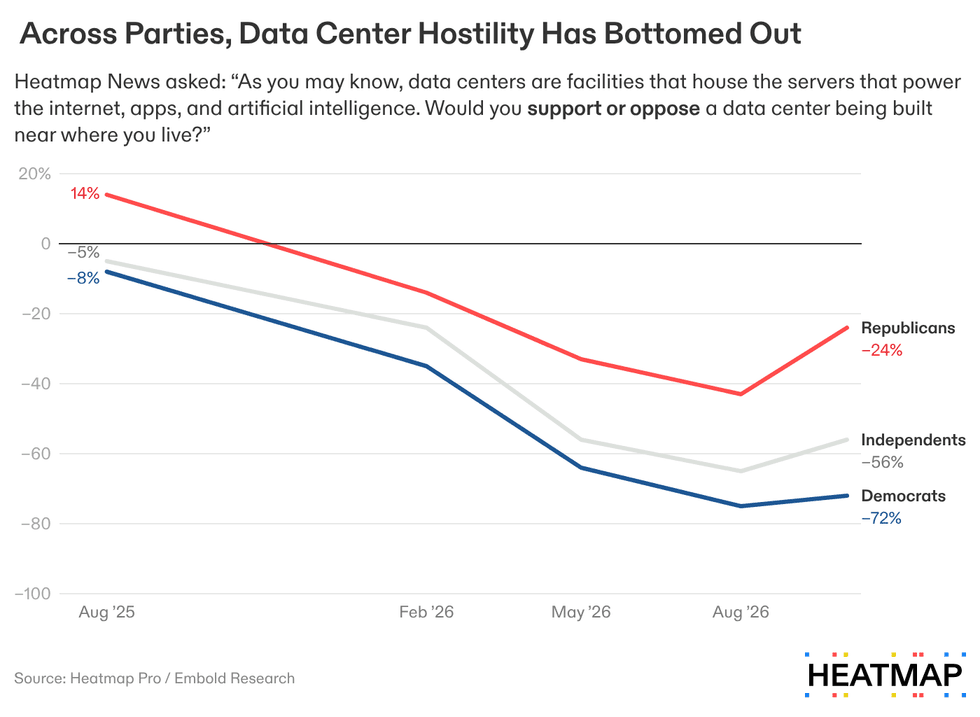
The parties’ long-standing energy coalitions have become destabilized, as well. The rise of China and the Biden administration’s unpopularity has destabilized climate policy in the Democratic coalition. At the same time, Republicans’ rejection of renewables and their embrace of the Big Tech has altered how that party looks to the public — and will change further if the economy slows or if the backlash to AI data centers grows. For the first time since 2012, you can see the outline of an energy realignment.
Or maybe not. If you are trying to tell the future of energy and climate policy in 2026, start here: Americans are going to need a lot more electricity in the years to come, as cheaply and cleanly as we can get it. Meeting that challenge will almost certainly require public investment and regulatory reform, meaning neither party’s radical flank will see its dearest visions come true. But everyone’s well-being depends on the grid: Republicans cannot achieve their economic objectives — nor Democrats their climate goals — without a grid buildout. Our choice is to grow the grid or watch the lights go out.
A blast from the past with the director of the Energy Policy Institute at the University of California, Berkeley’s Haas School of Business, Severin Borenstein.
Shift Key is off for the holidays, but we hope you’ll enjoy this classic episode.
Rooftop solar is four times more expensive in America than it is in other countries. It’s also good for the climate. Should we even care about its high cost?
Yes, says Severin Borenstein, an economist and the director of the Energy Policy Institute at the University of California, Berkeley’s Haas School of Business. In a 2024 blog post, he argued that the high cost of rooftop solar will shift nearly $4 billion onto the bills of low- and middle-income Californians who don’t have rooftop solar. Similar forces could soon spread the cost-shift problem across the country.
On this week’s episode of Shift Key, Rob and Jesse talk with Borenstein about who pays for rooftop solar, why power bills are going up everywhere, and about whether the government should take over electric utilities. Shift Key is hosted by Robinson Meyer, the founding executive editor of Heatmap, and Jesse Jenkins, a professor of energy systems engineering at Princeton University.
Subscribe to “Shift Key” and find this episode on Apple Podcasts, Spotify, Amazon, or wherever you get your podcasts.
You can also add the show’s RSS feed to your podcast app to follow us directly.
Here is an excerpt from our conversation:
Jesse Jenkins: I should say, it’s not really a problem with solar per se, right? It is sort of a wicked combination of significantly escalating costs in California due to wildfire prevention, and liabilities, and other investments in the distribution and transmission grids — which are largely fixed costs that you don’t avoid when you produce more solar power — and the particular way in which we design electricity rates, which then dictates how solar is valued if either you consume it on-site or, in the case of net metering, if you export it to the grid and are basically credited as if you could avoid a full kilowatt-hour of consumption, as well. So it’s this sort of combination of those three factors.
I just want to stress for listeners, like, this isn’t a problem with solar per se. It’s kind of a problem with how we design and structure electricity rates.
Severin Borenstein: Absolutely. If rates really reflected the actual cost of providing those additional kilowatt-hours then people would be facing exactly the right incentives on whether to put in solar or not. Unfortunately, nowhere do they really reflect that, but in California, they’re just completely out of line, and have gotten drastically more out of line in the last few years.
The two biggest utilities, PG&E and Southern California Edison — PG&E rates have gone up 80% in the last five years, and Edison’s rates have gone up 90%. So these are just huge increases. Some of it is directly connected to delivering electricity. A lot of it isn’t — a lot of it is the impact of climate change, and it’s the decision by the state legislature that we’re going to pay for these costs by raising your electricity price when we could easily be paying for these through the state budget.
Not easily, I mean there’s still costs. But it would be natural to pay for many of them through the state budget.
Mentioned:
Shift Key’s rooftop solar series, featuring Mary Powell, Severin Borenstein, and Heatmap’s own Emily Pontecorvo
Jesse’s distributed energy research at MIT
Australia’s Solar Choice Price Index
More on Texas’ Griddy debacle
Leah Stokes et al. on utilities’ climate record
This episode of Shift Key is sponsored by …
Heatmap Pro brings all of our research, reporting, and insights down to the local level. The software platform tracks all local opposition to clean energy and data centers, forecasts community sentiment, and guides data-driven engagement campaigns. Book a demo today to see the premier intelligence platform for project permitting and community engagement.
Music for Shift Key is by Adam Kromelow.
Reflections on a rock ’n’ roll road trip.
I expected touring the whole country with my rock band could change me. I didn’t think it would shatter my understanding of the U.S. energy transition.
First, a quick word about myself for any Heatmap readers who may not know: Along with delivering you scoop after scoop, I’ve been writing and playing music as the front person of a band called Ekko Astral. Last fall, we had the privilege of touring the entire U.S. opening for two of my favorite rock acts, PUP and Jeff Rosenstock. The tour itself was immensely successful, with packed-out rooms full of thousands of screaming fans. Getting to play those stages was the culmination of a dream I’d had since playing guitar at age 11 at the local coffeeshop open-mic. It was awesome.
What I hadn’t considered about this cross-country rock n’ roll tour, however, was that it would take me through the fields of wind turbines and solar projects being built across the country that I’d reported on but mostly hadn’t seen in person.
Driving across the country with my band, I saw solar and wind projects in Wisconsin, Kansas, Arizona, and Idaho. One drive from Austin, Texas to Rozwell, New Mexico, sent me through a dizzying maze of wind farms in a western portion of the Lone Star State that surrounded my vehicle on all sides with spinning blades and transmission lines — and fracking rigs, because it was Texas. It felt like some sort of twisted, magnificent energy wonk video game level.
I also drove through myriad pockets of rural America where companies have been fighting tooth-and-nail to build utility-scale renewable energy and sometimes losing to hardened opposition. I drove through open fields and farmland in the Midwest and the Great Plains, for example, including places where building solar or wind is banned outright. I drove straight through the part of central Idaho where Lava Ridge, once the largest wind farm in the country, would have been built this year if not for Donald Trump. Sure, there were counties where I could understand wanting to avoid solar farms on farmland, or wind turbines cluttering more picturesque vistas. But I can’t tell you how many times I looked out the window of my vehicle and thought, Why isn’t this a solar farm? There’s no one here!
At the same time, I was trapped in my own form of climate hypocrisy, touring the country in a gas-powered Ford Transit van. I kept longing for us to have the capacity to tour by electric van. But setting aside the limited availability of electric vans for touring purposes, the sheer logistical requirements of going electric would be difficult for any touring band. Music venues do not always have reliable charging access, and calculating when and how to charge the van on our tour probably would’ve made already time-limited logistics impossible. Sure, Ed Sheeran might be able to do it, but not an up-and-coming band on a budget.
To make matters more frustrating, it turns out band merch isn’t great for the planet. Yes, you can choose greener materials for T-shirts and record packaging, but vinyl records are produced with petrochemicals. Cleaner alternatives, known as biovinyl, have been tried but can have serious quality issues (see: the Billie Eilish experiment). Then add in the shipping required to get multiple rush orders of shirts dropped in random spots across the country and, well, you’re looking at quite a lot of potential carbon emissions.
One day, late in the tour, I walked off stage in Salt Lake City and opened my phone to a text from a source notifying me that Esmeralda 7 — the largest solar project in the U.S. — had been killed. I wrote the piece, then went back to selling more copies of Ekko Astral songs printed onto petroleum discs.
All of this made me feel angry and helpless. By the time the tour ended I wasn’t quite a doomer, but I was tired, and my views on climate action had changed in three important ways.
First, we need to rethink what kind of “permitting reform” is necessary for the energy transition. After driving through so many open areas with so little economic development and no new renewable energy generation, I no longer think that changing federal environmental laws will make much of a difference, except to make more polluting forms of energy more economical. The permitting issues delaying projects in these places are, as I have reported for Heatmap, sometimes caused by people on social media who are manipulating a decline in civil engagement and participation in municipal government to block energy projects they personally dislike, even when the developments enjoy broad community support.
This is not a federal permitting problem, it’s a local one. But national politicians could help mitigate this issue if they really wanted to. New gas pipelines need approval from just one entity — the Federal Energy Regulatory Commission — but transmission lines have to cross all the Ts with every state agency along their path. Lawmakers trying to rectify that problem should also turn their attention to the local moratoria and restrictive ordinances holding up what Heatmap Pro data shows is more than a thousand renewable energy and battery storage projects across the country. I do not know what the specific policy solution is here, but we need policy experts to start coming up with ideas.
Second, I believe that artists need to practice what we preach.
In the wake of my tour, I’ve found myself daydreaming about what a true climate-friendly tour would look like, and have spoken with fellow musicians — and climate wonks — about how to make it happen. Maybe one day I will commandeer an electric vehicle and bring only enough gear to play music off the battery in the car. Or perhaps I will put on an outdoor concert run entirely on renewable-powered generators, as the band Massive Attack did earlier this year, claiming it slashed most of the emissions from their performance. In any case, these forms of radical thinking will be crucial because culture is upstream of politics, and art is the soundtrack that defines action.
Lastly, I think more of us need to go out and see the rest of our world, because it’s frustrating it took me a rock n’ roll tour to see what was right there this whole time: the frustratingly slow pace of progress.
I’m used to hearing from all sides that renewable energy deployment in the U.S. is moving at a rapid clip, even in spite of Trump’s rise to power. Nearly half of all new power coming online this year is going to be solar and wind. Battery manufacturing investments continue to be a bright spot. Carbon emissions are going down, albeit slowly. All of this is nice to hear, but I just traveled the whole country and it didn’t feel like I was seeing or feeling the transition that is supposedly underway.
This country has a lot of potential. I want to see us go so much further towards a greener electric grid, transportation system, and arts community.