The most common way to judge whether a company or project is helping to tackle climate change is to measure emissions. Has the company reduced its carbon footprint? Will the project add fewer greenhouse gas emissions to the atmosphere than alternatives?
It’s a useful metric, but a limited one. One company might be doing more to advance the energy transition than another — by investing in an expensive, early-stage solution such as geothermal power, for example — but a comparison of their carbon footprints won’t necessarily show it. At the project level, a solar farm in Mississippi, where solar deployment has lagged, will do more to decarbonize the U.S. power grid than one of equal size in California, even though both projects emit zero carbon.
This presents a challenge for climate-minded investors like Jonah Goldman, the chief strategy officer of Generate Capital, who are trying to figure out where their dollars can make the biggest difference. To solve it, Goldman worked with colleagues at the California State Teachers Retirement System, which backs Generate’s investments, and a team at the Rhodium Group to develop a new way for investors to assess where to put their money.
“The question that most of the frameworks out there ask is, what are your carbon emissions today, and can your carbon emissions be lowered?” Goldman told me. “The Transition Acceleration Framework asks, how can you apply capital that has the best chance of getting to decarbonization over a reasonable time frame?
“It sounds like a similar question. It sounds like semantics. But it’s actually quite different,” he said.
At a high level, the Transition Acceleration Framework measures how much additional decarbonization a given investment can deliver beyond what would likely have occurred anyway. It can also be used to evaluate policy interventions and procurement decisions, such as where to get power for a data center. The Rhodium Group published a white paper describing the methodology on Thursday, as well as an accompanying report using it to evaluate options for powering data centers in the U.S.
The Transition Acceleration Framework has three components: transition potential, transition efficiency, and acceleration factor.
Transition potential is “the size of the emissions-reduction opportunity,” the white paper says — it measures the gap between the current trajectory for a given technology and its potential deployment in a deeply decarbonized world. Some of the solutions with the highest transition potential scores, per Rhodium’s analysis, include light duty electric vehicles and utility-scale solar.
Transition efficiency measures how effective a dollar spent on that technology can be at closing the gap, based on an estimate of the total capital expenditure required to realize the potential. There, more nascent solutions like low-carbon cement and geothermal power score higher than EVs and solar.
Rhodium combines these two complementary metrics into a single “technology factor,” a score on a scale from one to ten that can help identify the highest-leverage sectors to invest in. (The project is similar in spirit to Heatmap’s Decarbonize Your Life series, in which we tried to determine the highest-leverage actions a given individual could take to cut emissions. If you missed it, check it out.)
While the transition potential and efficiency metrics provide a high-level view into how transformative different types of investments can be, the third component of the framework — the acceleration factor — helps distinguish between specific projects.
This starts with an assessment of five “acceleration attributes” — cost reduction, capital availability, new markets, infrastructure and supply chains, and political economy — that represent different mechanisms by which a single investment can help move an entire technology category forward.
For cost reduction, for example, an investor might ask how likely it is that the project will reduce the cost of future deployments through learning by doing or economies of scale. If it’s a first-of-a-kind project, the answer is likely yes. For capital availability, they might look at whether the investment will de-risk the technology. Goldman praised Amazon’s early investment in Rivian delivery vans — not just because it took gas-powered Amazon vans off the road, but because it also spurred other automakers and major shippers such as Walmart and GM to follow suit.
“While the Amazon-Rivian deal wasn’t 100% responsible for it, it certainly was a huge signal to the market that there was safety in solving this last mile delivery problem,” he said.
The Rhodium report outlines a method investors can use to score and weight the various attributes and combine them with the technology factor score to reach a final “acceleration factor” score.
In an accompanying report, Rhodium researchers used the framework to compare a number of different options for powering data centers in the U.S. It’s a high-level assessment — i.e. it doesn’t consider project-specific acceleration attributes — but it provides a rough hierarchy of the arrangements that accelerate the energy transition the most against those that do the most harm. At the top of the list is a grid-connected data center that signs a power purchase agreement with a clean, firm generator, such as a nuclear or geothermal plant. At the bottom, with a negative score indicating it would actually hinder progress relative to a regular grid connection, is an off-grid data center powered entirely by natural gas.
Of course, hyperscalers prioritizing speed to power are unlikely to wait around for a nuclear plant to get built. But there are plenty of options between that and behind the meter gas. An off-grid data center that builds enough renewables and batteries for 95% of its electricity needs and relies on gas backup scores higher than a grid-connected project that buys spot market renewable energy certificates.
“Different data center power configurations can have a meaningfully different impact on the transition, even if you’re looking at things that might on the surface seem relatively similar,” Michael Delgado, a partner at Rhodium, told me.
For now, the Transition Acceleration Framework is just that — a framework. Rhodium is piloting it with Generate and CalSTRS, as well as some additional partners, conducting bespoke assessments or their portfolios and projects. The hope is that it could eventually inform not just individual investment decisions or portfolio analyses but regulations and policy packages.
“This is an open method that we’re trying to put out there and get feedback on from the investment and philanthropic and policy world,” Delgado said.









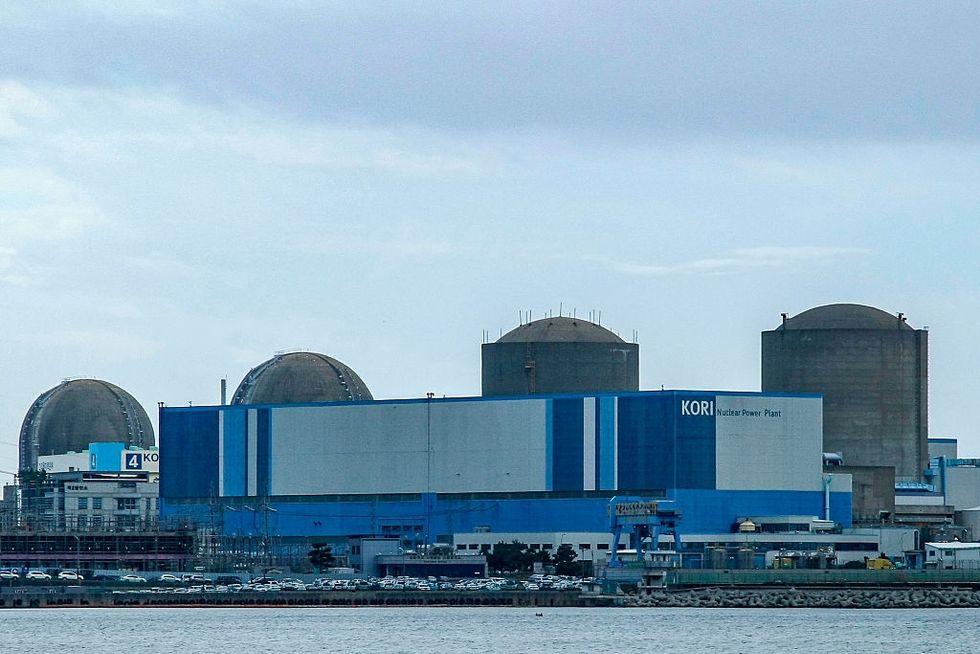 A South Korean nuclear plant in Busan. Seung-il Ryu/NurPhoto via Getty Images