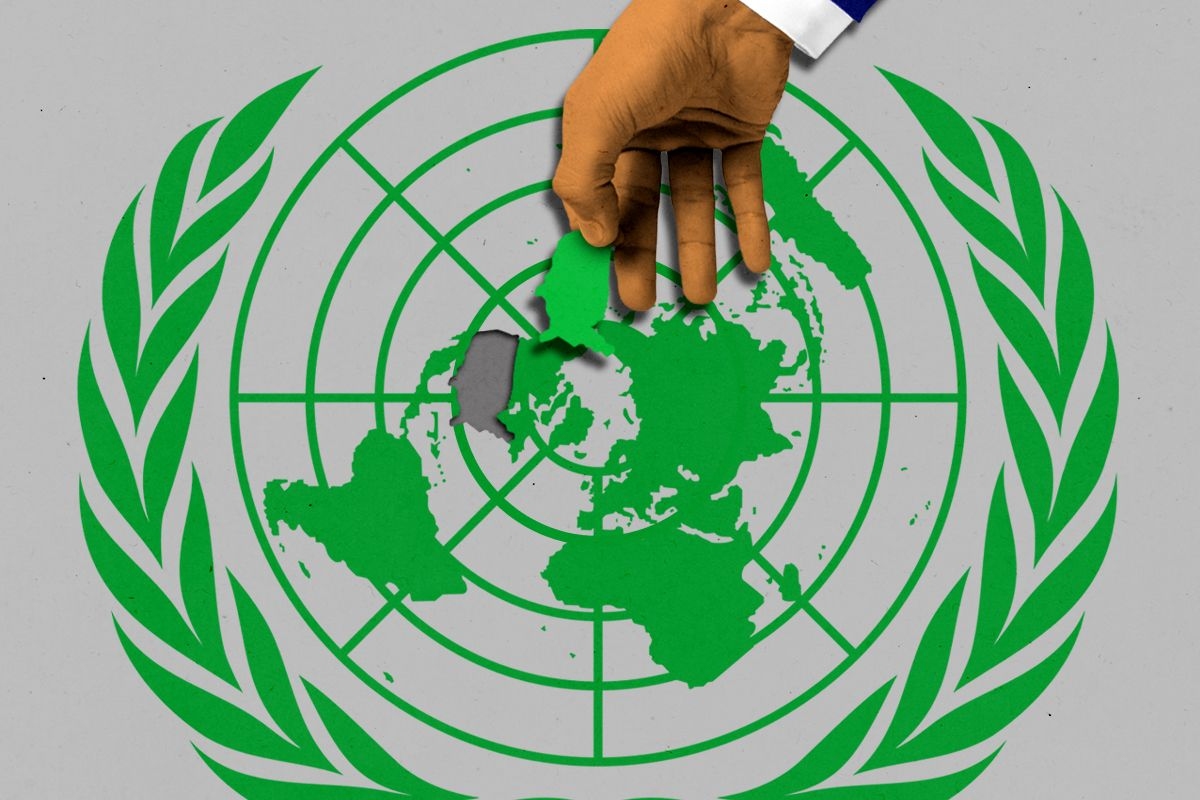
When the Trump administration moved on Wednesday to withdraw the U.S. from the United Nations Framework Convention on Climate Change, we were left to wonder — not for the first time — can he really do that?
The UNFCCC is the umbrella organization governing UN-organized climate diplomacy, including the annual climate summit known as the Conference of the Parties and the 2015 Paris Agreement. The U.S. has been in and out and back into the Paris Agreement over the years, and was most recently taken out again by a January 2025 executive order from President Trump. The U.S. has never before attempted to exit the UNFCCC — which, unlike the Paris Agreement, it joined with the advice and consent of the Senate.
Whether or not a president can unilaterally remove the U.S. from a Senate-approved treaty is somewhat uncharted legal territory. As University of Pennsylvania constitutional law professor Jean Galbraith told me, “This is an issue on which the text of the constitution is silent — it tells you how to make a treaty, but it doesn’t tell you anything about how to unmake a treaty.” Even if a president can simply withdraw from a treaty, there’s still the question of what happens next. Could a future president simply rejoin the UNFCCC? Or would they again need to seek the advice and consent of the Senate, which would require getting 67 senators to agree that international climate diplomacy is a worthy enterprise? And what does all of this mean for the future of the Paris Agreement? Is the U.S. locked out for good?
In an attempt to wrap my head around these questions, I spoke to both Galbraith and Sue Biniaz, a lecturer at Yale School of the Environment and a former lead climate lawyer at the State Department who worked on both the Paris Agreement and the UNFCCC. Biniaz and Galbraith were part of a 2018 symposium on the question of treaty withdrawal that was prompted, in part, by Trump’s first attempt to remove the U.S. from the Paris Agreement, during his first term in the White House. Those conversations led Galbraith to consider the question of rejoining treaties in a 2020 Virginia Law Review article. Suffice it for now to say that both questions are complicated, but we dig into the answers to both and more in our conversation below.
Interviews have been edited for length and clarity.
At the most basic level, what are the constitutional questions at play in an executive withdrawal from the UNFCCC?
Galbraith: Typically, the U.S. president needs to think about both international law and domestic law. And as a matter of international law, there is a withdrawal provision in the UNFCCC that says you can withdraw after you’ve been in it for a few years, after one year of notice. Assuming they give their notice of withdrawal and wait a year, this is an issue on which the text of the constitution is silent — it tells you how to make a treaty, but it doesn’t tell you anything about how to unmake a treaty.
And we have no definitive answer from the courts. The closest they got to deciding that was in a case called Goldwater v. Carter, which was when President Carter terminated the mutual defense treaty with Taiwan. That was litigated, and the Supreme Court ducked — four justices said this is a political question that we’re not going to resolve, and one justice said this case is not ripe for resolution because I don’t know whether or not Congress likes the withdrawal. There was no majority opinion, and there was no ruling on the merit for the constitutional question.
Presidents have exercised the authority to withdraw the United States from various international agreements. So in practice, it happens. The constitutionality has not been finally settled.
Both Trump administrations have removed the U.S. from the Paris Agreement, but the Paris Agreement was not a Senate-ratified treaty, whereas the UNFCCC is. How does that change things?
Galbraith: The text of the constitution only clearly spells out one way to make an international treaty, in the treaty clause [of Article II]. When you make an Article II treaty, it’s signed by the president and secretary of state. It goes over to the Senate; the Senate provides advice and consent — the U.S. is still not in it. At that point, the president has to take a final act of ratifying the treaty, which means depositing the instrument of ratification with the international depository, and that’s the moment you’re in. And it’s perfectly permissible for a president after the Senate has given advice and consent not to ratify a treaty, or to leave those resolutions of advice and consent for years and then go ahead and ratify.
In practice, you have all these kinds of other ways of making [a treaty]. You have what happened with the Paris Agreement, where the president does it largely on their own authority, but maybe pointing to pre-existing facts of, say, the UNFCCC’s existence. You have some international agreements that have been negotiated, then taken to Congress rather than to the Senate. Sometimes you have Congress pass a law that says, Please make this kind of agreement. So you have a lot of different pathways to making them. And I think there is a story in which the pathway to making them should be significant in thinking about, what is the legitimate, constitutional way for exiting them?
To me, it’s pretty obvious that if you don’t get specific approval for an agreement in the first place, then you should be able to unilaterally withdraw, assuming you’re doing so consistent with international law. I think the concerns around the constitutionality of withdrawal are more significant for the UNFCCC than they are for the Paris Agreements. But there nonetheless is this fairly strong body of practice in which presidents have viewed themselves as authorized to withdraw without needing to go to Congress or the Senate.
Biniaz: The Senate doesn’t ratify. It sounds like a detail, but the Senate basically authorizes the president to ratify — they give their advice and consent. And that’s important because it’s not the Senate that decides whether we join an agreement. They authorize the president, the president does not have to join. And that becomes relevant when we talk about withdrawing and rejoining.
We did not address, when we sent up the framework convention, whether it was legally necessary to send it to the Senate. But we sent it in any event, and it was approved basically unanimously by the full Senate back in 1992. With respect to the Paris Agreement, there are a lot of different considerations when you’re trying to figure out whether something needs to go to the Senate or not, but the fact that we already had a Senate-approved convention changed the legal calculus as to whether this Paris Agreement needed to go to the Senate. And then when the Paris Agreement ended up essentially elaborating the convention and the targets were not legally binding, we decided we could do it as an executive agreement. There was some quibbling in some quarters — more from a political point of view than a legal point of view — but I didn’t hear any objection from a legal point of view.
Now, in terms of withdrawing from an agreement, whether or not an agreement has been approved by the Senate, my view would be: The president can withdraw unilaterally. That is the mainstream view. It’s certainly the view that the president can withdraw unilaterally from an agreement that didn’t even go to Congress, like the Paris Agreement. And in part, that’s for the reasons that I mentioned. The Senate is not deciding to join the agreement — they’re authorizing, but it’s up to the president whether to actually join, and the president does that unilaterally. And then the mirror image of that would be he or she can withdraw unilaterally.
There’s a related legal question that has not been litigated, which is if Congress passes a law that says, Thou shalt not withdraw from a particular agreement, would that law be constitutional? Some would say no, because the president can withdraw, and so the Congress can’t fetter that right. So that’s like uncharted waters, but that’s not a live issue in this case.
Trump took the U.S. out of the Paris Agreement. Biden put the us back into the Paris Agreement. Trump then took us out of the Paris Agreement again, and is now withdrawing the U.S. from the umbrella organization of the Paris Agreement. I assume that would complicate the efforts of a future president to rejoin the Paris Agreement. Would it be possible for them to rejoin the framework convention? What would have to happen?
Galbraith: So first, the framework convention is the gateway to the Paris Agreement. There’s a provision in the Paris Agreement that says, in order to be in the Paris Agreement, you’ve got to be in the framework convention. And so as a matter of international law, in order to rejoin the Paris Agreement — at least unless it were dramatically amended, which is its own unlikely thing — you would need to be a member of the UNFCCC, which does mean that the question of how you rejoin the UNFCCC becomes significant. We have very little practice on any kind of rejoining. I myself think that the president could simply rejoin the UNFCCC by pointing back to the original Senate resolution of advice and consent to it. You could go back to the Senate. You could ask Congress for a resolution.
My own view is that if the president withdraws the U.S., well, they still have on the books this resolution in which the Senate has consented to ratification — they want to go back in, they go back in. I think this is pretty logically clear, but also an important constraint on presidential power. Because it’s a much more concerning increase in presidential power if you have to do all the work of getting two-thirds of the Senate, then any president can, just at the snap of their fingers, take you out, and you have to go all the way back to the beginning.
Biniaz: There are many options. One is a straightforward option: You go back to the Senate, get 67 votes. Another would be you get both houses of Congress to authorize it [on a majority vote basis]. Another would be — and there may be more — but another would be the idea that the original Senate resolution which we used in 1992 to join still exists, and nothing has extinguished it. And there the analogy would be to a regular law.
There’s several laws in the United States that authorized the president to join some kind of international body or institution. There’s a law that authorizes the president to join the International Labor Organization. There’s a law that authorized the president to join UNESCO. In both of those cases, the U.S. has been in and out and back in — and I think in one case, at least, back out. No one has batted an eye because, well, it’s a law. So the question there would be, is there any reason why a Senate resolution would be any different? Professor Galbraith explores in her law review article that exact question, and concludes that, no, there shouldn’t be a difference — I’m simplifying, but that’s the gist. And under that theory, yeah, a future president could rejoin the convention on his or her own, utilizing that authority, and then after having rejoined the convention, rejoin the Paris Agreement.
So you mentioned that there’s a provision in the UNFCCC that says you have to give notice that you’re exiting, and you wait a year, and then you exit. What does not waiting a year look like?
Galbraith: It can happen that an entity will announce its exit and then violate international law by violating the treaty terms during that one-year period. If there are, say, reporting obligations that the United States has, it would be a violation of international law not to meet those during the period while you’re still a party to the treaty.
This is obviously an escalation of Trump’s previous actions to withdraw from the Paris Agreement, in the sense that it cuts off the path to rejoining that. What does this tell us about the way the Trump administration views its position within global climate diplomacy, and also the international community, period?
Galbraith: It adds to the impression that we already see other contexts, which is that the second Trump administration is even less inhibited and climate-aware than the first administration was — which is really saying something, right? This is an escalation of a position that was already an international outlier. Every other country is in these things, and it shows a real, powerful, and deeply upsetting failure to address the crisis of the global commons.
Biniaz: The way I think about it is that, during Trump 1, it was more like there was an absence of a positive — so in other words, the administration continued to participate in negotiations. They were not pressing countries to take climate action, but neither were they pressing countries not to take climate action. This administration, you could think of it as not just the absence of a positive, but the presence of a negative. I don’t mean that in any judgmental sense. I just mean there’s been much more of an active push from the administration for others to sort of follow suit or to vote against climate-related agreements such as at the [International Maritime Organization]. That’s quite a difference between 1 and 2.
Going into this past year’s COP, it seemed like there was already a sense that international climate diplomacy was, if not dead, at least the wind had come out of the sails. Do you agree? And if so, do you think that wind will come back?
Biniaz: You have to think of international climate diplomacy very broadly. It’s not just the UNFCCC Paris Agreement and decisions that are taken by consensus. That was pretty thin gruel that came out of COP30. But if you think of international climate diplomacy more broadly as all kinds of initiatives, coalitions that are operating among subgroups of countries and at all levels of stakeholders, there’s really a lot going on in what people call the real world. I think over the next couple of years, the proportion of action that’s taken officially, by consensus, dips somewhat, and action goes up. And maybe that balance shifts over time. But I think it’s wrong to judge climate diplomacy simply by what was achievable by 197 countries, because that’s always going to be the hardest to achieve, with or without the United States.
I think it’s more difficult without a pro-climate U.S. because of the role the U.S. has historically played, in terms of promoting ambition and brokering compromises and that kind of thing. But I don’t think, if you only look at that, it’s not the right metric for judging all of global climate diplomacy.