You’re out of free articles.
Log in
To continue reading, log in to your account.
Create a Free Account
To unlock more free articles, please create a free account.
Sign In or Create an Account.
By continuing, you agree to the Terms of Service and acknowledge our Privacy Policy
Welcome to Heatmap
Thank you for registering with Heatmap. Climate change is one of the greatest challenges of our lives, a force reshaping our economy, our politics, and our culture. We hope to be your trusted, friendly, and insightful guide to that transformation. Please enjoy your free articles. You can check your profile here .
subscribe to get Unlimited access
Offer for a Heatmap News Unlimited Access subscription; please note that your subscription will renew automatically unless you cancel prior to renewal. Cancellation takes effect at the end of your current billing period. We will let you know in advance of any price changes. Taxes may apply. Offer terms are subject to change.
Subscribe to get unlimited Access
Hey, you are out of free articles but you are only a few clicks away from full access. Subscribe below and take advantage of our introductory offer.
subscribe to get Unlimited access
Offer for a Heatmap News Unlimited Access subscription; please note that your subscription will renew automatically unless you cancel prior to renewal. Cancellation takes effect at the end of your current billing period. We will let you know in advance of any price changes. Taxes may apply. Offer terms are subject to change.
Create Your Account
Please Enter Your Password
Forgot your password?
Please enter the email address you use for your account so we can send you a link to reset your password:
The former FERC chair explains why Chris Wright is likely to succeed where Rick Perry failed.

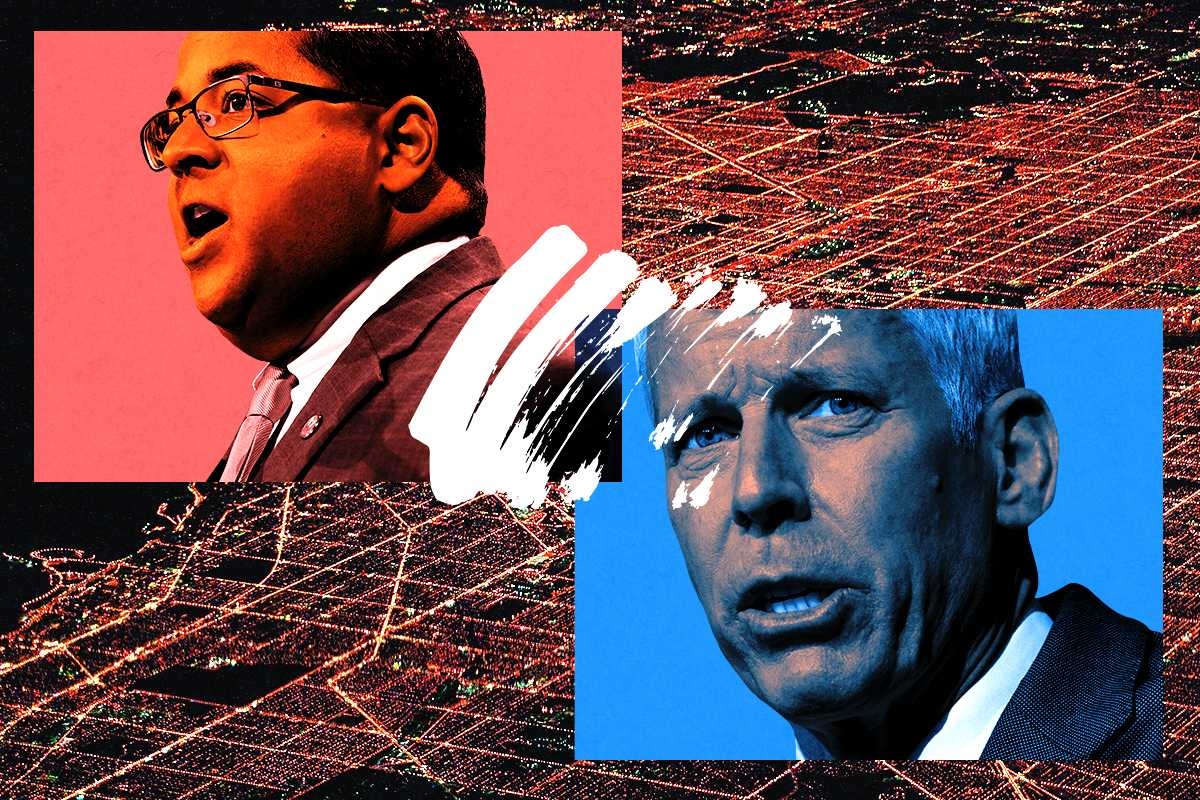
Neil Chatterjee thinks it’s going to go better this time.
Eight years ago, Chatterjee was the chairman of the Federal Energy Regulatory Commission, and Trump was the president. When Trump’s then-Secretary of Energy, Rick Perry, asked the commission to ensure that generators able to store fuel on site — which in the U.S. largely means coal and nuclear — get extra payments for doing so, thus keeping struggling power plants in business, it rejected the proposal by a unanimous vote.
“There’s no doubt my 2017 experience — that was politically driven,” Chatterjee told me, though he did concede that Perry was “right to be concerned about retiring generation at the time.” The Perry plan had been heavily influenced by the coal industry, he told me, and the regulatory structure of “compensating plants for having the attribute of on-site fuel … it was just a bit of a stretch.”
Now there’s a new Trump administration, with a new Secretary of Energy and a new FERC — and on Thursday, Energy Secretary Chris Wright asked the commission to do something else. He put forward what’s known as an advance notice of proposed rulemaking, directing FERC to come up with ways to help to make sure the grid can deal with another large-scale transition.
“They’re just apples and oranges,” Chatterjee said of the two requests. “This is a much more elegant, much more thoughtful exercise.”
Wright’s letter lays out the challenge of integrating large loads — i.e. data centers — onto the grid, arguing that they “must be able to connect to the transmission system in a timely, orderly, and non-discriminatory manner.” Doing so, he said, will “require unprecedented and extraordinary quantities of electricity and substantial investment in the Nation’s interstate transmission system.”
The overall thrust of the proposal is to make things easier and faster, including suggesting that interconnection studies for large loads that have their own generation or are flexible could be finished in just 60 days — which, if successful, could take a process that can last for years and get it done in less than a season.
The notice suggests a number of reforms for FERC to consider, including faster interconnection for “large loads that agree to be curtailable and hybrid facilities that agree to be curtailable and dispatchable” — touching on what has been the hottest subject in energy policy this year.
Tyler Norris, a Duke University researcher who has been one of the leading promoters of load flexibility, called Wright’s notice a “BFD” — that is, big effing deal — in a brief email to Heatmap.
Norris elaborated further on X. The proposal “appears to have done the near-impossible — generate overwhelming bipartisan enthusiasm — in what may be the most positive cross-sector response we’ve seen yet to DOE action under Secretary Wright,” he wrote.
Wright’s proposal suggests that both new data centers and new sources of power should be studied together for interconnection. While this sounds like it would be adding complexity, it may actually be simplifying the process. “Such an approach will allow for efficient siting of loads and generating facilities and thereby minimize the need for costly network upgrades,” the proposal says, reflecting the twinned desire to get more data centers on line faster while shielding electricity consumers from higher costs.
Another of Wright’s suggestions, however, might face more opposition. He argues that “load and hybrid facilities should be responsible for 100% of the network upgrades that they are assigned through the interconnection studies.”
This is designed to address the possibility — already being realized in parts of the country — that the network infrastructure required to bring data centers online could lead to higher costs for all electricity customers served by a given utility as it spreads out those costs to its rate base. The risk, however, is that utilities won’t like it. That’s because in most of the country, utilities earn a regulated rate of return on their investment in grid upgrades (by way of customer bill payments, of course), creating an incentive for them to continue to spend.
Those dynamics may be changing. Utilities once enjoyed primacy in Washington on electricity policy, especially among Republicans, but have seen their status slip of late in favor of a new force: big tech companies with big data centers.
“The hyperscalers have the influence to counteract the utilities here,” Chatterjee told me. “And that’s a new dynamic, historically — when it came to FERC, when it came to DOE, when it came to, quite frankly, Congress. People are sensitive to their utilities.”
Wright’s proposal, Chatterjee said, is trying to balance several different considerations the White House faces.
“This is the most vexing issue before the commission right now. And the reality is, it’s not clean politically within FERC, within DOE, even within the White House. There are differences of opinion on how best to thread this needle,” he told me, pointing to divides between those who want to drive AI development as fast as possible and those who are concerned about electricity prices.
By contrast, the Perry proposal to FERC was widely recognized as being primarily about supporting the coal (and to some extent nuclear) industry.
“I really think what DOE has put forward here is kind of an elegant solution that touches on everything,” Chatterjee said. “It’s not preferring particular sources of generation. It’s for flexibility — flexibility is having its moment.”
The proposal has already won some plaudits from the technology industry. In a letter to the White House, OpenAI Chief Global Affairs Officer Christopher Lehane wrote that the company “welcomed the news last week that DOE recommended to FERC that it assert jurisdiction and create standardized rules for large load interconnections.” He also noted that OpenAI’s data centers “are designed to be curtailable — reducing their draw or even returning power during peak demand, helping to protect reliability and avoid higher costs for consumers.”
The DOE gave FERC an April 2026 deadline for final action on the proposed rulemaking, and FERC said Monday night that comments would be due by November 14.
Chatterjee said he expects FERC to eventually issue rules based on the proposal on a unanimous and bipartisan basis.
“I think the initial thought was, Oh, here goes the Trump administration again, leaning on FERC. This is actually a thoughtful exercise that I think most people in the energy space recognize is necessary to be done.”

Log in
To continue reading, log in to your account.
Create a Free Account
To unlock more free articles, please create a free account.
The SPEED Act faces near-certain opposition in the Senate.
The House of Representatives has approved the SPEED Act, a bill that would bring sweeping changes to the nation’s environmental review process. It passed Thursday afternoon on a bipartisan vote of 221 to 196, with 11 Democrats in favor and just one Republican, Brian Fitzpatrick of Pennsylvania, against.
Thursday’s vote followed a late change to the bill on Wednesday that would safeguard the Trump administration’s recent actions to pull already-approved permits from offshore wind farms and other renewable energy projects.
Prior to that tweak, the bill would have limited the Trump administration’s ability to alter or revoke a federal permitting decision after the fact. The new version, adopted to secure votes from Republican representatives in Maryland and New Jersey, carves out an exception for agency actions taken between January 20 and the day the law takes effect.
"Last-minute changes to the SPEED Act undercut the bill’s intent to provide certainty to American business,” Rich Powell, the CEO of the Clean Energy Buyers Association said in a press release after the bill passed. “We hope the Senate will now take this language and strengthen those protections for existing and new projects needed to maintain grid reliability and meet growing electricity demand.”
At a high level, the SPEED Act would hasten federal permitting by restricting the evidence that federal agencies consider during the environmental review process and limiting the amount of time a court can deliberate over challenges to federal decisions. It would also disallow courts from vacating permits or issuing injunctions against projects if it finds that a federal agency violated NEPA. The changes would apply to permits of all kinds, including for oil and gas drilling, solar and wind farms, power lines, and data centers.
Environmental groups were generally against the bill. “Far from helping build the clean energy projects of the future, the SPEED Act will only result in an abundance of contaminated air and water, dirty projects, and chronic illnesses with fewer opportunities to hold polluters accountable in court,” Stephen Sciama, senior legislative council for Earthjustice Action, said in a press release on Thursday.
But proponents, such as the conservative energy group Clearpath Action, argue the bill will enable American industry to “invest and build with confidence” by cutting unnecessary red tape, improving coordination across agencies, and setting clearer rules and timelines for judicial review.
In House floor testimony on Thursday morning, Republican Bruce Westerman of Arkansas, the SPEED Act’s lead sponsor, said the bill had the backing of more than 375 industry groups and businesses, and bipartisan support in both the House and Senate. “The SPEED act will deliver the energy and infrastructure Americans need,” he said.
The bill lost at least one significant industry supporter after Wednesday’s changes, however. The American Clean Power Association, which had previously joined the American Petroleum Institute and others in a letter urging the House to pass the bill, withdrew its support, calling the new language a “poison pill” that “injects permit uncertainty, and creates a pathway for fully permitted projects to be canceled even after the Act’s passage.”
The Solar Energy Industries Association also denounced the bill’s passage.
Contrary to Westerman’s assertion, the bill’s fate in the Senate is far from certain. “Even if the House passes this bill today, it is going nowhere in the Senate,” Democratic Representative Jared Huffman of California asserted on the floor on Thursday. “What a missed opportunity to tackle a serious issue that Democrats were very interested in working on in good faith.”
Some Senate Democrats came out in opposition of the bill even before the late-breaking amendments. Senators Brian Schatz of Hawaii, Sheldon Whitehouse of Rhode Island, and Martin Heinrich of New Mexico told my colleague Jael Holzman that the bill did not do enough to ensure the buildout of transmission and affordable clean energy, but that they “will continue working to pass comprehensive permitting reform that takes real steps to bring down electricity costs.”
Some see getting the SPEED Act through the House as merely a starting point for a more comprehensive and fair permitting deal. Democratic Representative Adam Gray of California told Politico’s Joshua Siegel Thursday that he was voting in favor of the bill despite the last minute changes due to his faith that the Senate will hammer out a version that provides developers of all energy stripes the certainty they need.
His Californian colleague Representative Scott Peters, on the other hand, voted against the bill, but committed to getting a deal done with the Senate. “We need to get permitting reform done in this Congress,” he said on the House floor Thursday.
Federal energy regulators directed the country’s largest grid to make its rules make sense.
Federal energy regulators don’t want utilities and electricity market rules getting in the way of data centers connecting directly to power plants.
That was the consensus message from both Republican and Democratic commissioners on the Federal Energy Regulatory Commission Thursday, when it issued its long-awaited order on co-location in PJM Interconnection, the country’s largest electricity market, covering the Mid-Atlantic and Midwest.
The question is a holdover from last year, when Amazon struck a deal with independent power producer Talen Energy to co-locate an Amazon Web Services data center with the Susquehanna nuclear plant in Pennsylvania. Amazon eventually amended the deal to a more traditional power purchase agreement after failing to win regulatory approval for a behind-the-meter arrangement. Constellation, which owns a number of nuclear power plants in the PJM territory, had asked FERC to force PJM to adopt co-location rules and prevent what it saw as utilities obstructing co-location projects.
More broadly, though, the dispute is between independent power plants and their owners and utilities who build and operate the transmission grid. The latter want the former to essentially pay full freight for grid services for co-located power plants, even if they are largely or exclusively serving a single customer — such as, let’s say, a data center. Even co-located loads still incur substantial grid costs, utilities have argued, which should be paid for in their entirety.
Co-location has become attractive lately as a way to get data centers online faster and limit expensive grid upgrades that could drive up costs for everyone on the grid. Up until now, though, PJM didn’t really have a way to determine the distribution of costs and responsibilities when some or all of a new demand source is served by a co-located generator — and it wasn’t really in a particular rush to set one up, FERC said.
“The Commission finds that PJM’s tariff does not appear to sufficiently address the rates, terms and conditions of service that apply to co-location arrangements,” FERC said in its order. “The absence of this information may leave generators and load unable to determine what steps they can take to set up co-location arrangements of various configurations, and how to do so in an acceptable way.”
The commission was unanimous in its order, showing that despite the increased partisanship of regulatory politics in Donald Trump’s Washington, FERC is still operating under its traditional consensus-based approach. The consensus also shows the high level of dissatisfaction across the political spectrum with rising electricity prices, and specifically with PJM, which has combined rising prices with a clogged interconnection process and concerns about reliability.
“If a new large load wants to connect directly with a power plant and operate in a way that lowers grid costs, we should let it. If the current rules don’t let this work in a way that’s fair for everyone,” said Commissioner David Rosner, a Democrat. “We should change those rules so we can deliver the savings that consumers need and ensure reliable electricity for everybody.”
In its order, the commission asked PJM to come up with new arrangements that will allow transmission costs to scale with actual usage of the transmission system.
To do so, the new rules will have to reflect the actual usage of the transmission system of a co-located data center or other large load, Rosner explained.
He gave the example of a 1,000-megawatt data center co-located with a new 900-megawatt power plant. Its draw from the grid would be 100 megawatts, but “under PJM status quo rules,” Rosner said, “the data center needs to take the full 1,000 megawatts of front-of-meter transmission service from the grid, despite being directly connected to the co-located power plant.”
With the new options FERC is mandating PJM come up with, “the data center will now have the option to purchase what we call firm contract demand to take just 100 megawatts of firm service,” Rosner said, which will help cut costs across the board, he added.
The order also touches on the other hottest subject in grid policy today: flexibility. Because PJM will no longer be required to plan transmission or assure it has capacity for directly-connected loads, Rosner said, a big customer will have to accept the risk of being curtailed “if its usage exceeds what it’s contracted for in advance.”
The renewables industry cheered the order, especially the message that PJM needs to embrace flexibility and enable new generation and load to get online quickly.
“PJM needs to heed FERC’s message that grid flexibility enables speed, affordability, and reliability. As PJM proposes new rules to enable fast-tracking large load interconnections, it should prioritize the advanced energy technologies that are quickest to build and enable flexibility,” Jon Gordon, policy director at Advanced Energy United, said in a statement.
Independent power producers — i.e. the companies that own that power plants — also seemed happy with what the commission had to say. Talen, Constellation Energy, and Vistra Energy, all of whom have substantial footprints in PJM, saw their share prices rise at least 3% in early Thursday trading.
Thursday’s order comes as “large load interconnection” — i.e. data centers hooking up to the grid — dominates the energy regulatory discussion. Secretary of Energy Chris Wright has asked FERC to come up with new rules early next year to speed up interconnection without jacking up consumer electricity prices. At the same time, PJM’s market is under stress, with another capacity auction this week resulting in yet another round of record-setting payments to generators — plus, this time, a failure to secure its typical margin over and above its minimum projected capacity needed to ensure future reliability.
PJM is working on its own new set of rules to connect large loads without large price impacts, a process that has so far resulted in not much, as the market’s board has yet to agree on a proposal to bring to FERC.
Beating up on PJM was a bipartisan affair Thursday morning.
“The order recognizes that PJM existing transmission services are insufficient in that they do not recognize the controllable nature of co-location arrangement’s,” the commission’s Republican Chair Laura Swett said in her statement at Thursday’s meeting.
“Flexible options for co-located load means carving a path for minimizing expensive and time-intensive network upgrades in circumstances where they’re not needed,” Commissioner Lindsay See, another Republican appointee, said.
Rosner’s statement echoed his colleagues’, arguing that the existing PJM rates and contracts are “unjust and unreasonable” because they do not “contain provisions addressing with sufficient clarity or consistency the rates, terms and conditions of service that apply to interconnection customers serving co-located load and eligible customers taking transmission service on behalf of co-located load.”
He also addressed the electricity market’s board directly: “In my opinion, PJM board, tomorrow, once you’ve read this order, would be a great day to file this with us,” Rosner said.
Current conditions: Flooding continues in the Pacific Northwest as the Pineapple Express atmospheric river dumps another 4 inches of rain on Oregon • A warm front with temperatures in the 60s Fahrenheit is heading for the Northeast • Temperatures in Paraguay are surging past 90 degrees.
The Trump administration plans to dismantle the National Center for Atmospheric Research in Colorado. Founded in 1960, The New York Times credited the center with “many of the biggest scientific advances in humanity’s understanding of weather and climate.” But in a post on X late Tuesday evening, Russell Vought, the director of the White House’s Office of Management and Budget, called the institute “one of the largest sources of climate alarmism in the country,” and said the administration would be “breaking up” its operations. It’s just the latest attempt by the White House to salt the Earth for federal climate science. As I wrote in August, the administration went as far as rewriting existing climate reports.
The latest capacity auction in PJM Interconnection, where power generators in the nation’s largest electricity market bid to provide power when the grid is especially stressed, ended at the legally-mandated cap of $333.44 per megawatt. This adds up to some $16.4 billion, a record-setting figure following the past two auctions, which brought in $16.1 billion and $14.7 billion.
This auction covers 2027 through 2028, and is the last that will be subject to the price cap. Despite the dizzying spending, it failed to procure enough power to meet PJM’s preferred 20% reserve margin for a severe demand event. The auction procured 145,777 megawatts of capacity, 6,623 megawatts short of the target, giving the grid a 14.8% margin. Much of that projected demand will come from data centers, which, as Heatmap’s Matthew Zeitlin wrote, have stressed the grid operator nearly to the breaking point.

Global coal use is set to start declining over the next five years as renewables and liquified natural gas gobble up its market share, the International Energy Agency projected in its latest annual forecast Wednesday. Demand is on track to inch upward 0.5% this year to a record 8,845 million tons before dropping 3% by 2030. Analysts warned Bloomberg that coal has remained “stubbornly strong” given high levels of consumption in China and India, and the Paris-based IEA cautioned that its five-year outlook “is subject to significant uncertainties that could impact it materially.”
Among the factors that look increasingly certain: That the Trump administration won’t allow any more U.S. coal plants to shut down. On Tuesday, the Department of Energy ordered the 730-megawatt TransAlta Centralia Generation in Washington to remain past its retirement at the end of this month, despite the state’s ban on coal operations. There’s just one big problem with that plan, as Matthew wrote last month. Old coal plants keep breaking down.
Sign up to receive Heatmap AM in your inbox every morning:
Nuno Loureiro, a professor of nuclear science and the director of the Massachusetts Institute of Technology’s Plasma Science and Fusion Center, died Tuesday after being shot multiple times in his home near Boston the night before. Police statements made no mention of a suspect or motives, but Loureiro’s coveted position as one of the United States’ leading fusion scientists stoked speculation that the killing was politically motivated. Prominent influencers including the Trump adviser Laura Loomer falsely claimed that Loureiro, who was from Portugal, was Jewish and a vocal activist for the Israeli government. But The Jerusalem Post reported that Israeli intelligence officials are investigating potential links between the murder and the Iranian government, though the newspaper cautioned that the assessment “has not yet been verified.” As of now, there is no clear evidence of who killed Loureiro or why. His death shocked the field of research in which he was lauded as a leader. A former colleague in Portugal who started working at the same laboratory with Loureiro years ago in Lisbon and “knew him well” told me, “Everyone here is in shock.”
Back in June, Matthew wrote a good piece explaining why the commonly used metric known as levelized cost of energy was “wrong.” Essentially, LCOE represents the energy output of a given source in terms of its construction and operating expenses — the lower the LCOE, the more efficient it is operationally. But the metric fails to capture all the other things that make an energy source valuable, such as the frequency with which it operates, how long it lasts, or how much infrastructure is required to make use of it. When Ontario Power Generation assessed the cost of building new nuclear reactors at its Darlington station, the LCOE showed solar and batteries costing far less. But a full systems analysis found that nuclear reactors would last longer, require fewer transmission upgrades, and would not need back-up generation. A report published this morning by the consultancy FTI has proposed two new metrics instead: Levelized value of energy, or LVOE, “which reflects the total value a project can create for its owners, and Levelized Net Benefit (LNB), which quantifies the broader value a project can deliver to the overall system.” While the LCOE for solar is roughly 40% lower than nuclear power in both Texas’ ERCOT grid system and PJM, a chart from the report shows that nuclear has an LVOE roughly 10 times greater.

Record rainfall last month has revived an ancient lake in an unusual place. When ice covered the Sierra Nevada between 128,000 and 186,000 years ago, a lake 100 miles long and 600 feet deep sat in what is today the Mojave Desert in eastern California. That lake, called Lake Manly, has returned. As the science site Phys.org reported, “now Death Valley, one of the hottest places on Earth and the lowest point in North America, has a desert lake framed by snow-capped mountains.” But the “marvel” is likely to disappear soon.