It’s been a big weekend: I’m fairly certain Saturday Night Live mentioned Heatmap’s data center polling in one of its Weekend Update segments over the weekend. Watch here.
There are 22 days to the midterm elections here in the United States. We’ll soon enter that pre-election wormhole where only national politics can break through. So today I wanted to look at a story that might, on its face, seem like it has nothing to do with climate or energy. And warning: It’s a little bit of a weird one.
Last week, OpenAI released what it described as the solution to more than 700 open problems in mathematics. Many of the problems, such as the Quasi-Riemann hypothesis, had gone unsolved for decades. Some of the solutions came with proofs written in the programming language Lean.
The release made a stir in part because OpenAI had reached the solutions by using an internal model — that is, a version of ChatGPT not yet open to the general public. In a statement, the Association for Human Mathematics lambasted OpenAI for using an internal model to do research, violating what it described as a precept of AI-driven math research. (I’ve since seen speculation that OpenAI may not have even meant to solve the problems, but gave them to the internal model as a test … and then got the answers.) It’s also not clear whether all of OpenAI’s 700 solutions are correct — in many cases the proofs are so intricate that mathematicians are still wrapping their heads around them.
“There are some sad stories related to their users getting scooped [and] conflicts of interest,” Levent Alpöge, a mathematician at Anthropic, posted on X. “It’s obviously the most significant moment in mathematical history.”
On Friday night, the UCLA mathematician Terence Tao gave a pre-planned lecture at Caltech about what he called “Math 2.0”; it considered the revolution the field had seemingly undergone in the previous few days. (He posted the slides to his blog over the weekend, and I’m using them to summarize his talk here.) For most of math’s history, he said, the field operated under “proof scarcity,” in which finding a solution to an open math problem and confirming it as true was “difficult and rare,” requiring “significant human expertise.”
But AI, it has turned out, is well suited to solving math problems. This is partly because math, like the large language models themselves, is entirely conceptual, so confirming a proof as true requires no recourse to the physical. But it’s also because math’s solutions are “objectively verifiable”: “There is broad consensus on what constitutes a correct and complete proof of a given problem,” and thanks to the existence of proof programming languages like Lean, they can even be checked by computer.
The end result is that math is now entering a world of “proof abundance,” he said.
That is, perhaps surprisingly, a problem for math’s practitioners, and it will mandate a new intellectual regime for the discipline. Mathematicians have often used open problems as “lighthouses,” Tao wrote, “not destinations to be reached … but useful guides to explore the mathematical landscape.” Mathematicians often learn more in the solving than in the solution, in other words. But if mathematicians can now generate shortcuts to math problems without knowing how they got there, or even how the problem works, then actual human mathematical understanding will suffer. (One way to understand this is that mathematicians are now dealing with the same problem that math teachers have faced since the invention of the pocket calculator: How do you confirm students actually understand the material? Except the world’s most elite mathematicians themselves are the students in question.)
This disconnect can pose its own AI alignment problems, Tao said, analogizing math to pharmaceuticals. Suppose an advanced AI found what appears to be a cure for cancer that can pass a stage 3 clinical trial: “After a large amount of compute, it produces a cocktail of previously unknown chemicals which it claims, when mixed and injected into a patient, will kill all their cancer cells,” he said. It even generates a programmatic proof of the cocktail’s effectiveness.
“Before injecting this cocktail into your bloodstream,” he asked, “would you find it reassuring to know that there is at least one human cancer expert who understands — even partially — the mechanism behind this cure?” If not, you can see mathematicians’ problem, confronted by a surfeit of proofs that seem to work, but nobody who can explain how or why they do.
Now, Tao’s analogy is somewhat peculiar because something like this actually does happen all the time in medicine: Doctors still don’t fully understand how many drugs work, including acetaminophen, SSRIs, and lithium. (That said, those compounds were identified by trial and error, not by a mechanical superintelligence.) But the broader situation that Tao is painting — as well as the crisis posed by OpenAI’s 700 proofs — get at a significant question with economic importance far beyond just math: Will AI solve the economy’s secular attention shortage or worsen it?
This question has greater import than it may seem — but let me qualify what I mean by “attention shortage.” Writing in 1971, the economist Herber Simon observed the sudden superabundance of information that had exploded in every economic domain. There were more facts, data, news articles, and opportunities than any individual or organization knew what to do with. He pointed out that this newfound “wealth” of information implied an insufficiency of something else: attention.
“What information consumes is rather obvious: it consumes the attention of its recipients,” he wrote in Designing Organizations for an Information-Rich World. “Hence a wealth of information creates a poverty of attention and a need to allocate that attention efficiently among the overabundance of information sources that might consume it.”
He wrote this, of course, well before the advent of internet, smartphones, sensors, or networked cameras — all of which have worsened the problem. But in the ensuing half century, the economy has learned to deal (or at least intermittently manage) this secular scarcity of attention. Much of what we now call knowledge work is devoted to filtering, siphoning, processing, and otherwise attending to the information superabundance.
AI is, in theory, supposed to help address this same set of problems. AI is commodified attention — or, at least, that is its promise. (The most important machine learning paper of the past decade, after all, is entitled “Attention Is All You Need.”) Many AI products, such as Meta’s Muse, now want you to believe that by ceding control of your email, your calendar, your restaurant reservations, and your digital life to AI, you will gain an attentional edge. The AI will do the grunt-work of attending to boring things for you, and you will feel less overwhelmed. If this vision comes true, the economy’s mismatch of information and attention will prove to be a short-lived historical blip.
But the past week of math news and Tao’s “Math 2.0” regime suggest a different scenario is more likely, at least in the immediate near term. By allowing far faster and more automated information production, AI will create a new, more vicious, and even more abstract form of information overload. Every profession and intellectual discipline will be overwhelmed with new papers, ideas, observations, proofs, or choices. Yet the human understanding required to convert this new information into useful action will become even more scarce. In such a world, AI will not solve the economy’s attention shortage, but worsen it.
I’m not sure which world would be worse for humanity, to be candid. One world suggests the eventual automation of all human effort. But in Tao’s world, many of us might still have jobs — they will just involve even more filtering, sorting, and processing of an ever-deepening pile of automated idea generation than we do today.
And what is the connection to climate and energy? One easy connection might be to the permitting process: If you think a new transit line (at the local level) or transmission line (at the state or federal level) could be overwhelmed with procedural concerns 10 years ago, wait until you see what happens when information itself can be mechanically produced. But that is only one example of a more general problem. Soon, if not already, any process of providing input to an important policy question — on energy, decarbonization, or anything else — will be overwhelmed with facially high-quality analysis. It will be left to policy officials and elected leaders to sort through it.





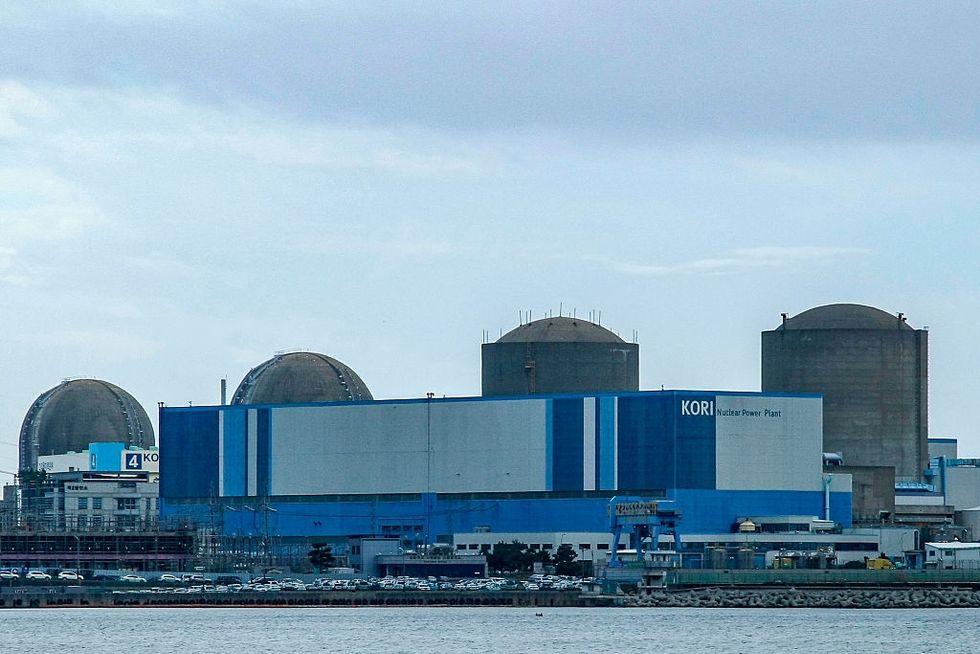 A South Korean nuclear plant in Busan. Seung-il Ryu/NurPhoto via Getty Images