When renowned sci-fi author Isaac Asimov first wrote about space-based solar power in the 1940s, it helped inspire engineers and the federal government alike to take the idea seriously. By the 1970s, a design had been patented and feasibility studies were underway. But those initial efforts didn’t get far — challenges with launch costs, constructing the necessary structures in space, and energy conversion efficiency proved too much for scientists to overcome.
Now the idea is edging ever closer to reality.
The space solar company Overview Energy emerged from stealth today, announcing its intention to make satellites that will transmit energy via lasers directly onto the Earth’s grid, targeting preexisting utility-scale solar installations. The startup has already raised $20 million in a seed round led by Lowercarbon Capital, Prime Movers Lab, and Engine Ventures, and is now working on raising a Series A.
The core thesis behind Overview is to allow solar farms to generate power when the sun isn’t shining, turning solar into a firm, 24/7 renewable resource. What’s more, the satellites could direct their energy anywhere in the world, depending on demand. California solar farms, for example, could receive energy in the early morning hours. Then, as the sun rises over the West Coast and sets in Europe, “we switch the beam over to Western Europe, Morocco, things in that area, power them through the evening peak,” Marc Berte, the founder and CEO of Overview Energy, explained. “It hits 10 p.m., 11 p.m., most people are starting to go to bed if it’s a weekday. Demand is going down. But it’s now 3 p.m. in California, so you switch the beam back.”
That so-called “geographic untethering” will be a key factor in making all of this economically feasible one day, Berte told me. The startup is targeting between $60 and $100 per megawatt-hour by 2035, when it aims to be putting gigawatts of commercial space solar on the grid. “It’s 5 o’clock somewhere,” Berte told me. “You’re profitable at $100 bucks a megawatt-hour somewhere, instantaneously, all the time.”
Making the math pencil out has also meant developing super-efficient lasers and eliminating all power electronics on its custom spacecraft. The type of light Overview beams to earth — called “near-infrared” and invisible to the naked eye — is also very efficiently converted into electricity on a solar cell. While pure sunlight is only converted at 20% efficient, near-infrared light is converted at 50% efficiency. Thus, Overview enables solar panels to operate even more efficiently during the night than during the day.
Today, the startup also announced the successful demonstration of its ability to transmit energy from a moving aircraft to a ground receiver three miles below — the first time anyone has beamed high power from a moving source. Although Overview’s satellites will eventually need to transmit light from much farther away — around 22,000 miles from Earth — the test proved that the fundamental technical components work together as planned.
“There’s no functional difference from what we just did from an airplane to what we’re going to do in 10 years at gigawatts from space,” Berte told me. “The same beacon, the same tracking, the same mirror, the same lasers, all the same stuff, just an airplane instead of space.”
Overview’s ultimate goal is ambitious to say the least: It’s aiming to design a system that can deliver the equivalent of 10% to 20% of all global electricity use by 2050. To get there, it’s aiming to put megawatts of power on the grid by 2030 and gigawatts by the mid-2030s. Its target customers include independent power producers, utilities, and data centers, and the company currently has a SpaceX launch booked for early 2028. At this point, Berte says Overview will likely be starting up its own prototype production line, which it will scale in the years to follow.
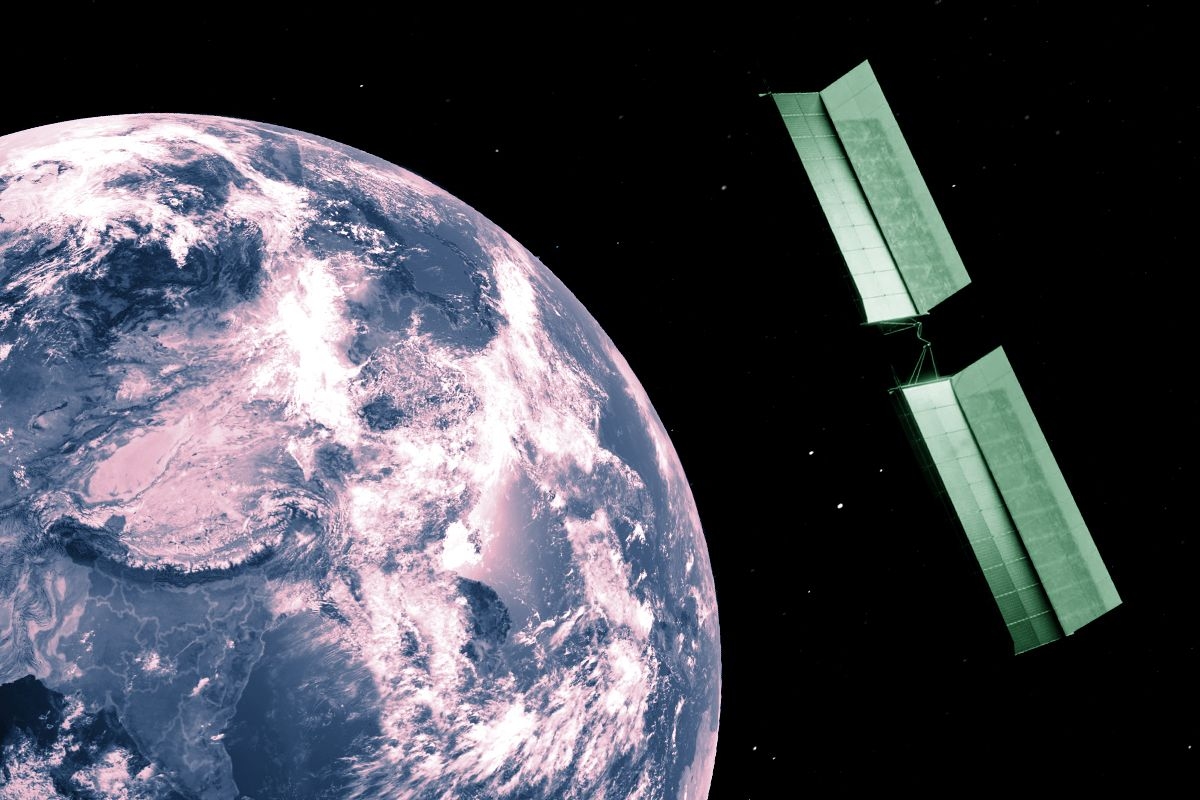
That certainly won’t be a simple undertaking. To produce a gigawatt of power, Overview will need to deploy 1,000 huge satellites, each measuring around 500 to 600 feet across and weighing about 8 to 10 tons. The largest satellites currently in space are about 100 to 150 feet across, and roughly 5 to 10 tons. “No one really mass-manufactures satellites in the kind of quantities required,” Berte explained, and nobody is producing the design and form factor that Overview requires. “So we are going to have to in-source a lot of the integration for that.”
But while the startup’s satellites will span the length of about two football fields, they fold up neatly into a package about the size of a shipping container, making it possible for them to fit on a SpaceX rocket, for example. When the satellites beam their power down to Earth, they’ll target a beacon — also shipping container-sized — that will be placed in the middle of the solar farm.
Initially, Berte told me, Overview will target deployment in places where logistical challenges make energy particularly expensive — think Alaska or island states and territories such as Guam, Hawaii, and Puerto Rico. But first, the company must demonstrate that its tech works from thousands of miles away. That’s what the funding from its forthcoming Series A, which Berte expects to close in spring of next year, is intended for.
“That is to take us to the next step, which is now do it in space. And after that, it’s now do it in space, but big,” he told me. “So it’s crawl, walk, run, but most importantly, the technology and how you do it doesn’t change.”