In four out of the five states I found remarkable harbingers of troubles and tension in the foreground, as the nation careens toward a midterm election fast being defined by rising electricity bills and the AI infrastructure many Americans believe to be to blame.
In Texas an influential conservative think tank, the Texas Public Policy Foundation, is urging the state utilities commission to pause transmission permitting so legislators can help “the market to direct less revenue to wind, solar, and storage.” In Arizona, Democrats and Republicans are clashing over a four mile “nuisance” setback for solar and wind projects which industry backers have claimed would be a de facto ban on new projects. In Wisconsin, GOP gubernatorial hopeful Tom Tiffany is campaigning with renewables dissidents while railing against data centers too on a platform of empowering local control over infrastructure siting.
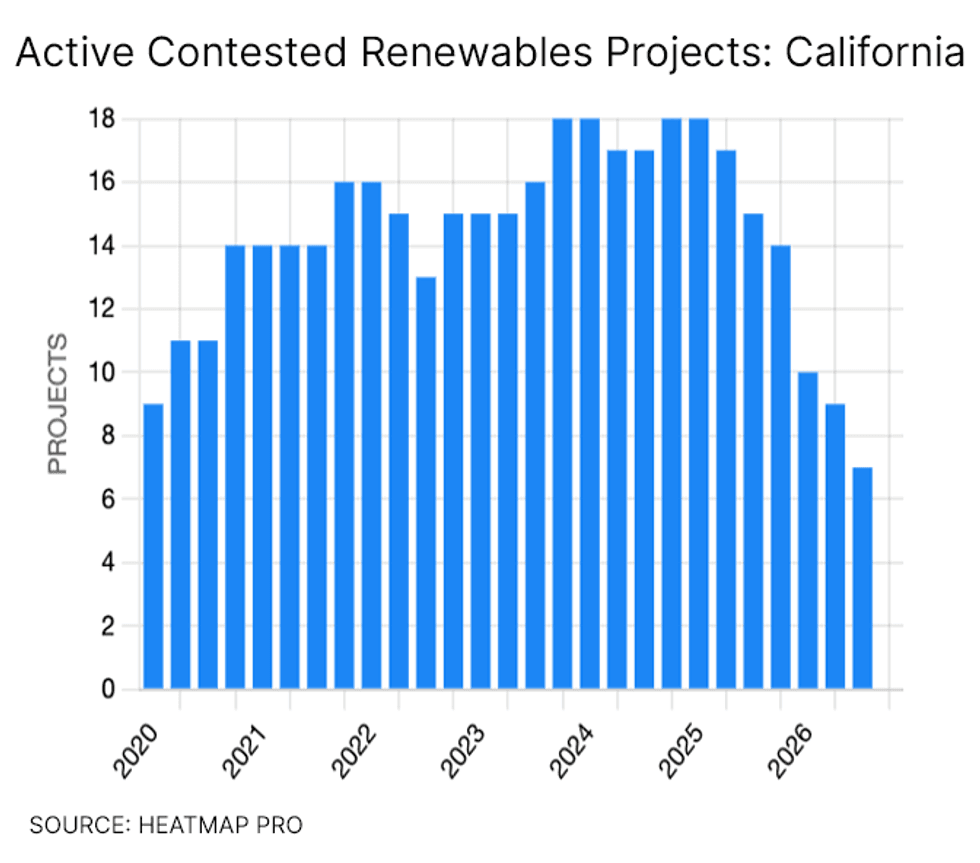
My only exception is California where, for a multitude of reasons, our Heatmap Pro data actually finds renewable energy conflicts and cancellations are actually down from their all-time average.
So here’s my breakdown of the top five states to watch for the future of policy governing renewable energy development. I hope this list is helpful. Oh, and for the sake of saving you time, I’m not going to delve deep into wind energy policy specifically, because there’s no reason to – you and I both know that industry’s fate is being decided by Donald Trump alone.
1. Texas
On Wednesday, after briefing Fight subscribers about this list in advance, I didn’t think I’d be breaking huge news. Then I spotted a grassroots anti-transmission organizer in the Lone Star State exclaiming on Facebook about a letter submitted that day to a Texas Public Utilities Commission docket from the Texas Public Policy Foundation, one of the most influential conservative think tanks in the United States.
The TPPF letter, which has not yet been reported, called for a statewide pause on transmission permitting pending new legislation that would deprioritize solar, wind, and battery storage on the state grid. It endorsed a motion to abate proceedings for approving new 765-kV high voltage power lines, a buildout in progress responding to various constraints on the grid as well as data center growth. And there were consignatories, including a litany of oil company executives as well as ranchers. “The need for so many long-distance lines is fundamentally driven by the failure of the wholesale market to properly incentivize the development of dispatchable generation close to load,” wrote Greg Sinclar, the think tank’s CEO. “The PUC and ERCOT need to implement a complete solution instead of partial fixes. Fundamentally, Texas needs the market to direct less revenue to wind, solar, and storage and more to reliable generation to properly account for the differences in reliability, variability, and duration of those different resources.”
Towards the end of the message, the think tank recommended what I now consider to be one of the most important pieces of state-level legislation considered anywhere in the country and which nearly became law last year. I wrote about the bill last year, as it would require energy generation projects to produce electricity whenever called upon or else they’d pay a fine, a concept opponents effusively say would target solar and wind projects lacking the energy storage to be on call for grid operators 24/7. (Nevermind the fact that solar plus storage has been the hero of the Texas grid this summer.)
“We think that the market will respond to those changes by building the amount and types of reliable generation needed in Texas and eliminate the need for more transmission and out-of-market subsidies,” Sinclair concluded.
The conservatives’ request was subsequently endorsed by Texas attorney general Ken Paxton, but wasn’t heeded. The Public Services Commission on Friday approved two large 765-kV lines out to West Texas, and it’s unclear whether the commission will heed future requests to pause green lines for these power lines given ongoing reliability concerns. But suddenly, Texas Gov. Greg Abbott’s support for a permitting pause looks a little different, especially since Texas attorney general and GOP senate candidate Ken Paxton filed comments supporting the abatement request earlier in the day.
“The Commission should pause to allow the Legislature time to evaluate the benefits and risks of these massive transmission lines. While the potential benefit of such lines may be significant, so is the risk of damage to privately owned lands and natural resources and the Legislature has not yet had the ability to balance those interests,” Paxton wrote in a legal brief to the commission, per the Texas Tribune.
For months now, myself and others at Heatmap have warned that the data center backlash could provide room for an anti-renewables Trojan Horse, as demand constraints and energy price politics change the calculus around the generation mix for elected officials and candidates for public office. Suddenly there’s a flashy new reason to argue for “firm” generation like gas and coal that can run all the time, especially in a state like Texas already dealing with blackout risk. And now it’s more evident than ever how at least one influential corner of conservative orthodoxy wants to respond: halting new electricity infrastructure so investors downgrade the value of building renewables.
When reached for comment, TPPF confirmed its desire to see this legislation passed before any major transmission buildout in the Lone Star State. “Texas ratepayers shouldn't be forced to subsidize billions in transmission infrastructure built primarily to move intermittent wind and solar generation that can't reliably deliver when Texans need it most,” read a statement provided by the think tank’s vice president of communications Eric Oldfather, which posited that “much of the pressure for these lines is coming from companies trying to meet their ESG goals, not by what Texas actually needs for a reliable grid.”
“The Legislature needs to weigh in before the PUC locks in costs that families and businesses will be paying for decades,” the statement concluded.
2. California
When Trump was first elected, the “Abundance” movement said California needed to be more like Texas when it came to permitting renewables. I’m not so sure that’s true anymore.
New renewable energy fights have consistently declined since early 2025, according to Heatmap Pro data, from a high of 18 fresh fights in the first quarter of that year to eight in the last three months. Every quarter, the number of new conflicts has gone down.

This could be for any number of reasons, like enactment of a siting law giving developers alternatives to local regulators more likely to represent the state’s historical NIMBYist tendencies. But it’s also possible that the state benefits from lacking the data center boom and backlash snaring other areas of the country. While California currently has one of the largest sets of operating data center facilities, it’s far from the primary destination for the new builds we’re seeing for artificial intelligence. There’s a teeny backlash happening, but it's been comparatively tiny.
Unlike New York State, there isn’t even a legislative push gaining steam for a statewide moratorium yet. That could be because rumored 2028 presidential contender Gov. Gavin Newsom last year vetoed a bill mandating new water use disclosures, suggesting he may not have purchase for that sort of law. But this also demonstrates regulating data centers is not as important a priority to him as, let’s say, strengthening the grid from fire risk and lowering gas prices.
In other words, California has more favorable waters than anyone could’ve expected last year.
3. Arizona
Some lawmakers in the sunniest state really want solar energy to be far, far away from people.
This year the Arizona state house passed a bill that would label utility-scale renewable energy projects a "nuisance" and compel them to be located at least four miles away from residential homes. Per the legislative text, project operators would suddenly be subject to a misdemeanor, unless they got certificates from the Arizona Corporation Commission and its committee on power plant and transmission siting. And it would require the state attorney general to immediately bring legal action to “abate, enjoin, and prevent” projects from being built or operating out of compliance with the new restriction. Pro-renewables organization Advanced Energy United called the proposal a “practical siting ban plus an automatic litigation trigger.” (At least the bill authors exempted rooftop solar from being a nuisance, because how would that work?)
It’s unlikely that in an election year favorable for Democrats this bill stands any chance of becoming law. Yet it’s important to recognize Arizona is now for the second time in two years home to a bitter divide over indefinitely halting at least some forms of renewable energy, after legislators last year rejected a flat out wind project ban. Should there be a Red Wave election cycle, we can only surmise the potential for choppy waters and relative instability in this otherwise blossoming state for solar development.
4. Alabama
Renewable energy developers better hope the future of Republican public utility regulators doesn’t look like Jim Zeigler.
In June, Zeigler won the GOP primary for a Public Service Commissioner against an incumbent, Chris Beeker. At the time, the former state auditor campaigned primarily on fighting the growth of data centers and solar farms in the state, lumping them together in the same breath. “They can ruin your community, consume water, and drive your electric bills up,” Zeigler said of both industries in an ad featured on the homepage of his campaign website. Zeigler is responding to local concerns like those in Stockton, a town south of the city Montgomery where residents are opposing a large Silicon Ranch project. People in the area routinely link the solar farm to a Meta data center campus being built north of them, in the city.
When Zeigler won the nomination, I predicted his candidacy, if successful, could set a blueprint for other Republicans elsewhere in the United States hoping to harness an industrial techlash against the development of renewable energy projects. In another era, I’d think a man who defended Roy Moore would have more trouble in Alabama. But it’s entirely plausible Zeigler’s previous work on the commission decades ago, combined with an enthusiastic base of support in the state’s Republican base, will catapult his remarkable candidacy to the PSC.
5. Wisconsin
Nothing has irritated me more lately than the online discourse over the Wisconsin gubernatorial campaign and data center development.
Right after winning the Democratic primary for governor, former Milwaukee County executive David Crowley told NBC News he opposed a moratorium on new data center projects because some communities might still want them. Then his GOP opponent Tom Tiffany went on a posting spree littered with deceptively cut clips and trotted out a Trumpian nickname for his opponent: Data Center David. Since then, for weeks, I’ve watched my X feed routinely return to this spat to debate whether Democrats let Republicans win on this issue as a whole, not only in Wisconsin but nationally.
Except… Tiffany doesn’t support a moratorium either. Where the two candidates differ most is that Crowley would require new data centers to not only bring their own energy but prioritize using 100% clean carbon-free energy. Tiffany, meanwhile, has been trotting around the Badger State campaigning in rural communities fighting renewable energy projects and also data centers, criticizing Crowley’s “BYONCE” approach. “David Crowley has called for 100% wind, solar, and battery storage to power data centers. That means not only paving over land for the data centers themselves, but destroying tens of thousands of additional acres of Wisconsin land for solar panels, wind turbines, battery facilities, and transmission infrastructure,” states Tiffany’s website.
Like Zeigler, a Tiffany victory would have ripple effects for renewable energy politics across the country. Both candidates combine this angst over data centers with an overlapping Venn Diagram of potential policy pain for solar, wind, battery storage, and transmission.
In Wisconsin, the most likely practical impact of a Tiffany victory would be changes to state siting. Wisconsin is like California in that state regulators can have a final say over utility-scale solar and wind permitting, instead of localities. And like in Michigan, I expect any new governing GOP majority in the state legislature to ready, aim, fire at that permitting structure, opting instead for emboldening local control over energy development.