Washington, D.C. has earned an unwelcome distinction: the largest one-year electricity price increase of any state (or equivalent geographic distinction) in the U.S. Prices there are up 87% over the past five years and 26% in the past year alone, according to new data from MIT and Heatmap News’ Electricity Price Hub. The average D.C. household is now paying $55 more for power each month than it did five years ago.
In the face of this crisis, local officials have done little but blame regional markets, emphasizing the parts of recent rate increases they don’t fully control — generation charges — rather than any proactive measures they could take to offer relief to D.C. households. Meanwhile Exelon, the parent company for Pepco, D.C.’s local utility, has used the crisis to lobby state policymakers across the region for something worse — a return to utility-owned generation, which could leave consumers holding the bag for projects that run over budget or that are built for demand that never materializes.
As residents of Washington, D.C. and energy researchers who helped put together the Electricity Price Hub, we are well aware that the District cannot remake the regional electricity market on its own. But it has meaningful tools to protect ratepayers now.
To be sure, the problems D.C. faces are not entirely of its own making. Rising demand and constrained supply across the Mid-Atlantic have created a wholesale market pressure cooker.
Capacity market prices in the Pepco region, which are set through a regional auction scheme designed to ensure the grid can reliably deliver power when demand peaks, increased more than fivefold in 2025. Those costs are passing through to retail bills. As capacity has come under increasing strain, generation charges in Pepco’s standard supply service have gone up 119% — 33% in the past year alone, with yet another rate increase set to kick in on June 1.
That regional dynamic is real. But it does not absolve local officials.
Roughly 30% of Pepco’s average residential bill is made up of charges that fall squarely under D.C. jurisdiction. Distribution charges, the largest of those local components, have risen 57% over five years, and account for 20% of the total rate increase. The D.C. Public Service Commission regulates utilities in the District and must approve Pepco’s rates before they take effect. The commission, in turn, answers to the D.C. Council, the District’s legislature, which confirms its commissioners and oversees its work. These bodies should be examining every dollar of Pepco’s proposed increases. Instead, a D.C. court recently struck down the commission’s most recent rate-hike approval, finding that it had failed to sufficiently scrutinize Pepco’s request.
When a regulator is doing such a poor job that judges have to step in, that is a five-alarm signal. Yet there is a workable action plan for the Council and the PSC to rein in costs and ease the burden on D.C. households.
First, scrutinize distribution charges aggressively — that is squarely within their jurisdiction. As Pennsylvania Governor Josh Shapiro argued in his public letter to utility leaders last month, the PSC should require Pepco to justify every additional dollar of revenue requested in plain language. That means using transparent, replicable data and analysis to show why it’s needed, the alternatives considered, and how the proposed spending will concretely benefit consumers. To support this, the D.C. Council should ensure that the PSC, the Office of the People’s Council, and relevant state agencies are adequately resourced and positioned to engage with and probe Pepco’s arguments in rate proceedings.
Second, force transparency into how Pepco procures power. The public has remarkably little visibility into what makes up generation charges for the utility. For example, how much of the total cost is attributable to capacity prices, energy procurement, administrative costs, and compliance with the District’s Renewable Energy Portfolio standard? And what changes could D.C. consider to the competitive procurement process or RPS eligibility requirements to mitigate costs? Officials can’t manage what they can’t measure.
Third, attack demand by making it easier for customers to generate their own supply. High and unpredictable interconnection fees, process delays, and other administrative hurdles add unnecessary costs and contribute to the above-average cost of solar in D.C.. The D.C. Council and PSC can incentivize distribution-level solar battery deployment by cutting permitting and interconnection costs and improve cost transparency and streamline interconnection reviews to speed up the process of installing solar and storage.
None of these moves alone will reverse five years of rate increases. But together they would put real downward pressure on bills and signal that the city is serious.
What officials should reject — across the region — is Exelon’s push for utility-owned generation. In practice, it could create a generation subsidiary tomorrow. The reason it wants its rate-regulated distribution utility to do so instead is that this would let it earn a guaranteed return on costs it currently just passes through, while shifting the risk of cost overruns, schedule slips, and overbuilt capacity from shareholders to ratepayers. It would also hand the utility an information advantage over independent power producers, suppressing the competition the market relies on to keep prices honest. More profit, less risk, less competition. A great deal — for the utility.
The D.C. Council recently passed emergency legislation pausing utility disconnections for residents with unpaid balances under $1,000. That is a humane stopgap as we head into summer, but it is not a strategy. Neither is anything that has been proposed during the current mayoral race, in which leading candidates have attacked each other’s records instead of offering a plan to lower bills.
D.C. residents do not need more blame-shifting. The choice in front of the council and the PSC is concrete: Scrutinize what is in their jurisdiction, force the transparency they have the authority to require, accelerate the cheapest sources of new supply, and refuse to subsidize a Pepco business model that turns ratepayers into the underwriters of utility risk. That is the test of whether they meet this moment seriously.







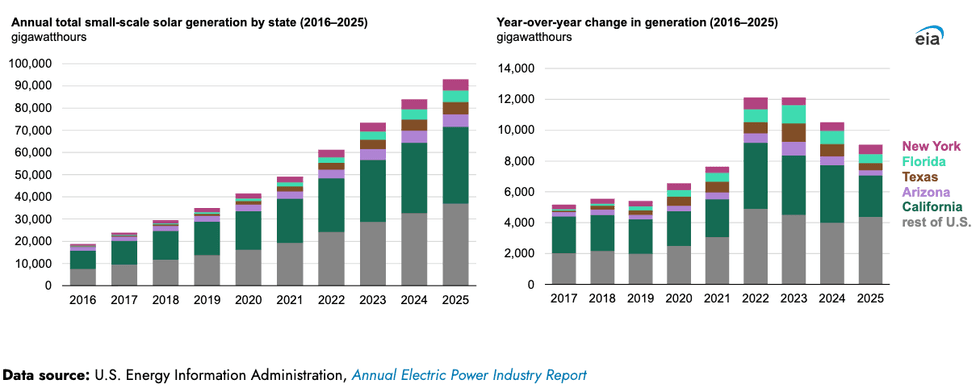 Solar capacity keeps growing. GoodPower