You’re out of free articles.
This Halloween, get 20% off using code ADVANCED
Log in
To continue reading, log in to your account.
Create a Free Account
To unlock more free articles, please create a free account.
Sign In or Create an Account.
By continuing, you agree to the Terms of Service and acknowledge our Privacy Policy
Welcome to Heatmap
Thank you for registering with Heatmap. Climate change is one of the greatest challenges of our lives, a force reshaping our economy, our politics, and our culture. We hope to be your trusted, friendly, and insightful guide to that transformation. Please enjoy your free articles. You can check your profile here .
subscribe to get Unlimited access
Offer for a Heatmap News Unlimited Access subscription; please note that your subscription will renew automatically unless you cancel prior to renewal. Cancellation takes effect at the end of your current billing period. We will let you know in advance of any price changes. Taxes may apply. Offer terms are subject to change.
Subscribe to get unlimited Access
Hey, you are out of free articles but you are only a few clicks away from full access. Subscribe below and take advantage of our introductory offer.
subscribe to get Unlimited access
Offer for a Heatmap News Unlimited Access subscription; please note that your subscription will renew automatically unless you cancel prior to renewal. Cancellation takes effect at the end of your current billing period. We will let you know in advance of any price changes. Taxes may apply. Offer terms are subject to change.
Create Your Account
Please Enter Your Password
Forgot your password?
Please enter the email address you use for your account so we can send you a link to reset your password:

This transcript has been automatically generated.
Subscribe to “Shift Key” and find this episode on Apple Podcasts, Spotify, Amazon, YouTube, or wherever you get your podcasts.
You can also add the show’s RSS feed to your podcast app to follow us directly.
Robinson Meyer:
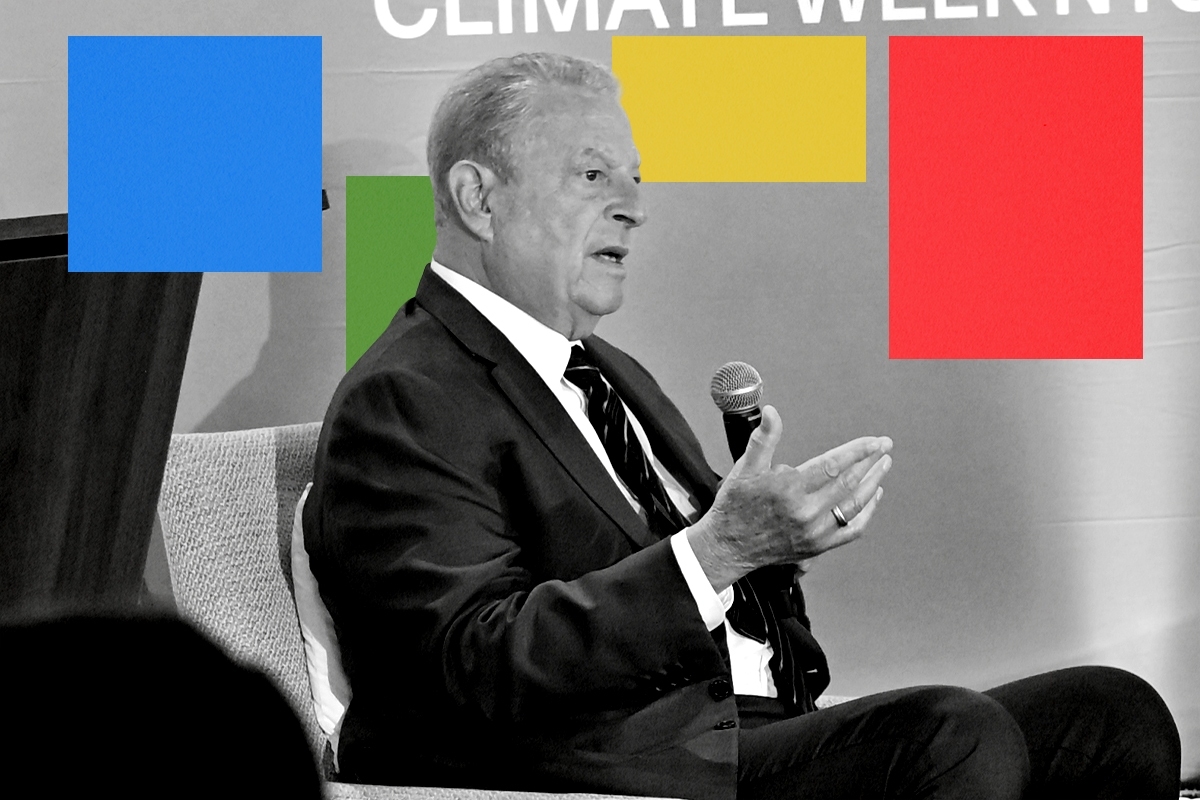
It’s Wednesday, September 30th, and this is a special New York Climate Week edition of Shift Key. Last week, Heatmap welcomed climate and energy leaders, experts, and influencers to Heatmap House, our all-day summit in New York City. Among those leaders was former Vice President Al Gore. Vice President Gore needs no introduction. He is, in a way, the original climate influencer. His film, An Inconvenient Truth, gave rise to a new wave of climate activism in the 2000s. It was one of the highest-grossing documentaries of all time when it was released, and it won an Oscar, a Grammy, and, for Vice President Gore, a Nobel Peace Prize. Of course, Gore has remained active in climate policy since then. At the time of our conversation, he’d just returned from Asia, where he was training a new cohort of leaders for his Climate Reality Project. Our conversation came on the 20th anniversary of An Inconvenient Truth. We discussed that film’s legacy, what’s changed since its release, what surprised the vice president the most, and his perhaps surprising thoughts on artificial intelligence. Let’s go to the show. I’m Robinson Meyer, the founding executive editor of Heatmap News. This conversation was recorded in front of a live audience at Heatmap House at 22 Vanderbilt in New York City on September 23rd. It’s all coming up on Shift Key.
Robinson Meyer:
Vice President Gore!
Al Gore:
Robinson Meyer!
Robinson Meyer:
It’s so good to have you here. Thank you for joining us.
Al Gore:
Great to be here. Thank you for doing the interview.
Robinson Meyer:
Of course. We wanted to have you at Heatmap House for a long time. I know I said this backstage, but thank you so much for joining us. We really appreciate your time.
Al Gore:
Thank you for what you and your colleagues are doing at Heatmap. It’s just an amazing organization.
Robinson Meyer:
So I wanted to start — I have questions, and we will get to them — but I wanted to start by asking how you’re feeling today. It is September 23rd, 2026. It’s been quite a few years. How are you feeling about the climate challenge, about American politics? What’s going on in your heart at the moment?
Al Gore:
Well, those two things are related, of course. But I’m temperamentally optimistic, and I’m specifically optimistic that we are going to solve the climate crisis. We are going to win this. The remaining question is whether we will win it in time to avoid crossing some of these very dangerous negative tipping points: the Gulf Stream, the Amazon flipping into savanna, the ice melt to pace. Greenland is losing 30 million tons of ice every hour right now. But I have an image that, to me, conveys what’s going on in the big picture. I see a very big wheel turning powerfully in the right direction, and inside it, little wheels turning in the opposite direction, but the overall momentum is extremely powerful. I would even say, Robinson, that there is a possibility that we will, in the future, look back on this year of 2026 as the positive tipping point on climate. I say that for a number of reasons. This is the first year that the production of energy from renewable sources has exceeded the overall increase in global energy demand. Some tipping points are rounded at the top; this may be a plateau. But if you look back 20 years, there were virtually no electric vehicles at all, maybe a couple of thousand sold. In 2010, 7,000 EVs were sold worldwide. This year, by the end of the year, 30% of all new cars sold globally will be EVs. Already last month, it was 65% in China, on the way to 82% in the next three or four years. If you look at electric power generation, last year, as you know very well, 86% of all the new capacity installed worldwide was renewable. And here in the U.S., in spite of Donald Trump, it was 92%. 91% — you add rooftop solar, 93% was renewable. If you look at investment, I’ve been saying there’s twice as much investment in renewables as in fossil fuels. Fatih Birol at the IEA is saying it’s almost three times as much now. Twenty years ago, 77% of all electricity was fossil. Now it’s down to a quarter.
Robinson Meyer:
Yeah.
Al Gore:
And there are other similar statistics. I think this movement, which has become the largest grassroots movement in the history of the world, is unstoppable. But it’s the pace, and it’s the fierce resistance, organized and massively funded by the fossil fuel industry, which makes the East India Company look like a popcorn salesman. They’ve achieved hegemonic control of all the policy verticals that affect their attenuating business plan. But we are winning. We need to win faster.
Robinson Meyer:
Let’s start by talking about 20 years ago, because 20 years ago, An Inconvenient Truth came out. I recently had cause to revisit the film, and I actually have to confess something. I was very excited when the movie came out, but I don’t think I’ve ever admitted this, and maybe this is the wrong audience to do it to: I was too stressed about climate change to actually watch it. Not that it was a daily anxiety, but I was like, “I can’t. There’s so many other things.” And so I actually watched it for the first time only recently. I had the book, let’s be clear. I had the book.
Al Gore:
A limited confession.
Robinson Meyer:
Yeah, yeah. It was so fascinating watching it 20 years on, because there are some sections of it that I think you could give today. Not that little has changed — the science hasn’t, of course — but the way people think about it, the way people move from denial to doom, hasn’t changed in some ways. I wondered what surprised you most about the intervening 20 years since the film came out. It received a response that, I don’t know what you were anticipating, but it was certainly on a scale beyond what was expected at the time. And then there’s where we are today.
Al Gore:
Well, when Laurie David first made the suggestion, here in this city, I gave an early version of my slideshow when we were promoting that movie. What was it, The Day After —
Robinson Meyer:
The Day After Tomorrow?
Al Gore:
The Day After Tomorrow. Was that it? Yeah. And they said, “Well, that’s fiction, isn’t it?” And I said, “Well, it’s not as fictional as the then-current administration was about climate.” But when she said, “This needs to be made into a movie,” I said, “You’re crazy.” As one of the early previewers said, “Al Gore giving a slideshow — what part of that doesn’t scream hit?” So I was a skeptic about the enterprise, and I was surprised at the reception it got. Really, the credit belongs to the scientists I was just channeling. The fact that everything they predicted has proven to be basically spot on is a credit to them. For the rest of us, the fact that they were so right then should cause us to pay more attention to what they’re warning us about now. As for what has surprised me, it’s the ferocity and durability and massive continued financing of climate denial by the fossil fuel industry. There was a time during these last 20 years when they said they were going to be part of the solution, and a couple of them made some good-faith efforts in that direction. But then, like Steve Martin on the old SNL, they went, “Nah.” They decided just to give up the ghost and go full speed ahead on more and more fossil fuels. I think they’re losing as we are winning, but they’re hanging in there.
Robinson Meyer:
Why do you think they — ? Since 2006, we’ve seen almost two cycles of climate policymaking in the U.S. There was the first Obama administration, when we didn’t get cap and trade, but the EPA regulations eventually came out, the car structure —
Al Gore:
And the Paris Agreement.
Robinson Meyer:
And the Paris Agreement, of course. And then the first Trump administration, and then the IRA, which I want to talk about in a second. But during that time, fossil fuel companies did make this move, as you said, toward at least appearing to be part of the solution, and then they backed off. What do you think caused them to back off? Was it a lack of subject-area expertise? Was it that, at the time, the technologies weren’t as profitable as their fuels, and they needed to fit into an investment mix in which they are always supplying this kind of outsized fossil fuel profitability?
Al Gore:
Well, I think it’s been, in some ways, the tyranny of short-term profits taking over their business model. And in order to solve the climate crisis, we’re going to have to pay attention to the democracy crisis. The compound ideology of democratic capitalism has served us well in many respects, but when the Berlin Wall came down and communism collapsed, there was a surge of triumphalism in the capitalist part of that sphere. Something similar happened when the fossil fuel companies faced pressure. You could earn a little bit more in the short term if you just went faster on fossil fuels. But something interesting has happened this year, and this is another reason why I think there’s a real possibility of a positive tipping point. I hate to turn my back on you guys over here. The war in Iran marks the second time in four years that the fossil fuel supply chain has been disrupted, and price volatility has returned. People around the world have reacted to this in a really dramatic way. In the last six months, 50 countries have doubled their share of EVs in their fleet. We saw the president of Korea say, and I’m paraphrasing, “This shows us we have got to speed up this transition away from fossil fuels.” Thailand just announced a big shift from LNG to solar. In Africa, where they were really not participating in the solar revolution a few years ago, they’re now installing 100,000 panels per day. These are signs that this thing is really moving into high gear.
Robinson Meyer:
I think it’s undercut the idea that fossil fuels, especially for countries without fossil fuel resources domestically, are a long-term, secure investment in your energy security. They’re not.
Al Gore:
Yeah. Look at their three —
Robinson Meyer:
Or at least oil and gas. I think coal is going to be a whole other problem.
Al Gore:
Yeah. Twenty years ago, the U.S. got 49% of its electricity from coal. Today, that’s down to 16%. Mike Bloomberg and the Sierra Club deserve a lot of the credit for that. But when I say the fossil fuel industry is losing, they know they’re losing, and they’re trying to slow down how quickly they lose. If you look at their three biggest markets, power generation is number one, and as I’ve already said, with 86% of all the new build last year being renewables, they’re losing that. Transportation is their second biggest source. The internal combustion engine peaked nine years ago, and since 2017, sales have gone down 25%, while EV sales have gone up 1,500%. Their third market is petrochemicals, which is now actually driving the oil part of the market, because 75% of petrochemicals is plastics. They’re projecting a tripling of plastics production by 2035. How’s that going to work for the rest of us, when microplastics are already in our bodies? In the oceans, the rivers, the roadsides. That’s why the fossil fuel companies have been so energetic in tearing apart the UN negotiations on a plastics treaty, and why they’ve blown up the shipping treaty negotiations. Forty percent of all shipping in the entire world, by mass, is lugging fossil fuels around. They see these trends, and they’re desperately telling their bigger, long-term investors, “Stay with us. Please stay with us.” They’re screaming about capital availability. I think they’re really desperate, and that’s why they’ve pulled out all the stops.
Robinson Meyer:
The destruction of the shipping treaty was interesting, because it was not merely anonymous fossil fuel actors. It was the Trump administration coming in and specifically blowing up those negotiations.
Al Gore:
Well, he told them during the campaign, very famously. One of his jujitsu superpowers is saying the corrupt part out loud, so people think, “Well, he said it publicly. It couldn’t be corrupt.” He’s by far the most corrupt president in all of history. And he said to the fossil fuel executives at Mar-a-Lago, you know the video, “Give me a billion dollars, and I’ll do whatever you want.” That transaction was made, and he’s following through on it.
Robinson Meyer:
What do you make of the fate of the Inflation Reduction Act? For those of us who were involved in climate, especially in the late 2010s, there was a feeling that climate should be a bigger part of politics and a bigger part of the Democratic Party’s policymaking agenda. And then a Democratic president did that. President Biden’s reconciliation bill was the IRA. I can’t say the electorate responded in an overwhelmingly positive way, and then, of course, the Trump administration has repealed aspects of the bill. So what did you make of this broader saga, where climate finally became a topic of legislating in the United States, and yet it seemed like voters maybe couldn’t care?
Al Gore:
Well, I think they did care. I think they didn’t see the implementation of that act in time to make any difference in their lives. And I think the whole movement that went by the label “abundance” came in part from frustration about all of the obstacles and difficulties that the administration encountered when they tried to implement it. Maybe there were some design flaws, but I’m not going to criticize that. I think they did the best they could. If you look at the charging stations for electric vehicles, for example, it was such a disappointment that hardly any of them got built. Now it’s coming on very strong. But I think the delays in implementation were a big part of that. They tried to portray it skillfully. After all, it wasn’t called the Climate Act; it was called the Inflation Reduction Act. But the people never saw on the ground the benefits to them personally. One other thing, if I could. Decades ago, I learned a lesson from my father, who was in the United States Senate. This is sort of elementary stuff these days, but he said, “Son, when there is a piece of legislation that benefits the broad public interest, the broad public is often barely aware of it. But if it has a negative impact on a small group, they are intensely interested and obsessed with it, and they work really hard to get rid of it.” When the IRA was passed, the fossil fuel industry went to work to try to block its implementation. And by the way, some of the provisions that have been blocked are being unblocked by the courts. That is also a process that takes time. And to all the lawyers for environmental groups, some of them here: thank you for what you’re doing.
Robinson Meyer:
I want to hit two more things quickly. Is this an issue that you think ordinary voters will come around on, that the mass of the electorate will see the light on? Or is climate change going to be one of these issues that a small group of dedicated activists, officials, and experts work on for a long time, making progress in the background, until eventually we’re in a much better place than we are now?
Al Gore:
No, I think it’s the former rather than the latter. I see this climate struggle in the context of the other morally based challenges that humanity has confronted in the past. You look back at the abolition movement, the movement to give equal rights to women, the struggle for civil rights, especially in the South, the struggle to give gays and lesbians equal dignity, the struggle against apartheid in South Africa. Nelson Mandela, after 27 years in prison, said, “It always seems impossible until it’s done.” What all of those movements had in common, first of all, is that there were times when the advocates felt deep despair, but they kept on going. The other thing they had in common is that when the underbrush of argumentation and false cases was cleared away, when the central issue was finally revealed as a clear choice between right and wrong, then — because of who we are, I would say because of the way God made us — the outcome became foreordained. When we have a clear choice between right and wrong that affects everyone, we do respond. We’re hardwired by evolution to respond instinctively to the kinds of threats that our ancient ancestors encountered and survived. If a snake came across this floor here, we would clear out without a second’s delay. A much bigger threat that has to be perceived through the use of our reasoning capacity — we are capable of that as well, but it’s not instinctual. It requires reflection, it requires communication, and it requires collective action. We are capable of that. That is why we’re going to win. That is now occurring, and Mother Nature is the most powerful advocate, changing opinions and firming up the conviction that we have to do something about this. One final point on this, if I could. These kinds of movements build slowly, but then they begin to capture everybody. And I think we’re seeing a big acceleration of progress right now.
Robinson Meyer:
What do you make of the current set of fears about artificial intelligence? To some degree, it resembles the existential fears that people have had about climate change for a long time. I think there are also separate fears that it could be slowing down decarbonization. What do you make of this new set of concerns around AI? Are you worried about the existential risk from AI? Do you think it’s going to be good for the climate eventually?
Al Gore:
When I was young, I remember when the first Godzilla movie came out. After a few sequels, the producers discovered that maybe there were some other prehistoric creatures that were also awakened by the nuclear testing. And then we got movies called Godzilla vs. Mothra and Godzilla vs. Rodan. I think the climate crisis versus artificial intelligence is a little bit in that category. If you look at the list of concerns about data centers and artificial intelligence more broadly, the emissions are a problem of concern but not a justification for panic. You could take all of the AI data centers in the world and quadruple the number, and their total emissions would still be a fraction of the emissions from uncovered landfills around the world. That is a point of leverage for activists concerned about AI, but it’s not the biggest concern. I think that cognitive atrophy, and the emergence of an intelligence that makes us no longer the apex intelligence on the planet, is a cause for very, very deep concern. They have something else in common. Donald Trump has called both of the concerns hoaxes, which is a clear sign we need to be concerned about them. When he says the climate crisis is a hoax, it’s sort of like his AI slop. You immediately know that it’s nonsense and false, but it has an impact nonetheless. And we’ve already had an experience with AI in its first generation, in the form of the algorithms that direct attention flows on the internet. Look at what that’s done. My goodness. It’s just crazy. A lot of guys now have to swipe left 1,000 times to get one cup of coffee with a girl. Body image problems with young girls. And the rabbit holes that suck people down. You know what’s at the bottom of the rabbit hole? That’s where the echo chamber is. And when you spend too long in the echo chamber, you face another kind of AI: artificial insanity. That’s where QAnon comes from, and that is what sustains climate denial, again funded lavishly by the fossil fuel interests. On any story about climate, you click on the comment section and it’s always — you know this — stuffed with anti-climate memes and falsehoods, or zombie falsehoods. Orwell said in one of his essays that we as human beings are capable of holding onto a false belief indefinitely, even when it is completely proven to be false to any reasonable person. And then as he continued impudently twisting words to make it seem we were right all along, he said, “The only problem is that eventually a false belief collides with a solid reality, comma, usually on a battlefield.” So we are now on a battlefield, in Iran and in the Persian Gulf and at the mouth of the Red Sea. Again, this has further awakened the concern that yes, we have to address this. On the emissions side of artificial intelligence, just briefly: Nick Stern at the London School of Economics and the Grantham Institute published a very influential study a few months ago showing that the emissions reductions from AI are going to be quite substantial. Unfortunately, it’s also going to supercharge the discovery of more fossil fuel assets, and that will offset it to some extent. But I think it can bring some net benefits in that regard. But we need to watch for cognitive atrophy. Fifteen-year-olds are reading at 14-year-old levels now. Kids are doing their homework faster but doing worse on testing. There’s cognitive atrophy, cognitive surrender, cognitive offload, and cognitive foreclosure. Kids at the age when they’re learning the reasoning skills that all of us learned when we were younger — if they don’t learn those in the same way, that’s one of many serious challenges from the advanced pioneer models. And of course, now that they’re breaking out of their confinement, it reminds me of Jurassic Park, where the velociraptors are testing the electric fences, you know?
Robinson Meyer:
I like this mode of existential risk as Godzilla and Mothra and Nadir. I think this is a good way to think about it. We need to get you on Shift Key, Heatmap’s podcast. Unfortunately, we’re going to have to leave it there, but thank you so much for joining us.
Al Gore:
Thank you, Robinson. Thank you all very much.

This Halloween, get 20% off using code ADVANCED
Log in
To continue reading, log in to your account.
Create a Free Account
To unlock more free articles, please create a free account.
If Democrats plan to restore the solar and wind tax credits, then passing BAAJA now suddenly looks like the savvy move.
This is Heatmap Daily, a weekday digest written by our executive editor. Subscribe here.
So here we are. The bipartisan permitting reform bill has cleared its first and most important procedural hurdle in the Senate. On Monday evening, 73 senators voted to end debate on the Bipartisan American Affordability and Jobs Act, or BAAJA, which would broadly make it faster and easier to build federal infrastructure projects of all sorts, especially power lines.
The bill will still undergo what its backers call a “healthy amendment process,” and it will face procedural and substantive votes for the next week or two. But its path to passage, at least in the Senate, is getting clearer.
That’s more than a little surprising. Going into the midterm elections, the conventional wisdom in Washington was that the bigger the Democratic wave, the harder it would be to pass BAAJA. Supporters feared that Democrats, newly flush with confidence, would drop the compromise and choose to restart negotiations anew in the next Congress. That’s certainly what Representative Jared Huffman, the likely incoming chair of the House Natural Resources Committee, has pushed for on X over the past week. And soon after the scale of the electoral deluge for Republicans became clear, Heatmap reported that the bill’s odds of passage had gotten a little steeper.
And yet the bill has actually gotten closer to becoming law, not further, since last Tuesday. And as I pondered the situation over the weekend, I realized the original conventional wisdom was misguided. The midterm elections have strengthened the politics of permitting reform. Tuesday’s results can help explain why the Democratic Senate caucus is now speeding toward passage.
The first dynamic is obvious: This is an affordability bill — it’s right there in the name — and Democrats just won an affordability election. The bill’s projected energy affordability benefits are small but real, and proponents argue (plausibly) that the bill’s most important changes are impossible to quantify in an energy model. The bill will make federally funded public transit much faster to build, for instance, which will have big affordability and emissions implications but is essentially impossible to model.
What’s more, much of the incoming Democratic Senate class ran on a policy platform that looks a lot like BAAJA. James Talarico of Texas, Adam Hamilton of Kansas, Annie Andrews of South Carolina, and — if they win — Scott Colom of Mississippoi and Mary Peltola of Alaska all promised an all-of-the-above energy policy that would expand the supply of fossil fuels and clean energy. That is what BAAJA does, according to its supporters and detractors.
South Carolina’s Andrews even went one step further and explicitly committed to finding a permitting reform compromise with Republicans. “Nobody has the political will to get to work and pass this bipartisan plan. It’s embarrassing,” she wrote. “In the Senate, I'll work to bring members of both parties together to finally get this done.” Now Democrats can get it done before she even gets to the Hill.
BAAJA mirrors Democratic policy commitments in more specific ways, too. Seven of the incoming 11 Democratic senators campaigned on forcing data centers to pay the full cost of their electricity use; it was even one of Abdul El-Sayed’s mandatory “terms of engagement” for the facilities. The rest of the winning Senate class made more vague pledges that data centers should not make Americans’ power bills go up.
The permitting bill would accomplish this goal, too. BAAJA would force data centers and crypto miners to pay the full costs of their connection to the grid, and it would let states go even further in transferring additional system costs from other ratepayers onto data centers.
Last week’s elections could help ease specific data center worries around the bill, as well. Some of BAAJA’s critics have feared that the bill could accelerate the nationwide data center buildout. And in a world where data centers are growing fastest in Republican states, activists might be loath to surrender any federal tool — no matter how feckless — that would be useful to fighting them. But many of the states where data centers and behind-the-meter gas plants are growing most quickly — such as Texas, Ohio, New Mexico, and Pennsylvania — will now have new Democratic governors or outright trifectas next year. The most effective tool for slowing the data center buildout remains state, county, and municipal land use laws. BAAJA would not touch those ordinances. And its data center electricity provisions would actually expand the ways that incoming Democratic governors could make data centers pay for the rest of the grid or even build new infrastructure.
Likewise, BAAJA’s new utility oversight tools look far more powerful in a world where state politicians have promised to fight utilities. Democrats likely also find it easier to write those powers into law in a world where public utility commissions are trending Democratic.
And there is one more reason Democrats might feel more comfortable passing this bill now: Tuesday has made their odds of gaining even more power in the future look better, and this bill will improve as Democrats pass other clean energy or climate policies to augment it.
If Congress soon restores the wind and solar tax credits, for instance — as most every incoming congressional Democrats have vowed to do — then BAAJA’s transmission provisions will go from being merely somewhat good for the climate to being very good. When the Inflation Reduction Act fell short, it was because the United States could not build new power lines fast enough to hook new solar and wind farms to electricity demand. But marrying the IRA’s clean energy tax credits to BAAJA’s transmission mandates would supercharge them both. And if a future Democratic Congress chooses to fund and build a national macrogrid, then passing BAAJA now would make it much easier, because some of the hardest political aspects of such a task — such as creating a federal backstop siting mechanism for new power lines — will already be done. There’s a reasonable political argument that Democrats should eagerly welcome Republican co-ownership of BAAJA’s transmission provisions, so that the party does not have to own the political consequences of such a buildout alone in the future.
Likewise, BAAJA will disproportionately benefit the party that wins the next presidential election, because the bill’s greatest affordability benefits will start accruing to the president who follows Donald Trump. Like all big energy bills, BAAJA will take time to work its way through the energy system. Americans won’t immediately experience cheaper bills or faster projects; after BAAJA’s passage, independent agencies such as the Federal Energy Regulatory Commission will need to write rules governing the law’s new programs and communicate them to states, utilities, and grid managers.
Many of those effects will start to be felt right around the time the next president takes office in January 2029 — or even in the early 2030s. If Democrats feel better about their chances of taking the White House today than they did a week ago, then they may very well feel better about passing this bill now, too.
BAAJA survived its first test, but Trump says the bill “hasn’t been fully negotiated.”
The Senate on Monday night moved to open debate on the Bipartisan American Affordability and Jobs Act — just after the president bizarrely threw cold water on the deal he struck for the bill.
Senators agreed to invoke cloture on a motion to proceed to the bill by a vote of 73–25, a forceful bipartisan tally that could bolster momentum behind the bill. Up next comes what Senator Sheldon Whitehouse, the Democrat from Rhode Island and one of the key sponsors of the bill, called a “healthy amendment process” at a press conference Monday morning. This will constitute the last remaining opening for senators and outside constituencies to try and change provisions they disagree with. How many amendments will make it to a vote, however, is not publicly known. Nor is how fast debate on the bill will move along, so best be patient.
I’m aware of pushes for at least two amendments to be considered — one ostensibly to remove the bill’s changes to the National Historic Preservation Act and another related to future administrations potentially revoking Trump-era permits. Some of the lawmakers who voted to proceed on the bill may become “nays” depending on how the amendment process goes.
In a normal world, this would be the clarifying moment for BAAJA, when the clouds would part and a pathway to passage and enactment would appear obvious. There are certainly rays of hope for the pro-BAAJA squad because a large bipartisan vote would help the legislation move briskly in the House.
But we still live in the Trump era, so instead, just as senators were preparing to vote, and after the White House released a formal statement endorsing the bill, the president told the world that actually, the deal wasn’t done.
Politico reported in September that the president told his aides he would direct the Pentagon to clear its queue of onshore wind projects to strike a deal on permitting. The White House has for weeks been telling reporters it’s been advancing wind projects through the Pentagon airspace clearance process in good faith. As we reported in late October, these claims have not always lined up with what the administration and renewable energy trade groups have been stating in federal court, where a judge months ago required the government to resume these once-routine height approvals.
For some reason, asked about this at a White House media briefing Monday evening, Trump told reporters from the press room podium that actually he won’t approve wind turbines even if the bill becomes law. Then he said, “The bill hasn’t been fully negotiated.” You can watch the full clip of the comments here.
It’s unclear whether these comments affected the bill’s odds at final passage, but they did lead to a very long all-caps post on X from Representative Jared Huffman, who’s in line to lead the House Committee on Natural Resources in the coming Congress. The White House has tried to clarify the president’s remarks, and Senator Whitehouse blamed the comments on Trump’s age. So just because we’re seeing legislative progress doesn’t mean the future will make sense.
Researchers, advocates, and funders gathered to discuss intervening in the global climate on purpose.
For decades, deliberately intervening in the Earth’s climate system was something most scientists and policymakers didn’t dare talk about. But last month, more than 250 people from six continents gathered in Reykjavik, Iceland for a three-day summit devoted entirely to willfully tinkering with the climate to make it more resilient.
The gathering served as a purposeful, if hesitant, coming out party for a field so controversial that just a few years ago, hundreds of researchers signed the Solar Geoengineering Non-Use Agreement, which called for an end to public funding for scientific research into the field. But this summit revealed that the sector — while still deeply divided over questions of money, governance, and deployment — is beginning to emerge from the shadows.
Why now? The consensus among climate scientists about our ability to mitigate warming is growing more dire by the day. The United Nations now acknowledges that limiting temperature to 1.5 degrees Celsius above pre-industrial levels is out of reach, putting more drastic adaptation solutions in play.
“It is increasingly clear to anyone who’s paying any attention that we are screwed, right? That we have blown past every possible reasonable threshold at which our existing theory of change can possibly lead to a safe and equitable climate future,” Joshua Elliott, chief scientist at Renaissance Philanthropy, told me. He directs the two-year-old nonprofit’s Advanced Research for Climate Emergencies initiative, which organized the event. “I feel like the second election of Trump was such a nail in the coffin.”
The three-day Global Risk and Stabilization Summit brought together scientists, engineers, funders, insurers, and at least one venture-backed startup to talk about everything from thickening Arctic sea ice to shielding Antarctic glaciers with underwater curtains to spraying reflective particles into the stratosphere to bounce a portion of incoming sunlight back into space. That last approach, a method of solar geoengineering known as stratospheric aerosol injection, tends to dominate geoengineering discussions, as it could theoretically cool the planet quickly and relatively cheaply.
That doesn’t mean it’s generally accepted, however. Far from it. The sessions at the ARC summit ran under Chatham House Rules, i.e. no reporting who said what — or even whether they were there at all — without explicit permission. ARC plans to release a synthesis report on the state of field next year, but in the meantime the conference website made clear: “Attending the summit does not imply that you endorse the report, any particular intervention, or the stabilization framing. Attending means you are taking part in the conversation and nothing more.”
This type of careful distancing is par for the course in geoengineering circles. Just as many mainstream climate advocates once viewed adaptation — and later carbon removal — as distractions from the need to cut emissions, geoengineering has suffered under the same criticisms. Its oftentimes sci-fi sounding interventions are already ripe conspiracy fodder. Add to that its underresearched environmental impacts and side effects, and some of these strategies could prove truly disastrous in the wrong hands.
But at least people are finally talking about it. In the weeks since the summit, attendees have published dozens of Substack and Linkedin posts about what they saw, heard, and took away from the conference. I talked to many of them about this first attempt to intentionally gather and grow the sector.
Naturally, they don’t all agree on the best path forward. Seemingly everyone acknowledges that conducting more research and designing better Earth monitoring systems is a no-lose situation. But big questions remain unresolved: what role private capital should play; how openly to discuss the possibility of near-term deployment; the somewhat uncomfortable overlap between climate engineering, defense, and national security; and how to educate policymakers and the general public about interventions that sound to some nefarious overlords trying to control the weather.
The field doesn’t even yet agree on what to call itself. The conference organizers prefer “Earth systems stabilization” to “geoengineering,” arguing that a sector like this should be defined by its goal rather than how it gets there. The terminology remains unsettled, however, with one critic, University of Waterloo economist and former geoengineering researcher Juan Moreno-Cruz telling me in an email that the renaming “feels like a campaign” with the “objective of moving more towards action.”
At this nascent stage, any one individual can have an outsized voice. Based on the published speaker list, as well as various recaps posted during and after the event, the guest list featured some of the field’s biggest names. That included David Keith, founder of the direct air capture company Carbon Engineering and a pioneer of solar geoengineering, which involves releasing aerosols like sulfates into the atmosphere to reflect a small portion of sunlight back into space. Also in attendance were Columbia University climate economist Gernot Wagner, Paris Agreement architect Sue Biniaz, and J.P. Morgan climate advisor Sarah Kapnick, alongside delegates from some of the big environmental NGOs, including the Environmental Defense Fund and Natural Resources Defense Council.
More potentially polarizing attendees included Yanai Yedvab, the CEO of solar geoengineering startup Stardust Solutions — one of the first for-profit entities to enter the space — and Lowercarbon Capital, the climate tech venture firm that led its Series A round.
The function that private sector funding and venture-style startups could or should play in this field remains one of the biggest points of tension. Many strongly believe that the only appropriate customer for a globally consequential intervention like stratospheric aerosol injection is a coalition of national governments. But there seems to be a preemptive acknowledgement among those I spoke with that getting the United Nations itself to align on research and potential terms of deployment is unlikely.
Paul Gambill, an ARC fellow and co-founder of Nori, an early carbon removal marketplace, told me that one session at the summit was titled “The Future is Minilateral,” a nod to the growing interest in a small bloc of countries — “maybe six or so” — working together on the issue. Several people I spoke with described a model in which governments would buy technology from a company like Stardust, but retain control over if, when, and how to deploy it.
But even within the ARC set, that framing seems to have skeptics. Noah Deich, another ARC fellow and carbon removal veteran who co-founded the nonprofit Carbon180, sees the profit motive as inherently dangerous. There’s no guarantee that the science will ever advance to the point where governments are comfortable becoming customers, but investors always want to see returns. That disconnect, he argues, creates the incentive to commercialize the technology before either the research or the public is ready.
“That to me is very, very concerning, and shows a lack of judgment at a first order for the people who have invested in this, and for the people who have accepted that private sector money,” Deich told me. “That makes me very, very wary about what they’re going to do when faced with the choice of, hey no government wants to do this. Or these governments have said it is illegal, and this one says it’s fine. Like, will they actually respect the ones that say it’s illegal?”
Others see private capital as all but inevitable. Susan Su, a climate tech investor and analyst, thinks the sector would do best to engage with the private sector strategically rather than fearfully. “Money in general comes with ideas, and in my view, that’s okay,” she told me. If a venture backer has their own notions about how and where to deploy stratospheric aerosol injection, for instance, that need not dictate the agenda. “It’s the entrepreneur’s or the initiative’s job to push back against those ideas and to shape them.”
Su also thinks the field ought to be more open to discussing deployment as a possible outcome from both the research and conditions on the ground, rather than treating it as the third rail. “There’s a sentiment of caution that I think is rooted in a previous era, where it’s been a long road to reach whatever limited consensus there is today that we should even research this,” she explained to me in an email. “With that much caveating, it’s hard to imagine why a funder would get excited to back something that everyone’s saying shouldn't exist.”
Still, it’s not hard to imagine a near-term future in which climate change presents an increasingly urgent national security concern, and the instant governments start treating geoengineering as a defense priority, the money could be practically limitless. Private geoengineering companies could function essentially as defense contractors, with militaries as their primary customers.
The comparison makes some understandably uneasy, as it risks framing climate interventions as weapons to be wielded by states with the resources to develop and deploy it. But however you look at it, “people are starting to realize, there’s no scenario where this stuff doesn’t become geopolitical very very fast,” Gambill told me. And that makes an already controversial field considerably messier.
One way to sidestep some of the thorniest questions around global governance could be to start with a focus on more localized interventions. In the Arctic, for example, companies such as Real Ice and Arctic Reflections are testing ways to thicken sea-ice by pumping seawater onto its surface during the winter. In Antarctica, researchers are studying the feasibility of underwater “seafloor curtains” in front of the Florida-sized Thwaites Glacier to keep warm ocean water from melting it from below. If that glacier were to fully collapse, it could raise global sea levels by up to two feet. There are also some truly low-tech options on the table, too: One calls for reintroducing bison to the Alaskan tundra, where their heavy footsteps would compact the snow and help keep the underlying permafrost frozen.
There’s even a more localized version of solar geoengineering. Called marine cloud brightening, it involves spraying a fine mist of seawater into low-lying clouds over the ocean. The salt particles encourage the formation of smaller cloud droplets, making the clouds brighter and more reflective, cooling the ocean and surface below. Unlike stratospheric aerosol injection, the impacts of which could persist for a year or more, a single deployment of marine cloud brightening lasts mere days, making it readily reversible and easier to test. Australian researchers have piloted this tech over the Great Barrier Reef.
"It feels like people read Kim Stanley Robinson’s novels and are trying to actually figure out if any of that stuff makes sense,” Deich told me. In Robinson’s acclaimed 2020 novel The Ministry for the Future, he imagines efforts at stratospheric aerosol injection, glacier stabilization, and large-scale rewilding in response to a fictional — but readily imaginable — catastrophic heat wave.
Deich worries, however, that he didn’t hear enough emphasis at the summit on the ongoing role carbon removal — not just emissions cuts — would have to play in a world even temporarily reliant on an intervention like stratospheric aerosol injection. That’s because of the risk of “termination shock”: If scientists suddenly halted solar geoengineering, the warming it had been masking would likely return within just a few years unless carbon removal efforts could draw down significant CO2 in the interim.
“The [carbon dioxide removal] community from the very early days tried very hard to say, first priority is obviously stopping emissions, but we also need to do removal, and we can’t wait for one to do the other,” Deich told me. “And I don’t see that same type of drumbeat being articulated by the SRM crowd.”
He and others are well aware of the moral hazard argument that has long dogged carbon removal: that this tech will give fossil fuel companies cover to keep emitting, and politicians an excuse to avoid the harder work of decarbonization. With carbon removal, however, that concern is generally simple to rebut. All recent IPCC reports have concluded that removals will be necessary to keep warming anywhere near safe levels. And in many cases, cutting emissions is still far cheaper than removing carbon after the fact.
But it’s a different calculus for an intervention like stratospheric aerosol injection, which is cheap by comparison and could lower global temperatures without doing anything to address the underlying emissions buildup. It’s easy to see how policymakers and the public could say, “Let’s let future generations deal with this building up of greenhouse gasses. We don’t really have to care about that now, we can just keep the temperatures a bit lower and buy ourselves time,” Robert Höglund, a carbon removal advisor and co-founder of the market tracker CDR.fyi, told me. “I think that’s fair. It’s a real risk.”
For its part, ARC plans to publish a report early next year bringing together the work of roughly 40 authors to lay out the state of the field’s science, governance, and social legitimacy. This will come alongside an open map of the interventions being studied and tested as well as funding and research gaps that remain. Rather than immediately holding another global summit, the organization plans to convene regional meetings next year primarily in low- and middle-income countries to explore possibilities for local research efforts in climate vulnerable nations. The next global gathering might then be scheduled for 2028.
In the meantime, many hope ARC and others will help shepherd along myriad research and communications efforts. Because if any message dominated the inaugural summit, it was: Geoengineering isn’t yet ready for prime time. There’s much more research to do, and significant stakeholder groundwork to lay, especially as the field considers how to best invite policymakers into the conversation.
“You cannot create a field. Nobody can declare it into existence,” ARC director Joshua Elliott told me of the effort to bring together the disparate experts working on climate stabilization. What organizations like ARC can do is build the infrastructure for it to emerge. That looks like convening researchers, advocates, and even skeptics; synthesizing siloed knowledge; opening the arguments to debate; establishing academic journals; and creating funding streams within governments and other institutions. But from there, the big decisions belong to others.
“That’s where our theory of change stops,” Elliott told me. ARC won’t decide whether the aerosols are injected into the atmosphere or Arctic ice is thickened. “It is the governments and the multilateral institutions that we have charged with making these decisions, despite however functional you think those institutions might be.”