This transcript has been automatically generated.
Subscribe to “Shift Key” and find this episode on Apple Podcasts, Spotify, Amazon, or wherever you get your podcasts.
You can also add the show’s RSS feed to your podcast app to follow us directly.
Robinson Meyer:
Hello, it’s Wednesday, September 2. I cannot believe it is already September. Last month, it became clear we’re witnessing a new kind of natural gas build out in the United States. Just think of the announcements we got in a few days in the middle of August. First, around August 11, the market intelligence service Cleanview identified that Amazon was behind a 7.6-gigawatt natural gas plant in Texas called Gigawatt Ranch. So just for comparison, that is huge. That would be the country’s biggest natural gas power plant. In fact, it would be the country’s biggest power plant, period. It’s about half a gigawatt bigger than the Grand Coulee Dam in Washington State, the largest power plant in America for like half a century. Then, just a week later, we learned that OpenAI and Nvidia are working together on a 9.2-gigawatt gas plant in Ohio.
Robinson Meyer:
That plant would obviously dwarf the Grand Coulee Dam. It would be the biggest power plant in America by far. But it would also even rival the Jebel Ali Power and Desalination Facility in Dubai as the world’s largest natural gas power plant of any kind. It would be a truly gargantuan facility. My colleague Emily Pontecorvo recently tried to identify the scale of the ongoing gas buildout. And she found a number of power plants, of projects that I think weren’t on my radar, weren’t generally on people’s radar. It’s been interesting because we’ve been getting a sense of the scale of this buildout at the same time that it’s become clear that the data center buildout is enormously unpopular in itself. If you’ve been reading Heatmap News, you know that according to a Heatmap Pro and Embold research poll conducted also in early August, 75% of Americans are now opposed to a data center being built near where they live, including a majority of Democrats, Republicans, independents, rural voters, urban voters, suburban voters, basically any demographic you can think of. They don’t seem to want a data center near them right now.
Robinson Meyer:
I recently sat down with Emily, a Heatmap founding staff writer, to talk about her reporting on the gas buildout, how she identified the 10 largest gas power projects now under construction or being permitted or being proposed in the United States, and how to think about this messy period. Also, how to think about the fact that it’s tech companies, who often have some of the most ambitious climate policies in America, who are now behind, a natural gas buildout on the scale that could actually increase the country’s, greenhouse gas emissions from the power sector, or at least increase them compared to the baseline. How should we think about these net zero commitments from companies like Amazon, Microsoft, Google, when often it’s those same companies that are now building some of the biggest fossil fuel projects ever proposed in the United States? And what would a good net zero commitment or climate commitment look like from those companies? We get into all of it in this conversation. It was a really generative, really interesting conversation for me. I’m Robinson Meyer, the founding executive editor of Heatmap News, and it’s all coming up on this episode of Shift Key. Emily Pontecorvo is here. Welcome to Shift Key.
Emily Pontecorvo:
Thanks, Rob. Glad to be here.
Robinson Meyer:
So you recently wrote a piece for us about the scale of the natural gas buildout in the United States that’s happening to service data centers and to service AI. And I think it’s quite interesting because we will talk about this, but I don’t know if we understood just how large this buildout was going to be as recently as the beginning of this year.
Emily Pontecorvo:
Yeah, I think that’s right.
Robinson Meyer:
What I think back to is, we did our poll, our annual poll of climate insiders, which are kind of sources and experts and former officials and chief sustainability officers. And we asked them at the end of last year, do you think the AI build out is going to significantly slow down decarbonization? And most people said no. And at the time, I don’t know how I would have answered, but ... I feel like we’re much closer to a place where the AI buildout is slowing down decarbonization now than we were even eight months ago. And so just to start off, can you put the scale of this gas buildout in context for us? So how many plants have been proposed? How many of these plants are going to happen? What do we understand about the scale of this next generation of gas that is being planned across the United States right now?
Emily Pontecorvo:
Yeah, so I will say to start that a lot of this information is very slippery because there’s been so many announcements. The announcements are constantly kind of changing. And so we have some numbers, but they’re definitely estimates. So last week, the Global Energy Monitor, which is this group that tracks oil and gas projects all over the world, they put out a report saying that they counted 189 gigawatts of natural gas plants in the U.S. that have either been announced, that are in a pre-construction phase, like they have some permits, or that are under construction. And that is nearly double the amount that they found at the end of last year, which was about 97 gigawatts.
Robinson Meyer:
And is that entirely behind the meter plants, or are those any kind of natural gas plant being planned across the United States, kind of for any purpose on the grid or off the grid?
Emily Pontecorvo:
So these numbers, 189 gigawatts up from 97 six months ago, those are projects that are specifically being motivated by data centers. So some of them are being built on the grid that utilities are building to kind of meet new demand room data centers. And a lot of them are off-grid projects that are being directly tied to data centers.
Robinson Meyer:
And I guess you’ve kind of alluded to this already, but like, So it’s almost 200 gigawatts of gas plants coming online. Do we know, like, how large is the existing U.S. gas fleet?
Emily Pontecorvo:
Yeah, so I, you know, had to look this up for this story. But as of last year, the existing natural gas generation capacity in the U.S. was 512 gigawatts.
Robinson Meyer:
Wow. It’s like 40% of the gas fleet we’re going to add to our existing fleet. Like, this is not a small change to the size of the gas fleet. This is like a major expansion of U.S. generation capacity.
Emily Pontecorvo:
Yeah. And the thing is, the numbers I gave earlier, those are just projects that have some relationship to the data center build out. The report also gave an estimate of just total natural gas generation that’s being planned across the country. And that number is 378 gigawatts. So it’s almost, you know, nearly doubling what we have today. And what was really interesting was I went back and looked at when was a lot of the existing natural gas generation built? Was there a time in the past where we ... Natural gas plants this quickly. And there’s like a pretty clear kind of analogous time period in the early 2000s where we built, what was it, like nearly, it was like more than 150 gigawatts in just four years. I saw different estimates. It was like maybe closer to 200. But that was a very different build out where this time the plants are much, much bigger. And so many of them are being built off-grid.
Robinson Meyer:
It is actually crazy to me the scale of the build-out that is not being built to service AI, first of all, because I would have assumed that basically the number, that upfront number, was basically all the gas because all of it would be going to AI. So the fact that there’s another, what, 150, 140 gigawatts going to just general generation is pretty crazy.
Emily Pontecorvo:
Yeah, I will say it is possible that some of that is duplicative. Like I was talking to Brendan Pierpont from Energy Innovation. He is on their electricity team, and he was pointing out that they’re seeing that in a lot of cases, the developers will go to the utilities first and ask for a certain amount of capacity. And then when they see how long that’s going to take, then they’ll kind of turn to an off-grid project. And so it’s possible that both of those are getting included in this data, but it’s so hard to really pinpoint what the numbers are.
Robinson Meyer:
So how should we think about these 189 gigawatts? Because as you said at the top of this episode, like there’s a haziness to all of this because sometimes the same gigawatt, so to speak, of demand gets requested in multiple different venues, either in different grids or at different locations, or they ask for it on grid and then they try to build it off grid. At the same time, One through line of this AI story since the beginning has been the difficulty of getting any kind of bead on demand and on the scale of demand. And it seems entirely possible to me that these 189 gigawatts are not going to all get built, but that we are going to add 189 gigawatts because maybe there’s another 100 gigawatts of demand that’s waiting to be requested. And, you know, if we build 70% of these requested gigawatts and 30% of those requested gigawatts, we’re still hitting 190 gigawatts, we’re still hitting 200 gigawatts. And so how do you think about the likelihood that this demand becomes like real capacity in the economy?
Emily Pontecorvo:
I think that the demand is real. I don’t know that 189 gigawatts of natural gas fired power plants, and especially the particular list that this report comes up with, I don’t know that those are real. But I think between data centers and a lot of other kinds of demand that we’re putting on the grid, air conditioning, electric vehicles, manufacturing, like absolutely 189 gigawatts is real. I think that the really big question is how real are these natural gas projects and how quickly will they get built? What kinds of equipment, what kinds of technology they’ll use? So
Emily Pontecorvo:
I basically went through this exercise of trying to identify the 10 biggest projects. And my initial list and my final list are not the same because as I was like researching each individual one, everything felt like sand slipping through my fingers. Like I would see one press release and then one, you know, news article with rumors about XYZ. And then the company’s website said one thing and the permit said another thing. And it was really hard to get a good grasp of, here’s a developer with a project that they say can meet five gigawatts of demand someday. And yet, in the near term, they’re actually just going to build 150 megawatts.
Emily Pontecorvo:
And so, like, should we think about that? Right, exactly.
Robinson Meyer:
This is the case for the OpenAI facility. I wrote about this for Heatmap Daily, our daily afternoon newsletter that everyone should hopefully be subscribed to. But there is this big OpenAI Department of Energy data center that is being planned in Ohio. It’s being built on a kind of ex-nuclear site that the DOE owns. And I think one of the interesting things, I mean, there’s a lot of interesting things about this project. But first of all, it’s massive. It’s nearly 10 gigawatts. It would rival the largest natural gas power plants in the world. I think it’s going to be right now.
Robinson Meyer:
Neck and neck. If the whole thing gets built, it would be right around the same size as the Jabal Ali power and desalination gas plant in Dubai. And it’s all going to go to an open AI data center. It’s backstopped by Nvidia. We learned that last month, it’s really going to increase the likelihood that this facility gets built out. But what’s interesting is that the natural gas plant is going to be built on federal land, on Department of Energy land. It’s going to be owned by the DOE and financed by Japan as part of this Trump-Japan trade deal. Now, I think there’s still a lot of questions about how much this gets built. But to your point, what’s difficult about thinking about this plant is that they want to eventually build more than nine gigawatts of power. They plan to initially build 800 megawatts of gas, which is a lot of gas, but not like a Grand Coulee Dam’s worth of gas. That is a very large gas plant, but it is not a unprecedentedly large gas plant. And how do you assess the scale of that demand, right? Do you think of it as an 800 megawatt gas plant that could literally grow 10x over the next few years? Or do you think of it as a nine and a half gigawatt gas plant, and therefore the largest power generation project in American history?
Emily Pontecorvo:
Right. I mean, so there’s like so many projects that are in this data, that are in that 189 gigawatts, like Fermi America, the big project in Texas.
Robinson Meyer:
The Rick Perry associated project, yes.
Emily Pontecorvo:
Yes. And so they’re also aspiring to even bigger than the OpenAI project. I believe their stated total power generation for the site is like 17 gigawatts, 11 gigawatts of natural gas, plus a bunch of nuclear and some other stuff. Just completely pie in the sky numbers. they already have a permit for the 11 gigawatts of natural gas though or actually no i’m sorry they have a permit for the first six and submitted a permit for the next five but
Robinson Meyer:
Big plant that’s still a really big.
Emily Pontecorvo:
Plant it’s a really big plant and yeah there’s all these projects in the list that have these huge numbers but then what’s actually happening is they’re being built in phases and the first phase might just be a couple hundred megawatts or one gigawatt or between one and two is what I’ve mostly seen. And so whether that first phase is successfully built will determine whether the additional phases are built will determine how much of that 189 gigawatts.
Robinson Meyer:
Right. Well, and also like if the AI boom is still going strong in 2028 and 2029 and 2030, then they can keep building gas to service it. Who knows what the economy will be like by then? You and I will work for AI map or something.
Robinson Meyer:
Can we talk a little bit about like, why are companies building gas? Clean energy advocates talk a lot about how wind and solar, especially solar and batteries are the cheapest source of electricity. I would say when you talk to electricity traders, too, like when you talk to people in the market every day, they also talk about how cheap solar is. So why are companies building gas and not solar to service these facilities?
Emily Pontecorvo:
So there’s like, a lot of different reasons that are all kind of coming together. Maybe the biggest one of all are the bottlenecks to connecting to the grid, the transmission bottlenecks. And that’s really pushing a lot of these companies to look for off-grid solutions.
Robinson Meyer:
And specifically just to like play that out, because they cannot site enough acreage of solar on the site where they would put a data center to generate the power they need, which means they need a grid hookup. But if they need to generate their own power on their own acreage, then you need an extremely energy-dense form of generation, and that means you go to gas. Right, right.
Emily Pontecorvo:
And then I think that’s coming together with a bunch of political factors, like the Trump administration has a strong interest in pushing natural gas. They have gotten rid of the tax credits for clean energy. They’ve made renewable energy, wind and solar, really hard to build with all of these permitting freezes and permitting obstacles for renewables. I think another element is just like the extreme speed and kind of urgency that AI companies are expanding at and demanding power at, which I guess kind of circles back to the interconnection issue and just not wanting to wait to be connected to the grid. And then the last one that I think is important is this issue with affordability in data centers where people are really worried about the build out, increasing their energy bills. And a lot of data center developers are pushing this idea that by bringing their own generation, by building these gas power plants on site, not connecting to the grid, they’re kind of putting their project in a box and ensuring that it doesn’t have any impact on regular rate payers.
Robinson Meyer:
It’s interesting to me, the ratepayer protection pledge from Trump pledges that, data centers won’t make electricity rates go up. And the solution to this for a lot of these companies, as you were saying, when they look at the set of constraints that they’re working within that include acreage, cost, regulation, local grid interconnection capacity, speed to power, they solve this set of constraints by going with gas. And I mean, I think there’s a few interesting aspects about it. First of all, it’s not clear to me that it makes data centers any more popular. He recently did polling that made a lot of news that found that 75% of Americans at this point would oppose the data center being built near where they live. I’m not convinced that adding a fossil fuel power plant to a proposed data center project makes it any more popular because it’s taking a quasi-industrial site and turning it into a full-on industrial site. But that being said, one of the promises made by adding gas generation at the data center is that by generating your own electricity, you’re not increasing local demand for electricity and therefore not increasing anyone’s rates. Now...
Robinson Meyer:
There’s a whole separate conversation to have here about whether adding marginal large-scale loads to electricity grids outside of markets like the Mid-Atlantic, which are structured in a particular way where that jacks up everyone’s rates. There’s a whole separate question and discussion to have here about basically, if you add large customers to an electricity grid because of how electricity rates are designed, that may actually bring down everyone’s bills. But I don’t want to have that conversation now. But like, it’s not clear to me that they are actually like, companies build gas to protect everyone’s electricity rates from going up nearby. And whether or not that is a good idea, and whether or not that is true, what gets left out of that conversation is whether they’re protecting everyone else’s gas rates. And the natural gas system is also a fixed system. And unlike the electricity system where you’re moving electrons around, so to speak, and you can re-rate lines, you can up-rate existing transmission lines, like you are moving molecules around with natural gas. And one thing I have wondered is like, if we’re adding gigawatts and gigawatts of gas generation to an existing gas grid.
Robinson Meyer:
Are we about to see natural gas prices go up around the country, especially when you take into effect that LNG demand is also about to double over the next few years? And so there’s like we were already worried about LNG export driving up natural gas rates. Now we’re adding LNG and a nine gigawatt scale natural gas power plant is basically like a medium sized LNG plant’s worth of demand. You’re just exporting carbon dioxide into the sky and producing electricity right so like hyperscalers can protect electricity rates by building local gas generation it’s not clear to me they can protect gas rates.
Emily Pontecorvo:
Yeah I, I mean we’ve talked about this. I, I think it’s a ... I did talk a little bit about this with folks when i was reporting on this gas build out, and I think the natural gas international natural gas market is complicated, and it’s not like there’s like a one-to-one, you know, increased demand here prices go up here…
Robinson Meyer:
It’s also like when you talk about natural gas pricing like what drives natural gas pricing in the united states is like number one weather and then like ... dot dot dot ... like a gap as big as the grand canyon and then number two like, local supply constraints and then number three is like local demand you know like there’s the number one thing driving natural gas rates remains weather but I don’t know whether these.
Emily Pontecorvo:
Things wonder yeah like if any of these mega projects get built to this the scale that they are trying to and like will they be fighting with lng exports for capacity it’s hard to it’s hard to imagine
Robinson Meyer:
Of these 10 projects, like what surprised you most? Or what project kind of wound up on the list that you did not expect to see on the list at the beginning?
Emily Pontecorvo:
So, you know, going back to a few things that we’ve talked about, like, why is this happening? Why are why gas plants? There were two projects on the list that I was surprised to learn about that were, I think, have been sort of overshadowed by the OpenAI project. But there are two additional natural gas mega projects that are coming out of this U.S.-Japan trade deal that are going to be financed by Japan and owned by the U.S.
Robinson Meyer:
I think they’re financed by Japan, owned by SoftBank’s new energy subsidiary.
Emily Pontecorvo:
In this case, SoftBank is not involved. So NextEra is building a big project in Pennsylvania. They haven’t said where yet. And a big project in Texas, neither is like has a data center attached to it. It’s a little bit unclear whether there will be a data center attached to it. The Pennsylvania one might connect to the grid. But nonetheless, these deals have been advertised as being sort of motivated by increased data center demand. And so just going back to what we were talking about before, like, I do think that a significant amount of this buildup is the Trump administration wanting to build gas plants. Like, that’s nearly 20 between these three projects, the OpenAI one and the two NextEra projects. That’s nearly 20 gigawatts of natural gas fired capacity that the Trump administration is behind through this trade deal.
Robinson Meyer:
That’s crazy. Do we know for the 180 gigawatts built-to-service AI, for the hundreds of gigawatts that we think might be coming online for these 20 gigawatts, do we know what ... Kind of power plant they’re going to build. Because as we’ve discussed on previous episodes of Shift Key, there’s several different kinds of gas plants that are being built. The most efficient tend to be these combined cycle plants, which use the exhaust from generating electricity to then generate more electricity. And then that can kind of scale up through a peaker plant all the way to just basically now people are running jet engines to generate electricity. That matters a lot to the emissions profile of these plants because it matters a lot to their energy efficiency in just a very kind of classical sense. Do we have any sense of how efficient this nearly 190 gigawatts could be?
Emily Pontecorvo:
No, we don’t. In the case of these three projects that came out of the U.S.-Japan trade deal, it’s a little bit fuzzy still what technologies they’ll be using. I think in the case of the OpenAI plant, they said that they have the initial generation equipment secured, which maybe that just leads me to think that it’s combined cycle turbines since those are in shorter supply.
Robinson Meyer:
The hardest to get. Or maybe it means that they absolutely don’t have combined cycle turbines. Maybe, maybe.
Emily Pontecorvo:
But in going through this list, what I learned is that like, yeah, a lot of these projects are the ones that are permitted where, you know, you get really specific information about exactly what technology they’re using. A lot of them are using these combustion engines, just putting like dozens of them on site and,
Robinson Meyer:
Let’s ask the question that I think is nearest and dearest to both of our hearts. Like, what does this mean for U.S. emissions? Do we have any ability to estimate what a gas build out of the scale, what does this mean for U.S. emissions?
Emily Pontecorvo:
I tried to answer that question for this story, and I think it’s one that I’m going to continue to look into. It’s really hard to say at this point because so much of it is speculative. We don’t know, you know, is a third of this real? Is half of it real? Will it all eventually be real? What technologies will they end up using? How much of it will be on-grid versus off-grid? Like all of those questions will impact what it means in the long run. I think the best kind of estimate that I found was to look at the Rhodium Group’s taking stock report. They just put out their latest version of this last month. And this report they put out annually, it basically looks at, you know, if we take current policy, energy, technology trends, and we project them out into the future, what happens to emissions. So they found power sector emissions could decline 24 to 48% by 2040.
Emily Pontecorvo:
Compared to today, yeah. So, you know, that maybe it’s hard to tell, like, is that good? Is that bad? That is a significantly worse outcome than what they found two years ago when they did the same exercise and the Inflation Reduction Act was kind of in full swing. At that point, their estimate was power sector emissions would decline by at least 42%, so near the high end of the current estimate, by 2035, so five years earlier. Both of those reports did take into account lots of data center demand growth, but they did not, neither of them took into account the potential for a lot of that demand growth to be met with off-grid natural gas combustion engines. And so, you know, those are much worse from a mission standpoint. And the other thing, when I spoke to Ben King, one of the authors, and he was saying, you know, not only are these less efficient systems, these combustion engines and simple cycle turbines, but putting them off-grid also, they’ll be running around the clock. Whereas like if they were on the grid, you have this amazingly efficient system that’s, they’re being called upon when they’re needed, but they’re not necessarily...
Robinson Meyer:
Right, you have price-based dispatch.
Emily Pontecorvo:
Yeah, yeah.
Robinson Meyer:
What does this mean for corporate net zero goals? And to what extent is the AI high boom kind of turning corporate net zero goals into a dead letter?
Emily Pontecorvo:
So, you know, all of these companies, the biggest AI hyperscalers, Microsoft, Google, Meta, Amazon, those four specifically, they are still the biggest clean energy buyers in the world. Like Amazon has funded, you know, has more clean energy PPAs than any other company in the world. At the same time, Amazon is behind this natural gas power plant in Texas that’s going to be 7.65 gigawatts, depending on what else gets built, could be the biggest natural gas plant in the U.S. So it’s really hard.
Robinson Meyer:
For about a week, we thought it was the biggest natural gas plant in the U.S. And then this OpenAI project got announced.
Emily Pontecorvo:
Right, right. So yeah, it’s very hard to square these two sides of the coin where like these companies, on the one hand, seem to be totally throwing out their net zero goals and just trying to build as quickly as possible with whatever they can get. And on the other hand, they are still publicly stating their commitment to the net zero goal and still publicly signing power purchase agreements with clean energy. I don’t know that we have a good accounting yet of how much gas are they helping get built versus how much renewables. And I don’t know if that exercise is possible, but if you know, reach out to me. But there is something sort of absurd or like it just feels so implausible that these companies could still say we’re committed to go net zero and meanwhile be supporting these natural gas mega projects.
Robinson Meyer:
How many of these companies are still pledging to hit net zero by 2030?
Emily Pontecorvo:
Those four, the big, like Amazon, Microsoft, Meta, Google, the thing is
Robinson Meyer:
They all still have 2030 net zero goals.
Emily Pontecorvo:
They’re either 2030 or 2035. But I mean, on one hand, Google calls it a moonshot. And they have language like that, where they’re like, this is our guiding principle. This is our aspiration. But even that if this is your guiding principle how is it guiding you to support it
Robinson Meyer:
We did get to the moon, do you know what i mean a lot companies the government does this now too like public sector organizations they use moonshot to refer to something they want to do but are not probably going to do but in fact the whole thing about the moonshot was we did in fact get to the moon.
Emily Pontecorvo:
The thing is, like, is it still possible for a company like Microsoft or Google to hit net zero emissions by whatever date they choose on paper? Probably. That will maybe depend on the corporate standards that rise up in the next couple of years that determine what they are allowed to say on paper and how we account for certain things like carbon removal and clean energy purchases, those accounting rules can really change what these companies say they’ve accomplished. Will they have achieved net zero in the true spirit of trying to get the whole world to go net zero? I think that seems a lot less likely.
Robinson Meyer:
Well, this is, I mean, you’ve written about this too, but I guess what all this suggests to me is that corporate net zero goals and arguably even national net zero goals are not even the right thing to be training on because, and I’m not trying to make excuses for the tech companies here, because I completely agree with you that this gas build-out is not at all in line with their climate commitments. However if they were to basically give up on their climate commitments, and pull out their investments in all these other technologies that are crucial for global decarbonization and those technologies never got developed that would be a tragedy, like that would be really bad and to some degree if google, or microsoft with their investments that they’re making to meet their net zero goal, were to seed, a technology that is crucial to overall global decarbonization. To some degree, that is more important than whether Google is able to make a zero appear on its books in 2035 or 2040.
Robinson Meyer:
And I don’t mean to be too glib about this, but I do think we actually accept this logic in the case of other industries. I would argue, I think climate advocates would argue pretty forcefully that like the coal that was an input into the Chinese solar industry ultimately at this point has been overwhelmed by the emissions reductions from the Chinese solar industry, number one. But it was number two, it was like important because now we have the Chinese solar industry, which is able to produce solar panels at this unprecedented scale for global decarbonization. And setting aside the particular kind of security implications of that, it just seems to me that like, It is bad that these companies are doing this, but it would in some ways be worse for them to kind of stop.
Emily Pontecorvo:
I don’t know why one precludes the other.
Robinson Meyer:
I mean, well, just because I think that the charge here is not hypocrisy. I would rather they remain hypocritical, but doing something for net zero. I would like them to stop emitting. But if they are going to emit, I don’t mind that they’re hypocrites, I guess is maybe what I’m saying.
Emily Pontecorvo:
Sure. I mean, I do think that there is a potential problem with using net zero as the kind of defining goal.
Robinson Meyer:
Yes, yes. Right. In fact, the goal is a bad one.
Emily Pontecorvo:
Yeah, I mean, I would love for these companies to come up with a new set of commitments that continue to motivate them to make the kind of transformative investments that they’re making, but that don’t lead people to believe that achieving this balance of inputs and outputs is not only feasible, but is like for one company by itself to do that is important.
Emily Pontecorvo:
And it’s much more important to look at the kind of global picture.
Robinson Meyer:
How do you think about this whole build out in context of climate? I mean, at this point, Heatmap has written extensively about the unpopularity of data centers. It’s clear that some people hate data centers because of their emissions impact, but it doesn’t seem to be driving that trend. Though in some ways that trend is so big, so generalized, and so amorphous in some ways that like everything is kind of driving it. How has your recent reporting made you think about the AI build out broadly?
Emily Pontecorvo:
I mean, I’d come back to the fact that we really don’t know the scale of it yet, because there are so many unknowns. So much of this development is speculative. How much natural gas will actually get built? We don’t know. I think there are some other kind of exciting unknowns, like will we be able to speed up the development of geothermal and some nuclear and some other cleaner sources that could maybe displace some of this gas? And then I also started to think about some other questions, which are like, in a future administration that wanted to do something about climate or a future Congress that had more capacity to do something about emissions, what kind of new constituencies does this build? Like, I wonder if, you know, in the past, companies like Microsoft and Google have been supporters of emissions regulation and clean energy policy. But if they suddenly have all this natural gas on their books, are they going to still support regulating emissions? Like, they might have a vested interest in fighting natural gas power plant controls.
Robinson Meyer:
It’s been so fascinating watching the political backlash to data centers. And I think especially because data centers threaten to be this massive emissions bomb, right? But also because that doesn’t really seem to be what the backlash is about. And I am filled with a little bit of a sense of foreboding watching this because I know the scale of infrastructure change that is going to have to happen to decarbonize. And it is smaller than the data center build out. Now, I think we have a lot more to offer people in some ways than AI does. But I don’t know that, for instance, the faces of that decarbonization infrastructure change will be any more trusted than the faces of this infrastructure build out. And so, you know, Tom Perriello, former congressman, actually was in climate philanthropy for a long time.
Robinson Meyer:
Was a fairly important figure in climate philanthropy, is now running for Congress again. His odds aren’t great, but he’s running in this Republican district near Charlottesville, Virginia. And he just came out with an ad that was against transmission lines. It was against a transmission line. And it was also kind of against data centers because there’s an unpopular transmission line in his district. And listen, he’s a politician, right? He’s going to do what he needs to do to win that election. But like, if Tom Perriello, of all people, is willing to nod along to the threats of transmission lines, which are non-existent and, in fact, essential to the energy transition. I can’t look at the data center backlash and be entirely like, yes, only good can happen, to paraphrase our president.
Emily Pontecorvo:
Yeah. I mean, the one thing that I, when I think about comparing, if we didn’t have this crazy data center build out, and instead what we had was a huge surge of electric vehicles and heat pumps that created this energy crisis that, you know, where we needed to build a lot of power plants. I think the main difference in those two scenarios is the speed of it. Like, less the scale. I think the scale is somewhat equivalent, but it would at least have happened or it can still happen in the it might have been, people wouldn’t have been bombarded with a project in their backyard in every county in the country.
Robinson Meyer:
That’s not happening. And there’s an interesting angle here. We’ve talked about it on previous shows, but we always expected load growth to come back in the 2030s. In fact, we kind of need it to come back in the 2030s if we’re anywhere close to hitting climate goals. And if the economy not only decarbonizes, but modernizes in the way that we would like it to modernize, it will require load growth to go up. But I wonder if climate advocates are a little lucky that the people eating, the initial wave of load growth, the people who are kind of the clarions of load growth, as it were, are not decarbonization industries, but the big tech companies, which already had their own PR issues.
Emily Pontecorvo:
I don’t know. Well, a second ago, you were wondering if this doesn’t bode poorly for...
Robinson Meyer:
I think it ... I don’t know. I don’t know. I managed to feel bad about it either way. We’re going to have to leave it there. Emily Panacorvo, thanks so much for joining us on Shift Key.
Emily Pontecorvo:
Thanks, Rob.
Robinson Meyer:
And that will do it for us today. I hope you enjoy the dwindling days of your summer. Remember to stick around after the show for a conversation between Heatmap Labs and the sponsor of this episode, Verse. It should be really, really interesting. Until then, Shift Key is a production of Heatmap News. Our editors are Jillian Gibbon and Nico Loricello. Multimedia editing and audio production is by Jacob Lambert and by Nick Woodbury. Our music’s by Adam Cromelow. Thanks so much for listening. See you next time.
Mike Munsell:
My name is Mike Munsell, and I’m the Vice President of Partnerships with Heatmap News. In my last conversation with Seyed Madaeni, we talked about Versus’ business model helping data centers and large energy consumers connect to power. In today’s conversation, we chat about Versus’ recent Series B, and we go deep on speed to power. Let’s talk about speed to power. Why is everyone talking about this concept today, and how is Versus helping to accelerate that deployment? Very good question. And I think this is the billion dollar question, if not a trillion dollar question. So as we know, AI is compute, and compute needs power. So the first order of business, if you’re, I’m just going to use an example, if you’re developing 100-megawatt data center, the size of these data centers are measured in units of power. Let’s say for the sake of the argument when we talk about 100 megawatt data center if you apply for interconnection meaning that you want to power your facility so your chips start running and your AI models start training that takes a long time the reason that it takes a long time is utilities need to do planning studies they’re basically answering two questions one is there enough energy at the grid level to serve your consumption and your demand? Second, if there is, is there enough transmission and distribution wires to get the power to your location?
Seyed Madaeni:
Given this enormous amount of growth, the answer usually fails on both fronts. And as days go by and our grid becomes more and more saturated, the wait times are going to be even longer and longer because the world of power and energy doesn’t move at the speed of AI. It takes years to build transmission lines. It takes years to build power facilities. So how do we solve this problem? Is there a magic wand that we can use to accelerate the time for in a connection of these large loads the answer is yes in a nutshell is to bring your own generation to the mix and that is by deploying behind the meter assets behind the meter assets that are capable of
Seyed Madaeni:
Charging up energy giving it back to the grid like energy storage or solar or nimble gas plants. So really the solution is to pair your data center with these large physical assets such that when you are being studied by the local utility, you’re not no longer seen as a 100 megawatt fixed load that consumes electricity around the clock. You have the capability to shape and form your energy profile. But those physical assets, they’re not just going to drive themselves. They need software. Ironically, they need AI to solve the AI compute problem. And that’s where we come in. We control these assets on a second by second basis to, again, make sure the needs of the utilities are met, the needs of the data center is met. And then plus, we can give back to the grid and be grid grid citizens by participating electricity markets and really trying to offer that capacity to suppress electricity prices. That’s the solution that’s really being adopted. And we play a role in kind of controlling those assets on a 10, 15 year basis.
Mike Munsell:
And I saw you recently completed a Series B of which Nvidia and Google Ventures were big backers. Can you talk more about that and why Nvidia and Google are invested in versus success? And is it related to that speed to power equation?
Seyed Madaeni:
We just closed the Series B round. It was led by Bessemer Venture Partners. They’re an amazing group of folks, have more than a century of experience in investing. You’re absolutely right. Nvidia backed us. Also, Google Ventures, which led our Series A round. They also took part in our Series B round. Essentially, the value prop that we have in the investment thesis that these investors try to pursue is, can Verse be the entity to solve the grid problem so we can be good grid citizens and also simultaneously win the AI race? That was the fundamental investment thesis. and we managed to prove that we are the team, we are the platform. And as a result, they did participate. Now we’re working alongside Nvidia to integrate with their DSX platform and kind of be that part of the standard reference design, which we are working towards. Obviously, Google has a big need of data centers. Plus, we’re also serving a lot of hyperscalers and we have a deep backlog in the queue to kind of help contribute to bring these CapEx online.
Seyed Madaeni:
But we also have a very good angle that we can look back and not only we solve the problem, but we also help towards sustainability because believe it or not, solar and storage is the quickest and cheapest solution that you can deploy. We’re at the moment of time that CFOs like clean energy because it’s economic and clean, which gives us momentum to try to solve this problem.
Mike Munsell:
Let’s get into that. What is VERS deploying today? And what does the system look like when you integrate it with a data center?
Seyed Madaeni:
We as a company, we are AI software driven. So we are not really developing the physical projects. That requires financing, that requires a balance sheet, that requires expertise in EPC and construction. That’s why we have partners like Calibrand and And they’re top notch, not from the kind of physical development, but understanding how the systems work, holding the hands of these customers to understand what the value proposition is. Our work is mostly on the software side. Just think about it when you build an amazing car. That car needs a driver. And in this case, these assets need a driver, but it can’t be a human driver because you’re making decisions every millisecond, whether to fire up the battery, curtail the solar. Draw from the grid so we’re you need a autonomous self-driving car and this is like self-driving assets so ironically we’re using ai to train our models to control these assets but that’s the role that we play and in terms of the underlying assets that we’re seeing a lot of lithium-ion batteries systems from tesla influence and etc.
Seyed Madaeni:
A lot of solar and some nimble gas generators that can and be part of the mix and the solution. But we have integrations with a lot of these OEMs, SCADA systems, meters to be able to effectively control.
Mike Munsell:
And you mentioned Calibrand. Can you talk more about your partnership with them and how they’re helping you deploy today?
Seyed Madaeni:
Yeah. So basically, as we announced in our Series B, I would look at them, the OG of energy infrastructure development, and they’ve made significant progress in this field. So they’re deploying assets, they’re financing assets, they’re their owner and operator. And our partnership, our involvement is on the software side because this is not a software and AI problem. You can’t build amazing software like the one that we have and just use it up in the air. You need to deploy it on physical assets. And it takes a whole team to do that from people that understand hardware, understand financing, understanding project development, and people who understand AI models and software platforms, we fit in more of the latter camp.
Mike Munsell:
Can you talk more about your project pipeline right now and maybe how your Series B is helping to deploy technology faster, perhaps?
Seyed Madaeni:
Yeah, so basically our backlog is pretty deep. We are in the business of managing assets at the end of the day. So we have gigawatts on the management. We’ll soon come out with some press releases in terms of showcasing what those numbers are. And then our backlog, it’s on the kind of plain vanilla contract management, utility bill management, a lot of enterprises ranging from retail to hyperscalers to manufacturing, steel companies. But on the dispatch intelligence, which is part of ARIA, we have a deep backlog and commitment from a lot of blue chip hyperscalers that need speed to power tomorrow. So really, our mix of customer base is, I would say, enterprises that spend $100 million and above on electricity, which by frame of reference, some of them spend billions of dollars. So that’s really our target ICP. And so far, the traction has been amazing.
Mike Munsell:
That wraps up today’s conversation with Sayed Medini, CEO of Verse. Stay tuned after the next episode of Shift Key to learn more about Verse’s next five years and what Sayed believes is needed for U.S. energy policy.






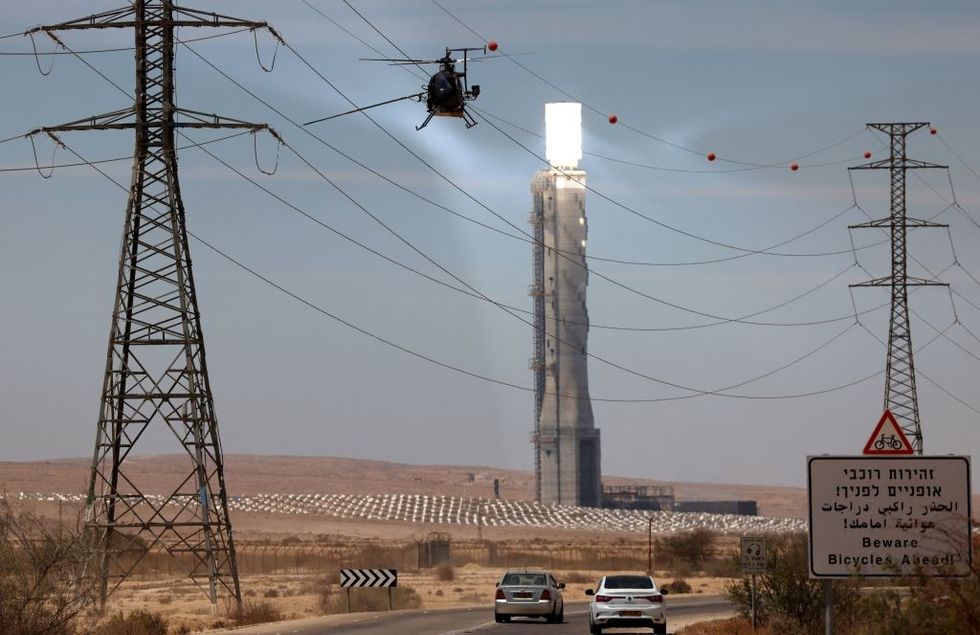 A crew cleans power lines at Israel’s Ashalim solar plant.EMMANUEL DUNAND/AFP via Getty Images