The trade-offs, beyond the benefits for fossil fuels, include making it far more difficult — in some cases, potentially impossible — to revoke permits for a project once the federal government has issued them. While this might help solar and wind under Trump or a Trump-like president, critics are worried it will give Trump carte blanche to approve shoddy oil and gas projects with abandon in his remaining two years. The bill also limits public participation in the environmental review process, makes significant changes to landmark environmental laws like the Clean Water Act and the Endangered Species Act, and weakens tribal consultation under the National Historic Preservation Act.
Several Democratic Senators and House members who had yet to comment on the bill came out of the woodwork in the post-midterms glow to share where they stood. Ruben Gallego, the senator from Arizona and likely 2028 presidential candidate, told a Washington Sun reporter that the White House may not be so willing to negotiate six months from now after a possible impeachment. “Or maybe we get too close to an election and Vance doesn't want to negotiate, right?” he said. “So why not take this win now?”
Senator Mark Kelly, of Arizona, on the other hand, said he wants to wait and see if Democrats can get more of their priorities into the bill in the next Congress, according to Politico. That sentiment seems to be growing among Democrats in the House, where minority leader Hakeem Jeffries of New York has come out against the current iteration of the bill. “Leader Jeffries will not rubber-stamp legislation that emerges from the Senate without more constructive involvement with our Caucus as we fight to make life more affordable for the American people,” Jeffries’ spokesperson told Politico.
The political calculus on the bill is in the eye of the beholder. Proponents are sure this is the best chance Democrats are going to get to clear transmission bottlenecks that will open the door to a clean energy future. Skeptics are worried the risks are too great, or otherwise feel it’s worth attempting a better deal in the next Congress when Democrats have more power.
On Thursday, I spoke to Representative Mike Levin from California as he was coming down from the high of his own reelection win on Tuesday night. Levin told me he was decidedly undecided on the bill, and so we talked through how he’s thinking about it.
Let’s start with the big picture. What is your opinion of the legislation as written?
I think a few things. One, having such a huge democratic victory in the House and the Senate changes the dynamics around the deal and really around the negotiations — not just around permitting reform, but all the things that have been punted to the lame duck. I think there’s a list of like a dozen things.
The question is, do we choose to accept the permitting deal in its current construct with whatever technical changes there are in the manager’s amendment? Do we negotiate much broader changes this Congress with the massive vote we received on Monday? Or do we wait until the 120th Congress when Democrats have the pens?
The next thing we're going to learn, after we get the final numbers in the House and Senate, is what does the manager’s amendment actually look like? There’s risks to any of the options here. There are more conversations that our caucus needs to have on permitting in light of Tuesday. We’ve raised specific concerns to our colleagues in the Senate. I know others have as well, and I’m going to be watching closely to see if Martin [Heinrich] and Sheldon [Whitehouse] can address some of these concerns that we’ve raised.
What are your biggest concerns about the bill?
There’s a big picture test that I have, a three-prong test. First: Is it going to actually lower costs? This whole election has been about lowering costs for consumers. Second: Is it going to protect the environment, and specifically, will it promote clean air and clean water that communities need? And then, third: Will it actually do the job on access to clean energy?
And what I would say is: there are some real problems. I have a lot of good things to say about the transmission provisions. A lot of it mirrors what we’ve been working on in the Energy Bills Relief Act for a long time. But I think there are loopholes around project certainty language. I read my friend John Podesta’s phrase of “loaded Howitzer” in Heatmap. I see these loopholes as ripe for corruption and potentially allowing permits for fossil fuel projects, and that’s very concerning.
You have the historic preservation tribal issues, right? My friends in New Mexico have been very loud about that, and other places as well. They’re very unhappy about the [National Historic Preservation Act] process and tribal sovereignty.
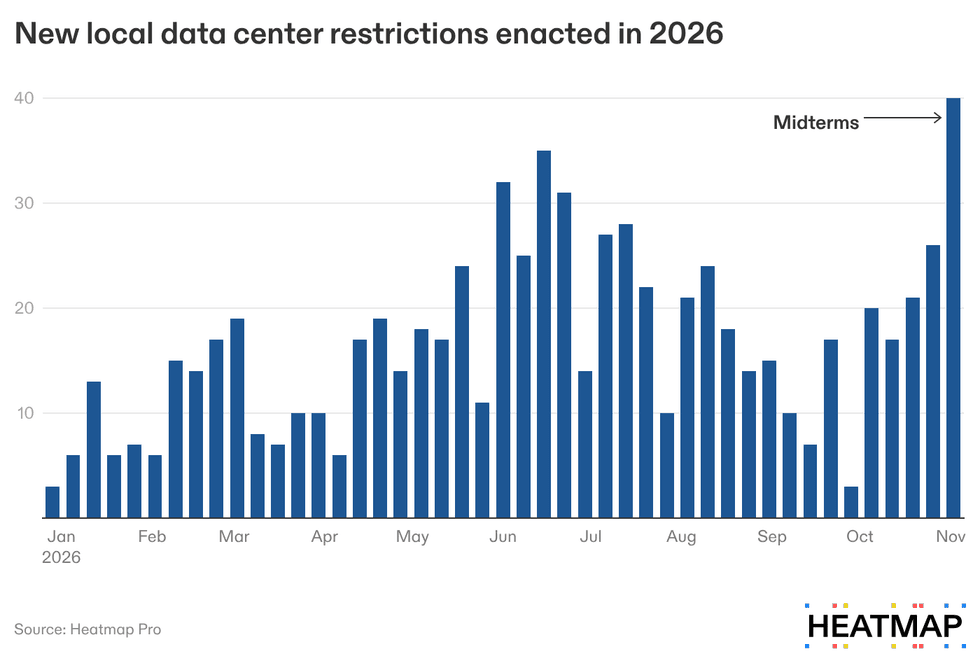
And I worry in the context of the whole data center fight that there aren’t enough steps in here to improve transparency for the public through the permitting process. You can’t have projects that are shrouded in secrecy, and you need community engagement to lead to better and more successful projects. So those are a few things, and those are not small things.
What is your sense of the sentiment around the bill in the House in general? Are there House Republicans that are against it? Do you think it could get the votes in the House?
Mike Johnson obviously came out strongly for it, which may not help get House Democrats on board. I have to tell you, the fact that he was so enthusiastically for it — in my view that wasn’t a great tell.
In my own opinion, any bipartisan permitting bill or any bipartisan bill at all is going to require compromise, and we owe the negotiators the room to try to get to a deal to a certain extent. We shouldn’t let the perfect be the enemy of the good. But until we see the final text, it’s tough to take a stance on the bill, and that includes the managers’ amendment. And we need more assurances and progress from the administration than we’re getting.
Time is running out for that, it seems.
Yeah. They still refuse to implement our current laws in good faith, and that doesn’t give me confidence that they’re going to implement any new law in good faith.
The other thing that I don’t think really gets talked about in this context, but I see it as germane — at least in the behavior of the administration — is what happened on the Lindsey Graham sanctions bill. This bill was negotiated by the White House, and there were a lot of Dems that were for it. It was a close vote for me. I voted against because I could not trust the administration to proceed in good faith. I thought Trump would use the tariff authority and the sanctions waiver authority in an unintended way, and that’s exactly what happened. Lindsey Graham would never, in a million years, have been okay with how Trump waived sanctions on Russia using a bill intended to impose sanctions. Just the same, I could see a scenario where, with the permit-certainty language, it is in fact the loaded Howitzer that John Podesta described. That’s my two cents.
Some proponents of the bill have said the midterms are an argument to pass this bill because they showed how much voters care about affordability, and this bill, by their account, is all about affordability, and if newly elected Democrats want to do more on clean energy down the road, this is a prerequisite. What do you make of those arguments?
They want us to get stuff done. There’s no question about that. But I also think that they want us to get things done that actually are reflective of our priorities and our values. And in this case, the three things that I laid out are reflective of those priorities and values. Again, costs, environmental implications, and access to clean energy — and clearly there are big challenges with unintended environmental repercussions.
I found it interesting that in [the Rhodium Group’s] analysis, they basically omit the certainty provision from their analysis of the GHG impact because there’s really no way to know how the administration will interpret and potentially abuse that provision. There’s great potential for abuse with that provision; I think it needs to be reworked. And it’s naive to think all of a sudden that the Trump administration will behave any differently than they have in the first six years of their opportunity to run afoul of bedrock environmental law, kneecap clean energy, and double down on fossil fuels. I would expect more of the same.
The other thing I think is wrong is the presumption that everyone in the clean energy industry is all on board —you're not talking to enough actual project developers who may not be on board.
Do you see a clear pathway to do something like your Energy Bills Relief Act in the next Congress?
There's a tremendous opportunity to do the Energy Bills Relief Act in the next Congress. We obviously have to discuss with all of our many new and unexpected colleagues to get them on board, and we may have to make amendments to the bill as it was constituted in the 119th Congress. But we got 160 on board. We have lots and lots of new people, and we may, after making changes, find ourselves with a really strong number of people in support. And I’m not giving up on the Republicans that are left in the House, some of whom have claimed to be more pro-clean energy. We’ll get there, and in the meantime, there are things we can do right at the beginning around the war and tariffs — maybe around other ideas as Nikki Budzinski and I presented to Leader [Hakeem] Jeffries that I’ll let him run with as we scope out the first 100 hours, 100 days in the year of the new 120th Congress.
If you do have an opportunity to do something like the Energy Bills Relief Act next Congress, how do you get Trump to sign it? Or another permitting bill if this one doesn’t pass?
Well, I guess two ways. One is if you get the majority in the House and you get 60 votes in the Senate, you send it to the president’s desk. And if you were to get two-thirds in both houses, then it’d obviously be veto-proof. I would have thought veto-proof majorities to be incredibly difficult, but then we saw something on Tuesday I didn’t expect. We got 260, perhaps more, in the House, and you need 290 to get your two-thirds. And then in the Senate, we got 56, if we hold in Mississippi and Alaska, meaning you’d need 11 Senate Republicans. And you have a changed national mood, where I think a lot of those Republican senators who will be up for re-election — I'm pretty confident you probably could get four of them, but maybe you could get more, and you could get all the way to 11.
But if you were to send a bill to the president’s desk that, on balance, is positive. The president could do what he did for the Road to Housing Act — neither sign nor veto. He could go that route. So I think it’s a lot more possible now with the majorities that we have. What I don’t think we need to do is just accept that the only option is the current deal, have that pass into law with the downside that there are still some pretty stark environmental rollbacks, and the risk that we don't have any real indications that this administration will faithfully implement the bill.
There are two other options as well: Given what happened in the election, we can make our Senate colleagues come to the table and pass a bill that is more reflective of those things I mentioned — costs, environment, and clean energy.
Or a third option is my friend Jared Huffman, who says, ‘Wait until we retake the majority in January, try to strike a better deal,’ with the risk that Trump is not willing to work with us at all.
Another idea I've heard floated by proponents of the bill is: pass it as is, and if there are things that turn out to be really bad or that you want to change down the line, Congress can come at it again later on. What do you think about that strategy?
That's true. The challenge is how long would that take, and what damage would be done in the interim? If Trump does take the certainty sections and turns it into a free-for-all for fossil, then I think it’s going to be two years of some really bad stuff happening, two years of unintended consequences, and potentially longer than two years if you have a Republican winning the White House in 2028.
We’ve got to be clear-eyed about the deal as it stands. This is not the last time in human history that we will have Congress and the White House negotiating. It’s a great opportunity to try to get something done that will be very meaningful, particularly around the transmission piece. And again, I don’t believe in perfect being the enemy of the good, but I want to make sure that it’s actually good.
Just to make sure I'm 100% clear on where you stand on this right now, it sounds like you're still relatively undecided, given what the bill says at this moment?
I am waiting to take a stance on the bill until I see the final text. I am closely watching the Senate process, and again, I’m judging the bill by those three factors that I mentioned, and I won’t know where I stand until I see the final text. We also have to have family discussions back in Washington D.C. next week. It doesn’t do any good to negotiate with the press before we discuss amongst ourselves. I have seen a lot of my colleagues that are very, very interested in this. They reach out to me, and I give them the best information that I can. I can also tell you that I have tremendous respect for John Podesta’s opinion.
This interview was edited for length and clarity.