You’re out of free articles.
Log in
To continue reading, log in to your account.
Create a Free Account
To unlock more free articles, please create a free account.
Sign In or Create an Account.
By continuing, you agree to the Terms of Service and acknowledge our Privacy Policy
Welcome to Heatmap
Thank you for registering with Heatmap. Climate change is one of the greatest challenges of our lives, a force reshaping our economy, our politics, and our culture. We hope to be your trusted, friendly, and insightful guide to that transformation. Please enjoy your free articles. You can check your profile here .
subscribe to get Unlimited access
Offer for a Heatmap News Unlimited Access subscription; please note that your subscription will renew automatically unless you cancel prior to renewal. Cancellation takes effect at the end of your current billing period. We will let you know in advance of any price changes. Taxes may apply. Offer terms are subject to change.
Subscribe to get unlimited Access
Hey, you are out of free articles but you are only a few clicks away from full access. Subscribe below and take advantage of our introductory offer.
subscribe to get Unlimited access
Offer for a Heatmap News Unlimited Access subscription; please note that your subscription will renew automatically unless you cancel prior to renewal. Cancellation takes effect at the end of your current billing period. We will let you know in advance of any price changes. Taxes may apply. Offer terms are subject to change.
Create Your Account
Please Enter Your Password
Forgot your password?
Please enter the email address you use for your account so we can send you a link to reset your password:
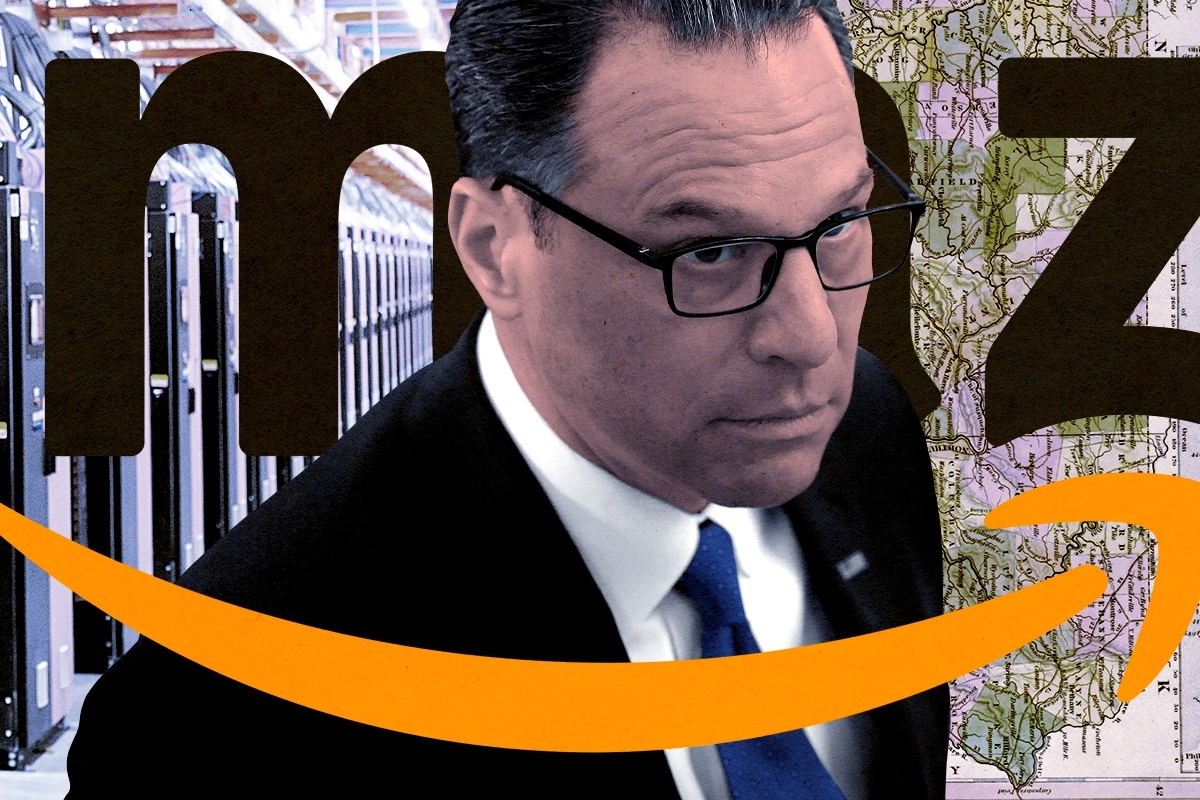
Emails between the Pennsylvania governor’s office and Amazon illustrate the difficulty of courting big business as anti-AI fervor explodes.

On March 6, Pennsylvania real estate mogul Brian O’Neill shot a panicked email to Benjamin Kirshner, a top state official, with a plea to the governor.
Amazon, wrote the property developer, had just told him “in writing, and I have sent you the e-mail, that they will not be doing any projects in Pennsylvania until they get certainty that the projects they have invested in can move forward. In conversations, they have pointed out to us that they have been appealed in EVERY project at EVERY turn,” O’Neill told Kirshner, Governor Josh Shapiro’s chief transformation and opportunity officer, referring to local governments rejecting the company’s permit applications. His own project in the Philadelphia suburb of Conshohocken had been blocked in November.
O’Neill then pleaded for the governor to “make sure we are not going to get appealed frivolously by people who just want to slow us down for sport like Amazon,” asking the governor to force those who challenge zoning decisions to post a bond double the value of the project. “If a $2 billion development is postponed due to an appeal, they should have to post a bond for $4 billion,” he wrote.
Kirshner forwarded the request to top officials in the Shapiro administration with a “FYI.”
What if anything came out of this correspondence we don’t know. The Shapiro administration told me it did not respond to O’Neill’s email. When asked if it supported his idea, the governor’s office declined to say, simply stating that the idea would require legislation, which has not been introduced. A representative for O’Neill told me they would supply a response but did not follow up. When asked about the email, Amazon gave me a statement from an unnamed spokesperson stating the company “has a deep and ongoing commitment to Pennsylvania.”
The whole exchange exemplifies the mess Shapiro — or any governor and future presidential hopeful — finds themselves in as an AI data center boom they welcomed runs headlong into a bitter backlash.
Shapiro is not the only state executive being forced to respond to the loud and opposing interests of real estate developers and voters concerned about the rapid pace and lack of transparency of the AI buildout. In Maine, Governor Janet Mills last week vetoed a statewide data center ban, much to the chagrin of the Democratic voter base she’ll need to win a U.S. Senate primary against insurgent progressive upstart Graham Platner.
On the one hand, there’s a lot for a governor to love in the explosion of data center development. The AI revolution has helped Pennsylvania’s economy grow during an overall difficult moment for the U.S. economy. Having announced last June that he was going “all in on AI,” Shapiro has coaxed billions of dollars in Big Tech investment to his state. Reports pin the planned data center investment in Pennsylvania at $100 billion total. Roughly a fifth of that total is from Amazon, which in 2025 announced that it would build more than $20 billion in AI infrastructure in the Commonwealth.
On the other hand, Pennsylvania — a key battleground for anyone seeking the White House — has become a bellwether for the country’s fears about data centers. Many in the state are worried the developments could disrupt the energy grid and raise electricity bills. Depending on how they’re designed, these projects can either be boring box-shaped structures running computers and generating tax revenue or noisy polluters draining local aquifers.
Since late 2024, 26 data center projects have attracted at least some degree of public opposition in Pennsylvania, according to the Heatmap Pro database, which shows the frustrations are widespread across regions, political affiliations, and socioeconomic classes. Most local complaints have focused water consumption, noise, energy consumption, and pollution. My own reporting has also found secrecy to be a major complaint; real estate developers are in many cases getting approval to build data center campuses without telling the public who may inherit these facilities after they’re completed.
Emails obtained by Heatmap News from a grassroots organizer in rural Pennsylvania provide a glimpse into how Shapiro has navigated the intensifying drumbeat against data centers. These records — more than 150 pages of correspondence between Shapiro’s office, Amazon, and others in the tech and real estate industries — paint a vivid picture of how the rumored 2028 Democratic presidential contender initially sought to woo Amazon, then sought to balance that pro-business approach with rising angst against AI and data centers.
For example, in April 2025, months before Amazon announced its $20 billion investment, Shapiro’s office offered the tech giant “exclusive early access” to a permitting fast track program not yet available to the public. Kirshner described the provision to Amazon as an “enhanced permit coordination framework established specifically for Amazon Web Services (AWS) development projects within Pennsylvania.” According to a memo included in the emails bearing the governor’s insignia, the state would help AWS “be among the first companies” to utilize a new program that lets third-party contractors complete parts of the permit application review process.
This program — known as SPEED, or Streamlining Permits for Economic Expansion and Development — was created through state law in July 2024. Under the program, companies seeking specific environmental permits are granted permission to use approved outside hires to review applications and then give those recommendations to the state for use in decisions on permits. The goal of this is to expedite permit reviews overall.
Even though the program was created in 2024, it takes time to stand up a new government program like this. Members of the public were given formal access to apply for the SPEED program at the end of June 2025. This was months after the “exclusive” offer was sent to Amazon.
Notably, the memo is labeled “subject to a non-disclosure agreement dated effective as of Feb. 15, 2024.” The use of NDAs between governments and data center developers is controversial because the agreements swear public officials to secrecy, making them answerable not to the public but rather to private entities within the scope of the contract. In Minnesota, lawmakers have explicitly tried to shed light on data center development by banning local political leaders from entering into NDAs. So controversial is this practice that Microsoft issued a public pledge to stop using NDAs with local governments.
Rosie Lapowsky, Shapiro’s press secretary, confirmed in a statement to me that the administration had given Amazon advance notice of the SPEED program and offered to help it navigate the permitting process, but said that AWS has not so far used the program for any projects.
As for the NDA, it’s not clear what the terms of the agreement referenced in the offer were, who in the office signed it, and whether Shapiro himself was bound by it. This is not the first time NDAs have come up within the Shapiro administration, however. Spotlight PA, an investigative news outlet, reported in 2023 that members of his transition team signed NDAs.
Amazon declined to say whether it had asked anyone in the Shapiro administration to sign a NDA. Shapiro’s office would not provide additional information on whether the governor, any top state officials — including Kirshner, the main signatory of the memo — or any of the governor’s staff are under a NDA with Amazon.
I obtained this window into the Shapiro administration from Colby Wesner, vice president of the grassroots organization Concerned Citizens of Montour County in Pennsylvania. By day, Wesner works in pediatric medicine, but he’s become a well-known figure in tech-anxious corners of Facebook for posting simple videos in which he details the findings of public records requests he submits to attempt to understand Amazon’s data center development practices in the Keystone State.
He first became involved in the fight against data centers, he told me, when developer Talen Energy asked Montour County to rezone hundreds of acres for industrial use. As I chronicled in February, Wesner and others suspected it was for an Amazon data center, but local officials wouldn’t say. Activists grew especially frustrated with this silence after discovering that county staff and at least one county commissioner had signed NDAs against discussing data center development. Wesner wound up discovering that one project was indeed for Amazon, and his video unveiling his findings sparked a local outcry.
“The more you learn, the more you crave to get more information to figure out how secretive these projects generally are, and how non-transparent the state government is,” Wesner told me. “Me personally, I feel obligated to keep doing this because it started from our small county, but Pennsylvania counties across the state are reeling from this.”
To be clear, there are some data center projects in Pennsylvania that Amazon has gotten behind publicly as it sought to develop them, such as this one in Salem Township and this one in Falls Township. Shapiro mentioned both projects in his June 2025 speech announcing Amazon’s $20 billion data center investment in the state, which he said was the single largest capital investment in the Commonwealth’s history.
“Our administration is actively engaged with Amazon on additional sites in our Commonwealth, helping them to secure local support, developing the infrastructure needed to support more data centers and ensure our permitting process works quickly,” Shapiro said at the time, crediting these investments to faster permits that “give confidence to companies like Amazon that their projects will get built on time.”
The emails from Wesner show that Amazon was involved in another project in the state it has not yet confirmed to date: Project Hazelnut in Hazle Township, which is currently under development by real estate firm NorthPoint.
According to tech trade publication Data Center Dynamics, the first public reference to Project Hazelnut was actually from Shapiro, who embraced the project site as a preferred location for tech development and faster permitting. In November 2024, he hosted an event there to publicize a new executive order establishing a statewide “permit fast track” program and identified Project Hazelnut as one of the first to benefit. In a press release, his office said the project was a “transformative technology campus” that “exemplifies Governor Shapiro’s commitment to growing Pennsylvania’s economy all across the Commonwealth by improving permitting processes, reducing delays, and increasing our competitiveness by ensuring government operates at the speed of business.”
It was apparently only afterward, in January 2025, that residents in the surrounding Hazle township learned what Project Hazelnut was: a roughly 1,300-acre campus that would purportedly include 15 data center buildings.
Over the months that followed, getting Hazelnut built was clearly on the Shapiro administration’s minds, as its permitting status was listed alongside the Salem and Falls township projects in the “exclusive” permitting benefit the governor’s office offered the tech giant in April 2025. The memo states that NorthPoint, not Amazon, is “the developer,” but also says Amazon would work on submitting air and storage tank permitting information. Elsewhere in the memo it states that Amazon’s public association as developer of the Salem project led to “multiple challenges” in the permitting process.
Over the summer, Ethan Dodd, a reporter for Real Clear Politics’ Pennsylvania blog, reached out to Amazon asking questions about Project Hazelnut and other data centers in Pennsylvania. “Governor Shapiro’s office thought you would be best to answer these.”
This email immediately led to worries at Amazon. “It appears from the inquiry and the fact that the Gov’s office has directed the reporter to Amazon for more details they may have outed us on a project,” wrote Preston Grisham, who was then a D.C.-based policy lead at Amazon, to Becky Ford, an executive on Amazon’s economic development team.
Ford then forwarded these concerns to Shapiro’s office. “Please see the inquiry below,” Ford wrote to Kirshner and Rick Siger, head of Pennsylvania’s Department of Community and Economic Development. She asked to know who told the reporter to contact Amazon and said Hazelnut was not a site they had “disclosed.”
“In talking to the team we absolutely did not confirm or discuss anything about AWS and Hazelnut,” Siger replied, accusing local residents of “speculating about AWS at Hazelnut — though we did not comment/confirm.”
Kirshner followed up, accusing the reporter of “attempting to create a narrative” and adding: “We did absolutely not tell this reporter that Northpoint was AWS.”
Months later, locals succeeded in pressuring Hazle to reject Project Hazelnut. NorthPoint has appealed the denial in court, as state environmental regulators under Shapiro have continued to advance the project’s environmental permit applications. NorthPoint did not respond to requests for comment. Amazon did not comment on whether it is involved with Project Hazelnut.
Hazelnut’s continued progress is happening as at least one data center project benefiting from the state’s fast-track permitting programs has stalled out. Earlier this week, The Washington Post reported that the permitting application for Project Gravity, another large would-be tech hub, had been put on hold pending additional information from the developer. As in the case of Hazelnut, locals in the tiny township of Archbald learned that Gravity would be a sprawling data center campus, one of a multitude of data center proposals in the area causing chaos between residents and local leadership.
Lapowsky stressed in the statement to me that state agencies in charge of permitting handle applications based on existing law, which includes opportunities for public input and appeal.
Amidst this anger, Shapiro has started to work rhetoric into his public comments saying he feels the pain of places like Hazle. In his February State of the State address, he laid out what he called “the Governor’s Responsible Infrastructure Development” principles, or GRID. He said that these standards, developed by his administration “in consultation with the community,” would “hold data centers accountable to strict standards if they want our full support.”
Three of the four standards struck me as standard fare. Developers would need to bring their own power or pay for new generation; companies would need to hire and train local workers; and they would need to commit to high environmental protection standards. One, though, stood out to me: Shapiro would make developers “commit to strict transparency standards.”
“Too many of these projects have been shrouded in secrecy, with local communities left in the dark about who is coming in and what they’re building,” he said. “That needs to change.”
The same day Shapiro gave that speech, Siger wrote Amazon to assure them the principles “are intended to be voluntary and Shapiro is “not proposing to ban or even discourage data centers or other large loads that don’t agree to implement them from siting here.”
Shapiro’s team also wanted to make sure Amazon got an advance look at the official “principles” before they were made formal and effective. On March 18, Shapiro’s deputy chief of staff Samuel Robinson wrote Ford and Merle Madrid, an Amazon lobbyist, with a “feedback draft of the principles” ahead of plans to “finalize and make the Principles public shortly.”
Amazon may have seen these principles, but I haven’t, and neither have most Pennsylvanians. More than two months since the State of the State address, Shapiro’s office has yet to release a formal outline of the governor’s data center development principles. The “feedback draft” itself wasn’t included in the cache of emails, nor was Amazon’s response, nor is it clear whether any other large tech companies may have received an advance consultation copy.
In the statement provided by the governor’s office, Lapowsky told me that the Shapiro administration is working to finalize and implement these standards and will release more details in the coming weeks, pointing to the GRID principles as outlined in the governor’s speech.
“These standards make clear that if companies want the Commonwealth’s full support — including access to tax credits and faster permitting — they must meet strict expectations around transparency, environmental protection, and community impact,” Lapowsky said. “This is about setting a higher bar for projects, not lowering it, and ensuring development happens responsibly and in a way that benefits Pennsylvanians.”
What we do know is that Shapiro last year was generally sympathetic to hearing Amazon’s needs, too. In the only message from the governor himself that appears in the emails — an August 2025 note sent to Matt Garman, CEO of Amazon Web Services, after the two saw each other in Pittsburgh — Shapiro writes, “We are thankful and excited about AWS’ historic investment and I agree that our teams continue to work very well together and we continue to be committed to your success in PA. We also look forward to the Fall announcement of the additional sites in PA, and would love to collaborate and maximize the impact of those announcements and share the story of positive economic and community outcomes together.”
He concluded the email: “My door is always open should you have issues or ideas you wish to discuss. Please keep in touch.”

Log in
To continue reading, log in to your account.
Create a Free Account
To unlock more free articles, please create a free account.
Why local governments are getting an earful about “infrasound”
As the data center boom pressures counties, cities, and towns into fights over noise, the trickiest tone local officials are starting to hear complaints about is one they can’t even hear – a low-frequency rumble known as infrasound.
Infrasound is a phenomenon best described as sounds so low, they’re inaudible. These are the sorts of vibrations and pressure at the heart of earthquakes and volcanic activity. Infrasound can be anything from the waves shot out from a sonic boom or an explosion to very minute changes in air pressure around HVAC systems or refrigerators.
Knowing some of these facilities also have the capacity to produce significant audible noise, growing segments of the population’s more tech-skeptical and health-anxious corners are fretting some data centers could be making a lot of infrasound, too. The whizzing of so many large computational machines combined with cooling fans and other large devices creating so many new columns of air flow. Add onto that any rotational onsite power generation – think natural gas turbines, for example – and you get quite a lot of movement that could potentially produce what they say is infrasound.
Some of the virality of this chatter about infrasound and data centers comes from a video about infrasound created by audio engineer and researcher Benn Jordan. Currently sitting at more than 1 million views, this short YouTube film documents claims that some data centers are operating like “acoustic weapons” through infrasound and harming people. Andy Masley, an “effective altruist” writer, has become the chief critic of the Jordan video, getting into a back-and-forth that’s raised the issue to Internet discourse territory.
The Jordan-Masley infrasound debate is honestly a bit of a mess. So I want to be clear: I’m not going to get into the science of whether or not infrasound poses any kind of public health risk in this article. We can get to that later. It’s worth saying that this subject may need more study and that work is ongoing. Also, talking about infrasound at all can make you honestly sound a little wacky (see: this study blaming people seeing ghosts on infrasound). It might also remind you of another panic in the Electric Age: electromagnetic fields, also known as EMFs. Developers of transmission lines and solar projects have long had to deal with people worried about transmission lines and large electrical equipment potentially glowing with invisible, unhealthy radiation.
In late 2024, I wrote about how an RFK Jr. supporter worried about this form of electrical emission was helping lead the fight against a transmission line in New Jersey for offshore wind. Maybe that’s why it didn’t surprise me one bit when the Health and Human Services secretary himself told a U.S. Senate Committee last week that he was asking the Surgeon General’s office to “do either meta reviews” or “base studies” on noise pollution and EMF radiation from data centers “so we can better inform the American public.”
“There’s a range of injuries that are very, very well documented. They’re neurological – very, very grave neurological injuries, cancer risk,” Kennedy Jr. told the Senate Health, Education, Labor and Pensions Committee on April 22 in response to a request from Sen. Josh Hawley of Missouri to study the issue. “The risks, to me, are tremendous.”
There’s also the unfortunate reality that infrasound impacts have previously been a cudgel to slow down renewable energy deployment. Wind turbines create infrasound because of the subharmonic frequencies created when one turbine rotates at a slightly different pace than another, producing a slightly dissonant low frequency noise. Groups like the Heartland Institute proudly list this infrasound as one of the reasons wind energy “menaces man and nature.”
But regardless of merit, this concern is already impacting local government decisions around data center projects, much like how one Michigan county sought to restrict solar energy on the same basis.
In February Adrian Shelley, the Texas director for environmental group Public Citizen, implored the city of Red Rock to study changing their noise ordinance to take into account infrasound. “It has effects on sleep patterns, on stress, on cardiovascular health, and it is potentially a very serious concern,” Shelley said at a February 11 city council discussion on data center rules. “It will not be covered by the city’s noise ordinance, which only deals with audible sound.”
Earlier this month in Calvert County, Maryland, a volunteer for their environmental commission recently told the county government that infrasound needs to be factored into their future data center planning. “It will have significant impacts on our region and the Chesapeake and the Patuxent because infrasound isn’t stopped by walls,” commission member Janette Wysocki, a proud land conservationist, said at an April 15 hearing. “It will keep going, it will move through anything. It’s a very long wavelength. So we need to protect our ecosystem.” Wysocki implored the county to consider whether to adjust its noise regulations.
Around the same time, similar concerns were raised in Lebanon, a small city in east-central Pennsylvania. “It permeates through concrete walls, it permeates through the ground,” Thomas Dompier, an associate professor at Lebanon Valley College, said at an April 16 Lebanon County commission hearing on data centers.
Lastly, last week I explained how Loudon County wants to rethink its noise ordinance to deal with low-frequency “hums” from data centers – a concern echoing those who fret infrasound.
Ethan Bourdeau, executive director of standards at Quiet Parks Intentional and a career acoustician and building standards writer, told me that what makes data centers unique is the “constant drone” of noise that could potentially carry subharmonic frequencies. Bourdeau said cities or counties could possibly factor concerns about infrasound into noise ordinances to address those who are most concerned. One way they could do it is by changing how decibels are weighted in the government’s measurements. A-weighting decibel meters are a common form of sound measurement geared toward perceptible noise. Using different systems, like C-weighting or G-weighting, would avoid ways that A-weighting can filter out sub-hearing frequencies.
“These are reporting and weighting systems where a sound level meter taking background noise receives all the unweighted sound and then you apply all these filters afterwards, like an EQ curve,” Bourdeau said.
So I guess if those most concerned about infrasound have their way, a lot of country commissioners and local elected leaders will be heading to the mixing booth.
And more on the week’s top fights around project development.
1. King County, Washington – The Moss Landing battery backlash is alive and well more than a year after the fiery disaster, fomenting an opposition stampede that threatens to delay a massive energy storage project two dozen miles east of Seattle.
2. Prince Williams County, Virginia – It was a big week for data center troubles. Let’s start with Data Center Alley, which started to show cracks this week as data center developer Compass announced it was pulling out of the controversial Digital Gateway mega-project.
3. Washtenaw County, Michigan – Turning to Michigan, real estate firm Sansone abandoned plans to purchase land owned by Toyota to build a hyperscale data center campus after the local township instituted a 6-month moratoria.
4. Okeechobee County, Florida – The backlash to data centers is killing projects in deep-red Florida too, as this county’s commission decides to kill a 205-acre prospective data center campus led by a state college.
.
A conversation with Holly Jean Buck, author of a buzzy story about Bernie Sanders’ proposal for a national data center moratorium.
This week’s conversation is with Holly Jean Buck, an associate professor at the University of Buffalo and former official in the Energy Department’s Office of Fossil Energy and Carbon Management. Buck got into the thicket of the data center siting debate this past week after authoring a polemic epistemology of sorts in Jacobin arguing against a national data center ban. In the piece, she called a moratorium on AI data centers “a massive strategic blunder for the left, and we should think through the global justice implications and follow-on effects.” It argued that environmental and climate activists would be better suited not courting a left-right coalition that doesn’t seem to have shared goals in the long term.
Her article was praised by more Abundance-leaning thinkers like Matthew Yglesias and pilloried by some of the more influential people in the anti-data center organizing space, such as Ben Inskeep of Citizens Action Coalition of Indiana. So I wanted to chat with her about the discourse around her piece. She humbly obliged.
The following conversation was lightly edited for clarity.
So my first question is kind of a broad one and perhaps a suitable polemic to open with: are data center moratoria (bans) “slopulism”?
Haha, oh no. I don’t know if I have a working definition of that term.
“Slopulism” is colloquially known as low-effort or performative populism slop that is focused on emotional gratification and elite resentment instead of substantive policy.
I think, sometimes? Moratoria have been proposed at a lot of different levels in a lot of different forms. With the national moratorium, as written in the AI Data Center Moratorium Act [proposed by Senator Bernie Sanders and Representative Alexandria Ocasio-Cortez], I thought from a rhetorical and textual standpoint it was a pretty amazing document. I just don’t think it’s a great policy proposal, so maybe that’s a little bit closer, but I don’t think people working on that theory of change would see it as slopulism. They’re thinking of this as a negotiating tactic and thinking, how do we leverage this moment and make it clear to the tech industry they don’t have social license?
I wouldn’t personally call it slopulism. I just don’t think it’ll work. I don’t think it's effective but I'm not big on labels.
Personally, I come down sort of where you’re at on the yes-and-no kind of tack. There’s definitely some vibes based stuff going on, which you address in your piece, but historically there’s a pretty long legacy of advocacy campaigns for, well, let’s ban this until we’ve finished regulating it.
You write part of why a moratoria push can be a dead end is that the right and left coalitions pushing to stop data centers have different interests on other issues and that it may not follow that stopping data centers will result in a clean energy buildout, or the social policies to address job displacement.
When you talk about the left-right coalition, help me understand what’s driving the opposition and why you think it’s happening the way it is?
I think there’s a lot of layers here. It’s pretty complex. It’s well established there are left-right coalitions. I don’t think we have a great body of social science research but I think that is a solid working assumption. So I think the people who are a part of this, it’s easy for them to come together and stop a thing that’s happening near them. But I don’t think they’re going to agree on how we build a decarbonized, resilient grid. The people in that coalition are going to have vastly different perspectives on whether we want to decarbonize, what measures are feasible and worth paying for to get there. Same thing when it comes to the thornier questions about AI governance. The solution set is just not something the members of that coalition are going to agree on.
So it feels maybe on the ground like this really cool moment about rising up against these big forces. It’s cool. I get it. I was actually very much on board with that a while ago. And my views on that have shifted. I don’t think it’s going to be productive unless it’s coupled with a lot of very real coalition building work I don’t see happening.
I’ve had conversations with environmental activists about that issue. I did a Q&A with someone from Public Citizen about this particular issue right after the national data center moratoria was introduced with Senator Sanders. I asked, do you have any concerns about pushing for a moratoria on new tech infrastructure when this tool is also used by those trying to stop solar, wind and batteries? Is there any concern that in some communities it’ll go from data centers to renewables?
I wondered reading your piece if this is part of what you’re getting at here, that this backlash doesn’t necessarily seem to be rooted as much in a transition away from fossil fuels or building lots of new renewable energy.
I think in the absence of systematic research, it’s one of these things where people can see it the way they want, through their own lens.
I’ve been following this in a few different places in the country, especially through online Facebook groups, and there is a noticeable overlap between some of those Facebook groups and the content and many of the anti-renewable groups I follow. Some of the themes remind me of this piece I wrote about para-environmentalism. There’s a lot of places where it dips into conspiracy and fears about new technology, electro-magnetic radiation, sorts of places where a data center is mundane but can take on creepy, supernatural overtones in some of these groups. Before I was studying para-environmentalism more generally I was thinking we really need this left-right coalition to rise up against these companies. Now I’m much more cautious about where it’ll lead.
I know Twitter isn’t real life, but the discourse around your work – those who have criticized it – are saying, why can’t we do both? Why can’t we go after the data center sector without potentially heading towards that form of politics you’re afraid of?
I don’t think it's the moratoria necessarily but the left-right blocking approach.
There’s a couple things I want to make discernments about. I want to make a discernment between people who want to stop a data center and a moratorium that’s more of a blanket, larger regional or national thing. I do think there are data centers being sited in really bad places, under really bad agreements. They shouldn’t move forward.
There’s bad data centers and there’s okay data centers and we need to be discerning between them. There’s also normal processes in this country for siting large facilities, whether they’re county level zoning commissions and something else.
But to your question of why can’t we do both, we could have a viable left-right anti-tech organizing that makes real demand for how we go about the lithium and AI age if people were investing in the social infrastructure necessary to make that happen. We’re very far from it because the framing of stopping a thing… We need people who are convening real conversations about what to do. I think they’re focused on stopping a thing.
I don’t know if they’re focused on whether we need universal basic income, a public wealth fund or something else, in a way that’s across the aisle. That would be a whole movement building infrastructure and it’s one we need if we’re going to decarbonize.
But that’s not what I am seeing – I’m seeing NGOs funded by wealthy and non-transparent donor-advised funds focused on some parts of the country and not others. We’re not getting to having those conversations happening or even having a shared media reality.
Can you go a bit deeper on how a situation where there is a national moratoria results in equity concerns? How are those less fortunate hurt by that?
There are three things I am concerned about. The first thing is that people who are better organized because they have more resources say we need a national moratoria which pushes development to regions with weaker organizing. Maybe they have weaker environmental and social regulations. I’m concerned about that because there’s a huge history of that happening across different regions and industries.
The second thing I am concerned about is driving up the cost of computation in ways that would make AI less affordable and accessible for people who may be able to use it for a variety of things. I realize that’s controversial for the segment of the population who thinks AI is useless but I think it’s tremendously valuable and I want a world where everybody has access to these capabilities and I think it’s made less likely by making computation less expensive.
The third thing, which I didn’t have room in my piece to address, is to what extent this moment is about the data centers. This is a new focus for the climate movement, which is understandable because there’s been a sideshift away from climate and the Trump administration has put everything in such a dire place that they need wins to hold on to. I’m worried about whether that displaces energy and funding away from other environmental issues. Are we taking space away from other priority areas? I’m not saying we know about those things but these are concerns we need to focus on. And if they’re not concerns, that’s good news. But we should think of them.
On that note, on the bigger question, do you believe artificial intelligence and these data centers are a net positive or a net negative for the effort to solve for climate change?
I think it’s too soon to say what the net effect will be and that net effect will be indirect. We can count the carbon emissions from these and say, great we have a whole new industrial sector to contend with among all these other industries we’re trying to decarbonize. And it’s bad from that point of view.
Then you have efficiencies that AI might discover. I have no clue about the extent of that.
Then you have AI impacting the information ecosystem, what they want to believe and what they want to do. Maybe the greatest impacts of AI will be it causes people to take climate more seriously. Or ways through social media that convince people it is a hoax.
It’s hard to measure all these factors and speculations against each other. So I have no idea what the net effect will be on climate and I don’t believe anyone who says they know what it’ll be at this point.
But the data centers – from your perspective, is this boom helping or hurting?
I think it’s definitely a setback. But if I look at the whole picture of climate change I think this is more tractable than some of the challenges we have with decarbonization. Number one, we know how to decarbonize data centers. It’s a lot harder than something like cement where we don’t know how to stop the emissions themselves. I think agriculture is really challenging to decarbonize – it’s mixed up in what people eat and land use. Data centers is a problem. But it seems tractable because of that.
We also have all these people working on this. All of these climate professionals who’ve pivoted to framing their work into being about AI. I think we have the knowledge and the personnel to do it. If I compare data centers to other parts of decarbonization, it’s not on the top of my list of things I’m worried about. But it is tough – we knew we had this many tonnes to deal with and now we’re adding things. It’s a challenge but I want to have perspective about the challenge.
Can I close on a fun question?
Sure.
What’s the last song you listened to?
Oh, gee. It was some terrible ‘80s song because my kind is really into that kind of music right now. The one that sticks out is “Sunglasses At Night,” which is always playing in the Buffalo airport.