Here we go: On Monday, Donald Trump was sworn in as the 47th president of the United States.
Surrounded by some of the country’s richest men, including Elon Musk, Mark Zuckerberg, and the oil magnate Harold Hamm, Trump rejected what he called a “radical and corrupt establishment” that has “extracted power and wealth from our citizens” while promising a new golden age for the United States.
At the center of that golden age, he said, was an almost totally unregulated fossil fuel economy. “Today I will also declare a national energy emergency,” he said. “We will drill, baby, drill.”
Over the next 12 hours, he signed a series of executive orders that relaxed protections across the oil and gas sector while imposing costly new restrictions on wind turbines, electric vehicles, and other forms of renewable energy. He demonstrated that his extreme vision for the American government — a new order where the executive reigns supreme and Congress does not control the power of the purse — will run straight through his climate and energy policy.
You could see in his actions, too, what could become fragility in his governing coalition — times and situations where he might too eagerly slap a cost on a friend because he believes they are a foe.
But all that remains in the future. For now, Trump is in charge.
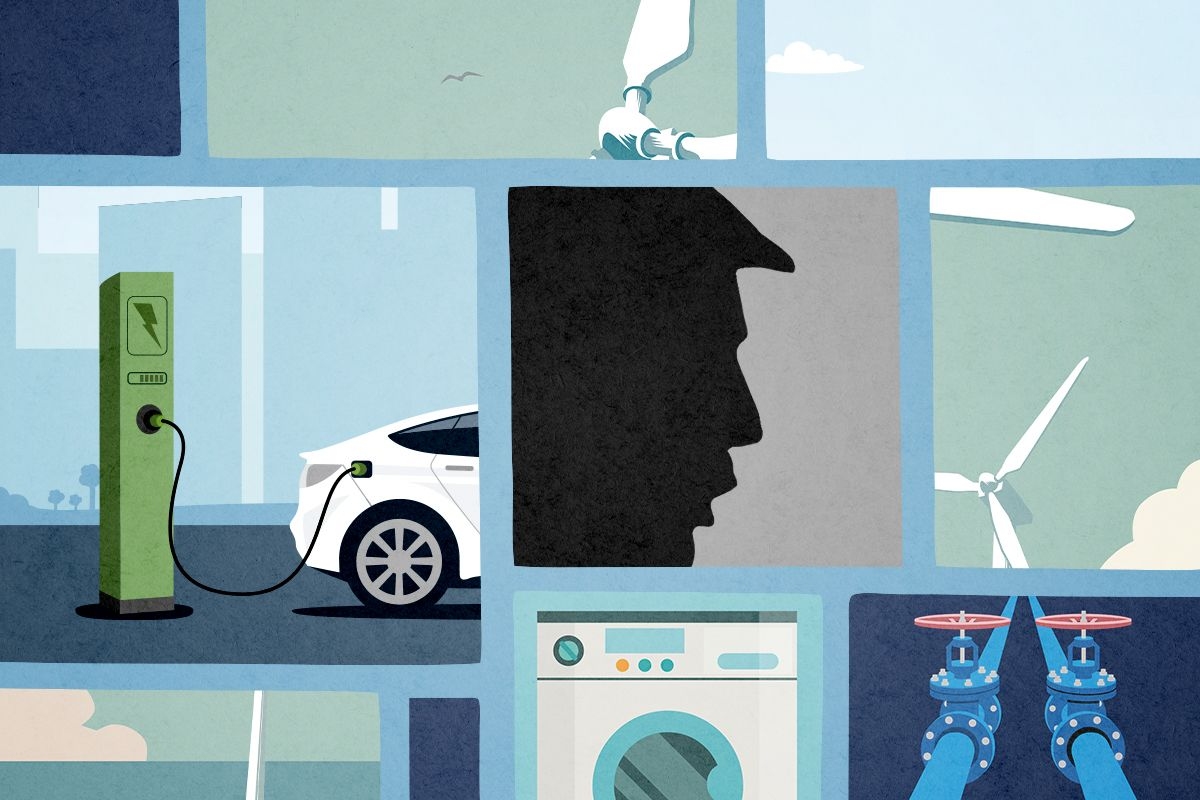
Trump’s first day was about undermining climate policy in virtually any form that he could find. Soon after taking the oath, Trump began the process of pulling the United States out of the Paris Agreement on climate change. He announced a broad freeze on virtually all federal wind energy permits, throwing at least one large-scale onshore wind farm into chaos while smothering virtually all offshore wind energy projects, including several planned for the East Coast. He moved to weaken energy and water efficiency rules for lightbulbs, showerheads, washing machines, and dishwashers. He began the multi-year process of rewriting the Environmental Protection Agency’s rules on tailpipe pollution from cars and light trucks, which he has described as lifting the federal government’s “EV mandate.” And he promised to open up new tracts of federal land for oil and gas drilling, including in the Alaska National Wildlife Refuge.
But most important were a series of executive actions that Trump signed in the late evening, many under the bearing of a “national energy emergency.” In these orders, Trump told the Environmental Protection Agency to study whether carbon dioxide and other greenhouse gases are dangerous air pollutants. This question has been a matter of settled science for decades — and, more importantly, has not been under legal dispute since 2009. In the same set of orders, Trump lifted federal environmental and permitting rules, potentially setting up a move that could force blue states — particularly those in the Northeast and West Coast — to accept new oil and gas pipelines and refineries.
Finally, and most importantly, Trump asserted the right to freeze virtually all ongoing federal spending under the Inflation Reduction Act — and the Bipartisan Infrastructure Law — for 90 days. Even after this time elapses, funding programs will have to be approved by the White House Office of Management and Budget. This move places at least tens of millions of dollars of federal contracts at risk, and it raises questions about the federal government’s ability to operate as a reliable counterparty. It is also of dubious Constitutionality because it appears to violate Congress’s sole authority over federal spending.
The stated goal of many of these policies is to bring down energy costs for American consumers. The president’s national energy emergency, for example, takes as its premise that the country is growing its energy supply too slowly. The United States, it suggests, is at imminent risk of running out of energy for new technology. (You might ask yourself why — if this is the case — Trump has also frozen all federal wind projects. But then you misunderstand Trump’s particular genius.)
Yet bringing down costs will be difficult. Energy costs — and particularly oil costs — are already low. Today, as Trump’s second term begins, gasoline stands at $3.13 a gallon, according to AAA. That’s about five cents above where it stood a year ago, and it’s within the inflation-adjusted range where gas prices hovered for much of Trump’s first term. (Oil prices crashed in 2020 because of the pandemic, but the industry — and the American public — would obviously prefer not to repeat that debacle.)
How much further could energy prices fall? Look at it this way: A barrel of oil in the U.S. costs $76 today, per the West Texas benchmark. (The international benchmark, called Brent, is a smidge higher at $79.) Last year, oil producers across much of the Permian Basin reported that they could break even only if oil stayed at or above about $66 a barrel. The rough rule of thumb is that for a $1 change in the per-barrel oil price, drivers will eventually see a roughly 2.5 cent change in prices at the pump. You can see how hard it will be to push oil prices down to record lows, at least with current levels of economic activity, interest rates, and demand volumes.
Which isn’t to say that it’s impossible. Trump will have advantages when dealing with the oil and gas industry that his immediate predecessor did not enjoy. Chief among these is that the industry’s leaders like him, want to see him succeed, and will be more willing to do favors for him — even if it means suffering thinner margins. These may help keep a lid on electricity prices, which are far more sensitive to natural gas and which really are set to surge as a new wave of factories, EVs, and data centers comes online.
Maybe! We’ll see. When you look closer, what stands out about Trump’s policies is how few of them are designed to lower energy prices. Instead, they aim to do virtually the opposite: shore up oil and gas demand. According to The Wall Street Journal, ensuring demand for oil and gas products — and not deregulating drilling further — is what the industry has asked Trump to do. That makes sense. The United States is, at the moment, producing more oil and gas than any country in world history. The fossil fuel industry’s problem isn’t getting gas out of the ground, but finding people to sell it to. By suspending fuel economy and energy efficiency rules, Trump can force Americans to use more energy — and spend more on oil and gas — to do the same amount of useful work.
In other places, what stands out about Trump’s policies is their incoherence — and how few of his constituencies they will satisfy. Late on Monday, Trump suggested that he might impose 25% tariffs on Canada and Mexico as soon as February 1. Such an action would quickly harm key segments of the American energy industry. Canada exports about $124 billion of crude oil to the United States every year — much of it a heavy, sludgy petroleum from the Albertan oil sands. That sludge is piped across North America, then fed into U.S. refineries, where it helps produce a large portion of America’s fuel supply. (Alberta’s heavy, sulfurous sludge is particularly well-suited to mixing with the light, sweet crude produced by American frackers.) Should Trump impose those tariffs, in other words, he would gambol into a self-imposed energy crisis.
Tariffs are not the only place where Trump could undermine his own policies. One of his executive orders on Monday aimed to establish America as “the leading producer and processor of non-fuel minerals, including rare earth minerals”; three clauses later, it announced an end to the federal government’s so-called “EV mandate.”
But by kneecapping demand for electric vehicles, Trump will hurt the critical minerals industry more than any anti-growth hippie could fathom. For the past few years, corporate America and Wall Street have invested billions of dollars in lithium and rare-earths mining and processing facilities across the country. These projects, which are largely in Republican districts, only make financial sense in a world where the United States produces a large and growing number of electric vehicles: EVs make up the lion’s share of future demand for lithium, rare earth elements, and other geostrategically sensitive rocks, and any mines or refining facilities will only pencil out in a world where EVs purchase their output. If Trump kills the non-Tesla part of the EV industry, then he will also mortally harm those projects’ economics.
Energy is a strange issue. Although it is one of the key inputs into the modern industrial economy, millions of Americans engage with it as an expressive, symbolic matter — as just another battleground in the culture war. Today, Donald Trump has become the most powerful American in that category. On his first day in office, he has demonstrated that he will use energy policy to advance his extreme ideas about how the Constitution and presidential authority works. How far he gets now will depend on what the American public, business leaders, congressional Republicans, and the Supreme Court’s arch-conservative majority will accept — and whether his fragile constituency is really ready to pay the costs of “American greatness.”






 Venti ambition with tall execution.Stephen Brashear/Getty Images