Sign In or Create an Account.

By continuing, you agree to the Terms of Service and acknowledge our Privacy Policy

Energy

Trump’s One Big Beautiful Blow to the EV Supply Chain

New data from the Clean Investment Monitor shows the first year-over-year quarterly decline since the project began.

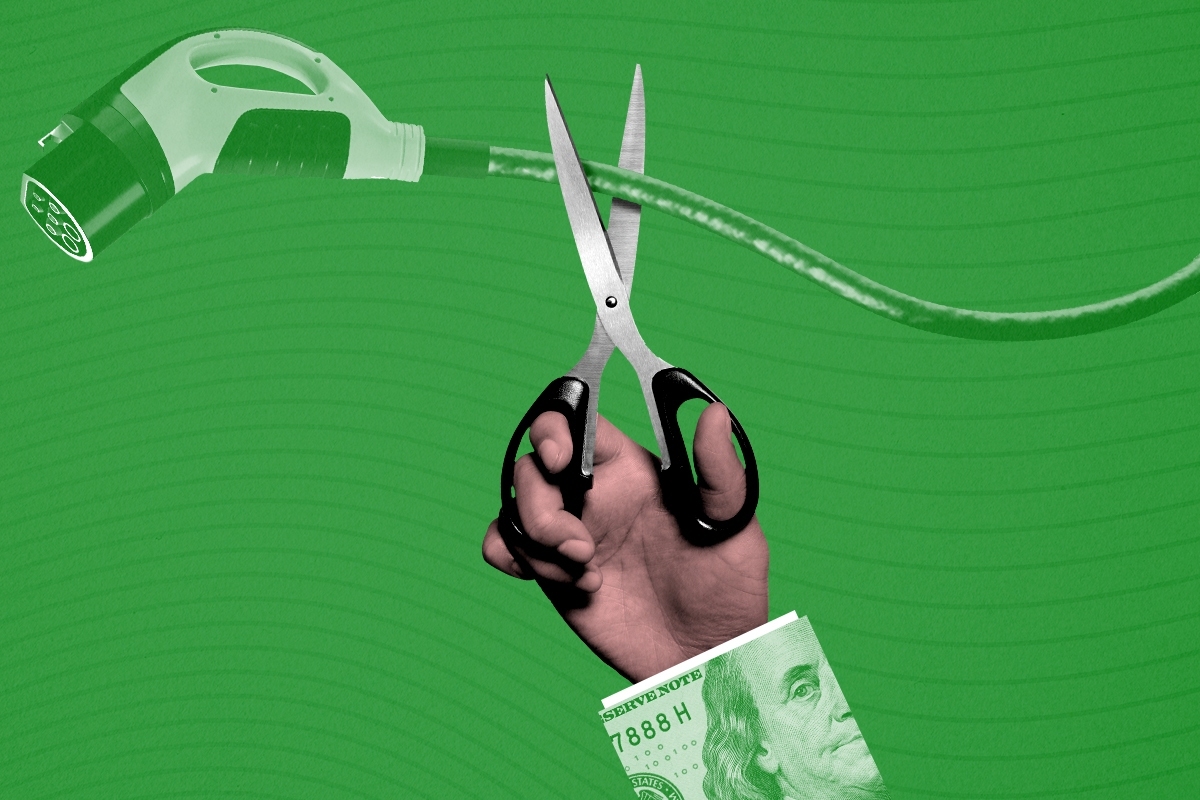
Cutting an EV charging cord.
Heatmap Illustration/Getty Images

Investment in the clean economy is flagging — and the electric vehicle supply chain is taking the biggest hit.

The Clean Investment Monitor, a project by the Rhodium Group and the Massachusetts Institute of Technology’s Center for Energy and Environmental Policy Research that tracks spending on the energy transition, found that total investment in clean technology in the last three months of 2025 was $60 billion. That compares to $68 billion in the fourth quarter of 2024 and $79 billion in the third quarter of last year. While total clean investment in 2025 was $277 billion — the highest the group has ever recorded — the fourth quarter of 2025 was the first time since the Clean Investment Monitor began tracking that the numbers fell compared to the same quarter the year before.

“Since 2019, quarterly investment has surpassed the level observed in the same period of the previous year — even when quarter-on-quarter declines occurred,” the report says. “That trend ended in Q4 2025, when investment declined 11% from the level observed in Q4 2024.”

It starts downstream, with consumer purchases of clean energy technology once favored by federal tax policy: electric vehicles, heat pumps, and home electricity generation. Consumer purchases fell 36% from the third quarter to the fourth quarter, after the $7,500 federal EV credit expired on September 30.

With a consumer market for EVs being undercut, car companies responded by canceling projects and redirecting investment.

“There were a lot of big, multi-billion dollar cancellations coming from Ford specifically,” Harold Tavarez, a research analyst at Rhodium, told me. There’s been a lot of pivots from having fully electric vehicles to doing more hybrids, more internal combustion, and even extended range EVs.”

Ford alone took an almost $20 billion hit on its EV investments in 2025. The company suspended production of its all-electric F-150 Lightning late last year, despite its status as the best-selling electric pickup in the country for 2025, and announced a pivot into hybrids and extended-range EVs (which have gasoline-powered boosters onboard), including a revamped Lightning. It has also announced plans to convert some manufacturing facilities designed to produce EVs back into internal combustion plants, but it hasn’t abandoned electricity entirely. Other decommissioned EV factories will instead produce battery electric storage systems, and the company has announced a pivot to smaller, cheaper EVs.

Ford is far from alone in its EV-related pain, however. Rival Big Three automaker GM also booked $6 billion in losses for 2025, while Stellantis, the European parent company of the Chrysler, Dodge, and Jeep brands, will take as much as $26 billion in charges. EV sales fell some 46% in the fourth quarter of last year compared to the third quarter, and 36% compared to the fourth quarter of 2024, according to Cox Automotive.

Looking at the investment data holistically, the true dramatic decline was in forward-looking announcements, again heavily concentrated in the EV supply chain. The $3 billion in clean manufacturing announced in the fourth quarter of last year was an almost 50% drop from the previous quarter, “marking this quarter as the lowest period of announcements since Q4 2020,” the report says. Announcements were down about 25% for the year as a whole compared to 2024. Of the $29 billion of canceled projects Clean Investment Monitor tracked from 2018 through the end of last year, almost three quarters — some $23 billion — happened in 2025.

“Collectively, we estimate around 27,000 operational jobs in the manufacturing segment were affected by cancellations,” the report says, “two-thirds (68%) of which were tied to projects canceled in 2025.”

“One of the most frustrating parts of watching Trump wage war on all things clean energy is the apparent lack of understanding — or care — of how it impacts his stated goals,” Alex Jacquez, a former Biden economic policy official who is chief of policy and advocacy at the Groundwork Collective, told me. “The IRA built a real, competitive manufacturing base in the U.S. in a new sector for the first time in decades. Administration priorities are being hampered by blind opposition to anything Biden, IRA, or clean energy.”


Green

You’re out of free articles.

Subscribe today to experience Heatmap’s expert analysis 
of climate change, clean energy, and sustainability.
To continue reading
Create a free account or sign in to unlock more free articles.
or
Please enter an email address
By continuing, you agree to the Terms of Service and acknowledge our Privacy Policy
Politics

The DHS Shutdown Will Starve Local Disaster Response

A conversation on FEMA, ICE, and why local disaster response still needs federal support with the National Low-Income Housing Coalition’s Noah Patton.

DHS and FEMA being separated.
Heatmap Illustration/Getty Images

Congress left for recess last week without reaching an agreement to fund the Department of Homeland Security, the parent agency of, among other offices, Customs and Border Protection, Immigration and Customs Enforcement, and somewhat incongruously, the Federal Emergency Management Agency. Democrats and Republicans remain leagues apart on their primary sticking point, ending the deadly and inhumane uses of force and detention against U.S. citizens and migrant communities. That also leaves FEMA without money for payroll and non-emergency programs.

The situation at the disaster response agency was already precarious — the office has had three acting administrators in less than a year; cut thousands of staff with another 10,000 on the chopping block; and has blocked and delayed funding to its local partners, including pausing the issuance of its Emergency Management Performance Grants, which are used for staffing, training, and equipping state-, city-, and tribal-level teams, pending updated population statistics post deportations.

Keep reading... Show less
Blue
AM Briefing

Energy Policy en Français

On Georgia’s utility regulator, copper prices, and greening Mardi Gras

Chris Wright.
Heatmap Illustration/Getty Images

Current conditions: Multiple wildfires are raging on Oklahoma’s panhandle border with Texas • New York City and its suburbs are under a weather advisory over dense fog this morning • Ahmedabad, the largest city in the northwest Indian state of Gujarat, is facing temperatures as much as 4 degrees Celsius higher than historical averages this week.

THE TOP FIVE

1. New bipartisan bill aims to clear nuclear’s biggest remaining bottleneck

The United States could still withdraw from the International Energy Agency if the Paris-based watchdog, considered one of the leading sources of global data and forecasts on energy demand, continues to promote and plan for “ridiculous” net-zero scenarios by 2050. That’s what Secretary of Energy Chris Wright said on stage Tuesday at a conference in the French capital. Noting that the IEA was founded in the wake of the oil embargoes that accompanied the 1973 Yom Kippur War, the Trump administration wants the organization to refocus on issues of energy security and poverty, Wright said. He cited a recent effort to promote clean cooking fuels for the 2 billion people who still lack regular access to energy — more than 2 million of whom are estimated to die each year from exposure to fumes from igniting wood, crop residue, or dung indoors — as evidence that the IEA was shifting in Washington’s direction. But, Wright said, “We’re definitely not satisfied. We’re not there yet.” Wright described decarbonization policies as “politicians’ dreams about greater control” through driving “up the price of energy so high that the demand for energy” plummets. “To me, that’s inhuman,” Wright said. “It’s immoral. It’s totally unrealistic. It’s not going to happen. And if so much of the data reporting agencies are on these sort of left-wing big government fantasies, that just distorts” the IEA’s mission.

Keep reading... Show less
Blue
Electric Vehicles

Why EV-Makers Are Suddenly Obsessed With Wires

Batteries can only get so small so fast. But there’s more than one way to get weight out of an electric car.

A Rivian having its wires pulled out.
Heatmap Illustration/Rivian, Getty Images

Batteries are the bugaboo. We know that. Electric cars are, at some level, just giant batteries on wheels, and building those big units cheaply enough is the key to making EVs truly cost-competitive with fossil fuel-burning trucks and cars and SUVs.

But that isn’t the end of the story. As automakers struggle to lower the cost to build their vehicles amid a turbulent time for EVs in America, they’re looking for any way to shave off a little expense. The target of late? Plain old wires.

Keep reading... Show less
Blue