Current conditions: The Pineapple Express, an atmospheric river originating in the Pacific near Hawaii, is arriving in the Southwest laden with heavy rain that’s set to flood the region • Indonesia has the worst air quality in the world as forest fires rage along Sumatra’s southern coast • A cross-country storm will soak much of the United States on Tuesday’s Election Day.
THE TOP FIVE
1. Permitting bill’s worst-case climate scenario is still carbon neutral
The Senate’s grand compromise to simplify federal permitting on energy projects would likely drop emissions slightly as the benefits to accelerating deployments of clean energy infrastructure outweigh the boost the legislation could give to fossil fuels. Even under the worst-case scenario, emissions remain on the same trajectory as today. That’s according to a hotly anticipated new analysis by the Rhodium Group, the consultancy whose U.S. emissions estimates are among the most widely cited in American politics. The report, shared first with my colleague Emily Pontecorvo, found that provisions in the Bipartisan American Affordability and Jobs Act largely counteract each other on climate. The bill makes building transmission lines much easier, a key step to patching more renewables onto the grid. But it also makes new gas pipelines simpler to permit, clearing the way for a buildout of the infrastructure for the fossil fuel already dominating U.S. electricity and heating systems. Still, under the best-case scenario, the legislation could cut U.S. economy-wide emissions by 5% below where they would otherwise go in 2040. The bill could also slash energy bills by $78 per year and support construction of more than 200 gigawatts of clean energy capacity, as compared to a world where it didn’t pass. The Rhodium report is at least the second analysis yet to find that the bill could modestly lower emissions. The first, as I reported last week, came from the think tank Resources for the Future, which saw a slight drop in power-sector emissions relative to a world without BAAJA.
If overhauling national permitting rules to make building green energy infrastructure easier doesn’t work to lower emissions, traditional negotiations in favor of regulations that can deliver cuts looks no more promising. Two weeks of United Nations-led talks in Armenia ended Saturday without a settled approach to meeting 2030 deadlines for preserving more nature. “We don’t need to spend more to close the biodiversity funding gap, we need to spend better,” Marina Von Weissenberg, a Finnish senior ministerial advisor, said in a statement. “Governments have a real opportunity here to reshape public spending with future generations in mind, but they can’t do it alone. International coordination is key to giving governments the confidence to lead change.”
2. China’s hydrogen investments doubled in the first 9 months of this year
Last week, my colleague Katie Brigham published a detailed feature highlighting China’s tightening grip over the global supply chain for electrolyzers, the technology that zaps water with electricity to separate the molecule’s hydrogen from its oxygen and harvest the former as fuel. Keen readers of this newsletter recognize the story. Even before the Iran War, China had beefed up its public support for green hydrogen and related technologies. After the conflict constricted the flow of oil through the Strait of Hormuz, the People’s Republic redoubled its efforts. Quite literally. New data from the National Energy Administration shows that investments into the hydrogen industry doubled in the first nine months of this year, according to Hydrogen Insight.
3. Fresh chaos at Fermi
Fermi America went public in a gangbusters initial public offering last year as the company, with a board of directors including former Texas governor and U.S. Secretary of Energy Rick Perry, pledged to build the world’s largest data center and power the facility with gas and four large-scale Westinghouse AP1000 nuclear reactors. In April, the chief executive and chief financial officer quit. The board room drama continued into the next month. The company’s stock recovered somewhat over the summer as investors bet on a turnaround pegged to a series of deals with companies looking to lease space on its future servers. But fresh chaos enveloped the startup Friday when The Texas Tribune reported that Perry had failed to earn enough support from the board of directors to win reelection to his seat.
In a statement posted to X on Friday evening, Fermi said that neither Perry nor investor Jeffrey Stein had been removed from the company’s board. “In fact, both Governor Perry and Jeffrey Stein received a majority of the votes cast by shareholders,” the statement read. “Let’s be clear: Governor Perry and Mr. Stein remain members of Fermi’s Board of Directors and will continue serving until their successors are duly elected. Both remain eligible for reelection.”
Sign up to receive Heatmap AM in your inbox every morning:
4. LA wildfire smoke exposed 7 million people to toxic metals
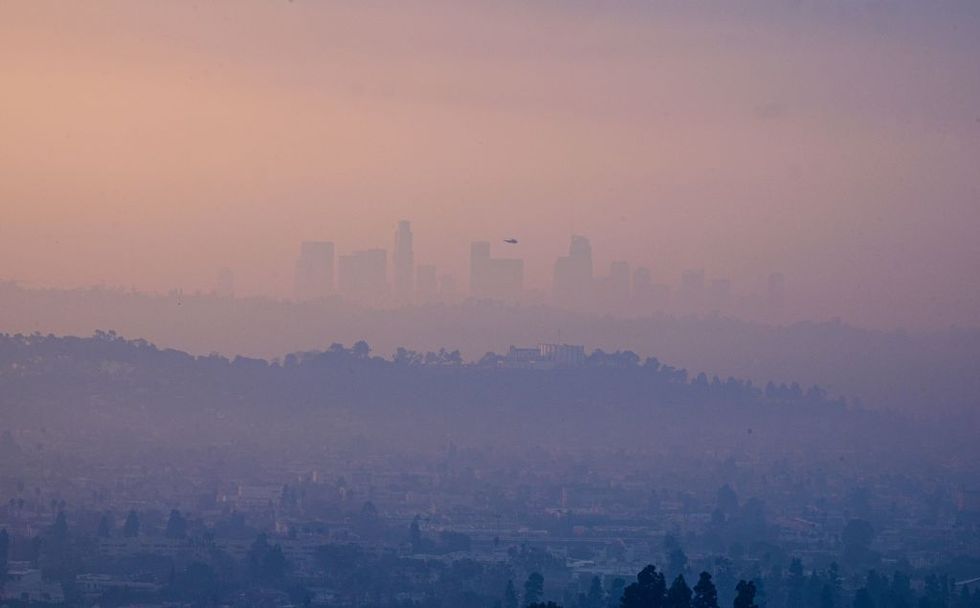
 W-what more can I say? W-wheezing in LA. ROBYN BECK/AFP via Getty Images
If you thought the fine particulate matter from last year’s catastrophic Los Angeles firestorm was bad, you weren’t thinking imaginatively enough about just how dangerous all that airborne material could be. A new study published in the journal Science Advances suggests that upward of 7 million people were exposed to high levels of airborne lead and other toxic metals released when homes and vehicles caught flame. The January 2025 Eaton inferno that destroyed more than 9,400 buildings and killed 19 people spewed 80 times the normal concentration of lead found in the atmosphere through a plume that settled over 70% of the Los Angeles metropolitan area. “I can envision that in the future we have these evacuation zones for smoke exposure as well,” Haroula Baliaka, the study’s lead author, who was a PhD candidate at Caltech last year, told Bloomberg. “Unfortunately, this is not a one-time event. It’s a new reality and we need to adapt to it and we need to do it sooner rather than later.”
The findings come a week after a study published in JAMA Pediatrics showed a link between wildfire smoke exposure during pregnancy and autism diagnoses in children. The research from Rutgers University examined 893,212 mother-child pairs enrolled in Medicaid, with children born between 2007 and 2014. Each increase of 0.75 micrograms per cubic meter in average concentrations of wildfire-related air pollution during pregnancy was associated with a 30% higher risk of a subsequent autism diagnosis. Exposure in the second and third trimesters had the highest risk. “Wildfire smoke can travel far beyond the communities where fires are burning, and exposure may occur even when smoke is not visible,” Stefania Papatheodorou, an epidemiologist at the Rutgers School of Public Health and lead author of the study, said in a press release. “Our findings highlight the importance of awareness of wildfire events and their potential effects on air quality during pregnancy.”
5. U.K. signals a potential crackdown on offshore wind
The United Kingdom is building out more than 10 gigawatts of offshore wind as London looks to shore up its electricity supplies amid the global energy shock. But Chancellor of the Exchequer John Healey said he would veto any offshore wind projects that don’t lower bills. While clean power is “how we break the grip of international gas prices on our bills,” he said the infrastructure “has to come at the right pace, in the right places, with the grid to carry it.” The statement fueled what The Guardian called “concerns that the government is moving away from the pro-renewables agenda.”
Meanwhile, the U.S. midterms aren’t the only election this week. In Sunday’s runoff election, Bulgaria’s pro-Russian acting President Iliana Iotova appeared to eke out a victory over the former prime minister Andrei Gyurov, a pro-Western banker. Her win unites the government with her close ally, Prime Minister Rumen Radev, ensuring stronger support for the leader’s two signature energy policies. One, a plan to build a pair of Westinghouse AP1000s at the Kozloduy nuclear plant, is scheduled to advance to the next planning stage next year. The other, the easing of sanctions on Russian uranium to ensure a supply of fuel for the plant’s existing reactors, looks likely to continue under Iotova’s friendly diplomacy with the Kremlin.
THE KICKER
William Nordhaus, the pioneering Yale University economist who won the Nobel Prize in 2018 for integrating climate change into macroeconomic analysis, has died at 85 following a battle with an aggressive form of brain cancer. His nephew, Ted Nordhaus of the Breakthrough Institute, referred to his father, Robert Nordhaus, as “the original environmental lawyer and Bill as the original environmental economist,” he wrote in a blog post after his uncle’s passing. “It is safe to say that the Nordhaus brothers were doing environmental law and economics, respectively, long before either label existed. Not bad for two kids who grew up in the intellectual hotbed of Albuquerque, New Mexico, population 40,000, during and after the second world war.” Their legacies are something of the Nordhaus family brand: Pragmatism. May his memory be a blessing.


 W-what more can I say? W-wheezing in LA. ROBYN BECK/AFP via Getty Images