Current conditions: Temperatures in Sicily and southern Italy are approaching 100 degrees Fahrenheit as a heat dome settles over the north-central Mediterranean • After pounding Okinawa and injuring two people on Japan’s remote southern islands, Typhoon Saudel is barreling west toward China • A geomagnetic storm known as a coronal hole could create a visible aurora from New York to Idaho, causing minor disruptions to technological devices such as GPS.
THE TOP FIVE
1. A catastrophic flash flood on the Nepali-Chinese border kills more than 330 people
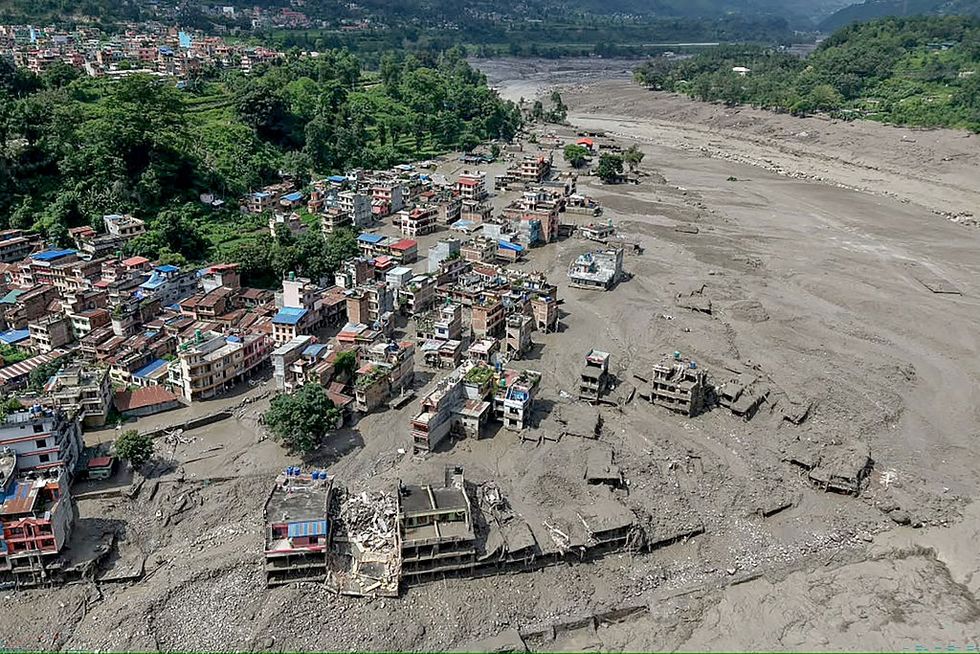
 The aftermath. Prabin RANABHAT / AFP via Getty Images
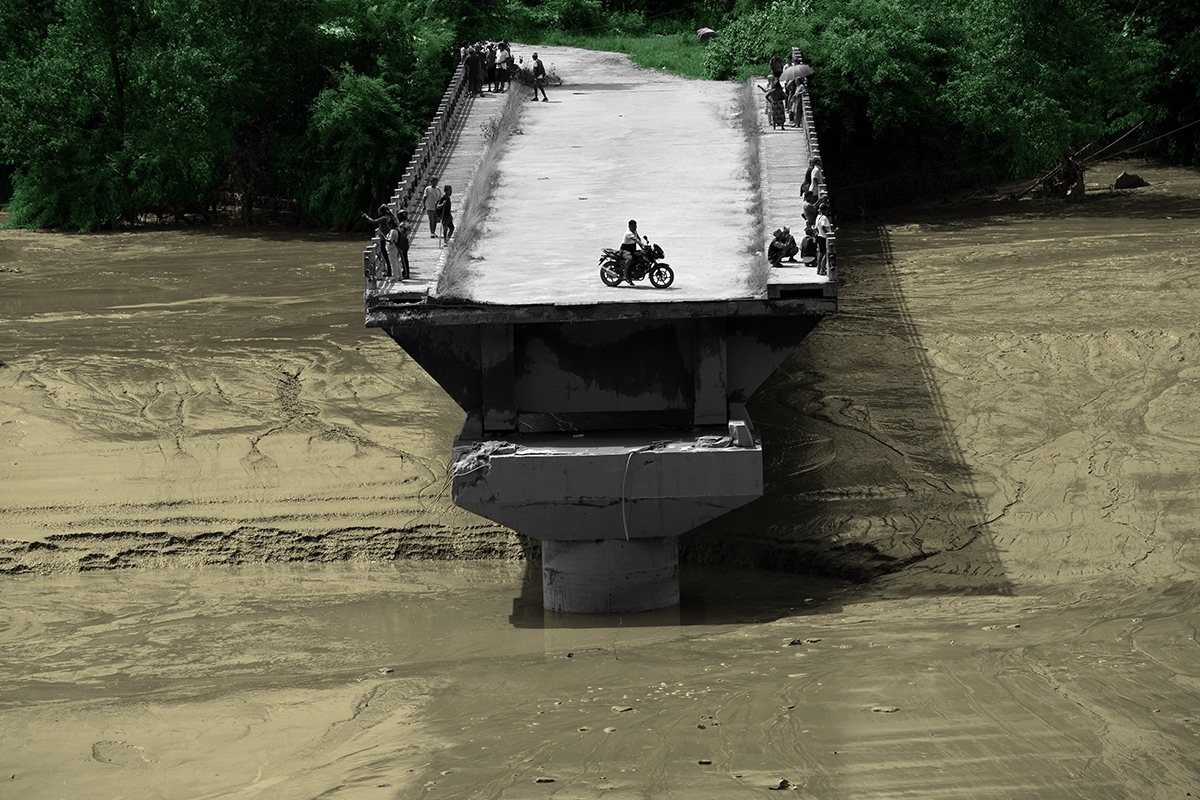
It’s like something out of an apocalyptic disaster film. From a camera situated on a cliffside overlooking the Rasuwagadhi border checkpoint in a valley between Nepal and Tibet, you watch as several — then dozens — of people start running away from the building. Birds fly across the screen in the same direction. Finally, after a few seconds, you see what they’re trying to escape: A giant wall of gray, muddy water crashing into the roughly six-story building like an ocean wave against a sand castle. In other videos, cars, trees, and homes disappear under the roar of a river of mud and rocks. Goliath boulders roll like basketballs. Men run for their lives. An avalanche on the Chinese side of the border “triggered a wall of water with no warning,” wrote The Kathmandu Post, an English-language daily in the Nepali capital, declaring this “one of Nepal’s deadliest disasters in decades.” By Thursday morning, the death toll counted at least 332, with hundreds more people still missing. Nepal’s disaster authority told the Indian broadcaster NDTV that a “chunk of snow and rock broke off near a glacier zone” on the border and either “fell into a glacial lake or blocked the river channel” resulting in a surge that swelled into a wave of glacial ice, meltwater, and debris. While initial reports suggested the avalanche started with an earthquake, a U.S. Geological Survey analysis found that the avalanche itself set off a magnitude 5.2 landslide.
2. Trump moves to ban more foreign grid equipment
Last month the Federal Communications Commission banned the use of new types of foreign-made inverters, the equipment needed to patch solar panels and batteries onto the grid, citing the need to protect the U.S. artificial intelligence buildout from Chinese sabotage. Now the White House is stepping in to block foreign imports of yet more types of grid equipment. In an executive order Wednesday, President Donald Trump said that “continued United States reliance on foreign sources of bulk-power system electric equipment with these potential national security vulnerabilities also creates a supply chain vulnerability that could eliminate the supply of these products in the United States as a result of disruptions in international trade.” In particular, the order will affect transformers, which are facing a years-long backlog as manufacturers struggle to keep up with demand from both the data center buildout and repairs to the grid after extreme weather mangles power equipment. The Biden administration had sought to increase the energy efficiency standards for transformers, paralyzing manufacturers who opposed the regulation and could not make investments into new assembly lines to meet surging demand until the fate of the rule was resolved. The Biden-era Department of Energy ultimately withdrew its proposal. While the Trump administration policy now will further protect those domestic factories, the import restrictions could, in the meantime, make obtaining the equipment primarily made overseas more difficult.
3. Trump plans to fast-track drilling in the Arctic
The Trump administration is set to speed up permitting reviews for oil and gas drilling in the Arctic. On Wednesday, Public Domain broke news that the Department of the Interior is planning to publish a categorical exclusion to the National Environmental Policy Act “that would make it easier for the oil and gas industry to conduct seismic surveys, obtain rights of way, and drill new exploration wells” in the National Petroleum Reserve in Alaska, a nearly 36,000-square-mile area on the continent’s northern Arctic Ocean coast.
The proposal, which the Interior Department confirmed, comes as a particularly devastating blow to the Native Village of Nuiqsut, which had brokered a deal with the Biden administration to create a nearly million-acre caribou reserve to foster a herd on which the indigenous residents have long depended. But former Nuiqsut Mayor Rosemary Ahtuangaruak told the public-lands-focused investigative site that new drilling activity around the village has already changed the herd’s migration patterns. “All of the contractual agreements that were supposed to guide how development is going to occur have been ripped out of the books,” she said. “We feel that it doesn’t matter that we have a unique DNA, a small community of 500 people, that are just being totally disregarded and sacrificed for the greed of development.”
Sign up to receive Heatmap AM in your inbox every morning:
4. Exclusive: AAA for rooftop solar repair inks two big expansion deals
Back in May, I told you about Otovo, the new startup from the former chief executive of defunct rooftop solar giant Sunnova. Instead of installing solar panels, the new company repairs rooftop photovoltaic units, in addition to batteries and generators — a sort of AAA for home energy equipment. Otovo started in Norway, targeting millions of homeowners across Europe with solar panels from installers that went out of business and left customers without maintenance service. The company has mounted a global expansion into the United States by buying smaller solar companies and maintenance providers. On Thursday, Otovo plans to announce two deals to make its latest acquisitions: Oahu-based PV Hawaii and Mr. Elektro in Norway and Sweden. The combined value of the deals — which are being reported first in this newsletter — is about $4.6 million. “PV Hawaii and Mr. Elektro bring licensed, experienced local teams that strengthen how we serve customers, and they extend our platform into Hawaii for the first time while deepening our reach across Norway and Sweden,” Otovo CEO John Berger told me in a statement.
5. A kidney transplant won a mining giant a contract in world’s likely next countr
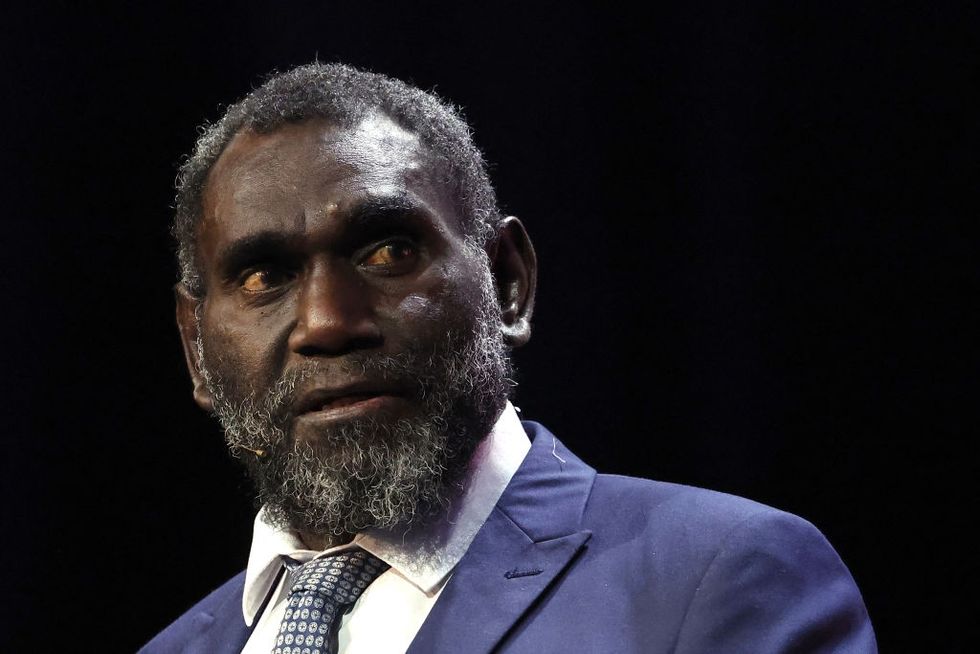
Bougainville President Ishmael Toroama.DAVID GRAY/AFP via Getty Images
You read that right. Unless you (like, uh, some people…) are familiar with late 20th century Melanesian geopolitics, you may not know the story of Bougainville. The island province off Papua New Guinea long had a troubled history. Ethnically, its people are related to those of the Solomon Islands, but German colonial borders hemmed the mineral-rich isle into the territory controlled by Port Moresby. In the 1970s, Anglo-Australian mining giant Rio Tinto built the Panguna mine in the center of the island. Pollution and labor violations plagued the open-pit copper and gold mine, ultimately fueling a separatist rebellion. A conflict, known as the Bougainvillean Civil War, erupted in 1988 and lasted for 10 years, only ending with a peace accord that allowed for a referendum on independence. In 2019, the autonomous province voted nearly unanimously in favor of breaking away from Papua New Guinea. The non-binding vote has yet to be ratified by the parliament in Port Moresby. But the leaders of Bougainville expect to become the world’s newest country by 2030.
To fund its sovereignty, the island wants to reopen Panguna. Last November, Ishmael Toroama, the president of Bougainville, signed a memorandum of understanding with Lloyds Metals and Energy. The Indian iron-ore miner won the deal “despite warnings from Bougainville’s majority state-owned mining company, Bougainville Copper, that Lloyds lacked the technical and financial capacity of rival bidders,” the Organized Crime and Corruption Reporting Project reported in a major new investigation. Just a month earlier, Toroama confirmed to OCCRP, “he accepted an offer from Lloyds’ managing director Balasubramanian Prabhakaran to arrange for his wife to travel to India and have a life-saving kidney operation at no cost to the president.” Toroama told OCCRP that the gift did not weigh on his decision to select the Mumbai-based Lloyds for the project.
THE KICKER
The first step in the Department of Energy’s effort to propel new reactor technologies to market was a pair of pilot programs to speed up development of projects from both power and fuel producers. The next step is the “nuclear launch pad” initiative at the Idaho National Laboratory’s National Reactor Innovation Center. This week, the agency announced the first 12 companies to participate in the new program, which bills itself as providing “flexible technical and regulatory frameworks designed to fast-track paths from concept to deployment.” The list includes microreactor developers Antares Nuclear, Atlas Atomics, Oklo, Valar Atomics, Scaled Atomics, and two projects from Deployable Energy; fuel makers Forge Atomics, Hexium, Lightbridge Corporation, Raven-Flint Nuclear, and Sublime Nuclear; and medical isotope startup Nusano. “These selections show a strong and growing interest from developers ready to move their technologies forward,” Brad Tomer, the director of the National Reactor Innovation Center, said in a statement. Meanwhile, another startup spinning out from the Massachusetts Institute of Technology announced a big initial funding round. Apollo Atomics — which aims to build next-generation pressurized water reactors, the type of reactor that makes up the bulk of the global fleet — announced a $31 million seed financing round, NucNet reported.


 The aftermath. Prabin RANABHAT / AFP via Getty Images
 Bougainville President Ishmael Toroama.DAVID GRAY/AFP via Getty Images

 Lula vs. Bolsonaro. Mauro PIMENTEL and Sergio LIMA / AFP via Getty Images