Current conditions: Heavy rainstorms are sweeping across the Great Lakes and the East Coast’s Amtrak Corridor, with the highest flood risk in North Carolina and New Jersey • Monsoonal downpours are drenching western Cameroon, with the West Region capital of Bafoussam facing more than a week of thunderstorms • A tropical storm on track to be named Moke as it strengthens will swipe Hawaii’s Big Island on Sunday afternoon as the archipelago state is still recovering from its rare encounter with Hurricane Lala last week.
THE TOP FIVE
1. Republicans fear data centers will cost the party Ohio
The “data center brand is the anchor” dragging down Republicans fighting to keep former Democratic Senator Sherrod Brown from winning back his old seat. That’s the takeaway from a National Republican Senatorial Campaign memo obtained by Axios. “Data centers are the centerpiece in the case Sherrod Brown is litigating; he has made them his de facto opponent, and no one is correcting the record,” the memo reads. Still, the strategists expressed hope: “While the perceptions of data centers are weak, the American people are with us. By overwhelming margins, the American people prefer a Republican candidate who wants to only let data centers be built in communities that approve them by a local vote of the people, and that pay for their own power, water, and other utilities versus a Democrat candidate who wants to stop data center construction altogether, which will cause America to lose the AI race to China.”
Increasingly, however, Republicans are embracing the left’s favored restrictions. Mike Rogers, the GOP nominee for Senate in Michigan, just endorsed a one-year moratorium on data centers, according to the Detroit News. In a Thursday post on X, days after President Donald Trump admonished him for the “mistake” of pausing data centers, Texas Governor Greg Abbott said his executive order restricting the facilities had halted “up to 1,800 data center projects.” Three-quarters of Americans now say they would oppose a new data center being built near where they live, according to a new Heatmap Pro poll my colleague Robinson Meyer wrote up. That’s prompted the federal government to step in with plans to build and own the nation’s largest power station, a colossal gas-burning plant. Now Elon Musk’s AI company, SpaceXAI, is asking the largest federal utility, the Tennessee Valley Authority, to provide its data centers with more electricity, according to the Daily Memphian.
2. Energy Department shells out $500 million for critical mineral projects
Last summer, I stood on the desolate shores of the Pepto-Bismol-pink Great Salt Lake in Utah, where the startup Lilac Solutions was harvesting lithium from the water. The novel harvesting method, called direct lithium extraction, uniquely avoids the environmental scars of hard-rock mining and the heavy water usage of the lithium brine pools popular in Chile. It was, on multiple fronts, an impressive sight. The Trump administration seems to agree. On Thursday, the Department of Energy gave the company $100 million to support construction of a lithium extraction and refining facility at the very location I visited. It’s not the only awardee. The agency gave out another $100 million to the startup Jervois to open a cobalt refinery, and another $100 million still for the battery recycling Nth Cycle. Earlier stage startups Princeton NuEnergy, Arcanum Ventures, Elevated Materials, and Coreshell Technology each received $50 million for projects spanning cathode recycling, electrolyte chemicals, lithium-metal materials, and silicon-anode batteries. In total, the Energy Department gave out $500 million.
3. Trump authorizes early use of dirtier, cheaper winter gasoline
The Trump administration is set to start relaxing normal summertime gasoline requirements, clearing the way for an early shift to the sale of wintertime blends to ease the cost of fuel as the Iran War sends prices upward. Summertime blends are typically more expensive, since the refining process requires a mix that evaporates less in gas tanks during heat. Wintertime blends, by contrast, can lean more on cheap additives like butane that will not evaporate in tanks during the cold. The Environmental Protection Agency said Thursday it would allow for dirtier-burning wintertime fuel blends that typically don’t hit the market until mid-September. Starting on September 1, the EPA waiver will allow the sale of gasoline blended with 10% ethanol, which evaporates faster than summertime fuel, Bloomberg reported.
Sign up to receive Heatmap AM in your inbox every morning:
4. Harold Hamm buys into Argentina’s shale industry
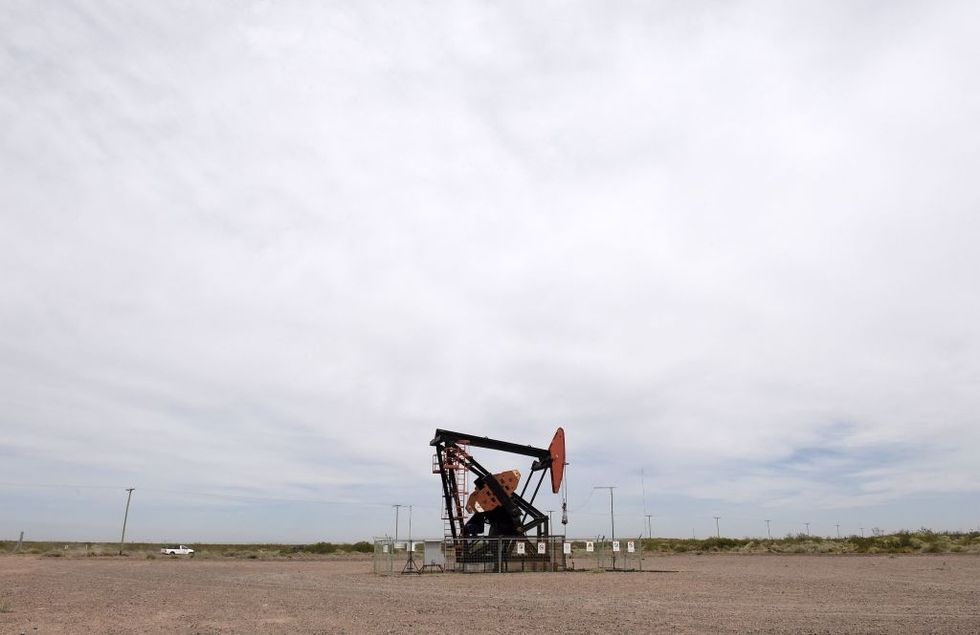
 Vaca Muerta looks a little like Texas. JUAN MABROMATA/AFP via Getty Images
Peter Thiel isn’t the only American billionaire buying into Argentina’s attempt to spur on an oil and gas boom in its Vaca Muerta shale formation. On Thursday, oil magnate Howard Hamm told the Financial Times that his Continental Resources was buying a 50% stake in Phoenix Global Resources, whose parent company plans to quadruple oil production to 100,000 barrels per day in Vaca Muerta by 2031. Hamm said he’s built a close relationship with Argentinian President Javier Milei, an ally of Trump who is pushing for deregulation of oil and gas drilling. “He’s done the right things. He’s got the right people in the right places and is making the changes necessary day by day,” Hamm told the newspaper. “We are all very encouraged with the leadership he has shown.” Still, as I told you this week, the American oil majors’ eyes are really on Africa next.
5. South Korea advances 2.1-gigawatt offshore wind farm
Pacifico Energy Korea, the U.S.-based company behind the 2.1 gigawatts of wind turbines off the coast of South Korea, won approval to serve as the sole developer of the country’s biggest new offshore wind project. The company’s twin projects, the Manho Offshore Wind and Jindo Baram Offshore Wind projects, are advancing just a day after the Danish wind giant Orsted proposed a new 2-gigawatt wind farm off Taiwan’s shores, as I reported yesterday. The projects highlight the extent to which, outside the U.S. and Japan, offshore wind is still booming, “This selection is an important milestone in building a large-scale offshore wind cluster in the Jeonnam-Gwangju region,” Seung-Ho Choe, Representative Director of Pacifico Energy Korea, said in a statement to the trade publication 4C Offshore.
THE KICKER
The dream of nuclear-propelled cargo ships is anchoring a little closer to reality. The British maritime nuclear startup Core Power just inked a deal with the Port of Corpus Christi Authority to work on a site-specific readiness study for the Texas port. It’s the second U.S. port, after California’s Port of Long Beach, to explore the concept, World Nuclear News reported.



 Vaca Muerta looks a little like Texas. JUAN MABROMATA/AFP via Getty Images



 The Syncrude refinery at Mildred Lake in Alberta. Daphné LEMELIN / AFP via Getty Images