You’re out of free articles.
Log in
To continue reading, log in to your account.
Create a Free Account
To unlock more free articles, please create a free account.
Sign In or Create an Account.
By continuing, you agree to the Terms of Service and acknowledge our Privacy Policy
Welcome to Heatmap
Thank you for registering with Heatmap. Climate change is one of the greatest challenges of our lives, a force reshaping our economy, our politics, and our culture. We hope to be your trusted, friendly, and insightful guide to that transformation. Please enjoy your free articles. You can check your profile here .
subscribe to get Unlimited access
Offer for a Heatmap News Unlimited Access subscription; please note that your subscription will renew automatically unless you cancel prior to renewal. Cancellation takes effect at the end of your current billing period. We will let you know in advance of any price changes. Taxes may apply. Offer terms are subject to change.
Subscribe to get unlimited Access
Hey, you are out of free articles but you are only a few clicks away from full access. Subscribe below and take advantage of our introductory offer.
subscribe to get Unlimited access
Offer for a Heatmap News Unlimited Access subscription; please note that your subscription will renew automatically unless you cancel prior to renewal. Cancellation takes effect at the end of your current billing period. We will let you know in advance of any price changes. Taxes may apply. Offer terms are subject to change.
Create Your Account
Please Enter Your Password
Forgot your password?
Please enter the email address you use for your account so we can send you a link to reset your password:
What the heck is “surficial mineralization”?

According to one of the world’s leading carbon removal buyers, the sector’s future lies in piles of industrial waste.
When Frontier, the Stripe-led coalition of carbon removal supporters, announced its latest $915 million funding commitment, it took the opportunity to lay out the five technologies it views as most promising. I was familiar with four of them — ocean alkalinity enhancement, biomass carbon removal and storage, enhanced rock weathering, and direct air capture. Heatmap has covered them all. But the name on the very top of the list stumped me: surficial mineralization.
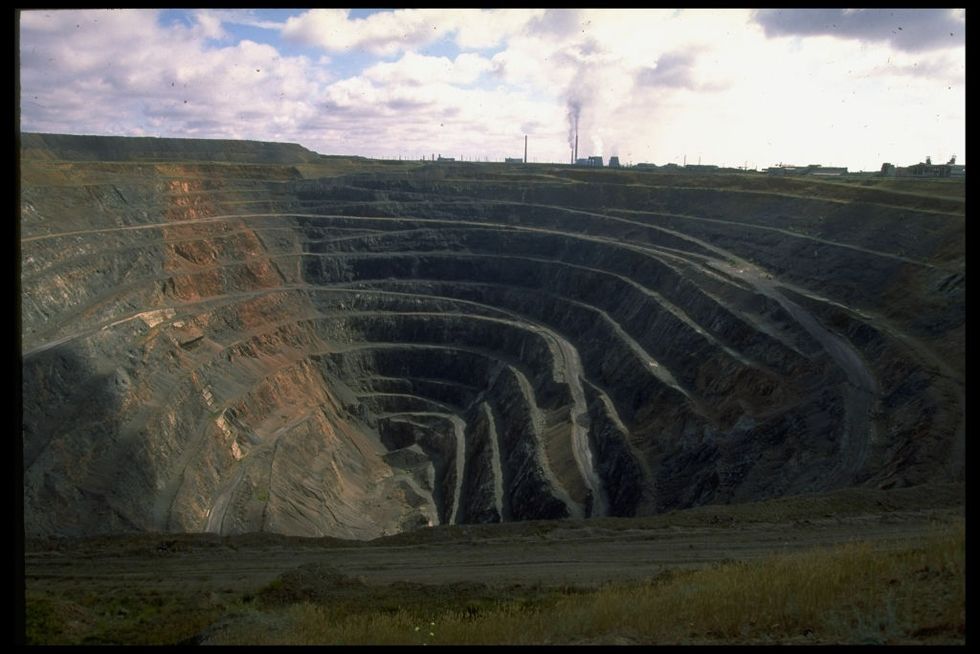
It sounds technical, and like all methods of carbon removal, it is — sort of. The idea is to take advantage of the tailings ponds and slag heaps left behind by the mining and steelmaking industries. These piles of calcium- or magnesium-rich debris naturally capture and store carbon from the air — not enough to change the trajectory of our warming planet without any human intervention, but managed well, they could one day capture carbon at a significant scale.
How significant, exactly? While there’s been very little action in the space to date, Frontier says surficial mineralization has the potential to remove over 10 gigatons of carbon from the atmosphere per year — as much or more than any other pathway — at an eventual cost of $80 to $120 per ton. That would put it among the cheapest approaches on Frontier’s list, in part because those heaps of industrial waste alone could absorb anywhere from a gigaton to 4 gigatons of carbon before there’s a need to mine rocks solely for carbon removal purposes.
“The beauty of surficial mineralization is twofold,” Hannah Bebbington Valori, who heads the Frontier coalition, told me. “One, we are working with an abundant source of highly reactive rock, and so there is a significant opportunity for carbon dioxide drawdown. And two, it is carbonating in place, and so sufficient mineralization technologies can be considered closed system approaches, and have generally more straightforward measurement reporting and verification infrastructure.”
At a chemical level, the process resembles other carbon removal pathways Frontier champions, such as enhanced rock weathering and ocean alkalinity enhancement. All three rely on alkaline minerals reacting with moisture and ambient carbon dioxide to form stable carbonate compounds that permanently lock away the gas. The difference is exactly where this reaction takes place: While surficial mineralization contains it to waste piles at industrial sites, the other approaches disperse the reaction across open, difficult-to-monitor systems such as farmland soils and the ocean.
That makes measurement, reporting, and verification — known as MRV — far more challenging and expensive for ocean- and soil-based systems, as scientists must track carbon uptake across ecologically complex environments where countless biological and chemical processes are unfolding simultaneously. These intersecting processes makes it difficult to demonstrate that human intervention was responsible for any given ton of carbon removed, as opposed to natural variability. MRV for these pathways thus relies heavily on modeling, which can never provide the same level of certainty as direct measurement.
Surficial mineralization, however, can be measured much more directly. On-site sensors continuously monitor CO2 concentrations above mine tailings or steel slag, providing a real-time signal of how quickly and to what degree the materials are drawing down carbon. Scientists can then validate these measurements in the lab by comparing physical samples of the material taken before and after the reaction, quantifying exactly how much solid carbonate formed as a result of various engineered interventions. The primary tool for this is X-ray diffraction — a well-established geological technique that identifies a sample’s mineral composition like a chemical fingerprint, making it possible to directly measure how much carbon the material locked away.
Don’t mistake the relative simplicity of the MRV framework for evidence that surficial mineralization is a proven carbon removal pathway — the reality is far from it. While mineralization may look simpler than, say, direct air capture, which typically uses giant fans and specialized sorbents to pull CO2 from the air, there are very few companies working in this space today. All are extremely early stage, and the time and capital required to secure feedstock partnerships, gain site access, and acquire necessary industrial equipment remain significant barriers to getting these projects off the ground.
Why is this heavy equipment needed in the first place? Because these waste piles won’t do much carbon capture work if they’re simply left untouched. That’s because the minerals at the pile’s surface will begin to slowly carbonate, eventually becoming fully saturated and acting as a seal that blocks carbon from reaching the reactive minerals below. As yet there’s no consensus on how to most quickly and cost-effectively break through this natural process to maximize carbon uptake — companies are testing a range of approaches, from crushing and spreading material to maximize air exposure (similar to enhanced rock weathering) to actively churning piles of waste to constantly reveal fresh reactive surfaces.
“Understanding exactly what is the best system to use to maximize your carbon removal efficiency and minimize your cost — this is what we need real-world deployment to do, and to understand,” Bebbington Valori told me.
One of the seed-stage startups Frontier has supported with a small pre-purchase agreement, Arca, spun out of the University of British Columbia to commercialize its approach to carbon removal from mine tailings. The company’s focus is ultramafic waste — magnesium- and iron-rich rock that locks away carbon dioxide as stable magnesium carbonate. “My pathway for interest on that was knowing that there was already about 2 billion tons of ultramafic mine waste sitting on the surface of the Earth in Canada alone,” Greg Dipple, Arca’s co-founder and head of science, told me.
Arca proposes to increase the surface area available for carbon capture in two ways. The first is by using customized robots to continuously till and churn tailings piles, constantly exposing fresh feedstock to the air to maximize carbon uptake before the next layer of tailings is deposited on top. That strategy, Dipple told me, “can give us a five- to 10-fold increase in the rate of CO2 capture” at active mine sites.
It successfully demonstrated this approach in an 18-month pilot project with Australian mining giant BHP at an active mine in the country's Northern Goldfields region where Arca says it increased the tailings’ mineralization rate by an order of magnitude. But the startup plans to push the efficacy of its tech further through what it calls “mineral activation.” This technique uses industrial-scale microwaves to heat the minerals rapidly enough to drive off the water that’s chemically bound within their crystal structure. This essentially blows apart the minerals from the inside out, exposing fresh magnesium-rich surfaces primed to react with carbon dioxide. The expected result is faster mineralization and more carbon captured per ton of mine tailings — but the startup has yet to test it in the field.
“Essentially we’re making microwave popcorn out of silicate minerals,” Dipple explained. “The microwaves cause the release of that water in the same way that when you make popcorn, you’re essentially boiling the water out of the center of the kernel, and that’s what blows the kernel up and creates this high surface area.” The idea is to eventually integrate this step into the mine’s tailings processing stream, with minerals moving through the giant microwave before they’re deposited at the storage facility.
Dipple told me that mineral activation will be a core part of Arca’s future projects, including those intended to fulfill the company’s 10-year carbon removal offtake agreement with Microsoft. Signed last October, the deal calls for Arca to deliver nearly 300,000 metric tons of carbon removal to the software giant.
While no other startup in the space has landed an offtake agreement of that scale, several have secured early backing from Frontier through pre-purchase agreements. One of them, Karbonetiq, is working to capture carbon from steel slag, the calcium-rich byproduct of steel production that accumulates in large piles at processing sites. Like the magnesium-rich minerals in mine tailings, calcium compounds in steel slag naturally react with moisture and carbon dioxide to form a stable calcium carbonate — a.k.a. limestone — permanently locking up the CO2.
Unlike mine tailings however, slag doesn’t begin as a fine powder. Instead, the molten byproducts poured off from high-temperature steel furnaces cool into chunks the size of large rocks, leaving only their outer surfaces exposed to the air and able to react with CO2. Karbonetiq’s strategy is essentially to crush and disperse those rocks to increase their reactive surface area. As the company’s commercial vice president, Luke Rondel, explained, “We crush [the slag] down so you get smaller particle sizes. We then spread that out in a field of material, and we till that material with a tractor and plow, which is just turning over new surfaces.”
Each pathway has its advantages — while Arca’s magnesium-rich mine tailings are the most abundant feedstock, Rondel told me that the calcium-based reactions in slag happen significantly faster. For its part, Frontier hopes to test and evaluate a range of approaches at its new Surficial Mineralization Hub in Quebec, which it announced at the end of April. Located at a former asbestos mine, the hub will give participating startups access to “10,000 tons of serpentinite tailings and space for pilot scale testing,” Bebbington Valori told me, as well as local labs with specialized equipment.
This should eliminate some of the hurdles facing the nascent sector, chief among them being access to the right kinds of reactive rocks. Small startups “really need to either partner with large academic labs or with large mining companies to get access to that feedstock,” Bebbington Valori told me — a difficult and expensive proposition for a company that’s just getting off the ground.
While Frontier has yet to announce the cohort of participating startups, both Arca and Karbonetiq told me they hope to test their technology there, with the latter planning what would be one of its first mine tailings pilots through the program. Ultimately the goal is to generate the proof points needed to give both the startups and Frontier a clearer roadmap for which approaches can realistically scale — and what kind of support they’ll need to get there.
It certainly won’t be a straightforward process — bringing new technology into old-school industries never is — and the economics will only start to pencil if their operations reach meaningful scale. In theory, mining companies could benefit from hosting surficial mineralization projects, whether through site access fees, outsourcing elements of waste management, or even critical minerals recovery. Miners could even develop and scale the technology themselves, if they so desire. But the sector has historically been reluctant to adopt new tech. “The classic quote is, in mining you always want to be No. 2, you don’t want to be the first one,” Dipple told me. “You don’t want to put up a $2 billion plant that doesn’t work.”
So like nearly everything in the carbon removal space, early execution is falling to the startups that aren’t afraid of a little risk. “They’re watching for sure,” Dipple said of the mining industry at large. “But they want to be No. 2. We’re going to have to be No. 1.”
Log in
To continue reading, log in to your account.
Create a Free Account
To unlock more free articles, please create a free account.
On New York’s solar farmland, German nuclear, and Argentinian gas
Current conditions: As a dangerous heat dome settles over the central and eastern United States, evapotranspirate, or “sweat,” from corn has rendered Iowa and Illinois more humid than the Amazon • Temperatures just topped 100 degrees Fahrenheit in Zagreb, where intense thunderstorms are deluging the Croatian capital today • Hanoi, Vietnam, is in the midst of a week of severe thunderstorms.
In May 2025, Reuters broke news that the U.S. government had discovered rogue communications devices in the inverters that converted the direct current flow of electricity from certain Chinese-made solar panels to the alternating current needed to patch the generators onto the grid. Now, more than a year later, Reuters is out with another scoop indicating that the Trump administration is preparing to slap new import restrictions on foreign-made inverters, particularly from China. The prohibition being drafted by the Federal Communications Commission would apply to all new foreign models of inverters and could be published as early as this year, unnamed sources told the newswire.
Chinese manufacturers such as Huawei and Sungrow currently dominate the inverter market. Earlier this year, SolarEdge started shipping inverters from its factory in Austin to buyers in Europe. But the global inverter market was on track to contract by 2% this year as policy changes in China, the U.S., and Europe created more uncertainty for solar.
The self-described “free state” of Florida has stripped municipalities of their right to set targets for bringing the local economy’s planet-heating emissions to net zero. A new law known as HB 1217 prohibits local governments from pursuing net-zero goals, though legal experts said the legislation will not necessarily upend existing climate targets in at least 10 cities and counties including Fort Lauderdale, Miami, Orlando, and Leon County, where the capital city of Tallahassee is located. “It’s certainly meant to scare municipalities and local governments from trying to do things to further net-zero policies,” Bradley Marshall, senior attorney at the advocacy group Earthjustice, told Inside Climate News. “Now, its exact impact and what it exactly prohibits is probably up for some debate. Things that are adjacent to it — emissions reductions and even climate change reduction policies — on their face will not run afoul at all of a ban on adopting a net zero policy.” The move comes two years after Florida’s governor, Ron DeSantis, signed a bill stripping the words “climate change” from state policies.
The Trump administration, meanwhile, has accused New York State of violating U.S. Department of Agriculture standards to make prime farmland available for large-scale solar development. In a letter sent last week to New York Governor Kathy Hochul, Secretary of Agriculture Brooke Rollins warned the state against fast-tracking solar projects on prime farmland, and gave Albany 30 days to “explain why New York is moving away from USDA’s prime farmland standards and what it’s doing to protect these irreplaceable agricultural resources.”
Sign up to receive Heatmap AM in your inbox every morning:
The pain in Spain is felt mainly by the investors who paid to build out all the solar panels now harvesting the sun on the plain. In just the past six months, the European country has already surpassed its annual record for the number of hours when the owners of solar farms must pay users to take electricity during sunny peak hours, when the sheer volume of panels now turning sunshine into power pushes midday prices well below zero. The glut has kept electricity prices in Spain among the lowest in Europe, with rates roughly half of what Germans pay. But at least four Spanish projects or companies have gone up for sale, according to a Bloomberg tally. The head of Catalonia’s regional utility, L’Energètica, said: “The economics have deteriorated so sharply that investors are trying to exit at steep discounts.”
Investors in the sector had expected that Spain would upgrade its grid and deploy more batteries as the country’s solar sector boomed. But the mismatch between the volume of generation and the capacity of wires, batteries, and offtakers to distribute or make use of that electricity has only grown since the April 2025 blackout that plunged most of Spain and Portugal into darkness. Since then, Spain’s national grid operator, Red Eléctrica, has grown more aggressive in ordering solar farms offline to avoid disruptions to the frequency and voltage of the distribution system. The country has vowed to undertake more than $34 billion in grid upgrades by 2030.

In the three years since Germany shut down its last nuclear power station, the country’s leaders have repeatedly called the phase out a mistake, but seesawed on whether the plants that haven’t yet seen the wrecking ball could be restored to operation. A new study by the nuclear consultancy Radiant Energy Group has found that the most recently shuttered five reactors, all pressurized water reactors, could be returned to service in 2031. “Germany’s nuclear phaseout was presented as permanent and irreversible. In reality, it is neither,” the report concludes. “The shuttered fleet remains to a large degree intact, with most of the value in each site preserved; every major component can be repaired or replaced using procedures demonstrated at comparable plants worldwide; and the economic case for restart is strong.”
Well over half of Argentinians claim Italian ancestry. The South American nation’s future natural gas molecules might now declare a similar background. Eni, the Milan-based national oil company of Italy, inked a deal last week to buy a 32% stake in three upstream blocks of Argentina’s Vaca Muerta basin. Located in the mountainous western province of Neuquén, the discovery is widely considered the most promising natural gas find in Latin America, so vast The Rio Times said it could “reshape South America’s energy map.” In a statement, Eni’s chief operating officer, Guido Brusco, said: “Vaca Muerta is one of the world's richest unconventional basins in terms of resources: our participation positions us across the entire value chain, from Argentine upstream to the supply of LNG to international customers, creating value while contributing to global energy security.”
Meanwhile, Brazil’s national oil company just notched a record output from at the flagship field of its Santos Basin offshore basin. The field is now producing a record 1.1 million barrels of oil daily, surpassing the previous peak set in October of a million barrels per day, according to Oil Price. The milestone comes as Brazil ramps up production of oil and gas, despite its left-wing government’s expressed concern over climate change.

New analysis by the Energy Information Administration shows this nation was founded on … renewables. Now, of course, that was primarily wood until hydropower came around in roughly the 1880s. But coal, which surpassed wood in 1885, was the real innovation behind the energy transition away from chopped trees. At a combined 18% of total energy consumption in the U.S., non-fossil sources such as wind, water, and nuclear reached what appears to be the highest point since 1900 last year.
Editor’s note: This story has been updated to correct the description of Solaredge.
The Supreme Court keeps changing the terms of the deal between the legislative branch and the executive.
The Supreme Court ended its 2025–2026 term today, issuing a flurry of rulings on its most controversial cases. Most significantly, it rejected President Trump’s attempt to overturn birthright citizenship, preserving the 14th Amendment as it has been read for more than a century. It also struck down restrictions on how much political parties can spend in coordination with candidates — a change that could shape political strategies in November’s midterm election.
But I suspect that the year’s most important ruling for energy and climate policy came … yesterday. In a 6-3 ruling, the court’s conservative majority allowed President Trump to fire the commissioners of independent agencies without cause. Although the case concerned the Federal Trade Commission, it will matter for every independent agency that governs energy and climate policy.
My colleague Matthew Zeitlin wrote about what the case will mean for the Federal Energy Regulatory Commission, for instance, and I urge you to read his story. As he writes, the agency that governs the country’s power markets, transmission grid, and natural gas infrastructure has a culture of bipartisan consensus, even comity, and the ruling could chill that warmer clime. Last year, a cross-partisan group of 11 former FERC officials warned that allowing the president to fire commissioners “would bulldoze the structural supports that Congress built into” the agency to protect its power “from abuse.”
But FERC is not the only commission that governs climate and energy policy. The Nuclear Regulatory Commission — which Trump has also sought to bring to heel — is led by independent commissioners. So too are the Securities and Exchange Commission and the Commodity Futures Trading Commission, which the Biden administration tried (and largely failed) to turn into climate policy-making agencies.
Get Heatmap in your inbox daily
The independent commission is an old American legal structure, invented in the 19th century to manage issues where Congress deemed technical expertise and a deliberative process were essential to producing good policy. Although some guardrails for these agencies remain intact — such as requirements that a certain number of their commissioners come from each party — the court has permanently changed how they work. For instance, instead of having to wait for commissioners at FERC or the FTC to retire, step down, or serve out their terms, the president can now fire any or all of them and remake an independent commission almost as soon as they take office — assuming, at least, a cooperative Senate that is willing to confirm new appointees.
While reading about the ruling, I’ve found myself thinking back to an article written last year by the Georgetown Law professor Josh Chafetz. It concerns a little-known (or at least new to me) 1983 Supreme Court case, INS v. Chadha, that reshaped the relationship between Congress and the executive branch. For decades, Congress passed laws granting new powers to the president (or a federal agency) while retaining the ability to nullify those powers with a “legislative veto,” whereby one or both houses of Congress could cancel a given action with a simple majority vote.
In Chadha, the court ruled that the legislative veto was unconstitutional, a decision that affected hundreds of statutes, according to Chafetz. But crucially, the court did not cancel Congress’ grants of authority in those statutes; it only removed Congress’ ability to veto the use of that authority by a vote. In doing so, it ratcheted up the executive branch’s powers and diminished the legislative’s — “thereby leaving in place only one side of a bargain between Congress and the presidency,” Chafetz writes.
Why does this matter? Because the court is doing something similar again. Congress struck a bargain with the president when it set up commissions like FERC and the NRC: It granted new powers to the executive branch, but also placed important restrictions on how those powers can be used. In allowing the president to fire commissioners, the Supreme Court has altered the deal, preserving Congress’ grant of authority while removing any real restrictions on the president’s ability to use that authority. In doing so, it has overhauled how those agencies work, essentially creating a new and more potent version of FERC, or the NRC, or the FTC that wears the staff and authorities of the old one as a skin suit.
No legislator would have chosen to set up FERC, or the NRC, or the FTC as they now exist. But after the Supreme Court’s partial demo job yesterday, they are the agencies we have. The court has overhauled how the United States regulates electricity markets, or antitrust law, or nuclear safety regulation. Let’s pray, I suppose, that the Supreme Court doesn’t alter the deal any further.
I promised I wouldn’t write about Europe’s air conditioning adoption today, and I have kept my vow. But my colleague Jeva Lange — who just returned from a 10-day trip on the continent with her husband, her 9-month-old daughter, and her 69-year-old father — has written about it, and in the most delightful way. What was Europe actually like, as an (ew) American? Find out.
I decided to go to Italy in June with my husband, my 9-month-old daughter, and my 69-year-old father. What could go wrong?
The start of a vacation really begins 10 days before departure, when your arrival date first appears on your weather app. Like the turning over of a tarot card, it is this initial forecast that hints at the potential character of your trip — whether your beach vacation might be ruined by rain, or if spring break will fall this year during an unanticipated cold spell.
For our recent trip to Bologna, Italy, my family and I seemed to have pulled one of the worst cards in the deck: Our weather apps suggested early on that the high would be near 100 degrees Fahrenheit on the weekend of our arrival.
Little did we know then, it would never cool down.
Coming on the heels of Europe’s second-hottest May on record, an extreme heat wave settled over the continent on June 18, 2026 — the first day of our trip — and lasted through Sunday, June 29 — the day we returned home. This would, on its face, seem to be a case of abysmal luck. But as someone who writes about extreme heat, it felt more like the moment I went from covering the story to living it myself, a jarring but not uncommon experience among my professional colleagues. As is often the case on the climate beat, it is only a matter of time before we become the subjects of our own stories.
To be sure, I’ve been hot in Europe before. Last year, I was also in Bologna during a heat wave, when the city set a record for the highest minimum temperature in June. At that time, I was pregnant and attending the Il Cinema Ritrovato film festival with my husband, a movie critic. Despite the wimpy European AC running in the theaters — and the nonexistent AC in many of the city’s best restaurants — we had such a good time that we pledged to make our attendance an annual family tradition. Next year, we decided then, we’d return with the baby.
Ah, the naïveté of parents to-be!
Our itinerary took us from Seattle to Paris for a one-night stopover before we would carry on to Bologna. On our arrival day, June 18, Paris hit 97 degrees Fahrenheit. Determined to try to see as much of the new-to-us city as we could, we stuck the baby in a backpack and raced from our air-conditioned room to another AC oasis, the Musée d’Orsay — a walk of about half an hour that took us along the sun-blasted east end of the Tuileries and over the exposed Pont Royal. By the time we reached the long line of wilting tourists waiting to enter the museum, our daughter had slumped, lethargic, in her carrier. Beside ourselves with panic, we pushed our way into the museum’s lightly air-conditioned ticketing office. I was calculating the fastest way to get medical help — yell for security and hope the museum had paramedics on hand? Dial the local emergency number? — when, after what felt like a terrifyingly long time, she opened her eyes and cried.
I’ve replayed that walk over and over in my head, wondering where we went wrong. Unfortunately, it is difficult to get good medical information about babies and heat. Infants’ warning signs are contradictory — sweat is a red flag, but so is not sweating; increased irritability should be watched for, but so should lethargy — and an individual’s acclimation and compounding conditions like hydration and airflow make it even harder to know when a temperature is safe, or isn’t. Did the sweltering ride into the city on an overcrowded RER mean our daughter was already under heat stress when we left again for our walk? Was it just jet lag compounding her lethargy? Was it the heat transfer from being in a carrier that was at fault, or all that direct sun on the Seine?
Whatever the cause, we arrived in Bologna on edge. In addition to our daughter, I was worried about the other most vulnerable member of our small party: my dad, a senior, who joined us a few days later. Having reported on the 2021 Pacific Northwest heat dome deaths and knowing the cardiac stressor of dehydration, especially on older adults, I was extra obnoxious about making sure everyone carried a water bottle and ensured that the apartment we rented (which I’d made extra sure came with air conditioning) stayed at an “American-style” temperature of “wrap yourself in a blanket indoors.” (I admit to having the weak American mind disease when it comes to using AC, although I was fascinated by the story a Belgian friend told about the social stigma against installing AC in his country because it’s perceived as making the conditions hotter for one’s neighbors.)
Still, meals out couldn’t be avoided, and while many restaurants seemed to have added air conditioning since our trip last year, Bologna is still an eat-on-the-street kind of city. Breakfast was tolerable; leaving for lunch and dinner, though, felt like having a tennis racket of heat swung directly at your face as soon as you stepped outside. The city’s famous porticoes, a “historical form of climactic refuge” designed to provide passive cooling in the form of shade and airflow, offered marginal relief. But even the clever medieval architecture couldn’t compete with the fossil fuel emissions-worsened heat; after the sun went down around 9 p.m., the heat would linger, radiating out of the masonry. The thermometer I hung from the stroller frequently read over 90 degrees Fahrenheit even as late as 11 p.m. To keep the baby cool, we tucked ice packs wrapped in burp cloths alongside her in the stroller, misted her with fans, and covered her legs in a Frogg Toggs evaporative cooling towel that we’d rewet in the city’s public water fountains.
During our 10 days in Italy, the daytime high never dropped below 95 degrees, and my dad and the baby spent almost their entire vacation indoors — either at the apartment or at the wonderful Biblioteca Salaborsa, a library and one of Bologna’s community cooling centers. It was from my colleague Robinson Meyer that I later learned more than half of Italian households now have air conditioning, although adoption has grown faster in the south than in the north, where we were. That’s a pattern that extends across Europe; about “28% of French homes and 13% of apartments have some kind of air conditioning,” Rob further writes.
But while excess mortality takes a long time to calculate accurately, France already reports that more than 1,300 people have died due to the heat since June 21, 2026. Most of the casualties are among people over the age of 65, as is usually the case during heat waves, but small children are also among the dead.
There isn’t a tidy ending to this story. We were hot, we lived, and we went home. I have almost no pictures of my child on her first international vacation because she spent practically all of it indoors, but that is hardly a tragedy. And — as I kept reminding myself when my intrusive thoughts and mom guilt became overwhelming — there are millions of parents raising millions of children in parts of the world that are very, very hot. What we accomplished, while inconvenient, was nothing extraordinary; in the coming years, it will probably become even more banal. (Indeed, it was about 10 degrees hotter in parts of France during this heat wave than anything we endured in Bologna.)
But let’s go back to that excess mortality number for just a moment. In 2022, a summer likely to be cooler than the six-day-old El Niño-fueled one now beginning in Europe, the World Health Organization calculated that more than 61,000 people died on the continent due to extreme heat stress. That’s 61,000 people with daughters and sons who also harangued them about remembering to drink water or stay out of the sun; 61,000 people who now won’t see their grandchildren start school, who won’t attend another family meal, who won’t take another vacation. While I spent 10 days worrying about how to keep the people I care about safe from extreme heat, it’s all but certain someone else — many someone elses — lost the ones they love in those same temperatures.
On the night before our departure for Paris, when our whole weather app had filled up with 97, 98, and 101 degree days stretching into the foreseeable future, my husband and I asked each other if we still wanted to go and be in that kind of heat. What a privilege it is, for now, to have been able to decide.