There’s seemingly plenty to celebrate in the Senate’s new 400-plus-page permitting reform bill, the Bipartisan American Affordability and Jobs Act, or BAAJA. The headline benefit — and the one drawing the most praise from energy hawks — is that expediting the buildout of energy infrastructure and transmission lines ought to bring tons more zero-carbon energy online. No doubt it will speed up fossil fuel projects as well, but modeling shows that renewables like wind and solar are disproportionately held back by the notoriously contentious and slow planning and permitting processes the bill seeks to overhaul.
Old-school renewables aren’t the only technologies that stand to benefit from BAAJA, however.
Here are four more climate tech sectors — and the startups working in them — that are probably pretty happy to see that, after four years of debate and countless failed negotiations, a permitting bill finally appears poised to become law.
Geothermal energy and exploration companies
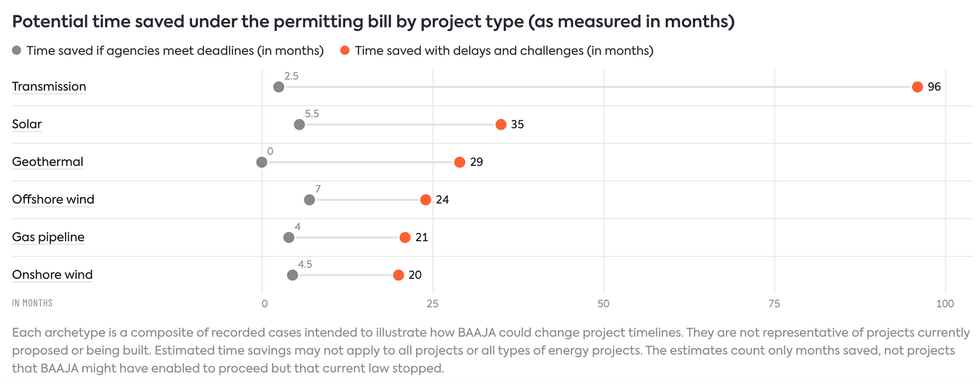
No surprises here: It’s well known at this point that geothermal is a beloved bipartisan technology, and BAAJA affirms the government’s commitment to bringing more of this clean, firm energy source online as soon as possible.
The bill would categorically exclude drilling exploratory geothermal test wells from review under the National Environmental Policy Act, and exempt lower-impact activities such as mapping and surface surveying from NEPA entirely. It would also require the Interior Department to hold annual geothermal lease sales, and drop the federal drilling permit requirement for geothermal exploration on non-federal land, so long as the government owns less than half of the underground resource.
Next-generation geothermal companies such as Fervo Energy, Sage Geosystems, Mazama Energy, and Quaise Energy stand to benefit, of course, as finding viable sites to trial their tech and build early commercial projects requires plenty of mapping and exploratory drilling. This cohort aims to expand geothermal beyond the relatively small number of geographies with the ideal combination of high heat at shallow depths, naturally occurring subsurface water or steam, and permeable rock that conventional geothermal power plants rely on. But a company like Zanskar, which uses AI to identify overlooked conventional geothermal resources, stands to benefit, too — its approach also depends on scouting and drilling across many sites.
Grid enhancing technologies
BAAJA is intent on advancing tech that can squeeze more capacity out of the transmission lines we already have. The bill requires utilities to conduct recurring evaluations on technologies that could increase the capacity of existing transmission infrastructure, such as higher-capacity replacement wires or monitoring systems that determine when the lines can safely carry more power. Investor-owned utilities have historically had little incentive to adopt any of this, since they earn money by building new infrastructure, not by making existing infrastructure more efficient. Now, that math could change. If the evaluations find this tech will provide net benefits, utilities are required to deploy it within a certain timeframe, lest the Federal Energy Regulatory Commission impose penalties.
That’s welcome news for dynamic line rating startups such as LineVision and Heimdall Power, which use sensors to monitor power lines in real time to determine when they’re capable of carrying more electricity than their fixed ratings allow. Companies building higher-capacity lines are also likely to see more business. This includes TS Conductor, which makes a carbon-fiber core wire that it says can double or even triple a line’s capacity, and VEIR, which originally aimed to build “high-temperature superconducting transmission lines,” though it recently pivoted to data center power solutions. Startups like NewGrid, whose software finds ways to avoid congested lines and route more electricity through the existing grid, could benefit, too.
Virtual power plant aggregators
The bill also opens doors for virtual power plants, networks of distributed energy resources such as rooftop solar panels, batteries, smart thermostats, and electric vehicle chargers that operate like a single power plant, responding to spikes in energy demand or shifting load to off-peak hours. Like grid-enhancing technologies, VPPs can reduce the need for new poles, wires, and power plants by making better use of the energy resources already installed in homes and businesses. And they also include an added perk: They pay these customers for adjusting their energy use when the grid needs it.
While FERC ordered grid operators to open their markets to these aggregators in 2020, implementation has dragged. BAAJA would speed things up by requiring operators to allow VPPs into their markets within 18 months of the bill’s passage and setting a low, 100-kilowatt threshold for device networks to be considered VPP-eligible. It would also require utilities to connect VPPs quickly and allow them to export power, while barring utilities from requiring aggregators to install the utilities’ own equipment like separate submeters and switches, which adds delays and added costs for hardware and installation. Separately, the bill directs the Department of Energy to fund efforts to streamline local government permitting and inspections for distributed energy resources like rooftop solar and batteries.
This is a boon for aggregators including Voltus, Renew Home, and David Energy, which sell grid services like demand response, capacity, and frequency regulation into utility programs and wholesale markets. Under this bill, they could do so more easily thanks to guaranteed market access and lower entry thresholds.
VPP software platforms like Leap could benefit, too. Leap helps manufacturers of devices such as smart thermostats and EV chargers enroll customers in VPP programs, so fewer utility equipment requirements and what will presumably be a much bigger addressable market would help. Home battery companies such as Lunar Energy and Base Power, which aggregate their residential batteries into VPPs, and smart panel-maker Span, which coordinates home appliances to respond to grid needs, could see similar benefits.
Critical minerals companies
Hard rock mining is also among the bill’s clear winners. It clarifies that miners can use as much federal land as is “reasonably necessary” to store waste rock and tailings, and opens additional federal land for hard-rock mining leases. It also requires lawsuits challenging mining approvals to be filed within 150 days. Broader changes to NEPA, the National Historic Preservation Act, and the Clean Water Act will also accelerate the mining approval process.
This will undoubtedly be controversial for many climate advocates; while the energy transition demands more critical minerals, mining itself is a dirty endeavor. Yet there are a number of climate tech-adjacent companies focused on extracting, refining, and processing materials like lithium, nickel, cobalt and copper that stand to benefit.
One of the buzziest startups trying to develop new critical minerals mines, AI-driven exploration and development company KoBold Metals, is mainly working abroad right now. But a more favorable domestic environment could prove an enticement to invest more at home. Mariana Minerals, a software-driven developer working to bring mines online faster and cheaper, definitely stands to benefit given its current domestic focus. So could startups like Jetti and Endolith, which are developing technology to extract more copper from low-grade ores. Both work with existing mines, so could stand to profit from a domestic mining boom.
Losers?
Of course not everyone will win here. For the horde of climate-tech adjacent startups trying to jump on the data center bandwagon — perhaps those working on chip cooling or capturing and recycling the waste heat from data center servers — maybe the added costs this bill imposes on data centers will reduce demand for their services just a bit. But I wouldn’t count on that. The bill certainly won’t stop the buildout so much as change who pays for some of the infrastructure required to serve it, shifting the cost of new power lines and grid upgrades from ratepayers onto the tech giants and developers themselves.
Then there are the myriad software startups such as Nira Energy, Paces, and Piq Energy that help energy developers navigate the grid interconnection process. Since the bill requires regional grids to streamline their queues, this could reduce demand for their services. But developers will still need to know where the grid has room and where projects pencil out, and utilities and grid operators will have to rebuild their interconnection processes, a transition that could generate demand for software of this sort.
There’s also just an array of climate industries that go largely unaddressed. While the Inflation Reduction Act offered incentives for practically every decarbonization technology under the sun, this bill is far more targeted, leaving sectors such as EV manufacturing, industrial decarbonization products like clean cement and steel, agricultural technologies, and methane abatement relatively untouched.
Carbon capture and removal projects, EV charging, and hydrogen get only minor nods: protection from administrative delays for carbon management projects and DOE funding to help local governments expedite permitting for EV chargers and hydrogen refueling stations. All of these industries could still benefit when building manufacturing plants or other facilities that need federal sign offs. But they could also lose ground if speedier approvals for fossil fuel infrastructure make cleaner alternatives less competitive.









 Seems significant. CGEP