You’re out of free articles.
Log in
To continue reading, log in to your account.
Create a Free Account
To unlock more free articles, please create a free account.
Sign In or Create an Account.
By continuing, you agree to the Terms of Service and acknowledge our Privacy Policy
Welcome to Heatmap
Thank you for registering with Heatmap. Climate change is one of the greatest challenges of our lives, a force reshaping our economy, our politics, and our culture. We hope to be your trusted, friendly, and insightful guide to that transformation. Please enjoy your free articles. You can check your profile here .
subscribe to get Unlimited access
Offer for a Heatmap News Unlimited Access subscription; please note that your subscription will renew automatically unless you cancel prior to renewal. Cancellation takes effect at the end of your current billing period. We will let you know in advance of any price changes. Taxes may apply. Offer terms are subject to change.
Subscribe to get unlimited Access
Hey, you are out of free articles but you are only a few clicks away from full access. Subscribe below and take advantage of our introductory offer.
subscribe to get Unlimited access
Offer for a Heatmap News Unlimited Access subscription; please note that your subscription will renew automatically unless you cancel prior to renewal. Cancellation takes effect at the end of your current billing period. We will let you know in advance of any price changes. Taxes may apply. Offer terms are subject to change.
Create Your Account
Please Enter Your Password
Forgot your password?
Please enter the email address you use for your account so we can send you a link to reset your password:
Deep cuts to the department have left each staffer with a huge amount of money to manage.

The Department of Energy has an enviable problem: It has more money than it can spend.
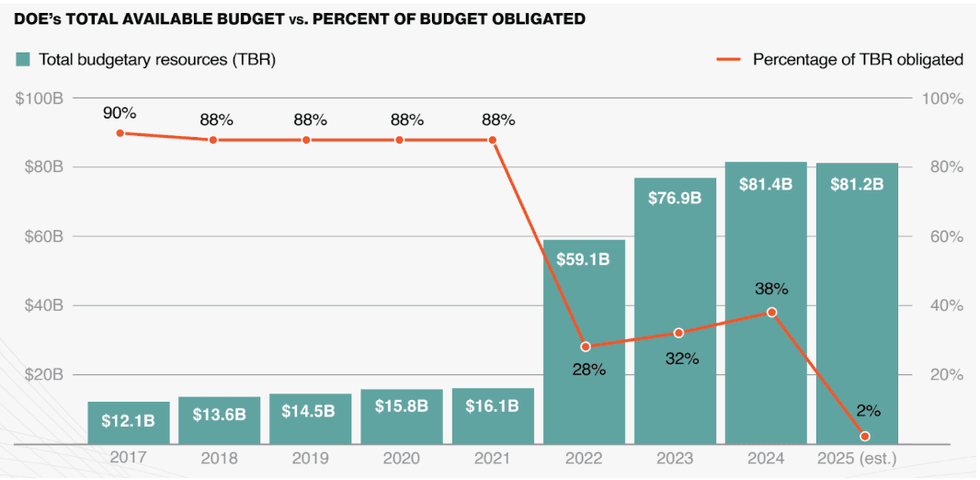
DOE disbursed just 2% of its total budgetary resources in fiscal year 2025, according to a report released earlier this year from the EFI Foundation, a nonprofit that tracks innovations in energy. That figure is far lower than the 38% of funds it distributed the year prior.
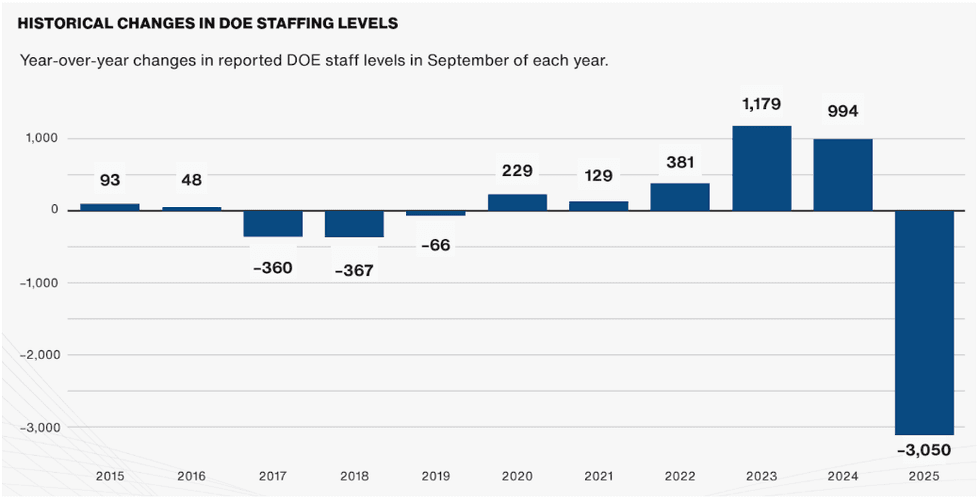
While some of that is due to political whiplash in Washington, there is another, far more mundane cause: There simply aren’t that many people left to oversee the money. Thanks to the Department of Government Efficiency’s efforts, one in five DOE staff members left the agency. On top of that, Energy Secretary Chris Wright shuffled around and combined offices in a Kafkaesque restructuring. Short on workers and clear direction, the department appears unable to churn through its sizable budget.

Though Congress provides budgetary authority, agencies are left to allot spending for the programs under their ambit, and then obligate payments through contracts, grants, and loans. While departments are expected to use the money they’re allocated, federal staff have to work through the gritty details of each individual transaction.
As a result of its reduced headcount, DOE’s employees are each responsible for far more budgetary resources than ever before.
“DOE is facing its largest imbalance in its history,” Alex Kizer, executive vice president of EFI Foundation, told me. In fiscal year 2017, DOE budgeted around $4.7 million per full-time employee. In the fiscal year 2026 budget request, that figure reached $35.7 million per worker — about eight times more.
Part of that increase is the result of the unprecedented injection of funding into DOE from the 2021 Infrastructure Investment and Jobs Act and the 2022 Inflation Reduction Act. The pair of laws, which gave DOE access to $97 billion, comprised the United States’ largest investment to combat climate change in the nation’s history.
The epoch of federally backed renewable energy investment proved to be short-lived, however. Once President Trump retook office last year, his administration froze funds and initiated a purge of federal workers that resulted in 3,000 staffers (about one in five) leaving DOE through the Deferred Resignation Program. The administration canceled hundreds of projects, evaporating $23 billion in federal support.
While the One Big Beautiful Bill Act passed last summer depleted some of the IRA’s coffers and sunsetted many tax credits years early, it only rescinded about $1.8 billion from DOE, according to the EFI Foundation. Much of the IRA’s spending had already gone out the door or was left intact.
This leaves DOE in a strange position: Its budget is historically high, but its staffing levels have suffered an unprecedented drop.

Even before the short-lived Elon Musk-run agency took a chainsaw to the federal workforce, DOE struggled to hire enough people to keep up with the pace of funding demanded by the IRA’s funding deadlines. The Loan Programs Office, for example, was criticized for moving too slowly in shelling out its hundreds of billions in loan authority. According to a report from three ex-DOE staffers that Heatmap’s Emily Pontecorvo covered, the IRA’s implementation suffered from a lack of “highly skilled, highly talented staff” to carry out its many programs.
“The last year’s uncertainty and the staff cuts, the project cancellations, those increase an already tightening bottleneck of difficulty with implementation at the department,” Sarah Frances Smith, EFI Foundation’s deputy director, told me.
One former longtime Department of Energy staffer who asked not to be named because they may want to return one day told me that as soon as Trump’s second term started, funding disbursement slowed to a halt. Employees had to get permission from leadership just to pay invoices for projects that had already been granted funding, the ex-DOE worker said.
While the Trump administration quickly moved to hamstring renewable energy resources, staff were kept busy complying with executive orders such as removing any mention of diversity equity and inclusion from government websites and responding to automated “What did you do last week?” emails.
On top of government funding drying up, Kizer told me that the confusion surrounding DOE has had a “cooling effect on the private sector’s appetite to do business with DOE,” though the size of that effect is “hard to quantify.”
Under President Biden, DOE put a lot of effort into building trust with companies doing work critical to its renewable energy priorities. Now, states and companies alike are suing DOE to restore revoked funds. In a recent report, the Government Accountability Office warned, “Private companies, which are often funding more than 50 percent of these projects, may reconsider future partnerships with the federal government.”
Clean energy firms aren’t the only ones upset by DOE’s about-face. Even the Republican-controlled Congress balked at President Trump’s proposed deep cuts to DOE’s budget in its latest round of budget negotiations. Appropriations for fiscal year 2026 will be just slightly lower than the year before — though without additional headcount to manage it, the same difficulties getting money out the door will remain.
The widespread staff exit also appears to have slowed work supporting the administration’s new priorities, namely coal and critical minerals. LPO, which was rebranded the “Office of Energy Dominance Financing,” has announced only a few new loans since President Biden left office. Southern Company, which received the Office’s largest-ever loan, was previously backed by a loan to its subsidiary Georgia Power under the first Trump administration.
Despite Trump’s frequent invocation of the importance of coal, DOE hasn’t accomplished much for the technology besides some funding to keep open a handful of struggling coal plants and a loan to restart a coal gasification plant for fertilizer production that was already in LPO’s pipeline under Biden.
Even if DOE wanted to become an oil and gas-enabling juggernaut, it may not have the labor force it needs to carry out a carbon-heavy energy mandate.
“When you cut as many people as they did, you have to figure out who’s going to do the stuff that those people were doing,” said the ex-DOE staffer. “And now they’re going to move and going, Oh crap, we fired that guy.”
Log in
To continue reading, log in to your account.
Create a Free Account
To unlock more free articles, please create a free account.
Will moving fast and breaking air permits exacerbate tensions with locals?
The Trump administration is trying to ease data centers’ power permitting burden. It’s likely to speed things up. Whether it’ll kick up more dust for the industry is literally up in the air.
On Tuesday, the EPA proposed a rule change that would let developers of all stripes start certain kinds of construction before getting a historically necessary permit under the Clean Air Act. Right now this document known as a New Source Review has long been required before you can start building anything that will release significant levels of air pollutants – from factories to natural gas plants. If EPA finalizes this rule, it will mean companies can do lots of work before the actual emitting object (say, a gas turbine) is installed, down to pouring concrete for cement pads.
The EPA’s rule change itself doesn’t mention AI data centers. However, the impetus was apparent in press materials as the agency cited President Trump’s executive order to cut red tape around the sector. Industry attorneys and environmental litigants alike told me this change will do just that, cutting months to years from project construction timelines, and put pressure on state regulators to issue air permits by allowing serious construction to start that officials are usually reluctant to disrupt.
“I think the intended result is also what will happen. Developers will be able to move more quickly, without additional delay,” said Jeff Holmstead, a D.C.-based attorney with Bracewell who served as EPA assistant administrator for air and radiation under George H.W. Bush. “It will almost certainly save some time for permitting and construction of new infrastructure.”
Air permitting is often a snag that will hold up a major construction project. Doubly so for gas-powered generation. Before this proposal, the EPA historically was wary to let companies invest in what any layperson would consider actual construction work. The race for more AI infrastructure has changed the game, supercharging what was already an active debate over energy needs and our nation’s decades-old environmental laws.
Many environmental groups condemned the proposal upon its release, stating it would make gas-powered AI data centers more popular and diminish risks currently in place for using dirtier forms of electricity. Normally, they argue, this permitting process would give state and federal officials an early opportunity to gauge whether pollution control measures make sense and if a developer’s preferred design would unduly harm the surrounding community. This could include encouraging developers to consider alternate energy sources.
“Inevitably agencies have flexibility as to how much they ask, and what this allows them to do is pre-commit in ways that’ll force agencies to take stuff off the table. What’s taken off the table, it’s hard to know, but you’re constraining options to respond to public concerns or recognize air quality impacts,” said Sanjay Narayan, Sierra Club’s chief appellate counsel.
Herein lies the dilemma: will regulatory speed for power sacrifice opportunities for input that could quell local concerns?
We’re seeing this dilemma play out in real time with Project Matador, a large data center proposal being developed in Amarillo, Texas, by the Rick Perry-backed startup Fermi Americas. Project Matador is purportedly going to be massive and Fermi claims its supposed to one day reach 11 GW, which would make it one of the biggest data centers in the world.
Fermi’s plans have focused on relying on nuclear power in the future. But the only place they’ve made real progress so far in getting permits is gas generation. In February, the Texas Commission on Environmental Quality gave Fermi its air permit for building and operating up to 6 gigawatts of gas power at Project Matador. At that time, Fermi was also rooting for relaxed New Source Review standards, applauding EPA in comments to media for signaling it would take this step. The company’s former CEO Toby Neugebauer also told investors on their first earnings call that Trump officials personally intervened to help get them gas turbines from overseas. (There’s scant public evidence to date of this claim and Neugebauer was fired by Fermi’s board last month.)
But now Fermi’s permit is also being threatened in court. In April, a citizens group Panhandle Taxpayers for Transparency filed a lawsuit against TCEQ challenging the validity of the permit. The case centers around whether the commission was right to deny a request for a contested case hearing brought by members of the group who lived and worked close to Project Matador. “Once these decisions are made, they don’t get reversed,” Michael Ford, Panhandle Taxpayers for Transparency’s founder, said in a fundraising video.
This is also a financial David vs. Goliath, as Ford admits in the fundraising video they have less than $2,000 to spend on the case – a paltry sum they admit barely covers legal bills. We’re also talking about a state that culturally and legally sides often with developers and fossil fuel firms.
At the same time, this lawsuit couldn’t come at a more difficult time as Fermi is struggling with other larger problems (see: Neugebauer’s ouster). Eric Allman, one of the attorneys representing Panhandle Taxpayers for Transparency, told me they’re still waiting on a judge assignment and estimated it’ll take about one year to get a ruling. Allman told me legally Fermi can continue construction during the legal challenge but there are real risks. “Applicants on many occasions will pause activity while there is an appeal pending,” he told me, “because if the suit is successful, they won’t have an authorization.”
Aerial photos reported by independent journalist Michael Thomas purportedly show Fermi hasn’t done significant construction since obtaining its air permit. Fermi did not respond to multiple requests for comment on the lawsuit.
Industry attorneys I spoke to who wished to remain anonymous told me it was too early to say whether EPA’s rulemaking would exacerbate local conflicts by making things move faster. “A lot of times the environmental community likes to litigate things in the hope delays will kill a project, so in that regard, this strategy may be harder for them to implement now,” one lawyer told me. “But just because a plant gets a permit doesn’t mean they can build.”
Environmental lawyers, meanwhile, clearly see more potential for social friction in a faster process. Keri Powell of the Southern Environmental Law Center compared this EPA action to xAI’s rapid buildout in Tennessee and Mississippi where the Al company’s construction of gas turbines before it received its permits has only added to local controversy. This new rule would not make what xAI did permissible; this is a different matter. Yet there are thematic similarities between what the company is doing and the new permitting regime, with natural gas generation expanding faster when companies are allowed to start forms of site work before an air permit is issued.
“By the time a permit is issued, the company will be very, very far along in constructing a facility. All they’ll need to do is bring in the emitting unit, and oftentimes that doesn’t entail very much,” she said. “Imagine you’re a state or local permitting agency – your ability to choose something different than what the company already decided to do is going to be limited.”
And more of the week’s top fights around development.
1. Berkeley County, South Carolina – Forget about Richland County, Ohio. All eyes in Solar World should be on this county where officials are trying to lift a solar moratorium.
2. Hill County, Texas – We have our first Texas county trying to ban new data centers and it’s in one of the more conservative pockets of the state.
3. Sussex County, New Jersey – A town in north Jersey rapidly changed course from backing a new data center to outright banning all projects.
4. Porter County, Indiana – The Chicago ex-urb of Valparaiso is significantly restricting data centers too, after pulling the plug on a large project under development.
5. King County, Washington – It’s Snoqualmie vs. the energy sector right now, as the new poster child for battery backlash bans BESS in its borders.
A conversation with Utah state senator Nate Blouin.
This week’s conversation is with Utah state senator Nate Blouin – a candidate for the Democratic nomination to represent the state’s 1st Congressional District, which includes Salt Lake City. I reached out to Blouin amidst the outpouring of public attention on the Box Elder County data center project backed by celebrity investor Kevin O’Leary. His positions on data centers and energy development, including support for a national AI data center moratorium, make him a must-watch candidate for anyone in this year’s Democratic congressional primaries. (It’s worth noting this seat was recently redrawn in ways that made it further left.)
The following conversation was lightly edited for clarity.
I guess to start, how’s the fight going?
On the [O’Leary] data center front? It’s good. People have really been activated by this. It’s always exciting for me to see when people get interested in politics because it hits close to their lives. I think that’s why you’re seeing people so passionate here. We had thousands file protests on their water rights change application. We had thousands show up to a county commission meeting in Box Elder County, Utah. The people have taken notice and understand the ramifications of such a gigantic project in our backyard. Officials are listening and I don’t know if that’s going to translate into concrete action to stop this thing but it’s good to have people involved, taking an interest in what I see as an environmental issue and an energy issue.
You’re running for office in the Salt Lake City area right?
Correct. I’m currently in the state senate representing central Salt Lake County running for a congressional district that is entirely located within northern Salt Lake County.
I assume your next question is: why is this a concern to you if this isn’t in Salt Lake County?
Yeah.
I was anticipating that.
This is a gigantic project. Several gigawatts of energy, an enormous amount to put on or off the grid depending on how it plays out. It’s a huge project, likely the largest natural gas generating facility in the country and on par with some of the largest generating facilities in the world. As the crow flies, my district right now and the one I’m running to represent are 50 to 70 miles across the Great Salt Lake just south of this proposed location. And we already have really massive air quality issues in our area. We have a Great Salt Lake that is struggling in incredible fashion, at one of its lowest ever levels and no hope of returning to normal in the near future. Any of those issues are going to come up, create climate damage, increase our ozone levels.
When you approach the data center issue as a candidate, how do you see it impacting your race and how do you approach the issue in general?
This ties together so many threads. The climate issues I’ve worked on in the past. Certainly looking at who is going to benefit here and who is going to lose out. We’ve seen the state give out massive tax incentives, to the tune of probably hundreds of millions of dollars. People are so angry about all these things. It’s these threads about billionaires who profit while we struggle with the air pollution that’s choking many in our community. That’s what put it at the center of this race. I think you’re going to see that more often across the country where other large proposals are.
On the larger picture, my perspective is that we need a moratorium on data centers as we envision what the future is. A national moratorium. I’m aligned with Sen. Bernie Sanders and Rep. Alexandria Ocasio-Cortez on that front. Sanders endorsed my campaign because I see eye to eye with him on many issues including this one.
I don’t want these dumped in our backyard. This one in particular because of how enormous it is, but we’ve seen other proposals and I fought these in the legislature.
We need to ask, what is the future of this industry? While average people are struggling with high energy costs, why are we incentivizing all this infrastructure to benefit the select few who own this stuff?
We have to get public buy-in both on how the infrastructure works and how if we move forward with any of these, how they benefit our communities. The environmental aspect as well, all these communities that have been dumping grounds in the past aren’t going to want these either. We have to look at what the future of AI also looks like.
If I may, when I spoke with Senate candidate Graham Platner about this idea over the past weekend, he told me that he doesn’t want a moratorium for the sake of a moratorium.
Right.
I mean look, there are great things AI can do. Great medicines to be discovered. Weather forecasts. We can better utilize clean energy.
I want a moratorium because it gives time to actually envision what policies are needed to get buy-in. What role the government plays in managing these technologies, too. Make sure they’re being used in the public interest and not against us.
A mish-mash of policies across the states or just saying we’ll do the work isn’t the right approach. I think we need to take a pause and develop those strategies. Then we’ll see what happens and move forward.
I spoke with Holly Jean Buck about that Jacobin piece where she argued against a data center moratorium after previously being for it. She mentioned being concerned about this unique allegiance between the folks fighting data centers on the left and on the right. It’s unclear those folks have the same end goals.
What’s your take on that allegiance and if it’ll lead to positive development in the long term?
I think there are shared end goals.
Protecting land? There’s different reasons. On the right, they’re concerned about farmland and agricultural land being developed into things they don’t want, where on the left it's about public land and the general environmental picture. But on surveillance, for example, there’s more commonality in what we want to see. Most people don’t want to see more government intrusion.
I think there are commonalities and differences. It’ll be interesting to see how those pan out in the long run.
I agree with Platner’s statement. This is to figure out the path forward before we spend trillions of dollars on infrastructure that’ll be paid for by ratepayers.
My last question: do you think we’ll still be having the same conversation about all of this 10 years from now?
No. I don’t think so – if we take the time that’s needed to get public buy-in.
That’s why we have to see the government play an active role here. So far, they’ve let everyone do whatever they want. We can’t keep letting the billionaire class get whatever they want so they can make a bunch of money off of us.
To return to Utah, the process here was horrible. It was a data center that would encompass 40,000 acres. It’s a gigantic area and amount of emissions. And it was done through an opaque government agency that pushed it forward.
What I know from my work in the clean energy space, like with transmission, if you do the process right and forums and tell people you’re interested in doing something nearby and in X way, you can see people rally around those projects.
Here you saw Kevin O’Leary, a Canadian guy, come in and work behind the scenes to make himself a bunch of money.
We need to figure out how to do this in a way that envisions how the public can be involved.