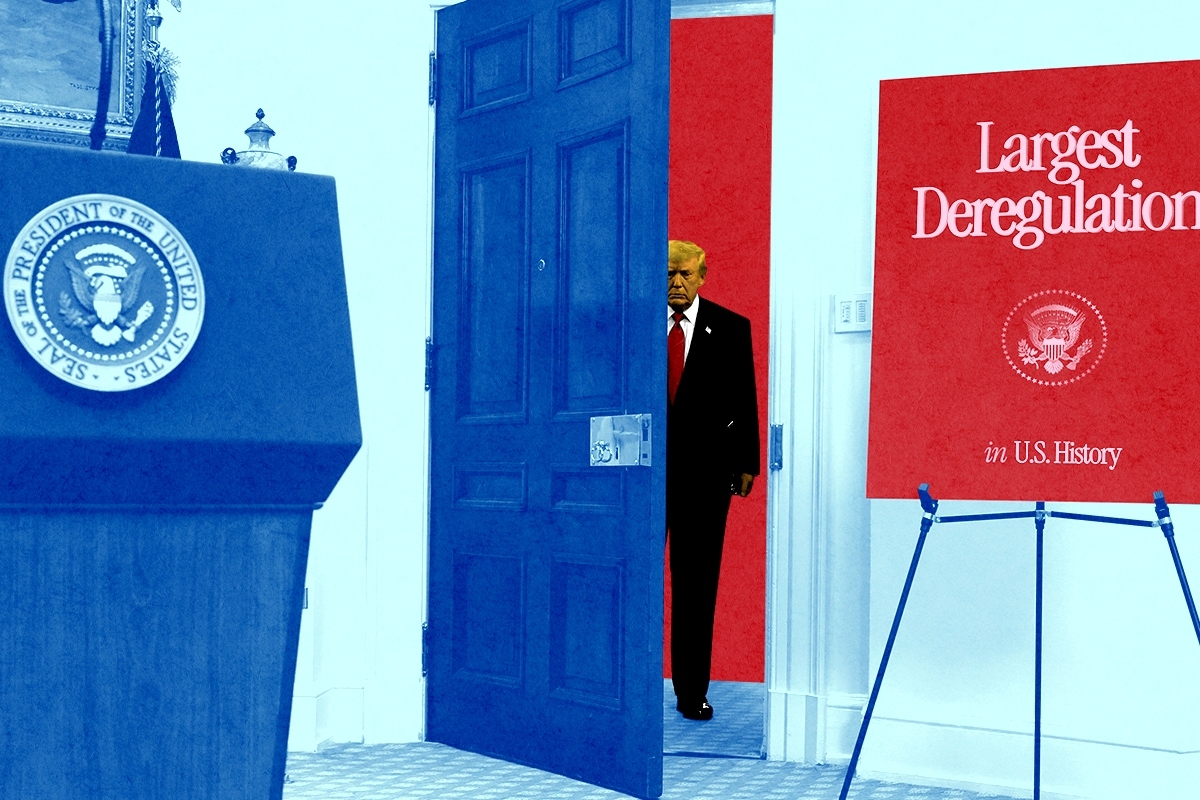
Environmental lawyers are in for years of déjà vu as the Trump administration relitigates questions that many believed were settled by the Supreme Court nearly 20 years ago.
On Thursday, Trump rescinded the “endangerment finding,” the Environmental Protection Agency’s 2009 determination that greenhouse gas emissions from vehicles threaten Americans’ public health and welfare and should be regulated. In the short term, the move repeals existing vehicle emissions standards and prevents future administrations from replacing them. In the longer term, what matters is whether any of the administration’s justifications hold up in court.
In its final rule, the EPA abandoned its attempt to back the move using a bespoke climate science report published by the Department of Energy last year. The report was created by a working group assembled in secret by the department and made up of five scientists who have a track record of pushing back on mainstream climate science. Not only was the report widely refuted by scientists, but the assembly of the working group itself broke federal law, a judge ruled in late January.
“The science is clear that climate change is creating a risk for the public and public health, and so I think it’s significant that they realized that it creates a legal risk if they were to try to assert otherwise,” Carrie Jenks, the executive director of Harvard’s Environmental and Energy Law Program, told me.
Instead, the EPA came up with three arguments to justify its decision, each of which will no doubt have to be defended in court. The agency claims that each of them can stand alone, but that they also reinforce each other. Whether that proves to be true, of course, has yet to be determined.
Here’s what they are:
1. Greenhouse gases are not pollutants under the Clean Air Act
Congress never specifically told the EPA to regulate greenhouse gas emissions. If it did, maybe we would have accomplished more on climate change by now.
What happened instead was that in 1999, a coalition of environmental and solar energy groups asked the EPA to regulate emissions from cars, arguing that greenhouse gases should be considered pollutants under the federal Clean Air Act. In 2007, in a case called Massachusetts v. EPA, the Supreme Court agreed with the second part. That led the EPA to consider whether these gases posed enough of a danger to public health to warrant regulation. In 2009, it concluded they did — that’s what’s known as the endangerment finding. After reaching that finding, the EPA went ahead and developed standards to limit emissions from vehicles. It later followed that up with rules for power plants and oil and gas operations.
Now Trump’s EPA is arguing that this three-step progression — categorizing greenhouse gases as pollutants under the Clean Air Act, making a scientific finding that they endanger public health, and setting regulations — was all wrong. Instead, the agency now believes, it’s necessary to consider all three at once.
Using the EPA’s logic, the argument comes out something like this: If we consider that U.S. cars are a small sliver of global emissions, and that limiting those emissions will not materially change the trajectory of global warming or the impacts of climate change on Americans, then we must conclude that Congress did not intend for greenhouse gases to be regulated when it enacted the Clean Air Act.
“They are trying to merge it all together and say, because we can’t do that last thing in a way that we think is reasonable, we can’t do the first thing,” Jenks said.
The agency is not explicitly asking for Massachusetts v. EPA to be overturned, Jenks said. But if its current argument wins in court, that would be the effective outcome, preventing future administrations from issuing greenhouse gas standards unless Congress passed a law explicitly telling it to do so. While it's rare for the Supreme Court to reverse course, none of the five justices who were in the majority on that case remain, and the makeup of the court is now far more conservative than in 2007.
2. The “major questions doctrine” says this isn’t our job
The EPA also asserted that the “major questions doctrine,” a legal principle that says federal agencies cannot set policies of major economic and political significance without explicit direction from Congress, means the EPA cannot “decide the Nation’s policy response to global climate change concerns.”
The Supreme Court has used the major questions doctrine to overturn EPA’s regulations in the past, most notably in West Virginia v. EPA, which ruled that President Obama’s Clean Power Plan failed this constitutional test. But that case was not about EPA’s authority to regulate greenhouse gases, the court solely struck down the particular approach the EPA took to those regulations. Nevertheless, the EPA now argues that any climate regulation at all would be a violation.
3. Regulation would be futile
The EPA’s final argument is about the “futility” of vehicle emissions standards. It echoes a portion of the first justification, arguing that the point alone is enough of a reason to revoke the endangerment finding absent any other reason.
The endangerment finding had “severed the consideration of endangerment from the consideration of contribution” of emissions, the agency wrote. The Clean Air Act “instructs the EPA to regulate in furtherance of public health and welfare, not to reduce emissions regardless [of] whether such reductions have any material health and welfare impact.”
Funnily enough, to reach this conclusion, the agency had to use climate models developed by past administrations, including the EPA’s Optimization Model for reducing Emissions of GHGs from Automobiles, as well as some developed by outside scientists, such as the Finite amplitude Impulse Response climate emulator model — though it did so begrudgingly.
The agency “recognizes that there is still significant dispute regarding climate science and modeling,” it wrote. “However, the EPA is utilizing the climate modeling provided within this section to help illustrate” that zero-ing out emissions from vehicles “would not materially address the health and welfare dangers attributed to global climate change concerns in the Endangerment Finding.”
I have yet to hear back from outside experts about the EPA’s modeling here, so I can’t say what assumptions the agency made to reach this conclusion or estimate how well it will hold up to scrutiny. We’ll be talking to more legal scholars and scientists in the coming days as they digest the rule and dig into which of these arguments — if any — has a chance to prevail.