You’re out of free articles.
Log in
To continue reading, log in to your account.
Create a Free Account
To unlock more free articles, please create a free account.
Sign In or Create an Account.
By continuing, you agree to the Terms of Service and acknowledge our Privacy Policy
Welcome to Heatmap
Thank you for registering with Heatmap. Climate change is one of the greatest challenges of our lives, a force reshaping our economy, our politics, and our culture. We hope to be your trusted, friendly, and insightful guide to that transformation. Please enjoy your free articles. You can check your profile here .
subscribe to get Unlimited access
Offer for a Heatmap News Unlimited Access subscription; please note that your subscription will renew automatically unless you cancel prior to renewal. Cancellation takes effect at the end of your current billing period. We will let you know in advance of any price changes. Taxes may apply. Offer terms are subject to change.
Subscribe to get unlimited Access
Hey, you are out of free articles but you are only a few clicks away from full access. Subscribe below and take advantage of our introductory offer.
subscribe to get Unlimited access
Offer for a Heatmap News Unlimited Access subscription; please note that your subscription will renew automatically unless you cancel prior to renewal. Cancellation takes effect at the end of your current billing period. We will let you know in advance of any price changes. Taxes may apply. Offer terms are subject to change.
Create Your Account
Please Enter Your Password
Forgot your password?
Please enter the email address you use for your account so we can send you a link to reset your password:
Where is the smoke worst, where will it go next, and what causes that color?

Before wildfire smoke turns the skies to a jaundiced yellow-gray, it might look almost pretty. Midday light grows diffuse, taking on a crepuscular golden hue. Shadows soften and stretch long. The sunsets are particularly incredible: radiant, neon red.
But as with oleander and poison dart frogs, beautiful things are often the most dangerous. The same wildfire particulates that scatter the light will, once dense enough, turn the air around you orange, then black. They will get into your lungs — slipping past your nose hairs and mucus, the body’s defenses that stop larger particulates — and provoke your immune system into an attack. The tiny air sacs at the ends of the bronchioles in your lungs, where the gas exchange of “breathing” actually happens, will become inflamed. You will become short of breath. You will cough. The smallest smoke particulates may even enter your bloodstream.
And if you are like 24,000 other Americans every year, this will kill you.
Though wildfire smoke exposure might seem to be more of a nuisance to a healthy person than anything else, experts agree it should be taken seriously. “In my profession, wildland firefighting, you make a decision that you run into that,” Nicholai Allen, a firefighter and founder of Safe Soss, a home-hardening product line, told me. “But for my family and my children, I don’t want them breathing in the smoke that’s traveling that far. We have air purifiers, and we’re taking similar precautions.”
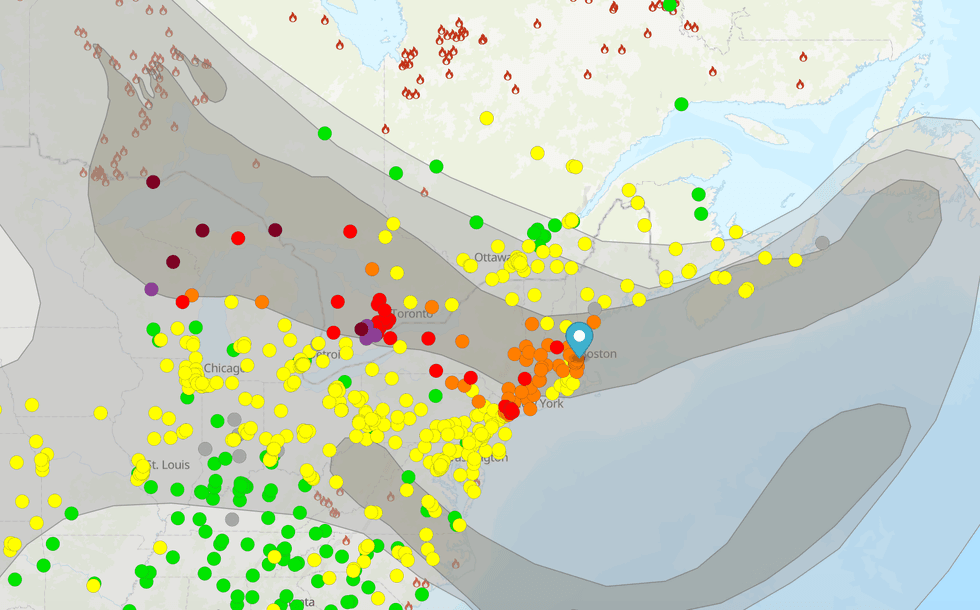
On Wednesday, more than 100 million people in the Midwest and Northeast face unhealthy smoke conditions from fires burning up to 2,000 miles away. Here’s what you need to know.
The smoke is largely coming from 150 or so lightning-ignited fires in Ontario and northeastern Minnesota. Triple-digit temperatures, dry conditions, and high winds have fanned a “wall of fire” across the region, as the firefighting newsletter The Hotshot Wakeup put it, even as Canada is, on the whole, tracking behind its five-year average for area burned so far. Most of the fires sending smoke to the U.S. this week are still out of control and spreading rapidly.

A high-pressure area over the central U.S. and a low-pressure area over Eastern Canada are acting as a funnel, pulling bad air east across the Great Lakes region and into the populous Acela Corridor. Conditions are worst closest to the fires: Around 8 a.m. on Wednesday morning, Duluth, Minnesota had a “hazardous” air quality rating of 785 out of 800. By the afternoon, Toronto had the worst air quality of any major city in the world, and drivers in northern Michigan have been advised to slow down and turn on their low-beam headlights because visibility has been so reduced by the smoke. The eastern-moving plume has also blanketed large portions of Upstate New York.
Degraded air quality reached the Boston and New York City areas on Tuesday night and is expected to linger through Thursday. The smoke reaches as far north as Maine, having dimmed the morning light in New Hampshire, and could spread as far south as Washington, D.C. over the next 24 hours.
Though the smoke is staying largely to the north over the middle part of the country, forecasts show it could dip into downtown Chicago on Thursday as well.
Wednesday and early Thursday will be the worst days for the eastern U.S., per the current outlook. A cold front should help push the worst of the smoke out of the region as we head into the weekend.
So far it appears that much of the smoke has remained high enough in the atmosphere that while you’ll be able to see and likely smell it, it might not cause extreme air quality problems on the ground. As of Wednesday afternoon, New York City was recording some of the worst air on the East Coast, with an air quality index of around 160 — bad enough to trigger an “unhealthy” alert for the general public and to rank fifth-worst among major cities worldwide. The rest of the region still mostly showed orange readings designed to alert sensitive groups such as older adults, people with respiratory conditions, and pregnant women, or more moderate yellow ratings.
Conditions could still change, though. Heat, pressure, and winds can drive smoke down to ground level, where it becomes a threat to public health. In fact, the Fox Forecast Center’s models indicate that particulate matter concentrations around the Great Lakes and Northeast could be on par with the 2023 East Coast smoke event, during which New York had the world’s worst air quality, although The New York Times reports that “even the most severe forecasts” this week should not approach that level.
The best thing to do is to continue monitoring your local air quality. If you want help navigating what those readings mean, my colleague Emily Pontecorvo has written a great explainer.
For many on the East Coast, the orange skies are a flashback to the 2023 smoke event. While eerie and apocalyptic, the smoke also gives us an excuse to talk about Mie theory.
Air molecules are much smaller than the wavelength of light. When white light from the sun enters the atmosphere, nitrogen and oxygen scatter the short, higher-frequency blue light in multiple directions. This is known as Rayleigh scattering, and is also the answer to, “Why is the sky blue?” Under normal conditions, wherever you look in the sky, blue light is headed toward your eye.
Smoke particles, while small enough to enter our lungs when inhaled, are larger than air molecules — about the same size as light wavelengths. Because these particles are larger, they also scatter light more democratically, including the lower-frequency, longer reds and oranges. This is called Mie scattering. When sunlight passes through smoke, the reds, oranges, yellows, and blues are all mixed together as they reach our eyes, appearing as a hazy gray or white.
You might expect thicker smoke to result in a darker gray, then. But smoke also contains organic compounds from burned plants called brown carbon, plus soot, both of which absorb visible light. Brown carbon, in particular, prefers light at the shorter end of the spectrum, absorbing about three-quarters of the total light at blue wavelengths in smoke plumes, compared to about half at red wavelengths. That means that when the smoke thickens, the blue light doesn’t reach our eyes nearly as well, and the sky takes on an orange appearance.
One of the dangers of the current smoke event is that it coincides with high temperatures across the Central U.S. and New England. Both conditions together — high heat and smoke — can lead to some confusion over how to respond.
The best strategy is to keep your windows closed. But while it might feel safe side, wildfire smoke can still degrade indoor air quality. “If you have a fresh air intake on your air conditioning system, I would shut that off so that you’re recirculating just your purified air inside your house,” Allen, the firefighter, told me.
You can also install activated carbon exterior filters on attic and crawl space vents and run a purifier with a HEPA filter. (If you bought an air purifier during the last smoke event, consider this your reminder to replace your filter.) “Then I would avoid going outside or exercising outside if there’s smoke in the air,” Allen added. “When the particles are arriving to you from a great distance from the wildfire, they are the smaller particles that can get in your lungs. So not to create undue fear, but there’s definitely stuff in that air that you don’t want to breathe.”

Log in
To continue reading, log in to your account.
Create a Free Account
To unlock more free articles, please create a free account.
Deciding what counts as a heat death is more difficult than it sounds.
Just last month, a heat wave killed an estimated 2,700 people in France. Think about that for a second: 2,700 people. That’s equivalent to the mortality of two Hurricane Katrinas or 10 Hurricane Sandys. In France, where there were roughly 970 murders in 2024, the heat wave killed more people in two weeks than almost three years’ worth of homicides.
But unlike floods, hurricanes, tornadoes, or murders, heat doesn’t leave behind much of a crime scene. Although heat kills people in obvious, direct ways like heat stroke, it also puts enormous strain on our hearts and kidneys as our bodies work to keep our internal temperature at 98.6 degrees Fahrenheit. Heart attacks spike during heat waves because vasodilation diverts blood to the skin’s surface to cool it down, in the process lowering blood pressure and forcing the heart to work harder and faster to circulate oxygen. Deaths from renal diseases also jump during periods of high temperatures due to severe dehydration and restricted blood flow to the kidneys.
“Let’s say you have two people with underlying heart disease; somebody has a heart attack versus somebody has a heart attack because it’s too hot,” Kristie Ebi, an epidemiologist at the University of Washington and an expert on heat-related mortality, explained to me. “Will the second one be recorded as a heat death or will it just be recorded as a heart attack? Frankly, when both go into the emergency department, the number one goal is to save a life — it’s not necessarily to record whether it was because of temperature.”
But if physicians don’t code the second heart attack as a heat death— a procedure designed for insurance and billing rather than getting to the root of underlying environmental conditions — then the headline number of heat wave-related deaths will almost certainly be an undercount. In Washington during the 2021 heat dome, for example, the state health department initially reported that 129 people died from the temperatures. But later analyses compared the overall number of people who died that week in the state to the average number of people who died during the same week from 2013-2019 and concluded that there were 485 “additional” deaths compared to what would have been expected during normal early summer conditions.
Those 485 deaths are called “excess deaths,” and the number offers a broader picture of who actually dies from a heat wave. The tally captures not only those heart attacks that are coded by physicians and medical examiners as caused by the heat, but also the ones the state may have overlooked or discounted. Air pollution deaths, homicides, drownings, and accidents, for example — all of which also spike in relation to heat waves — show up. As one epidemiologist explained it to the Seattle-area NPR affiliate KUOW, a boating death might count as an excess heat death, too, because while “not directly attributable to heat in the sense of heat stroke … it arguably is attributable to heat in the sense that had it not been hot, they would not have gone out.”
Excess death analyses are also methodical in what they don’t count. “After a heat wave, there’s a deficit in the number of deaths, which means that the heat wave brought forward deaths that would have occurred anyway,” Ebi told me. The analyses also take those into account to model only the “true” excess events. This, at least, is relatively simple in scope: The advantage of heat waves for mortality accounting is that they don’t have the long tails associated with hurricanes and other weather-related tragedies. “Deaths occur over a few days of a heat wave, and then it’s over,” Ebi added.
But the calculation, while relatively straightforward, has its critics, too. “The limitation of that approach is that it doesn’t actually quantitatively attribute that excess mortality to the heat,” Christopher Callahan, a climate scientist and assistant professor at Indiana University Bloomington, told me. Take the boating accident example: Maybe if it’d been a regular summer day, the enthusiast still would have taken his pontoon out and had all those beers. Maybe during the heat wave it was also smoky, and that caused some of the excess deaths. There’s also the possibility that the baseline number of deaths already includes some baked-in heat-related deaths, obscuring the cumulative total.
A third approach, favored by academics — and recently employed by Callahan to estimate the 2,700 heat-related deaths in France last month — involves using long-term data on both temperatures and mortality for a given location and then fitting a statistical model that relates the two. This method has the advantage of generating a U-shaped relationship that shows how mortality rates change once temperatures exceed a certain threshold (or drop below it, in the case of cold-weather-related deaths, hence the “U”). Like an excess death analysis, this method “has the benefit of, again, not having to rely on individual diagnoses,” Callahan said. “It has the drawback that there is no one right statistical model. Different people have different philosophies about how to fit those models.”
The other drawback is that creating such a model and subjecting it to the rigor of peer review is time-consuming — by the time you’re able to publish a death toll, the news cycle has probably moved on. Callahan got lucky: He had already created such a model for France to study the 2003 heat wave, which killed an estimated 15,000 in the country in a couple of weeks. The model relies on a historical understanding of the relationship between temperature and mortality in France — “not a crazy assumption, but an assumption,” he admitted to me — and he published the findings in Carbon Brief earlier this month. (Callahan also estimated that 20,000 people died continent-wide in Europe during the June 2026 heat wave — a number that circulated widely, but that he told me he’s now working to revise downward.)
Notably, the number Callahan arrived at for France does not represent “real” people or “real” deaths, at least as linked to death certificates. There are no biographical or even demographic numbers attached to it. (That said, you can create models of the same U-shaped relationship for anything: temperature and age, income, race.) More mind-bending, though, is that because of this, Callahan’s model can also be used to predict. Had there been a way to know the exact temperatures before the European heat wave, he could have told you how many people would likely die before they actually did.
In the case of France, the simple excess death count put the toll at 2,025, though officials say they expect the number to rise. While Callahan’s number and the official tally from France differ by what seemed to me to be a lot — 675 deaths — Callahan told me he’s actually encouraged by how close his model came to the government’s empirical count, given that the two use completely different methodologies.
After all, heat death counts can vary by orders of magnitude, including within a single government. Before 2020, the Centers for Disease Control and Prevention reported that only about 700 Americans died each year from heat, relying primarily on physician diagnostic codes. After moving in recent years to better incorporate underlying and contributing causes of death, the CDC adjusted its estimate upward to about 2,000 heat-related deaths per year in the United States. Still, the government’s numbers remain extremely conservative; independent researchers studying heat mortality say the figure is likely closer to 12,000.
But even more holistic heat-related mortality numbers have their critics. For example, models don’t work as well for many lower-income countries, where mortality may be reported monthly, thereby making day- or week-level heat attribution impossible.
Granularity presents its own set of problems. Excess deaths and modeling analyses both have to define the first “heat day” of an event. You can do that by setting a fixed threshold — say, anything above 90 degrees Fahrenheit counts as “high heat” — but Ebi told me there is little value in analyses or policies that take that approach. That’s because heat is contextual: “My standard joke is, if we had the temperatures here in Seattle that they have in Phoenix, we basically all die, because we don’t have the infrastructure and we’re not acclimatized,” she said.
A slightly better metric might be a relative threshold — say, temperatures above the 95th percentile of historical temperatures for a specific location count as “extreme heat.” The problem there, though, is that it may need to be stratified further by vulnerable populations that feel the effects much sooner, like adults over the age of 65, pregnant women, outdoor workers, or people with certain medical conditions. While that approach might seem overly complicated, parts of Asia already use nuanced thresholds to warn older adults to take precautions. “It’s going to be more challenging to communicate, I grant you that,” Ebi told me of such an approach — much less to try to model. “But it’s also going to be more useful.”
Even so, a larger problem remains: The multiple systems for calculating heat deaths are honed to address different questions, which makes them impossible to compare. The Federation of American Scientists has pushed for the CDC to upgrade and standardize its heat-mortality tracking. “We’ve thought about if it’s possible to ever set a goal of bringing heat-related deaths down by 50%, or something like that,” Grace Wickerson, the senior manager of climate and health at FAS, told me. “But we don’t even have a baseline number or a way to say, ‘This is the starting point for this goal or strategy.’”
Wickerson also suggested, though, that there might be things we lose in trying to nail down the most correct heat-related mortality number. “I’m almost a bit weary of the pursuit of large numbers,” she said. “At least to me, what feels more important is why people are suffering and dying, what types of people they are, and what stories, messages, and stakeholders we need to engage and target to actually build meaningful policy strategies.”
Despite being deeply engrossed in the calculations, Callahan stressed that he wants readers to have a similar takeaway from his own research. Improved “healthcare access and access to cooling, shade, and shelter” — or in the case of heat-related mortality from climate change, “reducing greenhouse gas emissions” — lead to fewer heat deaths, meaning the vast majority are preventable.
“The relationship between environmental conditions and a person’s mortality is not fixed or necessary,” he told me. “It can be stopped.”
Current conditions: Canadian wildfires smoke has returned to the Northeast United States, worsening air quality across the region • Catastrophic 1-in-1,000-year floods devastated Missouri’s Black River region, right as intense rainfall is headed for Texas • Temperatures in Beijing are set to drop by nearly 10 degrees Fahrenheit after roasting at nearly 100 degrees yesterday.
PJM Interconnection just released the results of its latest capacity auction for 2028 to 2029, and the nation’s largest grid system maxed out its prices yet again. The clearing price hit its cap of $325 per megawatt-day, all while PJM failed to line up enough supply to meet its incoming demand with a sufficient margin of safety. “These auction results show that demand for electricity continues to grow faster than electricity supply,” PJM CEO David Mills said in a statement. “At the same time, PJM recognizes how this supply-and-demand imbalance impacts the reliability of the system and costs for consumers. We are working with government and industry leaders on multiple fronts to restore that balance by bringing on new generation as fast as possible and managing the growth of new load on the grid.” But Julia Kortrey, the director of strategic initiatives for state-level programs at the climate advocacy group Evergreen, said PJM had just “delivered more bad news for people already struggling with higher energy bills,” and accused the grid operator of slow-walking “cheap, clean energy that could lower bills.”

Back in April, I told you about Clean Core Thorium Energy. The Chicago-based startup is dusting off a decades-old dream of harnessing abundant thorium as a fuel for nuclear reactors to replace uranium, which is rarer and produces more long-lived radioactive waste. In the spring, the firm inked a handful of deals to begin manufacturing its first fuel assemblies using thorium. Now, I can report exclusively, Clean Core has surpassed a technical milestone for its fuel with the publication of a comprehensive peer-reviewed engineering assessment in the journal Nuclear Engineering and Design. The paper comes after the company completed a multi-year campaign of irradiating the fuel at the Idaho National Laboratory’s Advanced Test Reactor. The results showed that the fuel can be used in an existing pressurized heavy water reactor, like those that make up the bulk of the Canadian and Indian fleets, and achieve a high “burnup” of the material. “Milestones in this industry are earned in reactors, not in renderings,” Mehul Shah, Clean Core’s chief executive and founder, told me in a statement. “The analyses underpinning the fuel’s design have now withstood the scrutiny of peer review in one of the field's leading journals.”
Google has agreed to buy the entire initial output of a sweeping solar project in Arkansas in a bid to offset its fossil fuel emissions. On Tuesday, the Financial Times reported that the tech giant would purchase the full 1.6 gigawatts of solar power and 2 gigawatt-hours of battery storage from the first phase of construction on the Steel River Energy Center, set to be complete in 2029. The second phase will up the output to 2.5 gigawatts of solar and 2.9 gigawatt-hours of storage. The panels will all come from First Solar, the U.S. manufacturer that boasts a 100% domestic supply chain. None of Google’s data centers will use the electricity, but the power will serve as an offset to gas-fueled operations elsewhere.
It’s hardly the only bullish sign for solar. In June, Europe generated a quarter of its power from photovoltaics for the first time, according to an analysis by the renewables-focused think tank Ember. “Solar’s rise has been truly stratospheric, beating prediction after prediction,” Chris Rosslowe, a senior energy analyst at Ember, said in a statement. “In just a few years solar has gone from a small player to an essential part of Europe’s power system, as governments and citizens look for low-cost, quick-to-install domestic power sources.”
Sign up to receive Heatmap AM in your inbox every morning:
You can’t make it here, but you can — at least, for now — make it anywhere else. New York Governor Kathy Hochul signed an executive order Tuesday enacting the nation’s first state-level moratorium on building large-scale data centers. The one-year pause “will ensure New Yorkers are not paying for transmission and infrastructure build outs” and will give Albany time to create a statewide investment framework to direct more benefits from projects to local communities, the governor’s office said in a press release. “New York will lead the way in creating the strongest standards in the nation for data center development, ensuring that when companies succeed because of New York, New Yorkers succeed too,” Hochul said in a statement. She also vowed to press the legislature to pass a bill to repeal sales tax exemptions from large data center projects.
It’s no surprise. At least seven in 10 Americans oppose data centers built near their homes, Heatmap Pro polling showed last month. That’s at least partly driven by the perception that data centers are driving up electricity costs. Utilities requested $18.6 billion in electric and gas increases in the first six months of this year, according to a new report from the grid-focused nonprofit PowerLines. More than $9 billion of those requests were filed in the second quarter of this year alone, surpassing the total for the same period in 2025 — which was itself a record — by 26%. “Summer is when Americans pay attention to what electricity costs because their utility bills are often higher,” Charles Hua, PowerLines’ founder and executive director, said in a statement. “The amount of utility rate increase requests in these filings shows the pressure on household energy bills isn’t easing.”
Realta Fusion, a magnetic mirror fusion startup, announced plans Wednesday to convert an iconic former Oscar Mayer plant in Wisconsin into its corporate headquarters and research hub. As part of the deal, the state and its capital city of Madison will contribute $55 million to support the conversion. The facility will employ more than 600 people in technical and non-technical roles. “We spent the better part of the past two years searching across the country to find the most favorable business environment and the most attractive site to build our R&D facility, and we found it in our own backyard,” Realta CEO Kieran Furlong said in a statement. “The state of Wisconsin and the city of Madison have made it clear they understand the promise of fusion energy and share our vision for the future, and now they’ve thrown their lot in together to make that vision a reality.” It’s yet another sign, as my colleague Katie Brigham put it in 2024, that fusion is “finally, possibly, almost” here.
Meanwhile, some fission news: Remember when I told you last month about why I try to cover all the major milestones in China’s nuclear construction projects? Well, I have another update: China General Nuclear, one of the country’s two main state-owned nuclear companies, just installed the reactor pressure vessel for unit 1 of the Lufeng nuclear plant in Guangdong province. In a statement to World Nuclear News, CGN, as the company is known, said the latest item off the construction checklist marks “the beginning of the peak period for the installation of main system equipment in the nuclear island of unit 1 and lays a solid foundation for the orderly progress of subsequent key processes such as the installation of main pipelines.”
There are thousands of ways to pull a climate or energy angle out of Russia’s ongoing war in Ukraine. Here’s one: Tajikistan isn’t receiving as much Russian oil and gas as before, given Ukraine’s campaign of drone attacks on key pipeline and refinery infrastructure, so it’s looking to ramp up its own drilling operations again. On Monday, the Times of Central Asia reported that Tajik Energy Minister Daler Juma said the country had only enough fuel to last about two months.
Rob sits down for a conversation with Stardust Solutions CEO Yanai Yedvab.
For more than 30 years, a heterodox group of scientists have proposed injecting sulfate aerosols into the stratosphere to reflect sunlight away from Earth, thereby cooling the atmosphere and reversing climate change.
But actual research into the idea has remained taboo, or at least the province of university and government labs. Then, last year, Heatmap broke the story of an Israeli-American company named Stardust Solutions that had raised $60 million to develop a new solar geoengineering technology. This system would be easier to control and track than the traditional approach to geoengineering, it claims.
On this episode of Shift Key, Rob is joined by Yanai Yedvab, the cofounder and CEO of Stardust. They discuss why Stardust is researching geoengineering now, whether a for-profit company belongs in the space, why Yanai believes Stardust’s particles are superior to sulfate aerosols, and whether Stardust has or will ever conduct outdoor experiments.
Shift Key is hosted by Robinson Meyer, the founding executive editor of Heatmap News.
Subscribe to “Shift Key” and find this episode on Apple Podcasts, Spotify, Amazon, or wherever you get your podcasts.
You can also add the show’s RSS feed to your podcast app to follow us directly.
Here is an excerpt from their conversation:
Robinson Meyer: It’s an inert particle — or it dissolves, right? If it dissolves and breaks down in water, is it really inert? Because on the one hand, we’re saying, oh it’s inert when it’s sprayed in the atmosphere, and on the other hand, oh but it dissolves in water. But a particle that dissolves doesn’t seem to me to be a particle that could be inert, so ... And then if it’s inert then it would bioaccumulate, right, because that’s, you know, plastic, for instance is inert and what we’ve learned is that plastic is bioaccumulating in tissue.
So walk through, how can it be inert and also dissolve in water and break down through a number of natural processes that exist in the Earth system already?
Yanai Yedvab: It sounds like a paradox, right? And the short answer is the difference between the air atmosphere, the stratosphere, where we need these particles to be inert, which is very, very dry, contains primarily sulfates and a few other trace gases. But much, much cleaner and drier than the atmosphere. And yes, you’re right. In that environment, the particle is inert. And once it falls on the ground, where you have enormous amount of water and vapor and all the other components, these components are able to dissolve it.
But I think that I would say the more fundamental point that you’ve been making in your question is that essentially you need to meet a very strict set of requirements. Part of it has to do with the stratosphere. Part of it has to do with the atmosphere. And to your question, why do we believe that the right way to do it is to actually develop the technology? It’s because in the end of the day, only when you’re walking through these problems and you are able to do, for example, I would say, micromanagement of the surface properties of the particle and make sure exactly, as you were saying, that it will be inert when it’s up there in the sky but once it falls, it will dissolve, is when you have a potential to come up with a solution that works.
So yeah, it looks like a paradox but the bottom line is that we were able to demonstrate that we can do both. That we can make sure that it’s inert up there but it dissolves when it falls on the ground.
You can find a full transcript of the episode here.
Mentioned:
Rob’s initial story on Stardust: Stardust Solutions, a Geoengineering Startup, Raises $60 Million to Build a Solar-Reflecting System by 2030
Stardust’s new governance commitments
What we know about Stardust’s tiny spheres
This episode of Shift Key is sponsored by ...
Tandem PV is the leader in perovskite solar technology. We’re building the most efficient and durable perovskite solar panels on the market at our factory in Freemont, California. Learn how we're restoring U.S. leadership for the next era of solar manufacturing at tandempv.com.
Music for Shift Key is by Adam Kromelow