Brazil’s national oil company, meanwhile, had a brutal day of trading on the stock market following left-wing Brazilian President Luiz Inácio Lula da Silva’s surprise surge to reelection in Sunday’s runoff. Shares of Petrobras plunged 14% on the New York Stock Exchange by the time trading ended Monday evening. While conservative candidate Flávio Bolsonaro had promised more privatization and fewer environmental regulations, Lula has ramped up drilling, particularly offshore, as he seeks to capitalize on South America’s oil boom.
2. A natural gas megamerger creates America’s new No. 1 producer
 A hot deal. Joe Raedle/Getty Images
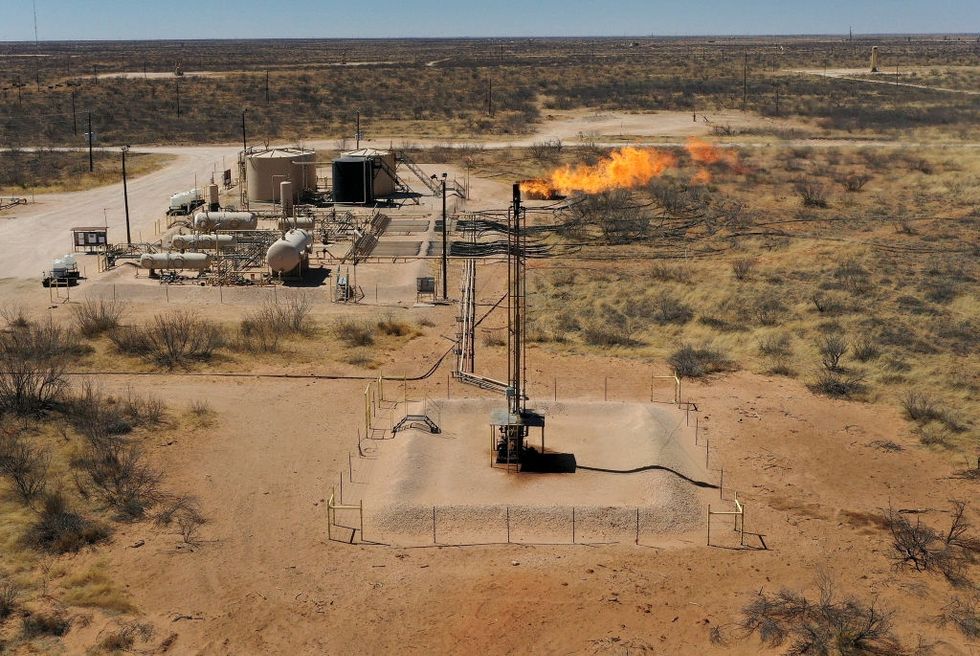
EQT Corporation bills itself as “America’s only large-scale, vertically integrated natural gas producer.” Soon it will also be the largest gas company in the nation. On Monday, the company announced plans to acquire Range Resources Corporation in a deal to create a North American gas giant worth more than $50 billion. The all-stock transaction would also establish the biggest gas producer in the U.S. by output. Combined, EQT and Range pump out 9 billion cubic feet of natural gas equivalent per day. The next largest shale gas producer in the U.S. is Expand Energy, at 7.5 billion cubic feet per day. The merged company would also command a network of pipelines and other midstream infrastructure that tops 3,700 miles. “This transaction brings together two of the highest-quality, longest-duration asset bases in North America and creates a company uniquely positioned for the next era of natural gas,” EQT CEO Toby Z. Rice said in a statement. “We believe this combination creates a must-own energy company capable of generating durable, through-cycle free cash flow while compounding value for shareholders for decades to come.”
The deal is a sign “U.S. gas consolidation is accelerating,” Salih Yilmaz, a senior oil analyst at the consultancy Bloomberg Intelligence, wrote in a post on X. “The bigger theme is consolidation: scale, concentration, and infrastructure control are becoming increasingly important in US gas, especially as LNG exports and power demand grow.”
3. U.S. wind turbine orders surged by nearly 3 gigawatts this spring
U.S. orders for wind turbines vaulted to 2.8 gigawatts in the second quarter of this year — the highest since the end of 2023 — as developers scrambled to meet the deadlines to qualify for expiring tax credits, according to a new market analysis by the consultancy Wood Mackenzie. New Mexico saw the biggest surge as the SunZia megaproject, the largest wind farm ever built in the U.S., came online, raising the state to the top of the list of capacity additions. Despite the Trump administration’s efforts to kill or slow walk permits for wind projects, the industry is on track to add 39 gigawatts of new onshore wind farms by 2030. More than half the projects set to come online over the next two years are already under construction, meaning there’s little risk of disruption. Offshore wind, by contrast, tops out at 5 gigawatts, all of which is on course to be delivered in the next two years. “Policy is the variable with the greatest impact on wind installations,” Wood Mackenzie analyst Tyler Gifford said in a statement. “With tax credit expirations on the horizon, developers are prioritizing projects that can be operational by 2030, so the five-year onshore wind installation outlook remains stable.”
On the other side of the Atlantic, exports of wind turbines are booming. While Europe is still debating how to deal with the sudden rise of China’s wind companies, as I told you last week, the European Union's exports of wind turbines spiked by nearly 11% to $3.4 billion last year, Renewables Now reported.
Sign up to receive Heatmap AM in your inbox every morning:
4. Exclusive: Clean Air Task Force is out with its new strategy for climate advocacy
The climate movement, as virtually anyone involved will tell you, is broken. Even those who are part of it want to stop talking about “climate change,” according to the results of this year’s Heatmap Insiders Survey. Clean Air Task Force, one of the more pragmatic groups in the policy arena fighting for clean energy, is out with a new memo detailing the strategy it plans to use through the end of the decade. Dubbed CATF Forward, the plan is “designed to drive the global adoption of climate solutions, orienting around three clear impact priorities and rooted in the attributes that have made” the group “uniquely effective” since its launch 30 years ago. “The world’s increasingly complex climate and energy challenges require sober thinking and sharper focus,” Armond Cohen, CATF’s founder and executive director, said in a statement. “How do we protect climate in a world turned upside down?”
His answer:
- Prevent pollution by reducing the most damaging emissions at a global scale.
- Advance clean power by calling for more energy and more options.
- Transform complex systems by grappling with the nuances different industries face and working to shift away from them.
All of that seems fairly straightforward. But the document is defined as much by what it omits as what it includes. Amid a growing debate over whether climate activists should keep targeting fossil fuel infrastructure, which my colleague Robinson Meyer aired out nicely on a recent episode of our podcast Shift Key, CATF isn’t pushing for boycotts of fossil fuels or, you know, committing crimes in the name of saving the planet.
5. An Indian solar giant is investing $525 million to take on China
India’s solar factories have boomed in recent years as the world’s most populous country turns to photovoltaics to meet surging domestic electricity demand and supply overseas buyers looking for alternatives to China. But the subcontinent has struggled to take on China’s dominance of the solar supply chain’s upstream elements. On Monday, Noida-based Jakson Solar announced plans to invest over $525 million into manufacturing solar cells, ingots, and wafers. The company plans to commission a 3-gigawatt cell factory by the end of next year, managing director Ivan Saha told Reuters on the sideline of a conference. The company then plans to stand up a 3-gigawatt ingot and wafer plant by the third quarter of 2028. That will all feed into Jakson’s existing 1.2-gigawatt module-making factory.
THE KICKER
Indonesia and Malaysia have launched more than 100 cloud-seeding missions this year in an attempt to engineer rain to quench parched lands as El Niño worsens droughts. The worst wildfire season in decades has shrouded the region in devastating toxic smog. But the high cost of the effort, including using dry ice to break up warm air that traps smog on the ground, “have so far brought little in the way of lasting results,” Bloomberg reported. “Sometimes, there’s a lot of political pressure to do things that may not be really well-founded scientifically,” Steven Siems, a professor at Monash University in Melbourne and the co-chair of an expert team on weather modification at the World Meteorological Organization, told the newswire.







 A hot deal. Joe Raedle/Getty Images